CBNS108 Lectures 3+4
 Call Kai
 Learn
Learn Practice Test
 Spaced Repetition
 Match
Match Flashcards
 Knowt Play
1/66

There's no tags or description
Looks like no tags are added yet.
Name | Mastery | Learn | Test | Matching | Spaced | Call with Kai | Chat |
|---|
No analytics yet
Send a link to your students to track their progress
67 Terms
Organize the following developmental events from earliest to latest: AP axis elongation and neurulation, morphogenesis in the gastrula, cleavage without growth, organogenesis in the pharyngula, formation of blastula/blastocyst.
Cleavage without growth—>formation of blastula/blastocyst—>morphogenesis in the gastrula—>AP axis elongation and neurulation—>organogenesis in the pharyngula
How does the cell have polarity before fertilization?
Through the animal-vegetal axis
Which hemisphere does fertilization occur in the cell? Why?
Animal; sperm receptors are concentrated in the animal hemisphere, animal side is less dense and easier for sperm to penetrate.
What are blastomeres?
Cells deriving from cleavage divisions
What is unique about patterns of cleavage divisions in the Xenopus?
They are fixed
Where is the grey crescent formed?
Opposite to sperm entry point
The first cleavage division typically divides the _________ equally into two cells
gray crescent
Initial cleavage divisions are ________(symmetrical/asymmetrical) and __________(synchronous/asynchronous).
Symmetrical; asynchronous
Stage where there are 16-64 cells.
Morula
Stage where there are 128 cells.
Blastula
Cleavage divisions end with the formation of a:
Blastula/blastoderm
What is the difference between a blastula and blastoderm?
The blastula is the entire early-stage embryo, blastoderm is the layer of cells that makes up the outer layer of the blastula.
What is a blastocoel?
A fluid-filled cavity present inside the blastula
The point at which the control of embryonic development shifts from maternal to the zygotic genome
Mid-blastula transition
When is the mesoderm induced(beginning to form)?
mid-blastula transition
Leading up to the MBT/MZT, cell size ______(increases/decreases) while DNA and cytoplasm _______(increases/decreases).
decreases; increases
MBT/MZT prepares the embryo for _______.
gastrulation
What factor controls the timing of the MBT/MZT?
Ratio of DNA to cytoplasm
What is the effect of higher DNA to cytoplasm ratio on MBT/MZT timing?
Causes it to occur earlier
What events occur during gastrulation?
Cell division is halted, there is extensive cell movement
The formation of the _________ is the first sign that gastrulation is occurring.
Dorsal lip
During gastrulation, how are mesoderm and endoderm cells internalized?
Involution of the blastopore
What is the blastopore?
the first opening that forms in the gastrula during development(next to dorsal lip).
What are 3 reasons extensive cell movement is required during gastrulation?
To bring cells to the positions that they need to be:
For spatial organization of three cell types (ectoderm, mesoderm, endoderm) into germ layers
For specific cell-cell communication events for pattern formation
What structure is formed during neurulation?
Neural tube
The formation of what is first visible sign of segmentation along the A-P axis?
Somites
Where do somites form?
The mesoderm flanking notochord
What is the first sign of neural tube formation?
Neural folds that develop in neural plate
This stage of development is phylotypic, reflects typical chordate body plan, and the AP axis elongates
Pharyngula
What is the main event that occurs in pharyngula?
Organogenesis
_______ __________ are important for establishing body axes.
Maternal determinants
What are maternal determinants?
Proteins and RNAs that are deposited in the egg by the mother during oogenesis.
What occurs in oogenesis?
Egg development
What cells differentiate into the ectoderm?
Animal cell(blastomeres formed at the animal pole)
What cells differentiate into the endoderm?
Vegetal cells(blastomeres formed at the vegetal pole)
What cells differentiate into the mesoderm?
The cells in between the animal and vegetal poles
What 2 mRNAs are localized at the vegetal pole?
Vg-1 and VegT
The animal vegetal axis corresponds roughly to what future axis?
Anterior-posterior
Which experimental technique would allow you to visualize localization of Vg-1 and VegT at the vegetal pole?
In situ hybridization
What is the function of Vg-1?
TGFb signaling protein
What is the function of VegT?
Transcription factor
What would be the result of removing VegT and Vg-1 mRNAs from the embryo?
The embryo would develop with no polarity, and only the ectoderm would form.
What are triploblasts?
Body is derived from 3 germ layers, includes all multicellular organisms except for sponges and coelenterates
This germ layer develops into the skin and nervous system.
Ectoderm
This germ layer develops into the bone, muscle, heart & circulatory system, and kidneys.
Mesoderm
This germ layer develops into the gut and associated organs.
Endoderm
What is fate mapping?
Technique that labels specific cells and follows them to trace which cells and regions of the embryo they give rise to
What experimental technique can we use to determine if a cell’s fate has been specified?
Explanting it: removing a particular cell out of its environment and place it in a neutral environment. If the cell continues to develop according to its normal fate, then its fate has been specified.
What does it mean that cells are autonomously specified?
They have the information to follow their developmental path even if removed from their normal context
What maternal determinant specifies the formation of the endoderm?
VegT
What maternal determinant specifies the formation of the ectoderm?
Foxl1e
Fill in the blank about mesoderm cells: They are found in explants of _____ blastula cells taken from the ______ of animal and vegetal hemispheres
late; margin
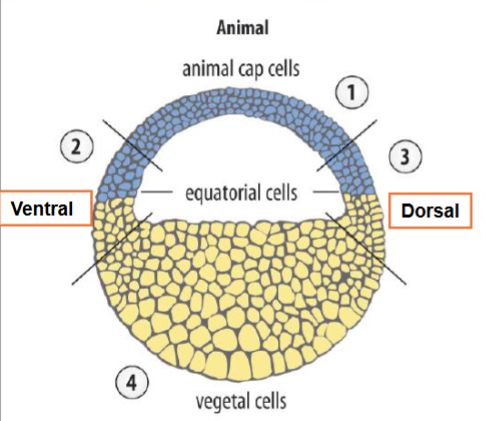
Explants taken from which regions will develop into mesoderm cells?
2 and 3
What experiment proved that mesoderm cells are induced by cell to cell communication between animal and vegetal cells?
Mixing animal cap and vegetal cells in explant experiments resulted in mesoderm cell formation
Which is true: Animal cells produce signal and induce vegetal cells to become mesoderm. OR Vegetal cells produce signal and induce animal cells to become mesoderm
Vegetal cells produce signal and induce animal cells to become mesoderm
When animal cells were labeled in early embryo, what tissues were the label found in later?
Ectoderm, mesoderm
True or false: Early in development, animal cells are specified and determined (committed) to become ectoderm cells
False; animal cells are not determined and can be induced to become mesoderm cells.
Can the vegetal signal induce animal cells from a distance?
Yes
What are nodals and what protein family do they belong to?
signals that induce mesoderm; TGF-β family proteins
What is the TGF-β family?
Large and highly conserved family of signaling proteins that are secreted from cells that produce them
Give 4 examples of proteins in the TGF-β family.
Nodal, Nodal-related proteins, Bone Morphogenetic Proteins (BMPs), and Activin