Chromosomal Abnormalities Part II
 Call Kai
 Learn
Learn Practice Test
 Spaced Repetition
 Match
Match Flashcards
 Knowt Play
1/68

There's no tags or description
Looks like no tags are added yet.
Name | Mastery | Learn | Test | Matching | Spaced | Call with Kai | Chat |
|---|
No analytics yet
Send a link to your students to track their progress
69 Terms
Why do structural abnormalities of DNA happen?
- Spontaneous
- Ionizing radiation
- Viruses
- Carcinogens
- Mutations in DNA repeat
Balanced Rearrangement
- A change in the chromosomal gene order that does not remove or duplicate any DNA (no net gain or loss)
- Carrier often healthy (genetic material all present)
What issue arises in Meiosis in the setting of a Balanced Rearrangement?
- Rearranged chromosomes may have difficulty pairing/separating normally during meiosis → unbalanced gametes with extra or missing chromosomal material
What do carriers of balanced rearrangements often experience?
- Reduced fertility
- Pregnancy loss
- Offspring with unbalanced chromosomal abnormality → phenotypic expression
Balanced Rearrangement: Common MOAs
- Inversions
- Reciprocal translocations.
Unbalanced Rearrangement
- A rearrangement in which chromosomal material is gained or lost in one chromosome set
- More likely to cause abnormal phenotype in individual
Unbalanced Rearrangement: Common MOAs
- Deletions
What do patents with unbalanced rearrangement often experience?
- Developmental abnormalities
- Pregnancy loss/reduced viability
Severity of symptoms in an unbalanced rearrangement is dependent on what?
- The amount and location of genetic material affected
A healthy man is found to have a small interstitial deletion on one copy of chromosome 15. He has no physical or cognitive abnormalities. Assuming normal meiotic segregation, what percentage of his gametes is most likely to carry this deletion?
- 50%
Inversions
- When a fragment of the chromosome is reversed
- Typically does not affect carrier
A 25-year-old woman is found to have a heterozygous chromosomal inversion during evaluation for recurrent pregnancy loss. She has no obvious phenotypic abnormalities. Which of the following best explains her infertiliy?
- The inversion causes abnormal chromosome pairing during meiosis → unbalanced gametes
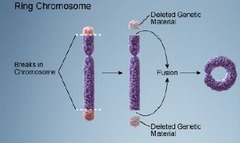
Ring Chromosomes
- Ring forms when a chromosome loses its genetic material at the terminal portions and the ends fuse to form a ring-like structure
- Unbalanced → phenotype
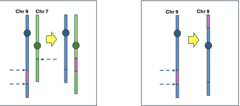
Insertions
- Segment of one chromosome is removed and inserted into another
Balanced bc no DNA is lost
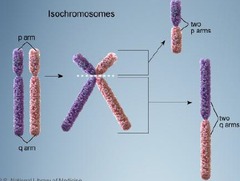
Isochromosomes
Chromosomes with identical arms
Form when centromeres divide along the incorrect plane during meiosis
Duplications
- Portion of chromosome is duplicated → produces partial trisomy
- Unbalanced (more DNA added)
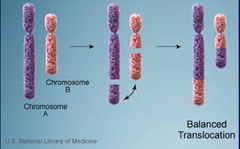
Reciprocal Translocations
- Two non-homologous chromosomes break and exchange fragments
- Balanced → but infertility in carriers (normally not passed to offspring)
Robertsonian Translocation
- Translocation in which the long arms of two acrocentric chromosomes become joined to a common centromere, resulting in a chromosome with two long arms and usually another chromosome with two short arms.
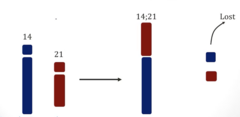
Robertsonian Translocation: Occurs in which types of chromosomes?
- Acrocentric Chromosomes
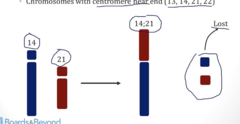
Acrocentric Chromosomes
- Chromosomes with centromeres near the end (13, 14, 21, 22)
- Robertsonian trans can occur (fusion of long arms)
Does a Robertsonian Translocation lead to clinical consequences?
- Only a small amount of DNA is typically lost → so no
What is typically the clinical consequence for Robertsonian Translocation
- It is very likely that many of their offspring will have chromosomal anomalies → many failed pregnancies/miscarriages
Many monosomy and trisomy gametes
Carrier of Robertsonian Translocation has how many chromosomes
- 45 (one translocated)
- Loss of short arms → normal phenotype
Most common Robertsonian Translocations
- 13:14
- 14:21 (can get down syndrome/trisomy 21 from this)
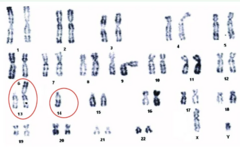
What can be done in couples with recurrent fetal losses?
- Karyotype → can be used to dx chromosomal imbalances
Which Phase of Meiosis does nondisjunction most commonly occur?
- Anaphase I: When homologous chromosomes are supposed to separate
Most age-related chromosomal nondisjunction events in human oocytes originate from errors associated with which stage of gamete formation?
- Meiosis I
Genetic Imprinting
- An epigenetic process where gene expression depends on the parent of origin, meaning only the allele from the mother or the father is active while the other copy is silenced
Genetic Imprinting: Explanation
1. We have 2 copies of gene A, one from both mom/dad. In most cells of our body, both copies can be expressed (functional/normal)
2. For a small subset of genes, one of the two genes is imprinted → not expressed
When does imprinting occur?
- During gametogenesis (before fertilization)
How are genes imprinted?
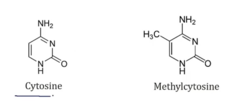
- Methylation of cytosine in DNA
After conception, what does imprinting control?
- Gene expression
Imprinted vs Non-Imprinted Genes
- Imprinted: Only one allele expressed
- Non-Imprinted: Both alleles expressed
Prader-Willi and Angelman Syndromes
Deletions on Chromosome 15
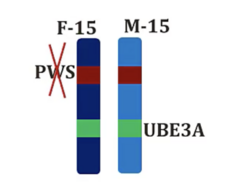
- Paternal copy deleted: Prader-Willi
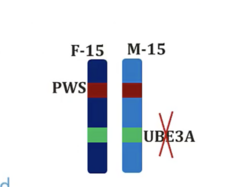
- Maternal copy deleted: Angelman
What gene is lost in Prader-Willi?
- Loss of function of paternal copy of PWS gene
Prader-Willi: Most common causes
- 75% cases from deletion in paternal gene (sporadic)
- 25% Maternal uniparental disomy
Prader-Willi Syndrome: Presentation
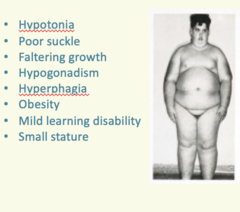
- Insatiable appetite
- Slow metabolism
- Death from obesity diseases
- Small hands feet
- Feeding difficulty in infants
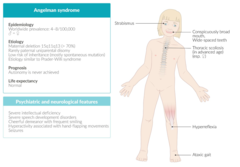
What gene is lost in Angelman Syndrome?
- UBE3A gene which normally codes E3 ubiquitin ligase (needed for degradation of specific brain proteins so loss of expression causes cognitive/motor defects)
Angelman Syndrome: Most common causes
- Most commonly caused by deletion in maternal chromosome 15
- Small % Uniparental disomy
Angelman Syndrome: Presentation
- Frequent laughter/smiling
- Hand flapping
- Seizures
- Ataxia
- Severe intellectual disability (worse than PWS)
Trinucleotide Repeat Disorders: Where do they occur? Most disorders involve which body system?
- In genes with repeat trinucleotide units (CAGCAGCAG...)
- Most disorders involve nervous system
Trinucleotide Repeat Disorders: Common features they all share
- For all genes affected, there is a wild type (normal) allele found in most individuals (relatively low # of repeats in population)
- Diseased gene (abnormal allele) found in affected individuals has increased/expanded number of repeats beyond normal range (likely d/t slipped DNA mispairing)
Unstable repeat expansions
- Short, repeated DNA sequences (e.g., CAGCAGCAG...) that can increase in the number of repeats between generations.
- These can either be in the coding region of a gene or in non-coding regions. Typically larger repeats cause a more severe disease phenotype.
Anticipation
- Disease severity worse/earlier onset in subsequent generations

Diseases with Anticipation
- Huntington's
- Fragile X
- Myotonic Dystrophy
Fragile X Syndrome: Inheritance
- X-Linked Dominant
Fragile X Syndrome: What gene?
- Abnormal/methylation of FMR1 (most common an ↑ in CGG repeats)
Fragile X syndrome: Presentation
- Males more severely affected
- Delayed cognitive function
- Autism
- Hand flapping
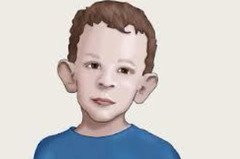
- Large ears, elongated face, large testes
Friedrich's Ataxia: Inheritance
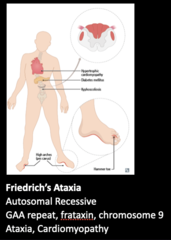
- Autosomal Recessive
Friedrich's Ataxia: Gene Mutation
- Mutation on Frataxin gene, chromosome 9
- Extra GAA repeats → extra frataxin levels
Friedrich's Ataxia: Frataxin
- Mitochondrial protein, if abnormal → mitochondrial dysfunction
- High levels in brain, heart, pancreas
Friedrich's Ataxia: Presentation
Begins in adolescence w/ progressive symptoms:
- Cerebellar/spinal cord degeneration→ loss of balance & weakness
- Hypertrophic cardiomyopathy
- Kyphoscoliosis (Hunchback)
- Foot abnormalities
Huntington's Disease: Inheritance and Gene Mutation
- Inheritance: Autosomal Dominant
- Mutation: HTT gene → encodes for huntingtin → increased CAG repeat
Huntington's Disease: Presentation
Initial presentation between age 30-40
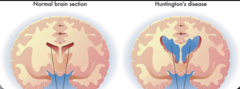
- Degeneration in basal ganglia
- Chorea: Involuntary movements
- Dementia
- Death typically 10-20 yrs after dx
Myotonic Dystrophy: Type of disorder and inheritance
- Muscle disorder
- Inheritance: Autosomal dominant
Myotonic Dystrophy: Type I
- Abnormal DMPK on Ch19 → CTG expansion → gene not transcribed
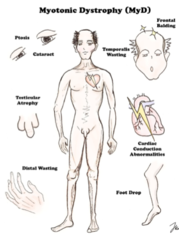
Myotonic Dystrophy: Presentation
Symptoms begin in adulthood
- Progressive muscle wasting/weakness
- Prolonged muscle contractions; unable to relax muscles, cannot release grip, locking of jaw
- Long, narrow face with hollowed cheeks, frontal balding
- Hypogonadism (↓Test, ↑FSH)
- Cardiac Arrhythmia
- Cataracts at young age
Myotonic Dystrophy: Intellectual
- Disability common, worse with younger age of onset
Childhood disease → severe cognitive impairment
Deletion Syndromes
- Partial deletion of chromosome
- Long/short arm could be lost, or a portion of that arm
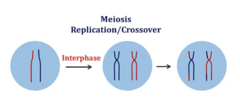
When do deletion syndrome typically arise? Its result?
- When: An error in crossover during meiosis I
- Result: Unbalanced exchange of genes such that one chromosome with extra genetic material/deletion and another ends up with deletion
Are deletion syndromes hereditary?
- No, often sporadic
Key Deletion Syndromes
- Cri-du-chat
- Williams
- Thymic Aplasia
Cri-Du-Chat Syndrome: MOA
- Deletion of part of short arm (p) on chromosome 5
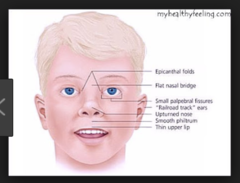
Cri-Du-Chat Syndrome: Presentation
- Severe intellectual disability (cognitive, speech, motor delays)
- Infants cry like cat
- Microcephaly, wide set eyes, low ears, small jaw
- Congenital HD
Williams Syndrome: MOA
- Partial Deletion on long arm of Ch7 → deleted portion includes gene for elastin
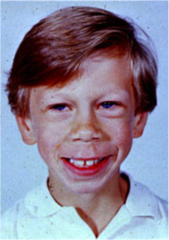
Williams Syndrome: Appearance
Classically an "elfin" facial appearance
- Small nose
- Small chin
- Wide mouth
- Long Philtrum
Williams Syndrome: Associated Presentations
Mental
- Intellectual disability
- Well developed verbal skills
- Extremely friendly with strangers, likes talking to adults
Physical Symptoms
- Aortic/Artery Stenosis
- Hypercalcemia
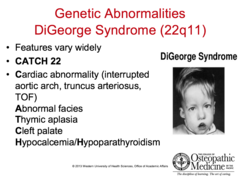
DiGeorge Syndrome: MOA
- Partial deletion of long arm (q) in Ch22
DiGeorge Syndrome: Presentation
- Hypocalcemia
- Thymic Aplasia
-Recurrent viral/fungal infections (T cell deficiency, because there is no thymus)
- Congenital heart defects
- Cleft palate