Autonomic Pharmacology
 Call Kai
 Learn
Learn Practice Test
 Spaced Repetition
 Match
Match Flashcards
 Knowt Play
1/57

Earn XP
Name | Mastery | Learn | Test | Matching | Spaced | Call with Kai |
|---|
No analytics yet
Send a link to your students to track their progress
58 Terms
What does the autonomic nervous system ensure?
ensures that the internal environment functions optimally even when the external environment changes
Membrane Potential
- Needed in excitable cells (nerve & muscle)
- Result from a difference in electrical charge across the plasma membrane of a neuron
- Changes in membrane potential above a threshold lead to action potential
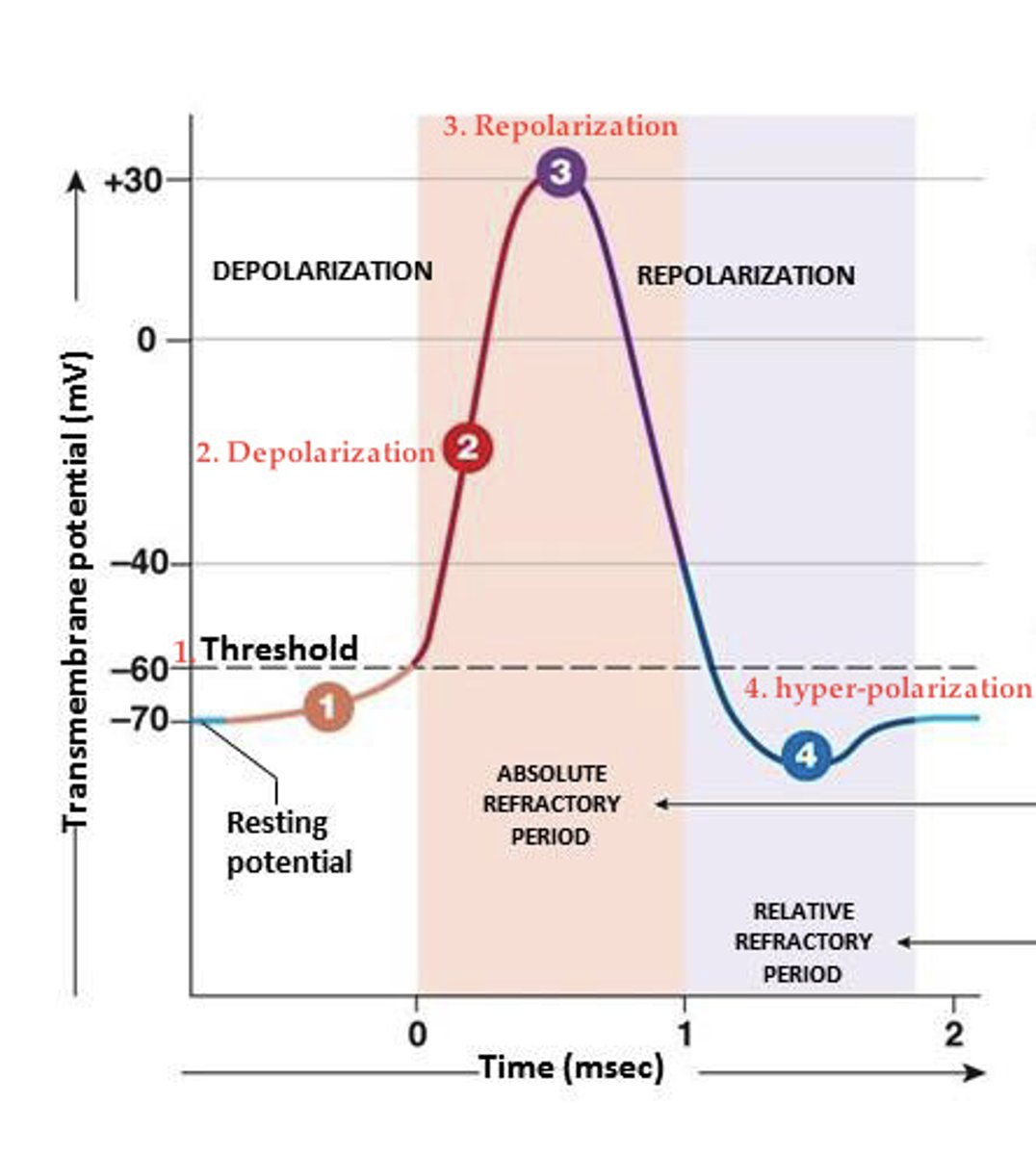
Action Potential
- sudden reversal of electric charge across the membrane of a resting neuron
- begins when neuron receives signal from another cell
- Signal causes Na+ channels to open, allowing Na+ to flow into cell = positively charged
- start in cell body, travel down the axon, & end at the axon terminal
synapse
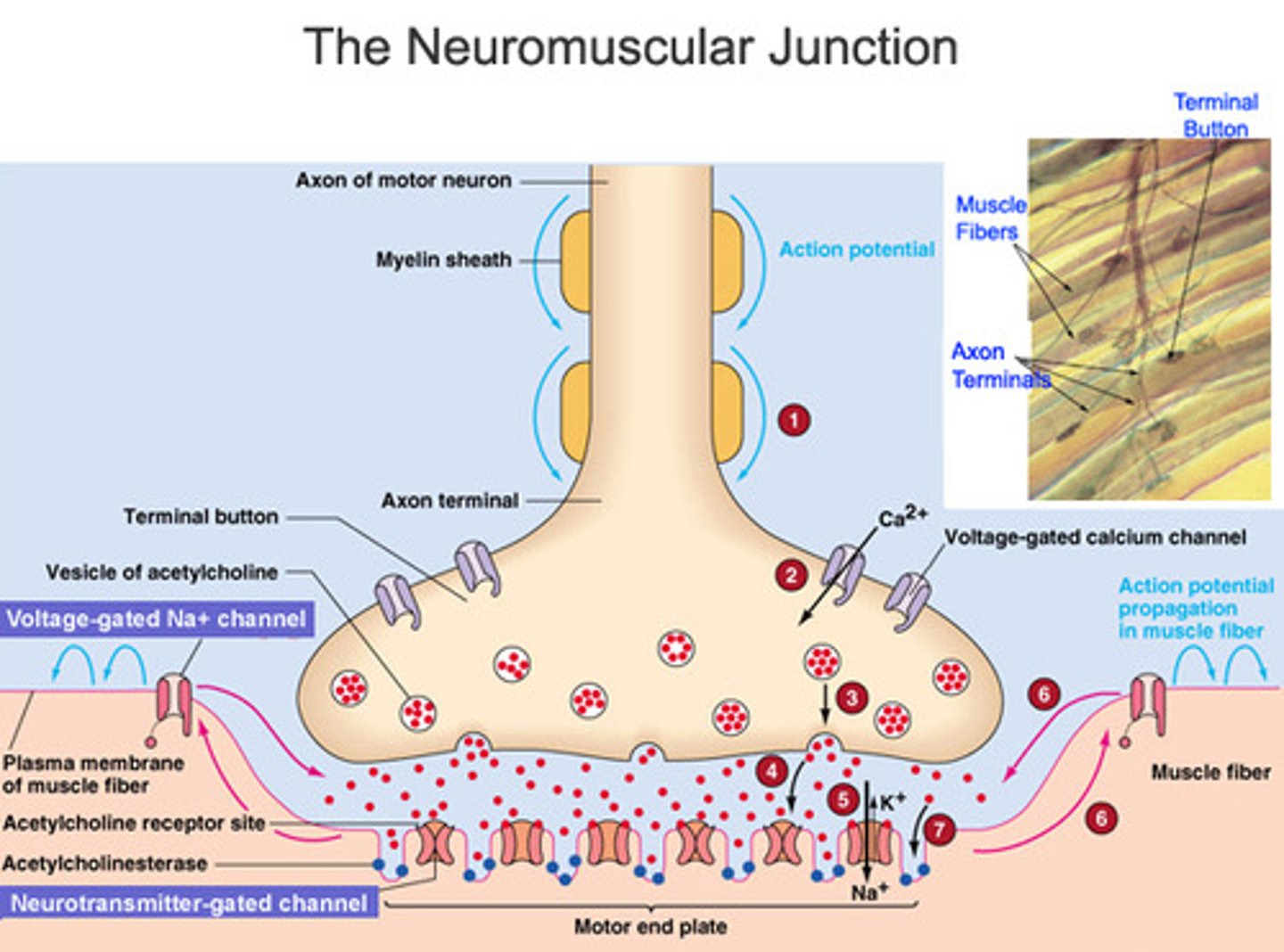
- Space between the axon terminal of one cell & dendrites
- Neurotransmitters travel across synaptic cleft & bind to receptors on the postsynaptic membrane
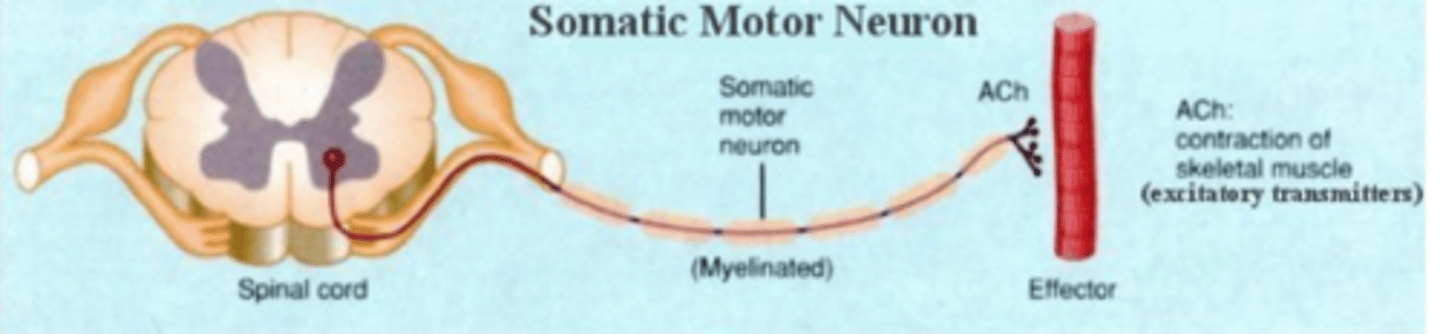
The Somatic Nervous System
- Responsible for carrying motor and sensory information to and from the central nervous system
- Made up of nerves that connect to the skin, sensory organs, and all skeletal muscles
Acetylcholine & the Neuromuscular Junction
Peripheral Nervous System
Neurons and ganglia outside of the brain and spinal cord
General Autonomic Nervous System Properties
- controls glands, cardiac & smooth muscle
- Regulates unconscious processes that maintain homeostasis
- BP, body temperature, respiratory airflow
- Visceral reflexes
Main neurotransmitters of the ANS
acetylcholine (ACh) and norepinephrine (NE)
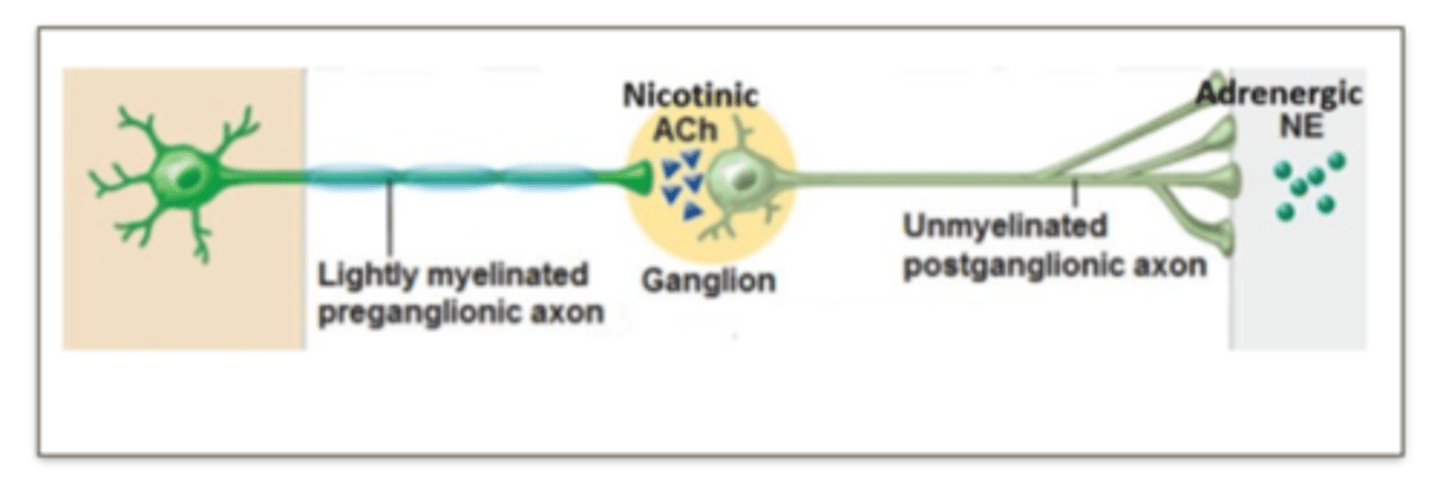
Preganglionic neuron of ANS
- cell body in brain or spinal cord
- Axon is myelinated fiber that extends to autonomic ganglion
Postganglionic neuron of ANS
- Cell body lies outside the CNS in an autonomic ganglion
Sympathetic neuron chain
Parasympathetic neuron chain
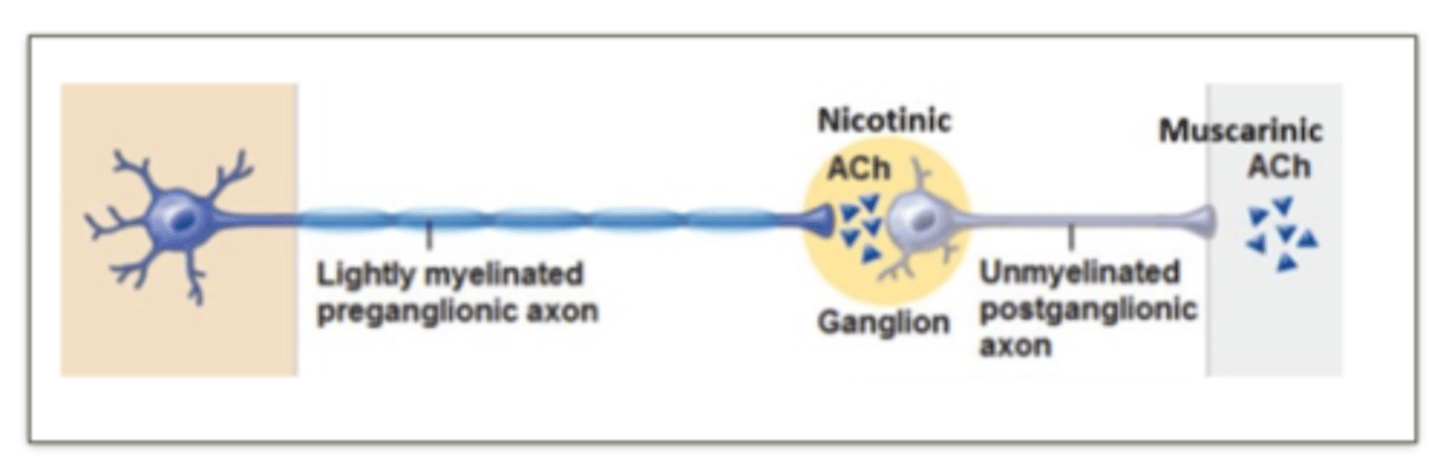
Cholinergic neurons release...
acetylcholine (ACh) from preganglionic neurons & from parasympathetic postganglionic neurons; can excite of inhibit depending on receptor
Nicotinic receptors
- found on dendrites and cell bodies of ANS cells at the NMJ
- Ion channels (Ionotrophic)
Muscarinic receptors
- plasma membranes of all parasympathetic effectors
- G-protein coupled (Metabotrophic)
Adrenergic neurons release...
norepinephrine (NE) from postganglionic sympathetic neurons only (excites or inhibits depending on receptor)
What adrenergic receptors cause excitation?
Alpha1 (α1) and Beta1 (β1)
What adrenergic receptors cause inhibition?
Alpha2 (α2) and Beta2 (β2)
What adrenergic receptors inc thermogenesis (brown fat)?
Beta3 (β3)
What is acetylcholine synthesized from?
- Acetyl CoA (mitochondria)
- choline (dietary)
- Catalyzed by cholineacetyl transferase (ChAT)
When enzyme metabolizes ACh?
Acetylcholinesterase (common drug target)
Where are nicotinic receptors found?
- ganglions
- skeletal muscle (NMJ)
- neurons in CNS
What are some sympathetic targets of ACh?
eccrine sweat glands and blood vessels in skeletal muscle
Where do you find muscarinic receptors?
at parasym target organs (effectors)
Nicotinic Acetylcholine Receptor (AChR)
- has 5 polypeptide subunits
- receptors vary in subunit structure, agonist sensitivity, & distribution
- mediate FAST synaptic transmission
Muscarinic AChRs
- M1-M5
- GCPRs
- Slower synaptic transmission via intracellular signaling cascade
Direct Acting of Cholinergic Agonists/Parasympathomimetics
drug acts right on postsynaptic receptor
Indirect Acting of Cholinergic Agonists/Parasympathomim
- Inhibit Acetylcholinesterase enzyme, which breaks down acetylcholine (reversibly or irreversibly)
- AKA anticholinesterases
- Inc amount of ACh
- Ex) Neostigmine (Bloxiverz) & Pyridostigmine (Mestinon)
Cholinergic effect on eye
miosis
cholinergic effect on cardiovascular
dec heart rate
cholinergic effect on respiratory
Bronchial constriction and increased secretions
cholinergic effect on GI
Increased motility and relaxation of sphincters (inc defecation)
cholinergic effect on genitourinary
Relaxation of sphincter sand bladder wall contraction
cholinergic effect on glands
inc. secretions
Esters of choline =
structurally related to ACh (see -chol- in name)
Alkaloids of choline =
not related to ACh (usually plant derivatives); Main reason for distinction is that alkaloids, due to structure, are NOT metabolized by cholinesterases (ex: pilocarpine)
BETHANECHOL (Urecholine)
- choline ester
- Short duration of action (several minutes)
- Used to stimulate bladder or GI muscle
CARBACHOL (Miostat)
- choline ester
- Intraocularly to produce miosis during ophthalmic surgery
- Can also decrease IOP after surgery
PILOCARPINE (Salagen)!
- plant alkaloid from small shrub Pilocarpus
- Greater affinity for muscarinic receptors than for nicotinic
- Ocular: Miosis (pupil constriction), glaucoma
- direct acting
Neostigmine (Bloxiverz) & Pyridostigmine (Mestinon)!
- reversible anticholinesterases (inc ACh/cholinergic)
- Used to reverse the effects of nicotinic antagonists like curare
- Used to treat myasthenia gravis
Aricept (DONEPEZIL)!
- indirect acting cholinergic drug by inhibiting AChE
- tx for Alzheimer's pts (they have low lvls of ACh)
- reversible
Reversible Inhibitors of AChE
- compete w/ acetylcholine for active site on cholinesterase
- include the quaternary amines and the carbamates
- include drugs w/ names ending in "-stigmine" & "-nium"
Irreversible inhibitors of AChE
- phosphorylate the enzyme & inactivate it
- Widely used as insecticides (commonly referred to as nerve gases); Organophosphates are lipid soluble & rapidly cross membranes, including skin & blood-brain barrier
Toxicity of Cholinergic Stimulants =
- D = diarrhea
- U = Urination
- M = miosis
- B = brachycardia
- B = Brochoconstriction
- E = Excitation (paralysis, ataxia, seizures)
- L = lacrimation
- S = Salivation & sweating
Cholinergic Toxidrome
- Muscarinic Symptoms: salivate, lacrimate, urinate, defecate, GI cramps, vomiting
- Nicotinic Symptoms: muscle cramps, tachycardia, weakness, twitching, fasiculation
Cholinergic Antagonists/Parasympatholytics
antagonize the effects of acetylcholine (most directly to the receptors, but others block ACh release)
Muscarinic blockers
Relax smooth muscle, decrease gland secretions, increase heart rate
Nicotinic blockers
Relax skeletal muscle during surgery
Muscarinic Antagonists Effects (Anticholinergic Toxidrome)
- dry mouth (no salivation)
- mydriasis
- flushing, inhibits sweating
- inc heart rate
- bronchodilation, inhibit secretions
- GI: reduced motility & secretions
- urinary retention
- Drowsiness, hallucinations, coma (CNS fx)
Uses of Muscarinic Antagonists
- dilate pupils
- tx for COPD
- Prevent salivation during surgery
- ntispasmodics, antinausea
Neuromuscular Blockers
- Competitive neuromuscular blocking used to produce skeletal muscle relaxation
- Bind ALL nicotinic receptors (at the neuromuscular junction & autonomic ganglia)
- Depolarizing = bind receptor & open ion channel, resulting in depolarization of the end plate
- Non-depolarizing = bind receptor, but do not open ion channel
Succinylcholine (Quelicin) Phases
1. Activates ACh receptors, but chronic depolarization at the muscle end-plate leads to inactivation of voltage-gated Na+ channels & 'flaccid paralysis' (short acting)
2. After chronic exposure to succinylcholine, Ach receptors desensitize (longer acting)
Succinylcholine (Quelicin)!
- Paradoxically causes persistent membrane depolarization that inactivates (desensitizes) Na+ channels & blocks neuromuscular (NM) transmission
- depolarizing neuromuscular blocker
Non-Depolarizing Nicotinic Antagonists
- Pancuronium and D-tubocurarine (curare)
- Muscle relaxation for surgery
- competitive antagonists at nicotinic receptor
- Selectivity is not good
Why do we want to co-administer a muscarinic antagonist with a neuromuscular blocker?
We want to avoid too much ACh from getting to muscarinic receptors to prevent Cholinergic Toxidrome
How can effects of neuromuscular blockers be reversed?
add a cholinesterase inhibitor (increases amount of ACh available to compete with antagonist)
Botulinum toxin (Botox)
- breaks down SNAREs
- inhibits acetylcholine releasefrom somatic nerves
- Can treat problemscaused by muscle spasms