c3 stoichiometry
 Call Kai
 Learn
Learn Practice Test
 Spaced Repetition
 Match
Match Flashcards
 Knowt Play
1/17

There's no tags or description
Looks like no tags are added yet.
Name | Mastery | Learn | Test | Matching | Spaced | Call with Kai | Chat |
|---|
No analytics yet
Send a link to your students to track their progress
18 Terms
how do workout the formula for ionic compounds
the compound need to be balanced so that the charges of the positive ions cancel out the charges of the negative ions meaning the overall charge of the molecule is neutral
what are ionic equations
an equation that only shows the reacting particles(products) that are formed, meant to show only the ‘useful bits’ of a reaction
how do you get an ionic equation
write out a regular equation into one that shows how the ions would sperate once dissolved, and remove any aqueous ions that are present on both sides. shows the equation for the formation of ionic solid from aqueous ions.
what is relative atomic mass(Ar)
the weighted average mass of all isotopes in relative molecular mass units(1/12 of a carbon12 atom)
what is relative molecular mass(Mr)
the relative atomic mass of all the atoms in a compound
how can you use Mr to work out masses of substances used in reactions
the ratio of Mr in the molecules in a reaction will be the same as the ratio of weight, so if oxygen(Mr 16) and 2carbons(Mr 24) react together in a ratio of 2:3 simplified, then 2 grams of oxygen would react with 3 grams of carbon.
what is a mole
the amount of of particles in a substance that there is, meaning that 1 mol of substance Mr 12 will weigh 12 grams, 0.5 mol of substance Mr 12 will weigh 6 grams.
what is avogrado’s constant
it is 6.02 × 10²³ and means the amount of particles in a mole
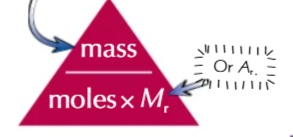
how do you calculate moles and formula triangle
moles = mass in g / Mr of molecule. this is the conversion triangle for moles, mass and Mr.
how to determine excess remaining in solution after reaction
by determining how much moles of one reactant is needed for another. since h2 and o2 react to form h2o, twice as much h is needed. with 1 mole of h2 and 0.8 mols of o2, only the needed 0.5 mols of o will react leaving 0.3 mols of o
what is percentage yield and how do you calculate it?
percentage yield means how much reactants were converted to products compared to the theoretical scenario. percentage yield = actual yield/theoretical yield * 100
what is the empirical formula
the ratio of atoms in a molecule in its simplest form. C6H12O6 has the empirical formula of C1H2O1, so there are 6 empirical units in the molecule
what does mol/dm³ mean
it is a until for concentration and it means the amount of mols in a litre/1000cm³
how do you calculate concentration
amount of mols/volume of solution(in dm³)
how do you convert mols/dm³ to grams/dm³
multiply the amount of mols by the Mr of the molecule
how do you calculate concentration based of titration results
calculate the mols of acid based off of volume and concentration, then calculate mols of alkali needed based of the ratio in the reaction. then with the given mols calculate the concentration using the volume provided
how much space does a gas occupy at RTP(room temp and pressure)
1 mol of gas at RTP takes up 24 dm³ of space no matter the gas
how do you calculate volume of gas in a reaction
you calculate the moles of that gas and just multiply by 24