Ling 101: Part 11
 Studied by 0 people
 Call Kai
 Learn
Learn Practice Test
 Spaced Repetition
 Match
Match Flashcards
 Knowt Play
1/30

There's no tags or description
Looks like no tags are added yet.
Name | Mastery | Learn | Test | Matching | Spaced |
|---|
No study sessions yet.
31 Terms
Problems with Borrowed Words
the sounds are often not in your system
even if they are, the sequences often still violate your phonotactics (eg. psi)
Solution to Borrowings
adapt the borrowed word to your system
eg. q → k, psi→si
say it like a foreigner, even if it violates your phonotactics, or the sound is not in the system
different languages, and different speakers can take different approaches
there’s nothing wrong with either approach
this kind of adaptation is one of the main reasons people have ‘accents’ when speaking in a foreign language
we unconsciously stick to the syllable structure and sounds of our native language
/ʃn, ʃm, ʃl/ onsets
sound ‘funny’ outside of Jewish or German contexts b/c they violate English phonotactic constraints (we say it like a foreigner)
children who hear these words a lot could easily re-analyze English, making it sound more like Yiddish
for now, they are not possible onsets in native English vocabulary
but we do get them in specific borrowings
Austronesian Family
arguably originated in Taiwan; it still is spoken there, though endangered
it spread across the pacific, forming the Austronesian family
in the pacific (and in sharp contrast to Austronesian in Taiwan), some of these languages today have huge numbers of speakers
Javanese (76M, Indonesia), Tagalog (47M, Phillipines), Malay/Indonesian (45M, Malaysia, Indonesia), Fijian (350,000, Fiji), Maori (100,000 NZ)
Austronesian → Hawaiian Language
Austronesian family → Malayo-Polynesian Branch; arrived Hawaiian Islands ~300-400AD
language was banned in schools (1893), which reduced the prestige of the language, and children spoke English in school everyday
traditional Hawaiian language nearly died out but recent generations started immersion schools in Hawaiian language
the result: today more than 20,000 fluent speakers
Langauge on Hawaiian Islands
‘Hawaiian Pidgin’, it is actually a creole
blends traditional Hawaiian, English, Portuguese, Cantonese, Tagalog, Japanese, Korean and Spanish
this creole is much more commonly spoken in Hawaii than the traditional Hawaiian language
more than 600,000 speakers
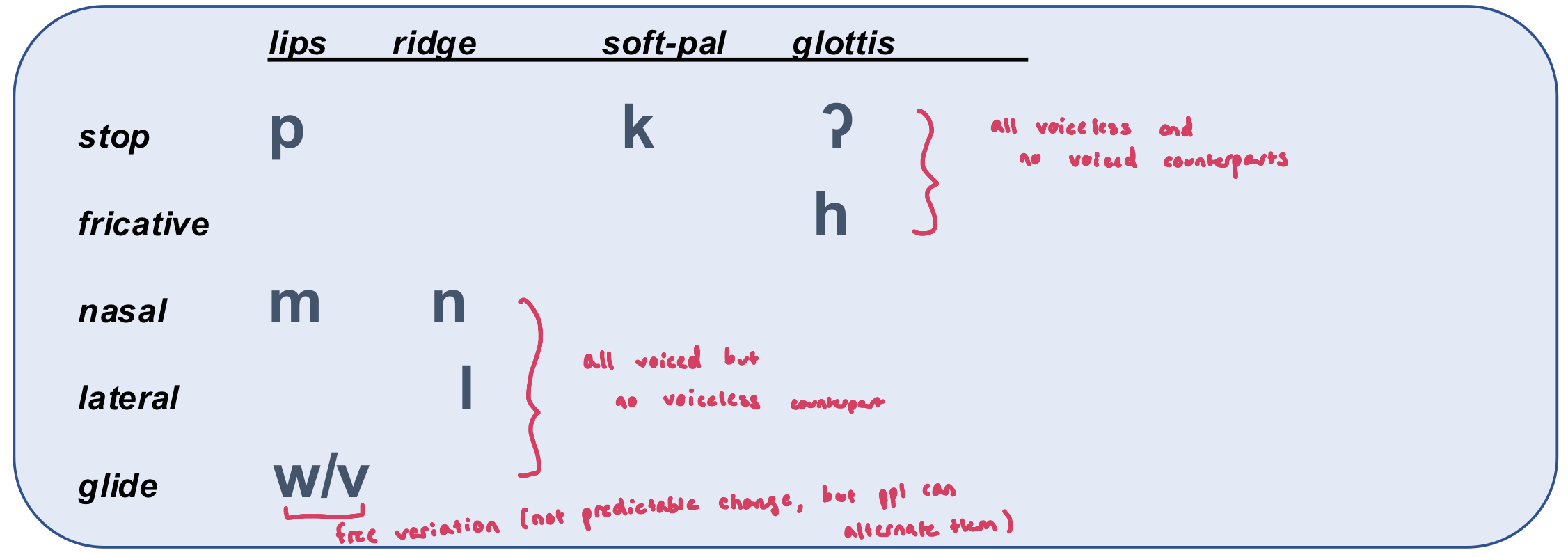
Traditional Hawaiian Sound System: Consonants
some Hawaiian words in Hawaiian writing system are close to IPA
glottal stop is apostrophe
8 total consonant phonemes
small system
voice is not a distinctive feature
/w/ is in free variation with /v/ (not predictable, people just vary)
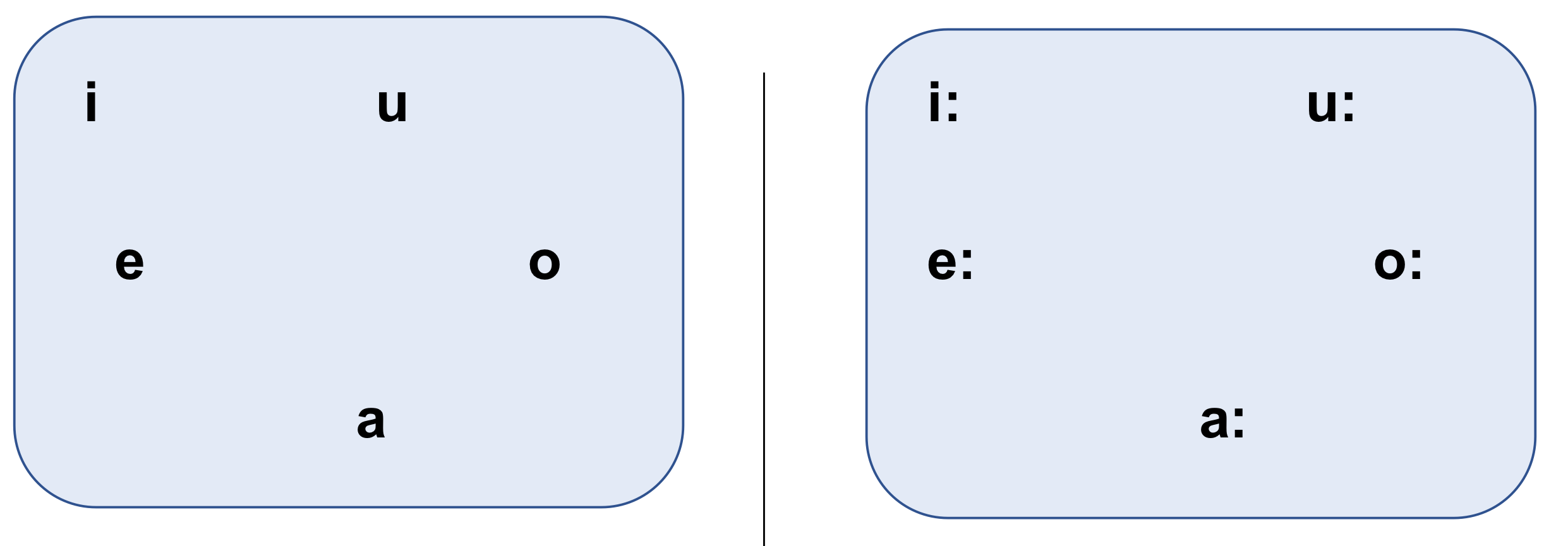
Traditional Hawaiian Sound System: Vowels
vowel length is marked with a line (macron) over the vowel
10 distinctive vowels including length
Hawaiian Phonotactics
the biggest onset (# of C’s) is 1
codas are not possible
the largest possible syllable (‘maximal syllable’) in Hawaiian is CV:
no CC clusters at start or end of words or syllable
only two kinds of syllables: CV or plain V
How does Syllable Structure Explain why even very common words have so many syllables?
have to put vowels b/w each consonant → leads to many consonants
every consonant needs a vowel
make up for the small # of distinctive vowels
short CV combinations
Extreme Hawaiian Adaptations
change sounds: look for the closest similar sound in their system (usually /k/)
syllabify: add vowels as needed to syllabify (sometimes /i/, sometimes /a/)
we can’t predict which vowel they will insert
waɪn
brʌʃ
tɪkət
waɪn: ɪ → i, n cannot be a consonant, n→ na (result: waina)
brʌʃ: b→p, r→l, ʌ→ a, ʃ→k, can’t have a CC onset so pl → pal (result: palaki)
tɪkət: t→k, ɪ →i, ə → i, can’t have coda, so k→ki (result: kikiki)
Shibboleths
using language differences as a tool for war
trapping people with their sound systems
tests for ethnic or other groups based on differences in pronunciation
now also used more generally for identifiable differences based on dress, beliefs, etc
Shibboleths: Origin
Israel, 1300 BC
War: Gilead vs. Ephraim
Gileadites wanted to conduct ethnic cleansing
Gileadites had /ʃ/; Ephraimites didn’t have /ʃ/, only /s/ (would substitute for /s/)
the Ancient Hebrew word for ‘ear of corn/grain’:
Gileadites: /ʃɪbələθ/
Ephraimites: /sɪbələθ/
42,000 Ephraimites died, because they couldn’t say /ʃ/
Shibboleths: Modern Examples
Conflict in Northern Ireland: /H/
Protestants: /etʃ/
Catholics: /hetʃ/
Lebanese Civil War: ‘tomato’
Lebanese Arabic: banadoura
Palestinian Arabic: bandoura
The Scheveningen Test: A Dutch Uvular Shibboleth Details
Dutch:
has /χ/ with dialect variation
voiceless uvular fricative (more forward)
in spelling sch =/sχ/
German
has /x/
voiceless velar fricative
neither /sx/ nor /sχ/ is possible
in spelling, sch = /ʃ/
The Scheveningen Test: A Dutch Uvular Shibboleth Events
1940-1945, Holland occupied by Nazi Germany
Dutch resistance army developed
German spies infiltrated the resistance
languages are very similar, so it’s easy to learn and become a spy
the Dutch solution: Scheveningen is a seaside resort in Holland pronounced with the /χ/, used it as the shibboleth
Dutch: /'sχeɪvənɪŋə(n)/
German: /ʃeɪvənɪŋən/
Evolution of French R: Background
example of how talking like foreigners can potentially influence language change
r sounds around the world include:
/ɹ/: central approximant (English R)
/r/: alveolar trill (Spanish R)
/ɾ/: alveolar flap (Scottish English R)
/ʁ/: voiced uvular fricative (German R and Parisian Friench)
these ‘r’ sounds are made in different ways, but they sound similar (share certain special sound frequency properties)
this is why different languages associate them with /r/ and also switch between them
Evolution of French R
Marie Antoinette was a German speaker using /ʁ/
before Marie Antoinette’s time, most French speakers said /r/ (voiced alveolar trill)
when Marie Antoinette became the queen of France /r/ > /ʁ/
not necessarily by directly borrowing it, but possibly influenced by German
this particular change might have happened anyway, but we know overall that German was a huge influence on French, thru contact b/w the cultures
Lip Rounding: Back vs Front in English
rounding makes vowels sound more back
why non-low back vowels are usually rounded (/u, ʊ, o, ɔ/)
unrounding (spread lips) makes vowels more front
why front vowels are normally unrounded (/i, ɪ, e, ɛ, æ/)
Front-Rounded Vowels
front rounded vowels are harder to hear b/c the lip-rounding makes them sound more back, but they exist
/y, ʏ, ø, œ/
German examples in figure; front rounded vowels doubled the system
in writing (front rounded vowels appear with umlauts)
English does not have distinctive front rounded vowels, and uses the umlaut only in borrowings, dieresis, or to look cool
dieresis: a mark placed over a vowel to indicate that it is sounded in a separate syllable

Back Rounded Vowels
hard to hear b/c the spread lips make them sound less back
/ɯ/ in Korean
Written Languages in America
most languages in Americas did not have written forms until very recently
Mayan is an exception, the system is original to Central America, but evolved in similar ways to Egyptian (and is now no longer used)
all other systems in the Americas prior to contact with Europeans were from the same region, Mesoamerica (though Incans had a system which may have also been writing)
several other First Nations languages did develop original writing systems after first contact, starting w/ the Cherokee syllabics systems developed in the 19th century
Cherokee Writing Systems
invented by a Cherokee speaker (Iroquian family) named Sequoyah
they saw from a distance that white people were using symbols to represent language and decided to make one for Cherokee from scratch
the first attempt was purely logographic, but he soon realized it was way too many symbols → he figured out that it was easier to use syllabics
the Cherokee system was the inspiration for several other systems still used in North American languages
Wakashan
7 languages
West Coast of Van, Island and Mainland coat, North of Island
all severely endangered
closest traditional neighbors= Salish
Wakashan and Salish ppl were often in conflict, but also had millenia of contact including trade, slavery and intermarriage
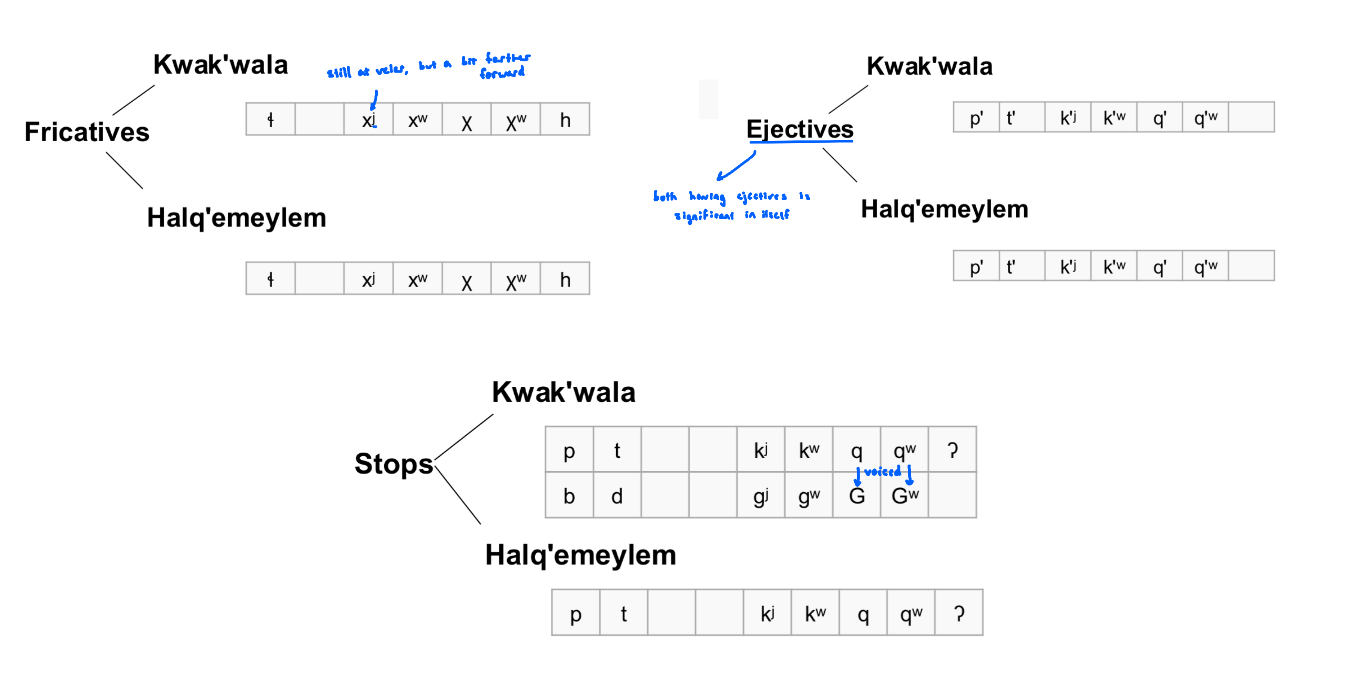
Wakashan vs Halq’ Sound System
same fricatives, ejectives
more non-ejective stops than Halq’ (has voice)
Wakashan vs Salish
linguists have determined Wakashan and Salishan languages are not historically connected
despite many similiarities, not many clear cognates found in the two groups except for borrowings
the borrowings and contact made the languages grow more alike over thousands of years
kids hear impossible phonotactics and change it over time
Sprachbund
A group of languages, with no single historical source that have come to share many features thru borrowing and contact
Mainland Southeast Asian Sprachbund
5 distinct families
all evolved tone, have similar syllable structures, have similar patterns for counting nouns, have similarities in certain other grammatical patterns
it was contact and borrowing that made them similar like this
Language Families Spoken in BC
Haida and Ktunaxa are languags by itself (isolate, family of one)
Salish: many languages
Wakashan: 7 languages
the southern families all form a Sprachbund, which makes them look superficially similar
Alonquian is a big family, spread across large areas of Canada and US
Tsimshainic: 4 identifiable systems, but not clear where to draw the line at languages
Na-Dené: tend to have distinctive tone, huge family (at least 46 languages), inside and outisde BC and down in S. US
not fully accepted yet, but some linguists have linked Na-Dene to Siberia

Newfie English
european settlement early 1600s (settlers from Ireland & SW England)
ϴ>t, ð>d
/aɪ ɔɪ/ merger → /ɑɪ/
in most Engl. dialects, a 3rd person subject triggers –s on verb
Newfie engl. adds an s to any present tense sentence