Requirements Engineering PPT 3
 Studied by 0 people
 Call Kai
 Learn
Learn Practice Test
 Spaced Repetition
 Match
Match Flashcards
 Knowt Play
1/6

There's no tags or description
Looks like no tags are added yet.
Name | Mastery | Learn | Test | Matching | Spaced |
|---|
No study sessions yet.
7 Terms
The Why-What-How Model / Goal Service Constraint Model
Goal: Why Needed? Service: What must it do? Constraint: How will we do it?
The 4 Variable Model
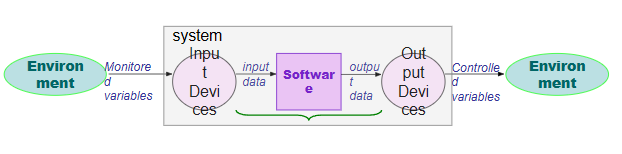
MCIO - Monitor, Control, Input, Output
Example : Cruise Control
Monitor: Variable observed in the environment (e.g. Vehicle Speed)
Controlled: Variables system can affect (e.g. Throttle Reading)
Input: Internal representation of M (e.g. Tire Rotation Sensor Readings)
Output: Internal representation of C (e.g. Actuator Readings)
NAT(m, c): describes nature, the environment of monitor and control
REQ(m, c): describes the requirement between monitor and control
IN(m, i): shows how monitor corresponds to their internal representation
OUT(m, i): shows how controlled corresponds to their internal representation
SOF(i, o): shows how input relates to the output
WRSPM Model / Reference Model
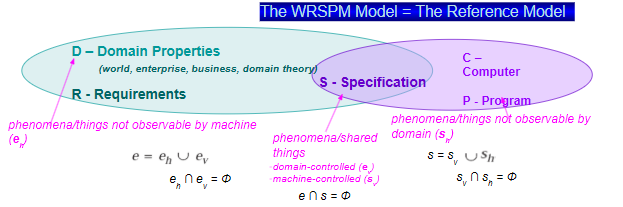
Venn Diagram
(e_h) Left - Domain & Requirements → Input
(e_v & s_v) Middle - Specification → Monitor, Controlled
(s_h) Right - Computer & Program → Output
the e and the s don’t have any shared
the e_v and e_h don’t have any shared
the s_v and the s_h don’t have any shared
D, S ⊧ R
P, M ⊧ S
What if the Domain assumptions are wrong
Then the Requirements will not be satisfied, does not satisfy logical statement
The difference between |– (soundness) and ⊨ (completeness)
Soundness means the statement just makes sense. Completeness takes it further and requires you list all parts of it. So even the Nurse in the domain
4 Worlds Model
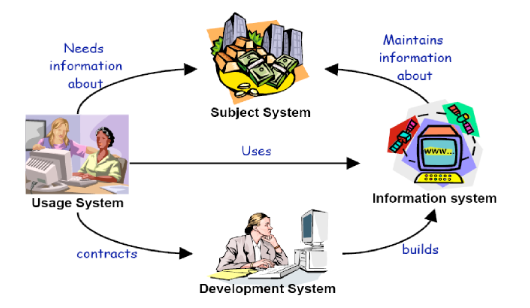
Subject World - Domain, accountants, bankers, loan managers
User World - tellers, clients, managers
Developer World - analysts, specifiers, designers
System World
Each has their own FRs, NFRs