UNM BIOL351 (General Microbiology 1) exam 1
 Call Kai
 Learn
Learn Practice Test
 Spaced Repetition
 Match
Match Flashcards
 Knowt Play
1/281

There's no tags or description
Looks like no tags are added yet.
Name | Mastery | Learn | Test | Matching | Spaced | Call with Kai | Chat |
|---|
No analytics yet
Send a link to your students to track their progress
282 Terms
Major cause of death for humans until about 100 years ago
diseases caused by microorganisms
Infant mortality 100 years ago
about 30%
global estimate of microbe cells
5*10^30
Microbiology definition
study of entities too small to be seen with unaided human eye (
groups of microorganisms: prokaryotes
bacteria and archaea
groups of microorganisms: eukaryotes
protozoa, helminths, and fungi
non-cellular group of microorganisms
viruses
Viruses
- Not independently living cellular organisms
- much smaller than cells - DNA or RNA wrapped in protein
- depend on host cell's machinery to multiply and disperse
Prokaryotes
- "pre-nucleus"
- lack organelles: small, double membrane-bound structures
- 10-100x smaller than eukaryotic cells
- ALL are single cells
Eukaryotes
- "True-nucleus"
- cells with a nucleus (organelles)
_ SOME are single cells
Carolus Linnaeus (1758)
Developed a new way to categorize plants and animals
Ernst Haeckel (1866)
Wrote about the morphology of organisms, proposing 4 kingdoms; Monera, Protists, Plants, and Animals
Robert Whittaker (1969)
Proposed adding a fifth kingdom - fungi - to the tree of life
Problems with the five kingdoms
1. relationships among microbes, both prokaryote and eukaryote were speculative
2. No criteria to relate organisms between "kingdoms"
3. Implicit timeline remained - "prokaryotes", "protists", "primitive"
4. Supposition that the eukaryotic nucleus was derived from a "prokaryote" progenitor turned out to be fundamentally incorrect
Carl Woese (1978)
developed the 3 domains based on sequences of nucleotides in a ribosomal RNA gene
The three domains
Bacteria, Archaea, Eukarya
Eukarya
Animals, plants, fungi, protists, algae...
Bacteria
- prokaryotes
- singe-celled
- divide via binary fission
- derive nutrition from organic or inorganic chemicals, or photosynthesis
- Free-living or symbiotic/pathogenic/parasitic
Archaea
- prokaryotes
- lack peptidoglycan cell walls
- gained notoriety for living in extreme environments, but just as many are found in the usual places
- free-living or symbiotic, no known human pathogens
- includes: methanogens, nitrifiers, organotrophs, extreme halophiles, extreme thermophiles
Major types of organisms referred to as microorganisms
Bacteria, archaea, fungi, protozoa, algae, viruses, multicellular animal parasites
fungi
- eukaryotes
- chitin cell walls
- yeasts are unicellular
- molds and mushrooms are multicellular
- free-living and parasitic
protozoa
- eukaryotes
- absorb or ingest organic chemicals
- may be motile via pseudopods, cilia, or flagella
- free-living or parasitic (derive nutrients from a living host)
algae
- eukaryotes
- cellulose in cell walls
- found in freshwater, saltwater, and soil
- use photosynthesis for energy
- produce oxygen and carbohydrates
multicellular animal parasites
- eukaryotes
- multicellular animals
- not strictly microorganisms
- helminths - parasitic flatworms and roundworms
- some microscopic stages in their life cycles
- not microbes but included in the study of microbiology due to similarity to bacterial diseases
- transmission
- human body response (immune system)
Viruses
- acellular
- consist of DNA or RNA core
- core is surrounded by a protein coat
- coat may be enclosed in a lipid envelope
- are replicated only when they are in a living host cell
- inert outside living hosts
Effects of microbes on humans
- spoilage
- disease
- fermentation
- decomposition
Robert Hooke (1665)
- Micrographia
- insects
- molds
- coined the term cell
- walls in cork
Antonie van Leeuwenhoek (1676)
- dutch fabric merchant
- considered father of microbiology, despite it being a side interest of his
- described bacteria
- made much better microscope lenses (light microscopes)
- very secretive about lenses
- possibly knew Johannes Vermeer
Antonie van Leeuwenhoek cont.
- saw much smaller things
- "animalicules"
Before 1600 AD
- no human knowledges of microbes
- Preservation of food - fermenation
- control of diseases - restrict movement of sick
- religious and cultural practices - types of food and natural preservatives
- agricultural practices - cyanobacteria added to fields to increase yield
Spontaneous generation
- hypothesis that life arises from nonliving matter - "vital force" necessary for life
- Extension of early philosophers
- enticing because microbes are invisible to naked eye
- also used for larger organisms, like insects
Crazy former biogenesis theories
- recipe for flies
- "Goose trees"
Francesco Redi (1668)
- rotting meat experiment, showed that maggots only developing in meat with the addition of eggs
- ended debate for MACRO organisms
- consistent with biogenesis - hypothesis that life can only arise from preexisting life
John Needham (1745)
- boiled chicken broth and put into covered flask. microbes grew - supported spontaneous generation
Lazzaro Spallanzani (1765)
- repeated Needham's experiments, removed air (source of contamination). No microbes grew, supporting biogenesis
Louis Pasteur (1861)
"boiled chicken broth, and put into long, s-shaped flasks. Microbes only grew when contamination could reach the broth. STRONGLY supported biogenesis
Louis Pasteur contributions
- yeast responsible for fermentation in alcohol
- Contamination in fermentation (bacteria) - heat it up to kill the bad microbes - pasteurization
Agostino Bassi (1835)
- amateur microscopist
- proved another silkworm disease was caused by a fungus
Louis Pasteur (1865)
- more problems for silkworm industry
- pasteur figures out its a fungus
- new hygiene rules implemented
Louis Pasteur (1857)
- Germ theory of disease 1857
- first to suggest it
- vaccine for anthrax (bacterium) and rabies (virus)
germ theory of disease
microorganisms are the causative agent for most diseases
Sterile
Free of all microorganisms
John Tyndall (1877)
found that microbes in the dust and air have high heat resistance
Ferdinand Cohn (1876)
discovered and described bacterial endospores
Ignaz Semmelweis (1840)
showed women became infected after examinations by doctors working in autopsy rooms. advocates hand washing to prevent disease transmission
Joseph Lister (1879)
First to utilize hand washing and misting operating rooms with antiseptic chemicals. Techniques would become foundation of modern microbial control. Listerine named after him - eucalyptol, menthol, thymol. and methyl salicylate
Robert Koch (1876)
first to link a specific microorganism with a specific disease (anthrax). Bacillus anthracis found in blood, cultured out on nutrients, injected back into healthy animals. Established a series of proofs that verified germ theory of disease
Koch's postulates
1. specific microorganisms should be present in all cases of the disease, but not in healthy animals.
2. The specific microorganisms should be isolated from diseased animal and grown in pure culture.
3. The freshly isolated microorganism when inoculated into a healthy non-immune laboratory animal should cause the same disease
4. The microorganism should be re-isolated in pure culture from the experimental infection
Koch Laboratory
- early work all in liquid media
- growing microbes on solid media (potato slices)
Fanny Hesse
- wife of Walter Hesse (lab member)
- recommended use of agar to culture bacteria
Koch (1881)
Grew the causative agent of tuberculosis (mycobacterium tuberculosis)
Richard Petri
made dish that made solid media easier to use and keep uncontaminated
Variolation
- early form of vaccination, powdered smallpox scabs, rubbed into scratches, had 1-2% mortality (still had scarring)
- china, India, possibly as far as sudan (1100s)
- spread to Europe in 1700s
- used in Americas at least by 1706
- technique brought by Onesimus (west African slave)
- continental army used technique in 1776 on orders by George washington
Edward Jenner (1796)
- vaccination
- milkmaids contracted cowpox, but not smallpox (much milder disease)
- collected cowpox blisters and infected people with them
- Vacca - latin meaning cow
Louis Pasteur (1876)
- vaccination
- wipe out a whole flock in days
- attenuated (aged) cultures of pathogen were used to create vaccine
Chemotherapy
synthetic drugs or antibiotics
antibiotics
chemicals produced by bacteria and fungi that inhibit or kill other microbes
Quinine
- alkaloid
- from cinchona trees
- used as medicine by Quechua people of current day Peru, Bolivia, Ecuador
- 1500s or 1600s people began using it to treat/prevent malaria
- tonic water + gin and tonic
Paul Ehrlich (1912)
- syphilis - Treponema pallidum - new world disease
- salvarsan - synthetic arsenic drug
- first for bacterial disease
- nausea, vomiting, deafness, liver damage
Alexander Fleming (1928)
- penicillium fungus makes compound that kills staphylococcus aureus
Howard Florey and Ernst Chain
- purify penicillin
- 1940 it is tested and mass produced
Martinus Beijerinck
- 1888 enrichment or selective media
- goal: isolate microbes capable of nitrogen fixation
- 1888 enrichment or selective media approach
- made media with no nitrogenous compounds
- if anything grew they had to make their own N (called enrichment culture)
- 1888 enrichment or selective media results
- isolated bacteria, green algae, others
- symbiont: Rhizobium - nitrogen fixing, plant associate)
Martinus Beijerinck (1898)
recognized that viruses are infectious agents smaller than bacteria
Sergei Winogradsky
- soil and water microbes 1887-1891
- specific bacteria are linked to specific biogeochemical transformations
- N cycle, S cycle
Sergei Winogradsky cont.
- proposed and demonstrated the concepts of chemolithotrophy, and oxidation of inorganic compounds to yield energy
- autotrophy: obtaining carbon from CO2 gas
Carl Woese
- studied genetics of microbes
- tree of life
- discovered archaea: looked like bacteria, but are not bacteria
- proposed new taxonomy system
- 3 domains: Bacteria, Archaea, and Eukarya
Ribomsomes
site of protein synthesis
Ribosomes
- ubiquitous in living organisms
- critical for reading RNA transcripts and creating amino acid chains for proteins
- composed of: small ribosomal proteins + ribosomal RNA
- woese used the small subunit rRNA: 16S rRNA gene sequences
- molecular phylogeny
Coccus
spherical or ovoid
Bacillus
rod-shaped, cylindrical
coccobacillus
short rod
vibrioid
curved rod
spirillum
spiral
spirochete
long, loose helical spiral
unusual shapes (prokaryotes)
stalked, filamentous, star-shaped, rectangular
diplococci, diplobacilli
pairs of bacteria
staphylococci
clusters of bacteria
streptococci, streptobacilli
chains of bacteria
tetrads
groups of 4 bacteria
sarcina
cube-like groups of 8 bacteria
prosthecate or appendaged bacteria
-appendages
- extensions of the cellular membrane
- contain cytoplasm
- different than pilli and flagella
prosthecate or appendaged bacteria stages
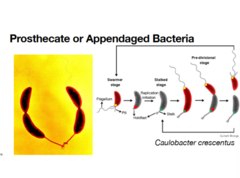
prosthecate or appendaged bacteria life cycle

Cytoskeletal proteins (prokaryotes)
FtsZ (tubulin homologue), MreB (actin homologue), CreS, crescentin (Intermediate filament protein homologue)
FtsZ
- tubulin homologue
- contractile ring that divides cell
- nearly all bacteria and archaea
MreB
- actin homologue
- elongation of cell
- motility, cell-polarity
CreS (crescentin)
- intermediate filament protein homologue
- polymerizes along the inner curve
Microbial cytoskeletal protein examples and diagram
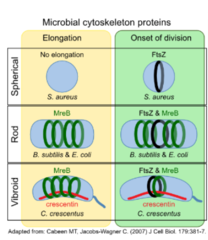
Microbial division example (appendaged bacteria)

units microorganisms are measured in
micrometers (μm, = 10^-3mm = 10^-6m), nanometer (nm = 10^-6mm = 10^-9m)
size range for eukaryotic cells
diameter: 10μm to >200μm
size range for prokaryotes
- diameter: 0.2μm to > 700μm
- length: up to 700 μm
- most cultured rod-shaped bacteria are 0.5μm - 4μm wide and
Unaided eye microscopy range
> 200μm
light microscope range
10mm - 200nm
scanning electron microscope
1mm - 10nm
transmission electron microscope range
100μm - 10pm (picometer = 10^-12m)
atomic force microscope range
10nm - 0.1nm
red blood cell size
5μm - 8μm