UE Intervention and Exercise for Spinal Cord Injury PT 672
 Call Kai
 Learn
Learn Practice Test
 Spaced Repetition
 Match
Match Flashcards
 Knowt Play
1/70

There's no tags or description
Looks like no tags are added yet.
Name | Mastery | Learn | Test | Matching | Spaced | Call with Kai | Chat |
|---|
No analytics yet
Send a link to your students to track their progress
71 Terms
Screen every patient for:
• Blood pressure and autonomic dysreflexia risk
• Orthostatic hypotension symptoms
• Skin integrity and pressure/shear risk
• Orthopedic precautions and fracture risk
• Fall risk and guarding needs
• Overstretching risk: tenodesis, hamstrings, lumbar paraspinals
• Shoulder overuse/stress
Compensation in SCI Rehabilitation Involves using
unaffected body parts, assistive devices, or braces to perform tasks the injured system cannot (e.g., transfers, dressing).
Compensation in SCI Rehabilitation Often needed early on, particularly during
spinal shock or when no muscle activation is present or if return of MMT does not occur.
Compensation in SCI Rehabilitation is important for ensuring
safe discharge during short inpatient stays,
especially due to insurance limits
risk of Compensation in SCI Rehabilitation
Over-reliance on compensation can suppress activation of
impaired neural circuits, leading to maladaptive plasticity and
limiting potential recovery but it is often necessary to use
compensatory strategies
Compensation Strategies in SCI Muscle and Mechanical Substitution
Use available muscles, gravity, passive tension, body position, and
closed-chain mechanics to accomplish a task
Muscle and Mechanical Substitution C6 example:
without functional triceps, shoulder position, external
rotation, weight bearing, and mechanical alignment can help
stabilize the elbow in extension
Muscle and Mechanical Substitution Tenodesis
wrist extension creates passive finger flexion for grasp
what are Compensation Strategies in SCI for Momentum & Head–Hips?
Generate momentum with available body segments to help move
body segments that cannot move actively.
what are Compensation Strategies in SCI for Momentum & Head–Hips during transfers?
movement of the head/trunk in one direction helps
move the pelvis in the opposite direction
what are Compensation Strategies in SCI for Momentum & Head–Hips during rolling?
movement of head and UE helps move trunk
C6 Grasp Substitution Techniques
Tenodesis Grasp using wrist extension andrelease using flexion
what are UE Compensatory Strategies
• Supinated hand
• Hand as a hook
• Tenodesis
• Using the unaffected or less affected limb to complete tasks
• Adaptive equipment
Adaptive Equipment:
use of device to compensate for lost grip, pinch or wrist control
environmental modifications
adjusting home or workstation set up, using assistive technology, installing grab bars or lamps.
what is Splinting for?
• Helps facilitate tenodesis
• Maintains tendon length and prevents over lengthening
• Maintains functional positions
• Help with hygiene
• Increase hand function
• Help with spasticity
• Most patients show a preference to avoid splint or
disuse as soon as possible
what is Elbow Extension Splint
C5 SCI Prevents bicep contracture – in bed
what is a tenodesis splint?
A functional custom made orthosis designed for
individuals with active wrist extension but no
active finger movement—most commonly used
in C6 and some C7 spinal cord injuries
what is the harnessess the natural tenodesis effect?
Wrist extension passively flexes the fingers and thumb, enabling grasp; wrist flexion allows release
tenodesis splint ideal for patients with :
• Fair to normal wrist extensor strength (≥ grade 3/5)
• No active hand or finger movement
• C6–C7 tetraplegia
Can be used as a training device or as a
permanent orthosis to promote independence
in ADLs (e.g., feeding, grooming, writing)
What is the downside to compensatory hand strategies?
• Only work in certain situations
• Energy
• May require multiple trials
• Risk of shoulder impingement and tendonitis
• Limited ability to pick up heavy items
what are UE interventions to improve function after SCI?
Promote Recovery / Motor Learning
enable or compensate for function
reconstruct function
what is Promote Recovery / Motor Learning
Functional task practice
Massed practice
Robotics
VR/motor imagery
FES task practice
Neuromodulation (transcranial magnetic stimulation)
what is enable or compensate for function
Tenodesis
Adaptive equipment
Orthoses and functional neuroprostheses
what is reconstruct function
Tendon transfer
Nerve transfe
Recovery-based approaches aim to improve
function of impaired neural systems through activity-dependent
practice and motor learning.
Recovery in SCI Rehabilitation Emphasizes motor learning through
• Maximal attention and effort by the patient.
• Allowing errors to promote skill acquisition
• High repetitions, of task-specific movements, to drive
cortical and spinal reorganization
How do I choose? Recovery vs.
Compensation?
• After spinal cord injury, rehabilitation aims to maximize independence and quality of life.
• Most patients benefit from a combination of strategies that promote both restoration of lost function (recovery) and adaptation to permanent deficits (compensation)
• Recovery strategies often most affective in incomplete SCI or when some neural pathways remain intact
Can The Impaired System Contribute?
YES / emerging function
→ Challenge it
→ Practice it
→ Strengthen it
→ Increase repetition
Can The Impaired System Contribute?
NO / insufficient for the task
→ Compensate
→ Modify the task/environment
→ Adaptive equipment
→ Protect independence and safety
C5 available function to build on
shoulder control and elbow flexion; little to no active wriest or hand function
C5 massed practice examples
Reach to targets • slide/move larger objects • hand-to-face practice • push
objects across table • repeated UE placement for grooming/feeding with
adaptive equipmen
C6 available function to build on
wrist extension --> tenodesis grip
C6 massed practice examples
Pick up/release cups or cans • grasp/release blocks • cup to mouth • hold
toothbrush/utensil • move objects between locations • progress to smaller
objects
C7 available function to build on
triceps and wrist flexion/extension; increasing hand function depending on completeness
C7 massed practice examples
Reach–grasp–place • squeeze toothpaste • open/close containers • turn cards •
turn doorknob • pour from pitcher • manipulate clothing
C8-T1 available function to build on
increasing finger flexion/extension, intrinsic hand control
C8-T1 massed practice examples
Coins • buttons • zippers • pegboard • keys • beads/lacing • nuts and bolts •
screwdriver • small containers • phone/typing tasks
CIMT parameters for SCI
2 hrs/day, 5 days/wk, 3 wks
CIMT outcomes for SCI
improved grip and pinch strength, sensory function, faster performance on functional tasks; neuroplastic changes
what is robotic assisted UE intervention
• Established as safe and feasible with minimal adverse effects in subacute and chronic SCI
• Some gains in UE motor scores, grip, pinch and ADL's
• Benefits greatest when robotic therapy combined with conventional OT or PT
• Small studies that lacked control groups and not all showed statistically significant or clinical meaningful improvements when compared to conventional therapy alone
Transcutaneous:
only uses surface electrodes
• Many types to improve grasp; most devices vary in type
of the grasps they elicit and the switch that triggers it
Functional Electrical Stimulation can use
surface, percutaneous or implanted electrodes
• Can be worn as a neuroprosthesis or part of therapy
to restore motor function
what is Prognosis of UE Function
• SCI clients often have significant improvements in sensorimotor and grasping function during the first year after injury
• Most rapid improvement during 50-100 days
• Recovery continues for 300 days
• Motor function recovers more than sensory function during this period
• Early upper extremity motor scores strongly predict future grasping ability
does motor or sensory function recover more in terms of UE function
motor
early UE motor scores strongly predict future...
grasping ability
what is SCI Interventions?
• Functional Mobility (Lab)
• ROM
• Strengthening
• Electrical stimulation
• Exercise and Physical Activity
what are ROM Interventions After SCI
• Maintain shoulders in slight abduction/external rotation, elbows extended (not hyperextended), wrists in 30–45° extension, and support the limb to prevent subluxation and pressure injuries.
• Prevent joint contracture
• C6–C7 injuries, always extend the wrist with fingers flexed during stretching and splinting to maintain optimal tenodesis
• Maximize use of available muscle function while positioning to prevent contracture of unopposed muscles and denervated muscles
Progressive strengthening after spinal shock has resolved and patient is
medically stable consider safety with partially innervated muscles and spasticity
what muscles are key to strengthen for shoulder health and transfer ability
Rotator cuff, serratus anterior, latissimus dorsi, pectoralis major, triceps
what two key muscles are important for ambulation
gastroc, quads
what are functional training examples?
seated bicep curl with leg lifter, lateral leans, serratus punch, wrist ex for grasp, reaching, sit to stand
Intact triceps often propel manual chairs __
independently
__ may need power for community distances for wheelchair use
C5/C6
__ injuries usually need power wheelchairs
higher cervical
A __ patient must be able to weight shift correctly to get a manual wheelchair
tetraplegia
All w/c users to weight shift every
15-20 minutes
(forward/lateral or push up)
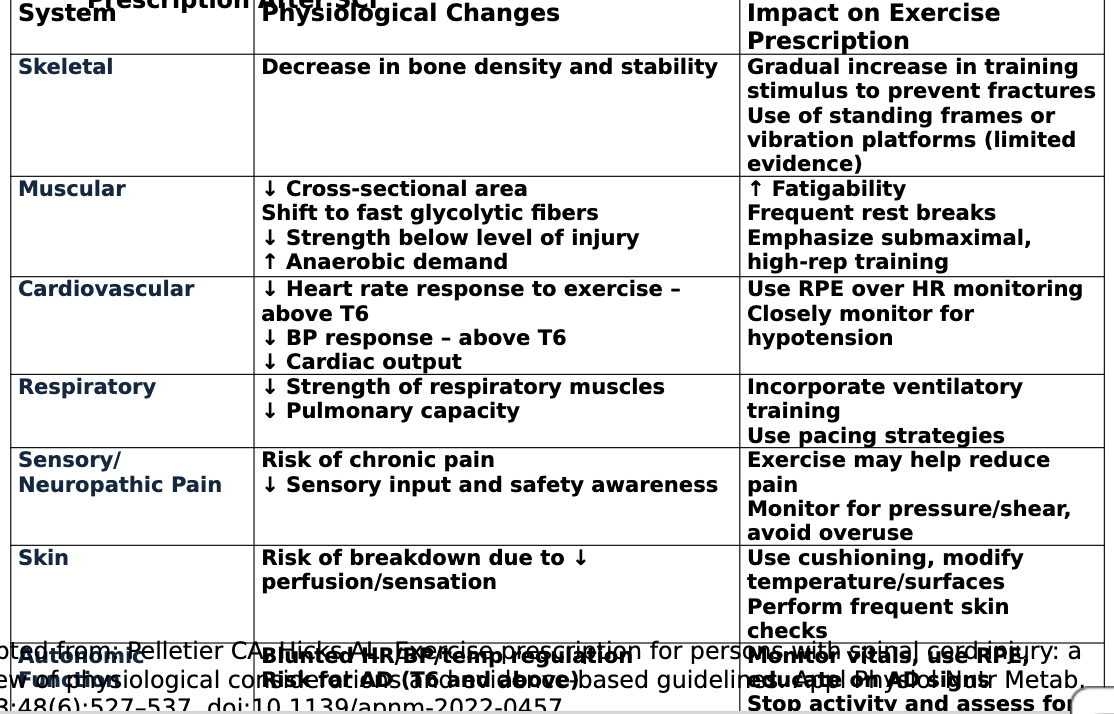
Section IV — Exercise After SCI
what is Exercise Response
Often have blunted HR and BP response (decreased
cardiac output, lower peak HR and post exercise
hypotension)
what is Peak HR in tetraplegia for exercise response?
Peak HR in tetraplegia often 100-120 bpm RPE 13-17
SCI patients participate in less physical activity than people
without SCI after
adjusting for age, sex, BMI, and socioeconomic status
Individuals with SCI have higher rates of
cardiovascular and metabolic disease
Body composition changes occur with
months and during the
years following a SCI
__% decline in hip and knee bone mass fist year after
injury and ¼ have OP (Pelletier et al. 2014)
30-50%
Obesity in __ % of population (Edwards et al. 2008)
20-78%
Benefits of Exercise for Individuals with SCI
Improves fitness:
Cardiorespiratory fitness, power output, and muscle strength
increase with regular exercise (aerobic and resistance training)
Benefits of Exercise for Individuals with SCI
Effective exercise types:
Arm cycling, rowing, hybrid arm–leg exercise, wheeling,
exoskeleton-assisted ambulation, and body weight-supported treadmill training
Benefits of Exercise for Individuals with SCI
Health outcomes:
Some evidence for improved cardiometabolic health, body
composition, and blood lipids, though high-quality trial data are limited
Benefits of Exercise for Individuals with SCI
Neuromuscular electrical stimulation:
Shown to improve body composition
Benefits of Exercise for Individuals with SCI
Quality of life:
Long-term exercise enhances well-being, quality of life, and social
connectedness
Benefits of Exercise for Individuals with SCI
Pain reduction:
Both acute and chronic exercise can reduce neuropathic pain