BIOL 221 Lecture 9
 Call Kai
 Learn
Learn Practice Test
 Spaced Repetition
 Match
Match Flashcards
 Knowt Play
1/28

There's no tags or description
Looks like no tags are added yet.
Name | Mastery | Learn | Test | Matching | Spaced | Call with Kai | Chat |
|---|
No analytics yet
Send a link to your students to track their progress
29 Terms
1. Which of the following equations would be used to solve this problem? (You may need a calculator for this.)
“How many bacteria would you need to start with in order to have as many cells as the Earth’s population (6 billion) within 12 hours? The bacterium divides in 30 minutes.”
Divides in 30 minutes = generation time (g) of 0.5 hour g = (ln 2) / μ μ = (ln 2) / g
A. (6 X 10^9) = x e^(1.39)(12)
B. (6 X 10^9) = e^12 x
C. (6 X 10^9) = x e^(0.5)(12)
D. x = (6 X 10^9) e^(2)(12)
E. x = (6 X 10^9) e^(1.39)(12)
A. (6 X 10^9) = x e^(1.39)(12)
2. A pharmaceutical technician wished to produce large quantities of a bacterial secondary metabolite from a chemolithoheterotroph. She grew the organism in a chemostat with glucose, H2S and oxygen, plus trace elements and growth factors. But she got very low yields of the secondary metabolite. What was her mistake?
A. She should not have used glucose.
B. The oxygen was probably toxic to her bacteria.
C. She should not have used a chemostat.
D. She needed sulfate in addition to H2S.
E. She probably did not wait long enough.
C. She should not have used a chemostat.
3. Cells in a biofilm are very tightly adherent to one another, have variable metabolic activity, and many are dead. What technique would be best to enumerate (count) the cells in a biofilm?
A. most probable number method
B. turbidity measurement
C. Coulter counter
D. measure metabolic acid production
E. dry and weigh the biofilm
A. most probable number method
4. More than 99% of the organisms present in a soil sample do not grow in laboratory media. What would be the most appropriate way to count the organisms present in a soil sample?
A. Coulter counter
B. Petroff-Hausser chamber
C. Pour plate technique
D. Dry and weigh the soil sample
E. Perform a luciferase assay
B. Petroff-Hausser chamber
5. One major difference between batch culture and continuous culture is that _____.
A. batch culture never reaches stationary phase
B. batch culture is best used to produce primary metabolites, such as ethanol
C. continuous culture involves fewer nutrients
D. continuous culture is set up in a series of flasks, not just one
E. continuous culture allows the researcher to change the bacterial growth rate
E. continuous culture allows the researcher to change the bacterial growth rate
6. The Most Probable Number (MPN) method _________________.
A. is a rough estimate of the actual titer based on optical density
B. is usually performed by pouring a sample of the culture through a filter
C. is used for very large sample volumes
D. requires multiple culture tubes, but no petri dishes
E. is considered to be a direct cell count, even though it is statistically based
D. requires multiple culture tubes, but no petri dishes
7. A new bacterial enumeration method has been developed that moves bacteria physically from one chamber of a microchip to another with a micromanipulator (sort of like an atomic force microscope probe tip). This would be an example of __________________.
A. a viable cell count
B. an indirect measurement
C. optical density measurement
D. a direct cell count
E. a statistical method
D. a direct cell count
8. Compare the two cultures represented by the growth curves on the right. Which of the following conclusions can you make?
A. Culture B has the higher growth rate.
B. Culture B was likely placed in a nutrient-rich medium just before growth.
C. Culture A never reaches stationary phase.
D. Culture A has more persister cells.
E. After 10 hours, all cells in culture A have stopped dividing.
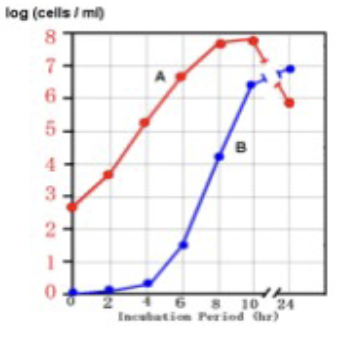
A. Culture B has the higher growth rate.
9. One advantage of growing cells in continuous culture is that _________________.
A. you can get them to produce more secondary metabolites, such as antibiotics.
B. their growth rate constant (μ) is higher than in batch culture.
C. you can make the cells grow as fast or as slowly as you want.
D. there is no special equipment required.
E. you can count them more easily than in batch culture.
C. you can make the cells grow as fast or as slowly as you want.
10. Which of the following methods would give the lowest count for a population of bacteria in stationary phase?
A. Petroff-Hauser chamber
B. Coulter counter
C. Turbidity measurement
D. Measuring the mass of the culture
E. Counting colonies on a pour plate
E. Counting colonies on a pour plate
11. On the right is a bacterial growth curve. What can you conclude about the culture from which the growth curve was measured?
A. It produced only secondary metabolites.
B. It was grown in a chemostat.
C. After 9 hours, no cells are still dividing.
D. It did not have to adapt to new growth conditions.
E. After 9 hours, no nutrients are left in the medium.
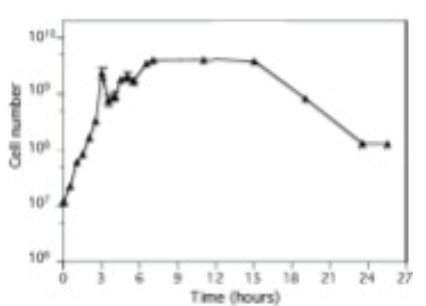
D. It did not have to adapt to new growth conditions.
12. You have a bacterial culture with high turbidity. Which of the following would NOT be a reasonable way to quantify the number of bacteria in this sample?
A. membrane filtration and plating the filter
B. using a Coulter counter
C. counting cells in a Petroff-Hausser chamber
D. dilution of the culture and spread plating
E. using the luciferase assay
A. membrane filtration and plating the filter
13. Which of the following methods of enumerating bacterial growth could be most easily adapted to counting only motile bacterial cells in a culture?
A. Membrane filtration and plating
B. Petroff-Hausser chamber
C. Luciferase reaction
D. Coulter counter
E. Weighing bacterial biomass
C. Luciferase reaction
14. Two bacterial cultures, A and B, were inoculated into "medium M," and produced the growth curves shown on the right. What can you conclude about these cultures?
A. Culture A has the higher growth rate.
B. Culture A produces more primary metabolites than culture B.
C. Culture A had been growing in a medium similar to "medium M" before it was inoculated.
D. Culture B had been growing in a nutrient-poor medium before it was inoculated into "medium M."
E. Culture B eventually becomes a continuous culture.
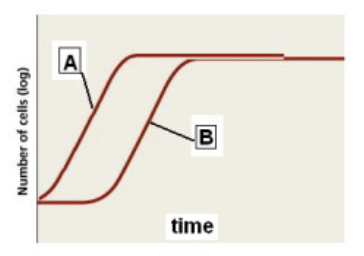
C. Culture A had been growing in a medium similar to "medium M" before it was inoculated.
15. Which of the following would typically be done in a chemostat?
A. Harvesting antibiotics
B. Enriching a culture for persister cells
C. Storing a culture long-term without allowing it to grow
D. Measuring the growth rate, μ, under a variety of nutrient concentrations
E. Determining how long bacteria may survive in a natural environment
D. Measuring the growth rate, μ, under a variety of nutrient concentrations
16. You are using a fluorescence microscope and an antibody-based stain to examine a mixed culture from a patient's blood for the titer of Treponema pallidum, the bacterium that causes syphilis. What would be the best method to make this titer determination?
A. Petroff-Hausser chamber
B. MPN method
C. Viable cell count
D. Membrane filtration and plating
E. Turbidity measurement
A. Petroff-Hausser chamber
17. Which equation would you use to solve the following problem:
You inoculate a single cell with a doubling time of 30 minutes into 50 ml of culture medium and allow it to grow for 7 days. How many cells will be in the culture after 7 days.
Divides in 30 minutes = generation time (g) of 0.5 hour g = (ln 2) / μ μ = (ln 2) / g
A. N = 50 e^(30)(7)
B. N = e^(0.5)(7 x 24)
C. 50 N = (ln30)(7 x 24)
D. N = e^(ln2 / 0.5)(7 x 24)
E. Binary fission will not continue for 7 days, so this cannot be solved with the growth equation.
E. Binary fission will not continue for 7 days, so this cannot be solved with the growth equation.
18. The bacterium Streptomyces does not undergo binary fission, but rather each cell elongates and then divides to become from 6 to 10 identical daughter cells. What would be the best way to enumerate the cells in this culture?
A. Turbidity
B. Viable Cell Count
C. Coulter Counter
D. Measure acid production from metabolism
E. Directly weighing a cell pellet from the culture
B. Viable Cell Count
19. Which equation could be used to solve the following problem?
A sample of milk has been pasteurized (bacterial count reduced by 5 logs). If the bacteria are growing at the rate of 0.1 per hour, how long will it take until there are as many bacteria in the milk as there were before the pasteurization?
N = (N0)eμt
A. 5 = 1 e^(0.1)(t)
B. ln(100,000) = (0.1)(t)
C. (10^5)e = (0.1)(t)
D. 1 = 100,000 e^(0.1)(t)
E. There is not enough information to set up an equation to solve this problem.
B. ln(100,000) = (0.1)(t)
20. Why would a scientist want to grow a bacterial culture in a chemostat?
A. So she can adjust the bacterial growth rate.
B. She is probably growing a culture of microaerophiles.
C. So she can get the bacteria to produce antibiotics.
D. So the culture will reach stationary phase more quickly.
E. She probably has a limited supply of growth media.
A. So she can adjust the bacterial growth rate.
21. Based on what you know about how the following methods for bacterial growth enumeration work, you should be able to classify one of them as a direct method. Which one?
A. Gas production measured in a Durham tube
B. Using the luciferase assay
C. Acid production measured on a nanochip
D. Most Probable Number estimation
E. Measurement of bacterial turbidity with a spectrophotometer
E. Measurement of bacterial turbidity with a spectrophotometer
22. In the United States, swimming beaches are periodically tested for bacterial counts. In Indiana, a beach is closed if the bacterial titer exceeds 125 bacteria per 100 mL. Which of the following would be the best way to determine this titer?
A. Petroff-Hauser chamber
B. Weighing a cell pellet
C. Membrane filtration and plating
D. Coulter Counter
E. Spread plating on agar in petri dishes
C. Membrane filtration and plating
23. Which of the following is NOT an example of a direct cell count?
A. Detecting acid production in the well of a biochip
B. Measuring culture turbidity with a spectrophotometer
C. Detecting when a bacterial particle interrupts an electric current
D. Obtaining a cell pellet by centrifugation and measuring its mass
E. Counting the number of cells per grid square on a ruled microscope slide
A. Detecting acid production in the well of a biochip
24. Salmonella is one of the important bacteria responsible for causing human diarrhea. It generally takes a million to ten million cells of Salmonella to make a person sick. You are running a medical clinic, and a patient comes to you with diarrhea. You want to count the titer of Salmonella in the fecal sample accurately, but as quickly as possible. Which of the following would be the best way to do it?
A. Dilute the fecal sample and plate it on selective media
B. Use a Petroff-Hausser chamber with a fluorescence microscope
C. Use a Coulter Counter
D. Weigh a pellet from a fecal sample
E. Filter a fecal sample and plate the filter on complex media
A. Dilute the fecal sample and plate it on selective media
25. You are measuring turbidity as a surrogate for cell number to make a growth curve. What will happen during the death / decline phase?
A. turbidity will decrease, since dead cells will also lyse in this phase
B. turbidity will remain the same, since dead cells still reflect light
C. turbidity will increase, since there are still cells dividing during this phase
D. turbidity will continue to increase for a while, then will decrease
E. It is not possible to measure turbidity during the death / decline phase.
B. turbidity will remain the same, since dead cells still reflect light
26. Secondary metabolites, such as antibiotics, are produced most effectively _____.
A. by persister cells
B. by cells in crowded growth conditions
C. when the number of cells = N0e^μt
D. as cells are adapting to growth in a new medium
E. when nutrients are constantly added to a culture
B. by cells in crowded growth conditions
27. You suspect a patient has a blood infection caused by a bacterium, and you need to get a titer of bacteria from the patient's blood. How would you do that most effectively?
A. Centrifuge the blood and weigh the pellet
B. Examine the optical density of the blood
C. Use a Coulter Counter to obtain the titer
D. Use a Petroff-Hausser chamber to estimate the titer
E. Spread plate the blood and count the number of colonies
D. Use a Petroff-Hausser chamber to estimate the titer
28. You have developed a new way to enumerate the bacteria in a culture. It involves covalently adding a fluorescent label to peptidoglycan monomers so that newly synthesized peptidoglycan becomes fluorescent. Then a special device counts only fluorescent cells. This method ___________.
A. will count all live cells, whether or not they are growing
B. will count both dead cells and live cells
C. is a type of direct cell count
D. is a type of viable cell count
E. will produce a higher titer than a Coulter Counter will
D. is a type of viable cell count
29. The luciferase reaction is not routinely used to obtain an accurate bacterial titer. Why not?
A. Luciferase is not a bacterial enzyme.
B. Dead cells do not produce ATP.
C. The amount of ATP produced per cell is not constant.
D. You do not see a reaction with fewer than 107 bacteria per mL.
E. It is only based on a statistical estimate of growth.
C. The amount of ATP produced per cell is not constant.