Hearing Science Quiz 1
 Call Kai
 Learn
Learn Practice Test
 Spaced Repetition
 Match
Match Flashcards
 Knowt Play
1/49

There's no tags or description
Looks like no tags are added yet.
Name | Mastery | Learn | Test | Matching | Spaced | Call with Kai | Chat |
|---|
No analytics yet
Send a link to your students to track their progress
50 Terms

In the above image, Interval C represents:
Wavelength
The time that it takes for a vibrating object to complete one cycle of vibration is the:
Period
_____ sounds have energy distributed at more than one frequency.
Complex
How many degrees are in one cycle?
360
Elasticity is…
Something’s ability to resist permanent distortion to its original shape or the distribution of its molecules.
Velocity is…
The speed of sound through a transmitting medium.
Reflection is when…
A sound strikes an object and bounces off.
When reflections are multiple or continuous to the point where they actually prolong the existence of a sound within a confined space, they are known as _____.
Reverberations
If a vibrating tuning fork completes 440 cycles in 1 second, its frequency is _____ Hz.
440
When a sound travels through the air, air molecules travel from the sound source to anywhere the sound reaches.
False
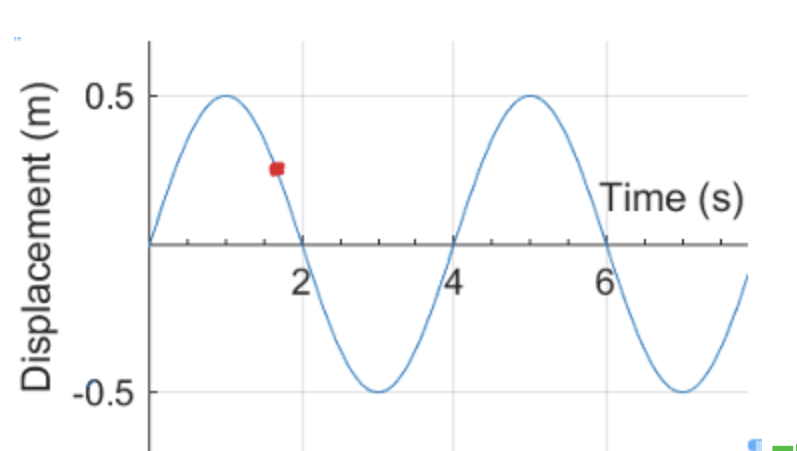
The phase where the red dot is located is:
135 degrees
An example of a complex sound would be…
The vowel [i]
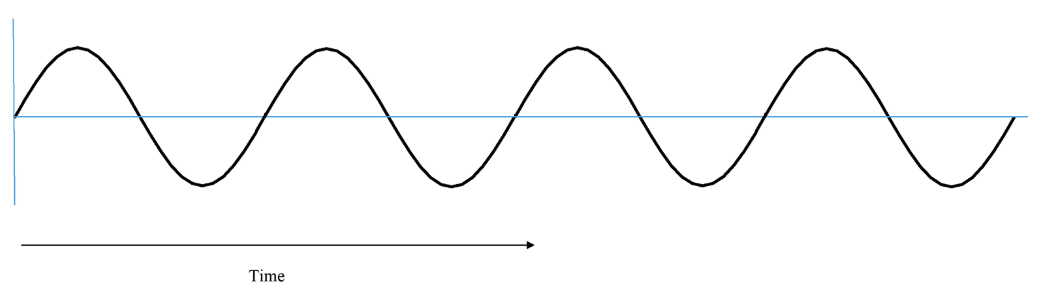
How many cycles are depicted in the above waveform?
4
The perceptual correlate of frequency is:
Pitch
Wavelength is…
Distance that a sound wave disturbance travels while moving from position of rest to compression to position of rest to rarefaction, back to rest.
What is the period of a sound with a frequency of 2 msec?
500 Hz
Wavelength can be expressed in…
Centimeters, millimeters, or meters
A spectrum displays _____ as a function of _____.
Amplitude; frequency
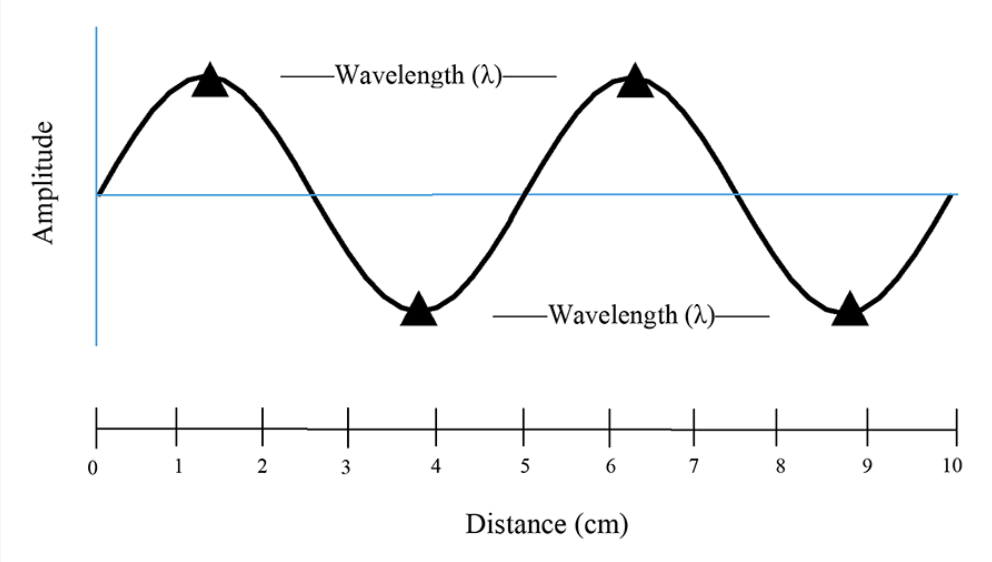
The wavelength of the waveform depicted above is _____ cm.
5
The speed of sound is _____ in water than in air.
Faster
What is the frequency of a sound with a period of 0.1 msec?
10000 Hz
As frequency increases, wavelength _____.
Decreases
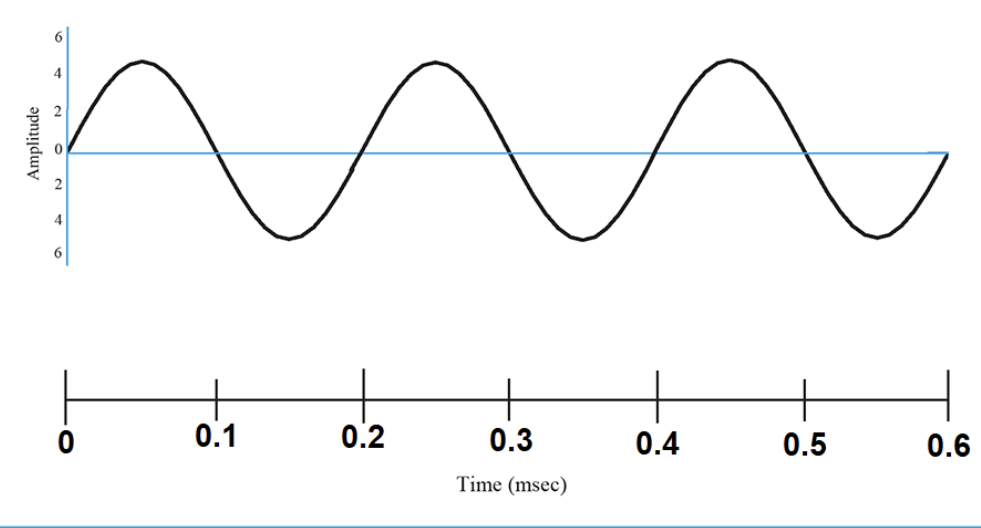
What is the period of the above waveform
0.2 msec
The distance between points of identical phase in two adjacent cycles of a wave is the wave’s _____.
Wavelength
What is the frequency of a sound with a period of 1 msec?
1000 Hz

What is the period of the above waveform?
10 msec

The height of each vertical blue line in the figure above represents _____.
The amplitude of a pure tome component of a complex sound.
Frequency is…
The number of complete cycles that occur in a certain time period.
Given that the speed of sound is 340 meters per second and using the equation f = v / λ, what is the frequency of a sound with a wavelength of 340 meters?
1 Hz

The phase difference of the above waveforms is:
90 degrees
If a pure tone sound causes air molecules to complete 1482 cycles of vibration every second, the sound has a frequency of _____ Hz.
1482
Given that the speed of sound is 1100 feet per second and using the equation f = v / λ, what is the wavelength of a 2200 Hz sound?
0.5 feet
A _____ displays amplitude as a function of time.
Waveform
What is the period of a sound with a frequency of 100 Hz?
10 msec
Given that the speed of sound is 1100 feet per second and using the equation f = v / λ, what is the frequency of a sound with a wavelength of 2 feet?
550 Hz
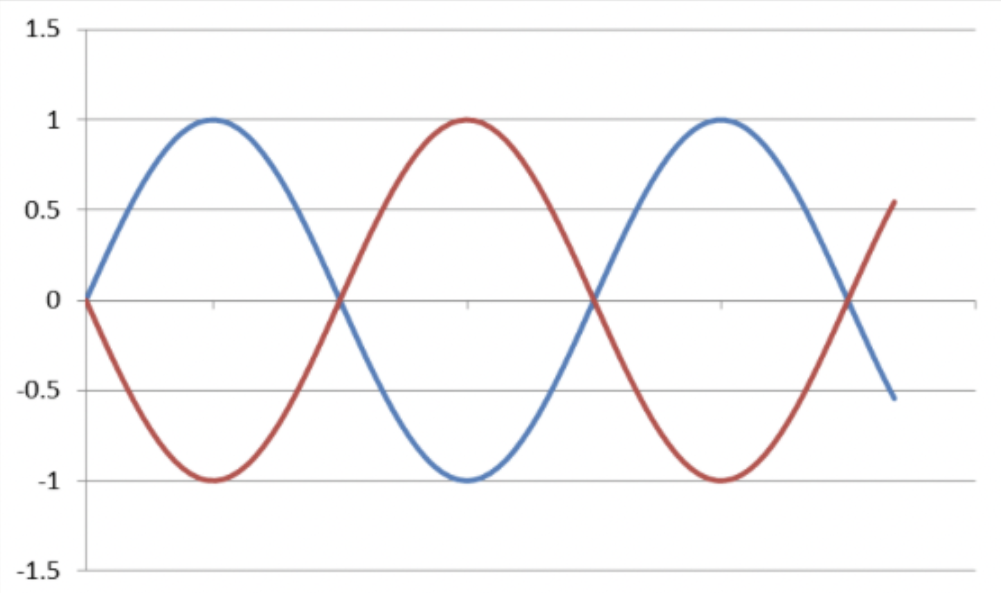
The two waveforms above are:
180 degrees out-of-phase
Frequency is usually measured in…
Hz, kHz, or cps
The process in which sound enters a structure, is converted to thermal energy, and then dissipated is known as ….
Absorption
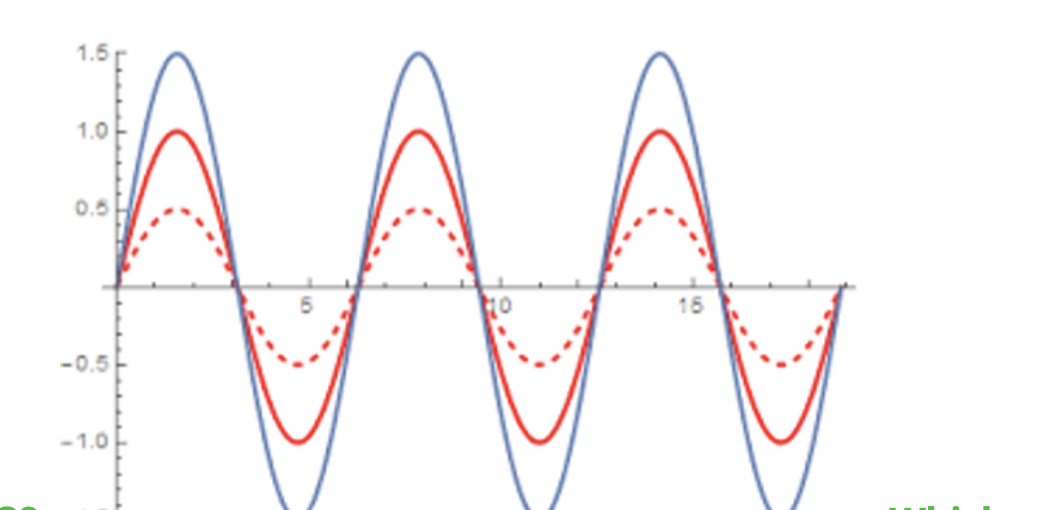
Which waveform has the lowest amplitude?
The red dotted line
A single tuning fork generating a sound with energy concentrated at one frequency is an example of a _____ sound.
Simple
If it takes 1 msec for a vibrating air molecule to complete one cycle of vibration, it has a period of _____ msec.
1
Reverberation time (T60) is…
The amount of time required for a sound to decay by 60 dB in a closed space.
Phase is the:
Point in the cycle at which molecule is located at a given instant in time.
Given that the speed of sound is 340 meters per second and using the equation λ = v / f, what is the wavelength of a 340 Hz sound?
1 meter
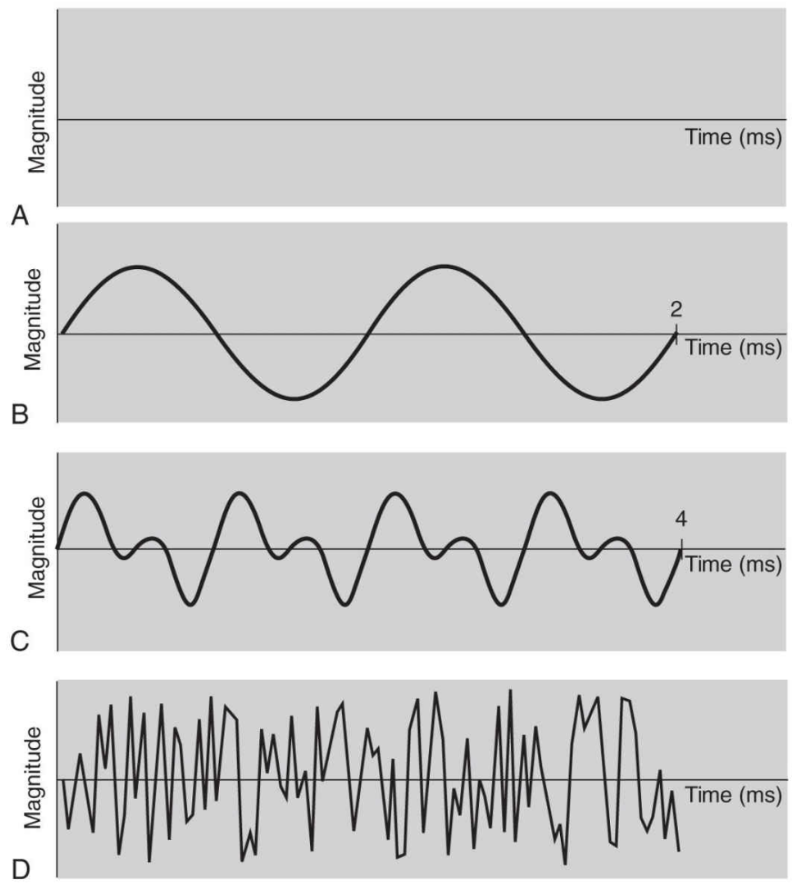
Waveform B represents:
Simple harmonic motion
Phase is usually measured in…
degrees.
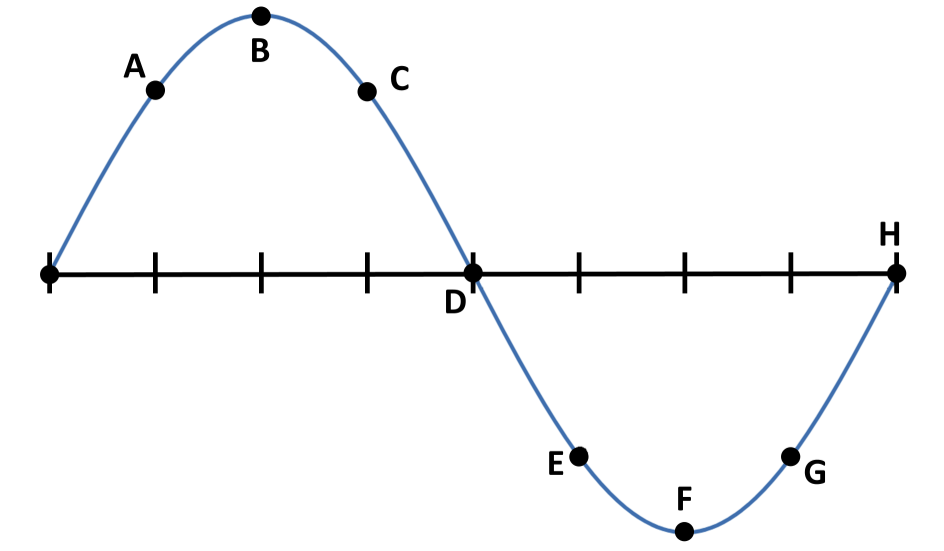
The phase at Point A is:
45 degrees

The phase at Point C is:
135 degrees
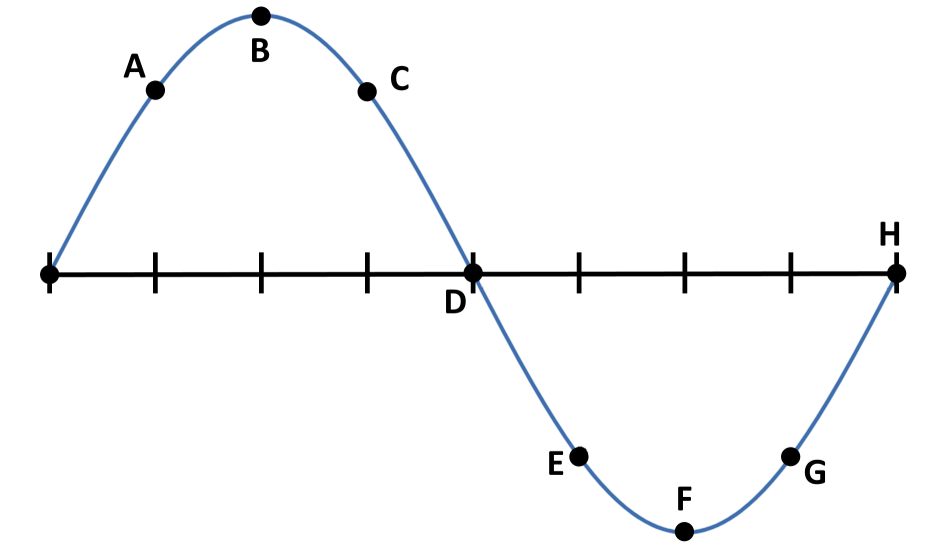
The phase at Point E is:
225 degrees
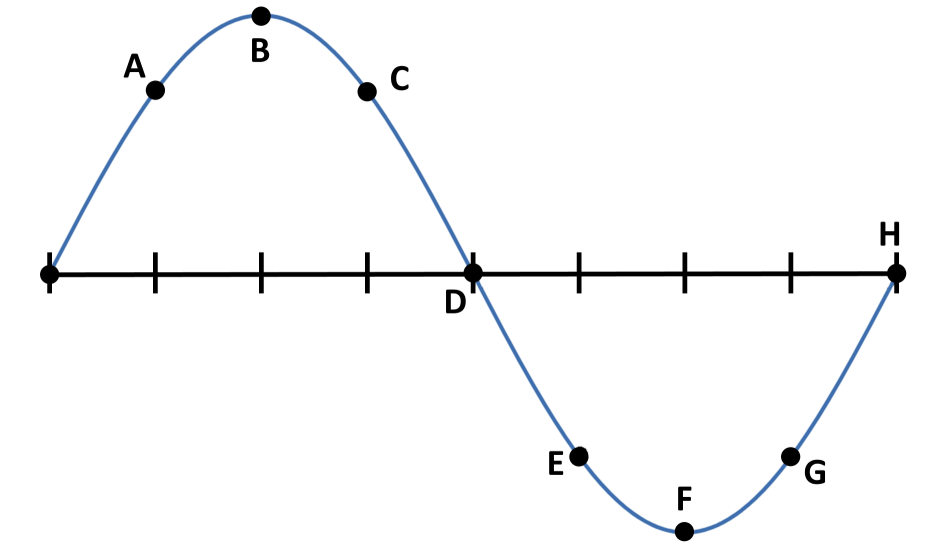
The phase at Point G is:
315 degrees