Non-Specific Immunity
 Call Kai
 Learn
Learn Practice Test
 Spaced Repetition
 Match
Match Flashcards
 Knowt Play
1/61

There's no tags or description
Looks like no tags are added yet.
Name | Mastery | Learn | Test | Matching | Spaced | Call with Kai | Chat |
|---|
No analytics yet
Send a link to your students to track their progress
62 Terms
When thinking of non-specific immunity, think antibody and antigen-___.
independent
What are the structural barriers to infection in non-specific immunity?
Skin and mucosal membranes
Skin is an ___ defense mechanism containing high saturated ___ ___ content, inhibiting bacteria/fungi.
Also includes ___ flora who keep other potential pathogens out!
external; fatty acid; normal
Mucosal membranes are an ___ defense mechanism that prevents microorganisms from ___ to cell surface.
external; attaching
If the structural barriers to infection are overcome it will lead to ___ → vasodilation → redness → ___ → pain.
Immune cells will ___ at site of infection to help.
inflammation; swelling; arrive
The structural barrier Skin can be overcome via ___.
Mucosal membranes can be overcome by ___ if there is too much foreign antigen or it manages to sneak past barrier.
wound; inhalation
___ defense mechanisms kick in after external defense is broken through. This involves the innate immune ___.
The predominant response is the ___, whose granules are ___ to degrade foreign material used intracellularly (___) and release extracellularly.
Internal; cells
neutrophil; bactericidal; phagocytosis
Neutrophils must ___ to where the invader is located in tissue by ___ via ___.
migrate; Diapedesis; Chemotaxis

Chemotaxis is the movement of one cell down a ___ gradient that is produced by a component (such as ___/cytokines).
Neutrophil will sense this component and be ___ towards it and the invader in the tissue!
concentration; chemokines; drawn
For a neutrophil to migrate to an invader in the tissue, it must first perform rolling ___, where it binds to a ___.
adhesion; Selectin

Chemotactic ___ enhance motility and promote the migration of WBCS toward source of chemokines. This facilitates ___, and is where WBCs sense the concentration gradient.
cytokines; diapedesis
After a neutrophil binds to a Selection in rolling adhesion, it must “___” the integrin by ___ to it.
capture; binding

After a neutrophil captures the integrin, it can now be ___ through the vascular membrane via ___ or extravasation.
pulled; diapedesis
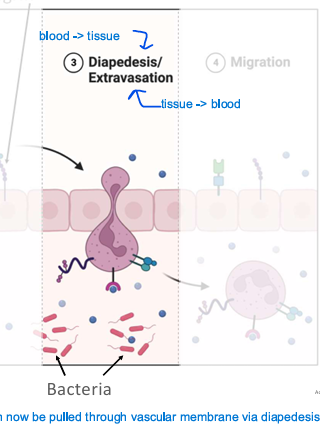
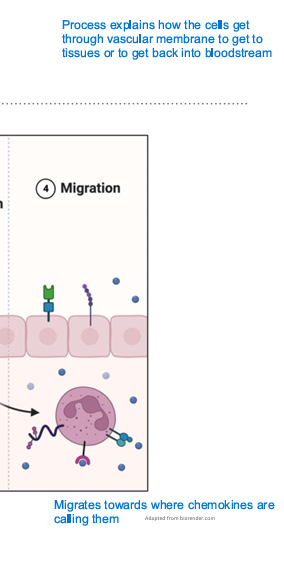
Once the neutrophil is through the vascular membrane, it can now migrate towards where ___ are calling them.
chemokines
Diapedesis is the migration of a cell from ___ → ___
blood; tissue
Extravasation is the migration of a cell from ___ → ___
tissue; blood
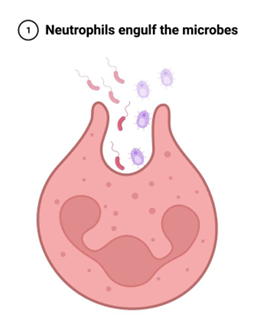
The main purpose of phagocytosis is for the ___ to engulf foreign material, ___ it, and then release it.
phagosome; dissolve
First step of phagocytosis is the physical ___ between WBC and foreign antigen.
contact
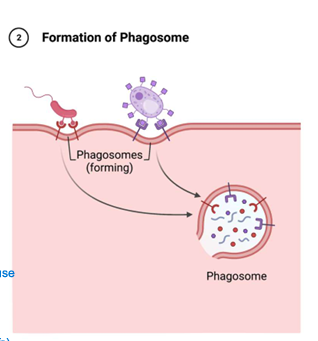
Step 2 of phagocytosis is the ___ of particle and formation of ___, a bubble inside cell that encapsulates foreign material inside.
ingestion; phagosome
In phagocytosis, the ingestion of foreign material and formation of the phagosome is done through the recognition of microorganisms by surface ___ and ___ molecules (on foreign material itself).
Our pattern-recognition receptors ___ the foreign lipid on bacteria that’s not on human cells.
lipid; carbohydrate; detect
Opsonins (C3b, IgG, CRP) increase the ___ and amount of uptake in phagocytosis by ___ the cell, allowing phagocyte to bind and ingest.
rate; coating
Step 3 of phagocytosis is the fusion of cytoplasmic granules in ___ with phagosome to form the ___.
The phagolysosome has ___ enzymes that kill or degrade microorganisms and particles.
lysosome; phagolysosome; hydrolytic
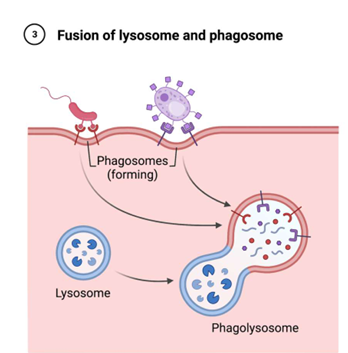
Step 4 of phagocytosis is ___.
___ granules kill using superoxide ions, hypochlorite, and hydrogen peroxide.
digestion; lysosome

It’s important to know that ___ (MPO) and ___ ___ is NEEDED for killing.
Hydrogen peroxide is the ___ important as it helps make ___ ions. Diseases where hydrogen peroxide formation is impaired are more ___!
Reactive oxygen particles (superoxide and hydrogen peroxide) give a “respiratory ___” to kill pathogen.
Myeloperoxidase; hydrogen peroxide
most; superoxide; severe
burst
The last step of phagocytosis is the release of debris into the ___ tissue.
extracellular
Summarize the 5 steps of phagocytosis
physical contact phagocyte-foreign material
ingestion and formation of phagosome
fusion of lysosome and phagosome to create phagolysosome
digestion
release of debris
Neutrophil dysfunction causes a harder time ___ foreign particles.
The Four Disease are:
1. Chronic ___ Disease (CGD)
2. ___ Deficiency
3. ___ Dehydrogenase Deficiency
4. ___ Syndrome
phagocytosing
Granulomatous; Myeloperoxidase; Glucose-6-Phosphate; Chediak-Higashi
Chronic Granulomatous Disease is the most ___ disease discussed. It is ___ and ___ autosomal.
Granulomas ___ where phagocytes cannot kill pathogens causing recurrent ___ (pus-producing) infections like Pneumonia, Osteomyelitis, liver accesses, dermatitis.
severe; X-linked; recessive
form; suppurative
Chronic Granulomatous Disease (CGD) features the absence of ___ oxidase enzyme, decreasing the ___ ___ production.
Consequently, neutrophils are unable to generate ___ bursts and cannot ___ kill the microorganism inside phagolysosome.
NADPH; hydrogen peroxide
respiratory; effectively
In Chronic Granulomatous Disease, neutrophils are able to engulf, form phagosome and phagolysosome, but there is no ___ ___ - thus, killing microorganism inside is not ___.
hydrogen peroxide; effective
Children with Chronic Granulomatous Disease having infections before age of 1 was previously ___.
The current survival increased into ___ with treatment including Anti-bacterial/fungals, ___ transfusion, and BMT.
fatal; mid-adulthood; Granulocyte
Myeloperoxidase (MPO) Deficiency is an autosomal ___ disease. It is the most ___ inherited neutrophil disorder.
Features the absence of MPO in neutrophils and monocytes, with a decrease in ___ acid causing ___ intracellular killing (Entire phagocytosis process takes longer!).
This could cause more secondary effects in infections including worse or longer symptoms!
recessive; commonly
hypochlorous; delayed
Glucose-6-Phosphate Dehydrogenase Deficiency is the deficiency of a digestive ___, the G6PD enzyme. It is a ___ ___ disorder that features ___ intracellular killing. Makes the host more ___ to infection!
enzyme; X-linked recessive; impaired; susceptible
The difference between MPO and G6PD deficiency example:
10 microbes present, 10 microbes die after ___ in MPO def.
10 microbes present, only ___ microbes die in G6PD.
awhile; 5
In G6PD deficiency, there is a ___ in symptoms - the majority being ___. This is because the body has ___ mechanisms to kill things - but if you have NO G6PD, you will be really impaired.
Deficiency also affects RBCs leading to ___, which ___ NADH, ___ Reactive Oxygen Species, and increases ___.
variation; asymptomatic; other
anemia; decreases; increases; lysis
Chediak-Higashi Syndrome is a defect in gene in intracellular vesicle ___ (cannot form phagosome as well as it should). This causes a failure to fuse lysosomes with the ___. It is an autosomal ___ disease.
formation; phagolysosome; recessive
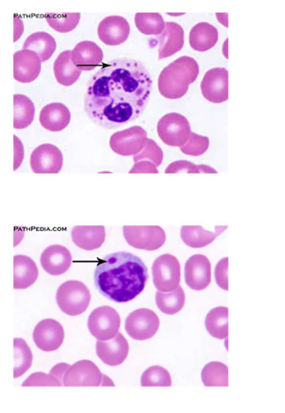
Chediak-Higashi Syndrome features abnormal leukocyte ___ like giant cytoplasmic granular inclusions in neutrophils, T cells, and platelets. This is indication of a phagosome that was not able to be ___ or fused with lysosomes. Also impairs platelet aggregation.
Causes increased ___ to infections and partial ___ (where ___ granules are not distributed correctly).
granulation; removed
susceptibility; albinism; melanin
Other phagocytes include the ___ phagocyte system who function to remove ___ and injured blood cells, antigen-antibody ___, and damaged cell membranes.
It cleans up after ___ is over! But if there’s ___ much, can damage own tissue (causing autoimmunity issues).
mononuclear; old; complexes
inflammation; too
The mononuclear phagocyte system includes monocytes in the ___ and macrophages in the ___ (spleen, liver, lymphoid tissue).
blood; tissue

Natural Killer cells kill virally infected cells or tumor cells via ___ (ADCC). They have a receptor for the Fc portion of ___ which binds to the IgG on viral proteins on the surface of ___ cells.
antibody dependent cell mediated cytolysis; IgG; infected

The major innate soluble mediators are ___ phase reactants - ___ that are normally found in the body at ___ levels. They are produced by ___ (liver cells) within ___-24 hours.
Infection, trauma, injury causes these levels to rapidly ___ (>25%).
acute; proteins; low; hepatocytes; 12; increase

List the Acute Reactant Proteins to know:
-CRP
-Serum ___ A
-___-Binding Protein
-Alpha-Anti-___
-Haptoglobin
-Fibrinogen
-___
Amyloid; Mannose; Trypsin; Ceruloplasmin
C Reactive Protein (CRP) is an acute ___ marker with a ___ increase (100-1000x in 4-6 hrs). It also ___ rapidly with a half-life of 19 hrs.
inflammation; rapid; declines
CRP functions as a ___ (attracts immune cells), ___ (one of the ___ because it reacts so strongly), and complement ___.
chemoattractant; opsonin; best; activator
Serum Amyloid A is an acute ___ marker in ___ infections.
Functions:
-Removes ___ from cholesterol filled ___ at site of tissue injury (contributing to cleanup and helping phagocytosis)
- activates monocytes and macrophages to ___ inflammation
-___ to increase inflammation
inflammation; bacterial
cholesterol; macrophages; increase; chemoattractant
Mannose-binding protein binds mannose. Mannose is a ___ found in bacteria, yeast, viruses, and parasites - but NOT ___. The protein is found in ___ surfaces in body.
Functions to activate the complement by ___ mannose binding protein pathway.
A lack of this protein is associated with recurrent ___ infections.
sugar; human; mucosal
specific; yeast
Alpha1-Anti-Tryspin is a ___ inhibiter. Leukocytes express proteases to ___ tissue during inflammation.
protease; navigate
Haptoglobin binds ___ hemoglobin that is released from ___ hemolysis lysing RBCs.
Haptoglobin protects against ___ damage due to free hemoglobin. Can ___ by 2-10x in stress, inflammation, and tissue necrosis. But will ___ if intravascular hemolysis is occurring. (all haptoglobin being bound to free hemoglobin)
free; intravascular
oxidative; increase; decrease
Fibrinogen aids in formation of fibrin ___, increasing strength of wound. Creates a ___ barrier to prevent spread of microorganism.
It also stimulates ___ cells, promoting the healing factor.
clot; physical; endothelial
Ceruloplasmin is the ___ transport protein. It binds copper to help transport ___ of body before toxicity.
Depletion of this protein results in ___ disease, an autosomal ___ disease. Causing a massive increase of copper in ___. (liver, brain, cornea, kidneys, bones)
copper; out
Wilson’s; recessive; tissues
Innate Immune Cell Cytokines are small soluble proteins that ___ the immune system (“chemical ___”). They can be induced by ___ stimuli such as Gram Negative ___.
regulate; messengers; foreign; LPS
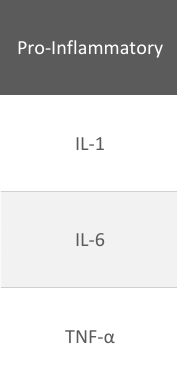
Name the innate immune cell cytokines to know:
IL-1, TNF-Alpha, and IL-6
As a innate immunity cytokine, IL-1 (Interleukin-1) is a big player in ___. It is induced by ___ pathogens and other cytokines. Produced by ___ and macrophages.
inflammation; microbial; monocytes
The cellular effects of IL-1 include:
-cell adhesion
-chemokines
-IL-6 ___ CRP (IL-1 turns on IL-6 so it can turn on CRP)
-CSF in bone marrow
-IL-2 ___ from T helper cells
Systematic effects include:
-___
-activation of phagocytes
-production of acute phase reactants
activates; secretion; fever
Innate immunity cytokine: TNF-Alpha (Tumor Necrosis Factor)
Triggered by: ___ of gram neg bacteria.
Secreted by: ___/macrophages.
Activates ___ cell to express MHC Class__ molecules, enhances antigen presentation, and causes apoptosis of ___ cells due to cytotoxic effect.
LPS; monocytes
T; II; tumor
As a innate immunity cytokine, IL-6 is produced by innate and lymphoid cells. It plays a role in the ___ immunity by stimulating ___ cells to proliferate and differentiate into ___ cells.
This cytokine is one of the ___ ways the body turns B cells into plasma cells so that antibodies can be released!
Each turn on each other: IL-_ → IL-_ → ___
adaptive; B; plasma
main; 1; 6; CRP
The NK cell-IgG interaction triggers the release of ___ and granzyme from NK cell and creates a ___ in the target’s membrane. It may induce ___ lysis of cell or apoptosis.
(non-specific = not MHC-specific, just looking for IgG)
Perforin; pore; osmotic
CRP is a non-___ indicator that can be seen in bacterial infections, rheumatic fever, viral infections, malignant diseases, TB, and heart attack. It is one of the ___ indicators than an infection is occurring.
specific; main
Innate Immune Cell Cytokines functions:
-Increase ___ and diapedesis
-Chemokines ___ cells to inflamed areas
-Activate cells and induce ___
-Regulate ___
-Physical symptoms like ___
adhesion; attract; differentiation; growth; fever
CRP is used to observe the response to ___ of infection or follow course of malignancy. (If CRP lvls decrease, you are healing for infection).
It is the acute phase protein used the most to monitor treatment because it has the highest ___ based on infection state.
treatment; influx
Alpha1-Anti-Tryspin ___ neutrophil invasion during response! Regulating and inhibiting pro-inflammatory ___ (TNF-a, IL-1b, IL-6). It is a way to ___ how body is reacting - we don’t want too much!
counteracts; cytokines; control
A deficiency in Alpha1-Anti-Tryspin results in premature emphysema (long-term lung disease) and ___ disease due to too much protease activity ___ tissue.
liver; destroying