Enthalpy and Entropy
 Call Kai
 Learn
Learn Practice Test
 Spaced Repetition
 Match
Match Flashcards
 Knowt Play
1/19

There's no tags or description
Looks like no tags are added yet.
Name | Mastery | Learn | Test | Matching | Spaced | Call with Kai | Chat |
|---|
No analytics yet
Send a link to your students to track their progress
20 Terms
Lattice enthalpy
the enthalpy change that accompanies the formation of one mole of an ionic compound from its gaseous ions under standard conditions
Formation of gaseous atoms
changing the elements in their standard states into gaseous atoms
endothermic as it involves bond breaking
Formation of gaseous ions
changing the gaseous atoms into positive and negative gaseous ions
endothermic
Lattice formation
changing the gaseous ions into the solid ionic lattice
exothermic
Standard enthalpy change of formation
the enthalpy change that takes place when one mole of a compound is formed from its elements under standard conditions, with all reactants and products in their standard states
Standard enthalpy change of atomisation
enthalpy change that takes place for the formation of one mole of gaseous atoms from the element in its standard state under standard conditions
First ionisation energy
the enthalpy change required to remove one electron from each atom in one mole of gaseous atoms to form one mole of gaseous 1+ ions
endothermic because energy is required to overcome the attraction between a negative electron and the positive nucleus
First electron affinity
the enthalpy change that takes place when one electron is added to each atom in one mole of gaseous atoms to form one mole of gaseous 1- ions
exothermic because the electron being added is attracted in towards the nucleus
second electron affinity is endothermic
Standard enthalpy change of solution
the enthalpy change that takes place when one mole of a solute dissolves in a solvent
Enthalpy change of hydration
the enthalpy change that accompanies the dissolving of gaseous ions in water to form one mole of aqueous ions
Dissolving process of solid ionic compound
the ionic lattice is broken up forming separate gaseous ions. this is the opposite energy change from lattice energy, which forms the ionic lattice from gaseous ions
the separate gaseous ions interact with polar water molecules to form hydrated aqueous ions. the energy involved is called the enthalpy change of hydration
Enthalpy Change of Solution
the enthalpy change when one mole of an ionic substance dissolves in sufficient water to form an infinitely dilute solution
can be exothermic or endothermic depending on the relative sizes of the lattice enthalpy and the enthalpy changes of hydration
Factors affecting lattice enthalpy - ionic size
As lattice enthalpy decreases -
ionic radius decreases
attraction between ions decreases
lattice energy is less negative
melting point decreases
Factors affecting lattice enthalpy - ionic charge
As lattice enthalpy increases -
ionic charge increases
attraction between ions increases
lattice energy becomes more negative
melting point increases
Factors affecting hydration - ionic size
As hydration enthalpy decreases -
ionic radius increases
attraction between ion and water molecules decreases
hydration energy less negative
Factors affecting hydration - ionic charge
As lattice enthalpy increases -
ionic charge increases
attraction with water molecules increases
hydration energy becomes more negative
Entropy
the dispersal of energy within the chemicals making up the chemical system
the greater the entropy, the greater the dispersal of energy and the greater the disorder
solids have the smallest, liquids have greater, gases have the greatest entropies
Predicting entropy changes
if a system changes to become more random, energy can be spread out more - there will be an entropy change which will be positive
if a system changes to become less random, energy becomes more concentrated - the entropy change will be negative
Feasibility
a reaction can happen if the products have a lower overall energy than the reactants
feasibility is used to describe whether a reaction is able to happen and is energetically feasible
spontaneous may also be used for energetically feasible
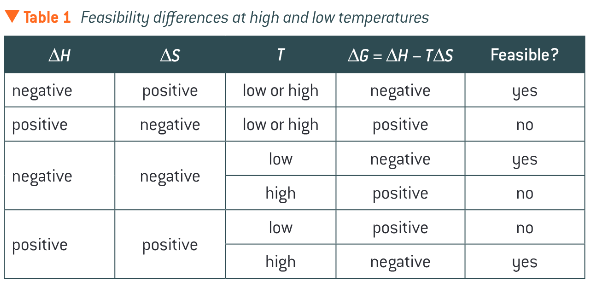
Free energy
overall change in energy during a chemical reaction
made up of 2 types - enthalpy and entropy
enthalpy - heat transfer between the chemical system and the surroundings
entropy - dispersal of energy within the chemical system itself