The Pyramidal System Spastic Paralysis
 Call Kai
 Learn
Learn Practice Test
 Spaced Repetition
 Match
Match Flashcards
 Knowt Play
1/25

There's no tags or description
Looks like no tags are added yet.
Name | Mastery | Learn | Test | Matching | Spaced | Call with Kai | Chat |
|---|
No analytics yet
Send a link to your students to track their progress
26 Terms
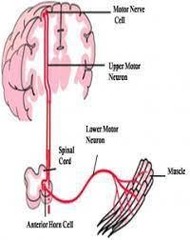
What is the Pyramidal System composed of?
Upper motor neurons

Where do the axons of the Pyramidal System pass to?
Lower motor neurons (LMN) at a certain spinal cord level
What is the primary function of the Pyramidal System?
Initiation and regulation of voluntary motor movements
Where are most neuronal cell bodies of the Pyramidal System found?
In the precentral gyrus and anterior paracentral lobule
What are the two axonal tracts of the Pyramidal System?
Corticospinal tract and corticobulbar tract

What does the corticospinal tract connect?
Upper motor neurons in the primary motor cortex to spinal motor nuclei
Where does the corticospinal tract decussate?
In the caudal third of the medulla

What percentage of corticospinal fibers cross to become the Lateral Corticospinal Tract?
90%

What is the function of the corticobulbar tract?
It connects upper motor neurons in the primary motor cortex to cranial nerve motor nuclei
What movements are controlled by the corticobulbar tract?
Chewing, speech, swallowing, and tongue movements
What is a supranuclear lesion?
An upper motor neuron injury occurring before reaching the neuronal nuclei
What is a nuclear lesion?
A lower motor neuron injury occurring to the neuronal cell bodies
What is an infranuclear lesion?
A lower motor neuron injury occurring to the axon of the lower motor neuron
What are common causes of upper motor neuron lesions?
CVA, tumors, trauma
What are common causes of lower motor neuron lesions?
CVA, polio, tumors, trauma
What is spastic paralysis?
A condition characterized by increased muscle tone and exaggerated reflexes
What is flaccid paralysis?
A condition characterized by decreased muscle tone and absent reflexes
What is the clasp-knife response?
A clinical sign of spasticity where resistance to passive movement decreases suddenly

What is sacral sparing?
Preservation of motor and sensory function in the lower sacral segments despite spinal cord damage
What occurs immediately after a complete spinal cord transection?
Loss of all voluntary movements, sensations, and temporary abolition of reflexes
What is the clinical significance of a positive Babinski sign?
Indicates upper motor neuron lesions

What is the typical presentation of a capsular stroke?
Contralateral paralysis, hypertonia, spasticity, and exaggerated reflexes
What is the difference between UMN and LMN lesions in terms of muscle tone?
UMN lesions exhibit increased tone, while LMN lesions exhibit decreased tone
What is the role of the premotor cortex?
Planning of learned movements and activation of multiple muscles
What type of paralysis results from a complete transection at C7 or above?
Quadriplegia
What type of paralysis results from a complete transection of C8 or T1?
Paraplegia