Microwave Part 1
 Call Kai
 Learn
Learn Practice Test
 Spaced Repetition
 Match
Match Flashcards
 Knowt Play
1/75

There's no tags or description
Looks like no tags are added yet.
Name | Mastery | Learn | Test | Matching | Spaced | Call with Kai | Chat |
|---|
No analytics yet
Send a link to your students to track their progress
76 Terms
Microwaves
electromagnetic waves with frequencies ranging from 300 MHz to 300 GHz
Microwaves
Due to the inherent high frequency of these EM waves, their wavelengths are relatively shorter compared to the wavelengths of conventional RF signals
Microwaves
Propagate in space in a straight line like beams of light
Microwaves
Can be reflected by conductive surfaces
Microwaves
The current created by Microwaves travel through a thin out layer of conductor
Microwaves
They penetrate through the ionosphere
Advantages of Microwaves
• More data can be sent due to its high frequency
• Requires smaller antennas
• Signals can easily propagate around physical obstacles
• Improved directive properties reduce the risk of interference and minimal crosstalk
• Much less background noise
• Fewer repeaters are necessary for amplification
• Does not require physical facilities like underground cables
• Does not require right-of-way
• Less fading
• Does not require high transmit power
• Minimum delay times
• Lower start-up and operational costs
Disadvantages of Microwaves
• More difficult to analyze and design circuits at microwave frequencies
• Difficult to implement measuring techniques
• Conventional components behave differently at microwave frequencies
• Conventional semiconductors do not work properly at microwave frequencies
• Transit time is more critical
• Requires use of specialized components
• Transmission distance is limited by line-of-sight
• Microwaves are easily diverted due to their short wavelengths
• Prone to absorption and attenuation by fog and heavy rains
• Cost of building the infrastructure is high
Safety of Microwaves
• Microwaves are non-ionizing
• Has insufficient energy to cause cancer or change in DNA composition
• Links have limited power, typically a few hundred watts
ITU
set up by the UN, is responsible for controlling the allocation of spectrum
ITU-T
handles standards for end-to-end circuits covering all media
ITU-R
deals with radio link
Microwave Communication System
A form of electronic communications the uses microwaves to transmit and receive information signals
microwave link
Simplest form of Microwave Communication System
microwave link
a high frequency radio link designed to provide a signal connection between two points
hop
Two microwave terminals form a_____
Microwave Radio
a point-to-point fixed digital link that operates in duplex mode
Duplex Mode
means that each channel consists of a pair of frequencies for transmission and reception
Duplex Mode
Sometimes called low-band channels and high-band channels
T to R spacing
Spacing between two frequencies
Frequency Division Duplexer
The transmit and receive frequencies are combine in a single antenna using a _____
Microwave Radio
The transmit and receive frequencies are combine in a single antenna using a Frequency Division Duplexer
duplexer
provides coupling for the two signals
Digital modem
RF unit
Passive Parabolic Antenna
A microwave radio terminal has 3 basic module:
Digital modem
to interface with the customer Microwave Radio: Modules and Hardware Configurations equipment and convert customer traffic to a modulated signal
RF unit
to up and down convert signal in RF range
Passive Parabolic Antenna
transmission and reception of signals
E1
basic digital channel containing 30 voice channels Microwave Radio: Capacity Configurations and 2 other channels (for sync and signaling) at 64 kbps each and time division multiplexed
30 voice channels, 64 kbps
E1is the basic digital channel containing ____and 2 other channels (for sync and signaling) at____ each and time division multiplexed
E1
has a total bit rate of 2.038 Mbps
2.038 Mbps
E1has a total bit rate of _______
non-protected
1 + 0 configuration
protected
1 + 1 configuration
Monitored Hot Standby (MHSB)
1 + 1 configuration or protected
• Analog
• Digital
Based on nature of signal
Short Haul
uses frequencies greater than 15 GHz
Long haul
uses lower frequencies to minimize attenuation
Narrowband
generally less than 3 GHz in frequency
Wideband
utilizes frequencies from 3 GHz to 15 GHz
Microwave links
are used for the control and maintenance of the power grid
Microwave links
are used to connect radio/TV repeaters to main and regional transmission sites
Microwave links
are used for BTS-BTS, BTS-BSC, BSC-MSC MSC-PSTN connections
16 kbps
Bit rate for one voice GSM channel
120 VC
1 GSM E1 is
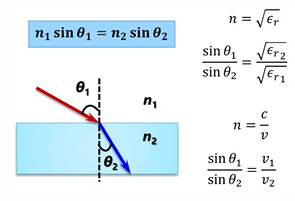
Snell’s Law
refraction
the radio horizon is extended due to
radio horizon
approximately one-third greater than the visual horizon for standard atmospheric conditions
𝑵= 𝒏−𝟏 𝒙𝟏𝟎^6
Radio Refractivity
refractive index
non-ionized atmosphere is always greater than 1
Refractivity gradients
change with time leading to anomalous propagation conditions
Microwave beams
travel in the atmosphere along curved paths
effective Earth radius
In designing MW links, a microwave beam is assumed to be traveling along a straight line relative to an ______ , adjusted by the refractivity gradient
k-factor
The effective Earth radius is the actual radius multiplied by the _____
k-factor
ratio of the effective radius to the actual radius of the earth
k-factor
It is used to determine the relative clearance and not to predict the beam curvature
k-factor
a numerical figure that considers the non ideal condition of the atmospheric refraction that causes the beam to be bent toward to, or away from the eart
standard refraction
when the gradient of refractivity displays average characteristics
k= 4/3
During a standard atmospheric condition, k=
Cold or dry climates and high altitudes
have lower k-factor
Coastal areas
where humidity is high will have higher k facto
Superstandard Refraction
Also called super refraction
Superstandard Refraction
results from meteorological conditions such as temperature inversion or marked decrease in total moisture content of the air
Superstandard Refraction
result from excessing increase in water vapor content near the surface
Superstandard Refraction
In this condition, the value of k approaches infinity and the microwave beam follows the contour of the earth and becomes partially parallel to it
Substandard Refraction
This occurs when the dielectric constant of the atmosphere increases with height
inverse beam bending or earth bulging
The microwave beam tends to be deflected away from the earth and is usually
less than 1
K-factor for substandard refraction is
temperature inversion and negative humidity gradient or hydrolapse
Negative refractivity gradient results from
Temperature inversion
is the primary cause of ducts which influence radio link propagation
blackout
G becomes negative
Ground-based Duct
a very dense layer of air close to the ground with a thin layer on top of it
Elevated duct
exists when the atmosphere has a thick layer in some height above the ground
Ducting Probability
Refers to the percentage of time when dN/dh is less than 100N/km for a specified month
ITU-R
issues DUCT Probability Contour Maps
Equatorial regions
most vulnerable to ducts
G is -157
the microwave beam would be parallel to the earth