🧈 Rendered Animal Proteins and Fats + Insects

0.0(0)
Studied by 0 people
call kaiCall Kai
Locked
learnLearn
examPractice Test
spaced repetitionSpaced Repetition
heart puzzleMatch
flashcardsFlashcards
GameKnowt Play
Card Sorting

1/40

encourage image

There's no tags or description

Looks like no tags are added yet.

Last updated 1:12 AM on 9/19/26
Name
Mastery
Learn
Test
Matching
Spaced
Call with Kai
Chat

No analytics yet

Send a link to your students to track their progress

41 Terms

1
New cards

Rendered Animal Proteins and Fats

knowt flashcard image
2
New cards

U.S. Animal Agriculture Annual Production – 2017

Livestock Production
  • 32 million cattle49% of live weight not used for human food
  • 121 million hogs44% not used for human food
  • 9 billion chickens37% not used for human food
  • 242 million turkeys36% not used for human food

Meat Production
  • U.S. meat production → 24 billion kg
  • Approximately 10 billion kgmeat by-products

Poultry Production
  • U.S. poultry production → 22 billion kg
  • Approximately 8 billion kgpoultry by-products

<p><strong>Livestock Production</strong><br>  • <strong>32 million cattle</strong> → <strong>49%</strong> of live weight not used for human food<br>  • <strong>121 million hogs</strong> → <strong>44%</strong> not used for human food<br>  • <strong>9 billion chickens</strong> → <strong>37%</strong> not used for human food<br>  • <strong>242 million turkeys</strong> → <strong>36%</strong> not used for human food</p><p><strong>Meat Production</strong><br>  • U.S. meat production → <strong>24 billion kg</strong><br>  • Approximately <strong>10 billion kg</strong> → <strong>meat by-products</strong></p><p><strong>Poultry Production</strong><br>  • U.S. poultry production → <strong>22 billion kg</strong><br>  • Approximately <strong>8 billion kg</strong> → <strong>poultry by-products</strong></p>
3
New cards

Eating High Off the Hog

Meaning
  • “Eating high off the hog” → refers to eating what many consider choice cuts of meat
  • These cuts are found high on the body of an animal
  • Examples → shoulders, hams, steaks, roasts, and chops

Changes in Eating Habits
  • In the past, it was said that many Americans ate every part of the pig except the squeal
  • Over the last few decades, many Americans have become more particular about what parts of animals they eat
  • Parts that are nutritious and were previously considered delicious are now widely avoided

Co-Products / By-Products
  • In many places around the world, these animal parts are still considered delicacies
  • In the United States, nutritious animal parts that people choose not to eat are often called byproducts
  • In reality, they are co-products of the steaks, chicken breasts, and hams that are preferred
<p><strong>Meaning</strong><br>  • “<strong>Eating high off the hog</strong>” → refers to eating what many consider <strong>choice cuts of meat</strong><br>  • These cuts are found high on the body of an animal<br>  • Examples → <strong>shoulders, hams, steaks, roasts, and chops</strong></p><p><strong>Changes in Eating Habits</strong><br>  • In the past, it was said that many Americans ate <strong>every part of the pig except the squeal</strong><br>  • Over the last few decades, many Americans have become more particular about what parts of animals they eat<br>  • Parts that are <strong>nutritious</strong> and were previously considered <strong>delicious</strong> are now widely avoided</p><p><strong>Co-Products / By-Products</strong><br>  • In many places around the world, these animal parts are still considered <strong>delicacies</strong><br>  • In the United States, nutritious animal parts that people choose not to eat are often called <strong>byproducts</strong><br>  • In reality, they are <strong>co-products</strong> of the steaks, chicken breasts, and hams that are preferred</p>
4
New cards

Agrarian Society

Butchering and Food Use
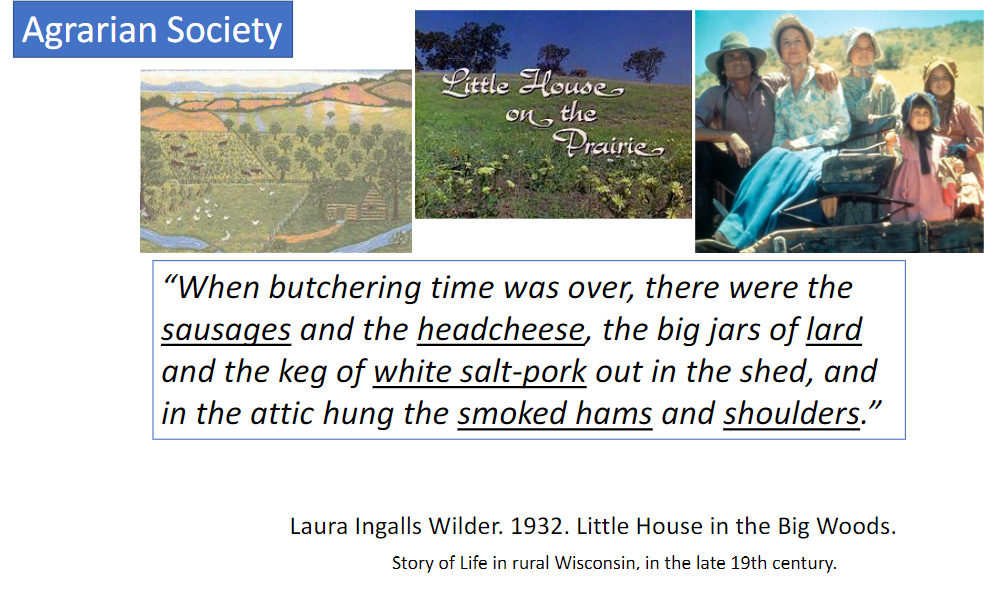
  • In an agrarian society → society based largely on agriculture and farming
  • After butchering, many parts of the animal were used and preserved rather than discarded
  • Examples → sausages, headcheese, lard, white salt-pork, smoked hams, and shoulders
  • These foods show how different parts of the animal were used for food
<p><strong>Butchering and Food Use</strong><br>  • In an <strong>agrarian society</strong> → society based largely on <strong>agriculture and farming</strong><br>  • After butchering, many parts of the animal were <strong>used and preserved</strong> rather than discarded<br>  • Examples → <strong>sausages, headcheese, lard, white salt-pork, smoked hams, and shoulders</strong><br>  • These foods show how <strong>different parts of the animal were used for food</strong></p>
5
New cards

Gastronomical Treasures

Animal Co-Products as Foods
  • Fromage de tête (Head cheese)Germany / delicatessen
  • Tête fromagée (Head cheese)France / Canada
  • Salade de gésiers (Gizzard salad)France
  • Tripes à la mode de Caen (Caen-style tripes)France
  • Thalia ou Douara (Lamb offals stew)Oum Rayane
  • Chicken feet dim sumChina

<p><strong>Animal Co-Products as Foods</strong><br>  • <strong>Fromage de tête (Head cheese)</strong> → <strong>Germany</strong> / delicatessen<br>  • <strong>Tête fromagée (Head cheese)</strong> → <strong>France / Canada</strong><br>  • <strong>Salade de gésiers (Gizzard salad)</strong> → <strong>France</strong><br>  • <strong>Tripes à la mode de Caen (Caen-style tripes)</strong> → <strong>France</strong><br>  • <strong>Thalia ou Douara (Lamb offals stew)</strong> → <strong>Oum Rayane</strong><br>  • <strong>Chicken feet dim sum</strong> → <strong>China</strong></p>
6
New cards

Centralization of Meat Packing Facilities

Large-Scale Facilities
  • 500 animal pens covered 60 acres of land
  • Facility could accommodate at one time:
    • 21,000 cattle
    • 75,000 hogs
    • 22,000 sheep
    • 200 horses

<p><strong>Large-Scale Facilities</strong><br>  • <strong>500 animal pens</strong> covered <strong>60 acres</strong> of land<br>  • Facility could accommodate at one time:<br>    • <strong>21,000 cattle</strong><br>    • <strong>75,000 hogs</strong><br>    • <strong>22,000 sheep</strong><br>    • <strong>200 horses</strong></p>
7
New cards

Interrelationships of Rendering with Animal Agriculture

Animal Production
  • Animal production → animals are raised for agricultural purposes
  • Animal slaughter → produces by-products
  • On-farm deaths → also provide material for rendering

Rendering
  • Rendering → processes animal by-products
  • Materials include fat, bone, and trim

Uses of Rendered Products
  • Feed uses → rendered products can be used in animal feed
  • Non-feed uses → rendered products can be used for other purposes
  • Meat processing → connected with the production and use of animal by-products
  • Retail meat → meat produced for consumers

Importance of Rendering
  • Rendering plays an essential role in an environmentally, ethically, and economically sustainable agriculture industry

<p><strong>Animal Production</strong><br>  • <strong>Animal production</strong> → animals are raised for agricultural purposes<br>  • <strong>Animal slaughter</strong> → produces <strong>by-products</strong><br>  • <strong>On-farm deaths</strong> → also provide material for rendering</p><p><strong>Rendering</strong><br>  • <strong>Rendering</strong> → processes animal by-products<br>  • Materials include <strong>fat, bone, and trim</strong></p><p><strong>Uses of Rendered Products</strong><br>  • <strong>Feed uses</strong> → rendered products can be used in animal feed<br>  • <strong>Non-feed uses</strong> → rendered products can be used for other purposes<br>  • <strong>Meat processing</strong> → connected with the production and use of animal by-products<br>  • <strong>Retail meat</strong> → meat produced for consumers</p><p><strong>Importance of Rendering</strong><br>  • Rendering plays an essential role in an <strong>environmentally, ethically, and economically sustainable agriculture industry</strong></p>
8
New cards

Value Chain for Animal Products / Co-Products

Uses
  1. Human Food
  2. Pharmaceutical and Fine Chemistry
  3. Pet Food
  4. Animal (Livestock) Feeds
  5. Industrial Uses
  6. Fertilizers
  7. Fuels

Rendering
  • Rendering is the central process connecting animal products/co-products to these different uses

<p><strong>Uses</strong><br>  1. <strong>Human Food</strong><br>  2. <strong>Pharmaceutical and Fine Chemistry</strong><br>  3. <strong>Pet Food</strong><br>  4. <strong>Animal (Livestock) Feeds</strong><br>  5. <strong>Industrial Uses</strong><br>  6. <strong>Fertilizers</strong><br>  7. <strong>Fuels</strong></p><p><strong>Rendering</strong><br>  • <strong>Rendering</strong> is the <strong>central process</strong> connecting animal products/co-products to these different uses</p>
9
New cards

The Rendering Industry – U.S. and Canada

Industry Size
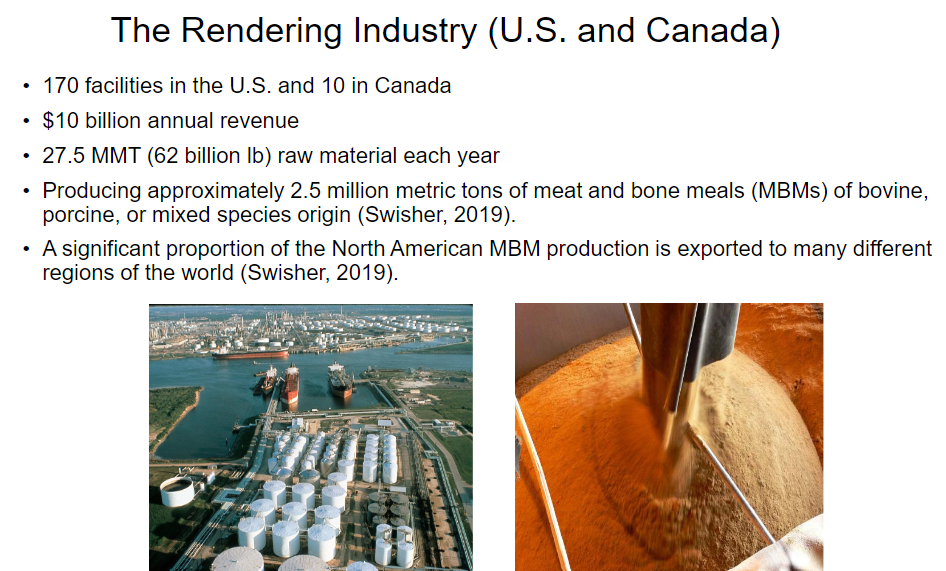
  • 170 facilities in the U.S.
  • 10 facilities in Canada
  • $10 billion annual revenue

Raw Material
  • 27.5 MMT (62 billion lb) of raw material processed each year

Meat and Bone Meal (MBM)
  • Approximately 2.5 million metric tons of meat and bone meals (MBMs) produced
  • MBMs can be of bovine, porcine, or mixed species origin
  • Bovine → cattle
  • Porcine → pigs

Exports
  • A significant proportion of North American MBM production is exported
  • Exported to many different regions of the world
<p><strong>Industry Size</strong><br>  • <strong>170 facilities</strong> in the <strong>U.S.</strong><br>  • <strong>10 facilities</strong> in <strong>Canada</strong><br>  • <strong>$10 billion</strong> annual revenue</p><p><strong>Raw Material</strong><br>  • <strong>27.5 MMT</strong> (<strong>62 billion lb</strong>) of raw material processed each year</p><p><strong>Meat and Bone Meal (MBM)</strong><br>  • Approximately <strong>2.5 million metric tons</strong> of <strong>meat and bone meals (MBMs)</strong> produced<br>  • MBMs can be of <strong>bovine, porcine, or mixed species</strong> origin<br>  • <strong>Bovine</strong> → cattle<br>  • <strong>Porcine</strong> → pigs</p><p><strong>Exports</strong><br>  • A significant proportion of North American <strong>MBM production</strong> is <strong>exported</strong><br>  • Exported to many different <strong>regions of the world</strong></p>
10
New cards

Diversity of Raw Materials

Raw Materials Used in Rendering
  • Offal → internal organs and other parts not typically used as meat
  • Bones and fat
  • Blood
  • Animals dead on arrival, in transit, or on farms
  • Restaurant grease
  • Feathers
  • Recalled meat
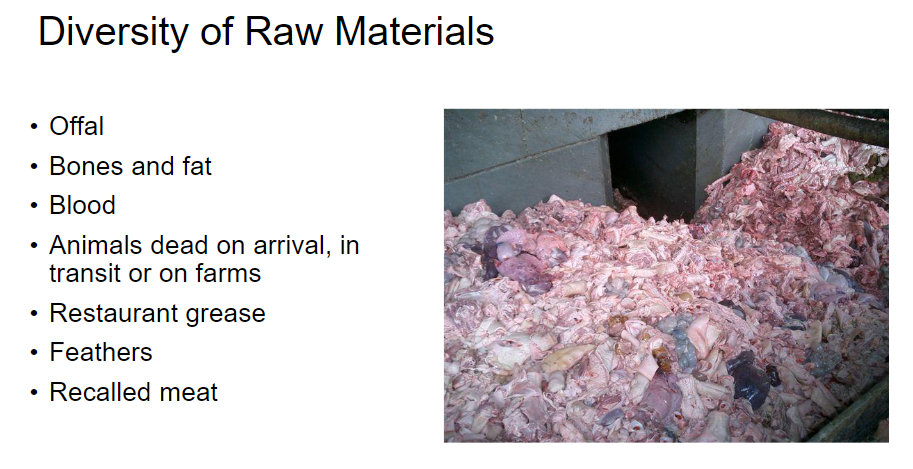
<p><strong>Raw Materials Used in Rendering</strong><br>  • <strong>Offal</strong> → internal organs and other parts not typically used as meat<br>  • <strong>Bones and fat</strong><br>  • <strong>Blood</strong><br>  • Animals <strong>dead on arrival, in transit, or on farms</strong><br>  • <strong>Restaurant grease</strong><br>  • <strong>Feathers</strong><br>  • <strong>Recalled meat</strong></p>
11
New cards

Raw Materials

By-Products
  • Hides, skins, hair, feathers
  • Hoofs, horns, feet, heads
  • Bones, toe nails
  • Blood, organs, glands, intestines
  • Muscle and fat tissues
  • Shells
  • Whole carcasses

Composition Before Rendering
  • Raw materials vary, but an overall approximation is:
    • 60% water
    • 20% protein and mineral
    • 20% fat

Perishability and Microorganisms
  • These organic materials are highly perishable
  • Laden with microorganisms → many can be pathogenic to humans and animals

Importance of Rendering
  • Rendering provides a safe and integrated system for animal raw material handling and processing
  • Complies with fundamental requirements for:
    • Environmental quality
    • Disease control

<p><strong>By-Products</strong><br>  • <strong>Hides, skins, hair, feathers</strong><br>  • <strong>Hoofs, horns, feet, heads</strong><br>  • <strong>Bones, toe nails</strong><br>  • <strong>Blood, organs, glands, intestines</strong><br>  • <strong>Muscle and fat tissues</strong><br>  • <strong>Shells</strong><br>  • <strong>Whole carcasses</strong></p><p><strong>Composition Before Rendering</strong><br>  • Raw materials vary, but an overall approximation is:<br>    • <strong>60% water</strong><br>    • <strong>20% protein and mineral</strong><br>    • <strong>20% fat</strong></p><p><strong>Perishability and Microorganisms</strong><br>  • These <strong>organic materials are highly perishable</strong><br>  • Laden with <strong>microorganisms</strong> → many can be <strong>pathogenic</strong> to humans and animals</p><p><strong>Importance of Rendering</strong><br>  • Rendering provides a <strong>safe and integrated system</strong> for animal raw material <strong>handling and processing</strong><br>  • Complies with fundamental requirements for:<br>    • <strong>Environmental quality</strong><br>    • <strong>Disease control</strong></p>
12
New cards

Specific Risk Materials (SRMs)

Definition
  • In both the United States and Canada, SRMs (Specified Risk Materials) are defined as parts from cattle aged 30 months or older
  • SRMs include:
    • Skull
    • Brain
    • Trigeminal ganglia → nerves attached to the brain and close to the skull exterior
    • Eyes
    • Spinal cord
    • Distal ileum → part of the small intestine
    • Dorsal root ganglia → nerves attached to the spinal cord and close to the vertebral column

Feeding Restrictions
  • In Canada, enhanced animal health safeguards were implemented in July 2007
  • It is illegal for SRMs to be fed to any animal, including dogs and cats
  • The United States has similar rules

<p><strong>Definition</strong><br>  • In both the <strong>United States and Canada</strong>, <strong>SRMs (Specified Risk Materials)</strong> are defined as parts from <strong>cattle aged 30 months or older</strong><br>  • SRMs include:<br>    • <strong>Skull</strong><br>    • <strong>Brain</strong><br>    • <strong>Trigeminal ganglia</strong> → nerves attached to the brain and close to the skull exterior<br>    • <strong>Eyes</strong><br>    • <strong>Spinal cord</strong><br>    • <strong>Distal ileum</strong> → part of the small intestine<br>    • <strong>Dorsal root ganglia</strong> → nerves attached to the spinal cord and close to the vertebral column</p><p><strong>Feeding Restrictions</strong><br>  • In <strong>Canada</strong>, enhanced animal health safeguards were implemented in <strong>July 2007</strong><br>  • It is <strong>illegal for SRMs to be fed to any animal</strong>, including <strong>dogs and cats</strong><br>  • The <strong>United States</strong> has similar rules</p>
13
New cards

The Basic Production Process of Rendering

Rendering Process
  • Raw Materials → animal by-products enter the rendering process
  • Sizing → raw materials are reduced to an appropriate size
  • Heat Processing → materials are heated using controlled time × temperature
  • Protein Press → separates protein material from fat
  • Grinding → processed protein material is ground
  • Fat Clean-up → fat is cleaned/purified
  • Storage/Load out → finished products are stored and prepared for shipment

Process Control / GMP Points
  • Process control and GMP (Good Manufacturing Practices) points are used throughout the rendering process
  • Help ensure the process is properly controlled and products are handled safely

<p><strong>Rendering Process</strong><br>  • <strong>Raw Materials</strong> → animal by-products enter the rendering process<br>  • <strong>Sizing</strong> → raw materials are reduced to an appropriate size<br>  • <strong>Heat Processing</strong> → materials are heated using controlled <strong>time × temperature</strong><br>  • <strong>Protein Press</strong> → separates <strong>protein material</strong> from fat<br>  • <strong>Grinding</strong> → processed protein material is ground<br>  • <strong>Fat Clean-up</strong> → fat is cleaned/purified<br>  • <strong>Storage/Load out</strong> → finished products are stored and prepared for shipment</p><p><strong>Process Control / GMP Points</strong><br>  • <strong>Process control</strong> and <strong>GMP (Good Manufacturing Practices)</strong> points are used throughout the rendering process<br>  • Help ensure the process is properly controlled and products are handled safely</p>
14
New cards

Rendering is Cooking and Drying

Rendering Process
  • Rendering involves cooking and drying animal materials
  • Can be done as:
    • Continuous flow → materials move continuously through the process
    • Batch → materials are processed in separate batches
  • Uses steam cookers
  • Processing temperature → 115–145°C (245–290°F)
  • Processing time → 40–90 minutes

Purpose of Rendering
  • Provides a sanitary and eco-friendly way to dispose of the massive amount of meat and food by-products produced every year
  • These materials spoil easily and provide an excellent medium for pathogens to grow and multiply

Disease Control
  • Temperatures used during processing kill conventional disease-causing organisms
  • Examples → bacteria and viruses

<p><strong>Rendering Process</strong><br>  • Rendering involves <strong>cooking and drying</strong> animal materials<br>  • Can be done as:<br>    • <strong>Continuous flow</strong> → materials move continuously through the process<br>    • <strong>Batch</strong> → materials are processed in separate batches<br>  • Uses <strong>steam cookers</strong><br>  • Processing temperature → <strong>115–145°C</strong> (<strong>245–290°F</strong>)<br>  • Processing time → <strong>40–90 minutes</strong></p><p><strong>Purpose of Rendering</strong><br>  • Provides a <strong>sanitary and eco-friendly</strong> way to dispose of the massive amount of <strong>meat and food by-products</strong> produced every year<br>  • These materials <strong>spoil easily</strong> and provide an excellent <strong>medium</strong> for pathogens to <strong>grow and multiply</strong></p><p><strong>Disease Control</strong><br>  • Temperatures used during processing <strong>kill conventional disease-causing organisms</strong><br>  • Examples → <strong>bacteria and viruses</strong></p>
15
New cards

Examples of a Few Finished Products

Finished Products
  • Stabilized poultry fat
  • Hydrolyzed poultry feather meal
  • Stabilized pet food poultry fat
  • Stabilized poultry protein meal
  • Low ash pet food poultry protein meal
  • Pet food grade poultry protein meal
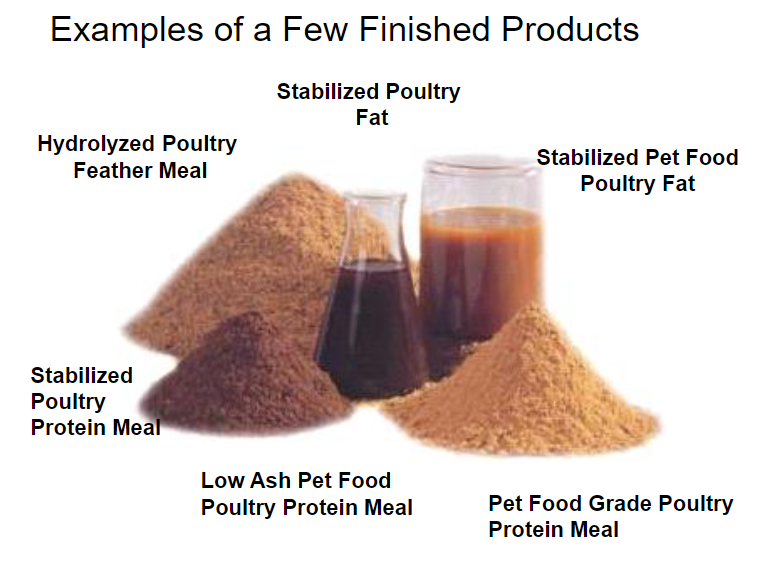
<p><strong>Finished Products</strong><br>  • <strong>Stabilized poultry fat</strong><br>  • <strong>Hydrolyzed poultry feather meal</strong><br>  • <strong>Stabilized pet food poultry fat</strong><br>  • <strong>Stabilized poultry protein meal</strong><br>  • <strong>Low ash pet food poultry protein meal</strong><br>  • <strong>Pet food grade poultry protein meal</strong></p>
16
New cards

Efficacy of the U.S. Rendering System in the Destruction of Pathogenic Bacteria.

knowt flashcard image
17
New cards

Protein Meals

Production
  • 5 million metric tonnes of protein meals
  • 125 AAFCO-defined animal by-products

Types of Protein Meals
  • Meat meal
  • Meat and bone meal → can be species specific
  • Blood mealflash, spray, ring, or batch dried
  • Poultry by-product meal
  • Poultry meal
  • Hydrolyzed poultry feather meal

<p><strong>Production</strong><br>  • <strong>5 million metric tonnes</strong> of protein meals<br>  • <strong>125 AAFCO-defined animal by-products</strong></p><p><strong>Types of Protein Meals</strong><br>  • <strong>Meat meal</strong><br>  • <strong>Meat and bone meal</strong> → can be <strong>species specific</strong><br>  • <strong>Blood meal</strong> → <strong>flash, spray, ring, or batch dried</strong><br>  • <strong>Poultry by-product meal</strong><br>  • <strong>Poultry meal</strong><br>  • <strong>Hydrolyzed poultry feather meal</strong></p>
18
New cards

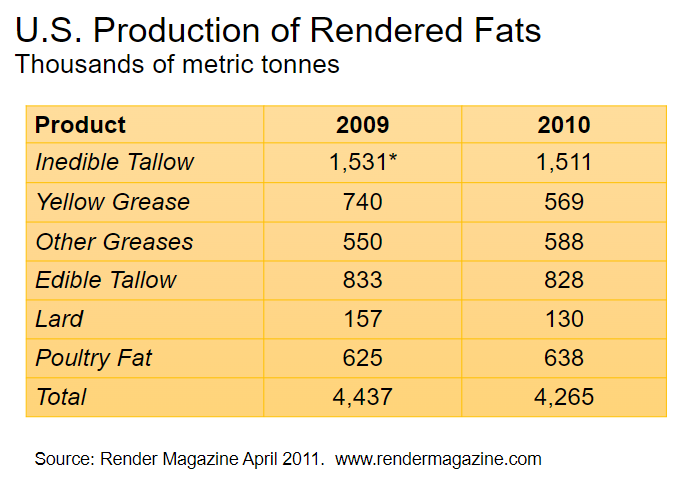
U.S. Production of Rendered Fats

knowt flashcard image
19
New cards

Fatty Acid Composition of Common Feed-Grade Oils and Fats

knowt flashcard image
20
New cards

Examples of AAFCO Definitions

Meat and Bone Meal
  • Rendered product from mammal tissues, including bone
  • Excludes:
    • Blood
    • Hair
    • Hoof
    • Horn
    • Hide trimmings
    • Manure
    • Stomach and rumen contents
  • These materials are excluded except for amounts that unavoidably occur during good processing practices

Poultry By-Product Meal
  • Ground, rendered, clean parts of the carcass of slaughtered poultry
  • Examples → necks, feet, undeveloped eggs, intestines
  • Excludes feathers, except for amounts that unavoidably occur during good processing practices

Poultry Fat (Feed Grade)
  • Primarily obtained from poultry tissue during commercial rendering or extraction
  • Contains only the fatty matter natural to the product produced under good manufacturing practices
  • Contains no added free fatty acids or other materials obtained from fat
  • Must contain:
    • ≥ 90% total fatty acids
    • ≤ 3% unsaponifiables and impurities
    • Minimum titer of 33°C → temperature-related measure of the fat
  • If an antioxidant is used → common name(s) must be listed, followed by “preservative(s)”

AAFCO
  • Association of American Feed Control Officials
  • A voluntary membership association of local, state, and federal agencies
  • Members are charged by their local, state, or federal laws to regulate the sale and distribution of animal feeds and animal drug remedies in the USA
<p><strong>Meat and Bone Meal</strong><br>  • <strong>Rendered product from mammal tissues</strong>, including <strong>bone</strong><br>  • Excludes:<br>    • <strong>Blood</strong><br>    • <strong>Hair</strong><br>    • <strong>Hoof</strong><br>    • <strong>Horn</strong><br>    • <strong>Hide trimmings</strong><br>    • <strong>Manure</strong><br>    • <strong>Stomach and rumen contents</strong><br>  • These materials are excluded except for amounts that <strong>unavoidably occur during good processing practices</strong></p><p><strong>Poultry By-Product Meal</strong><br>  • <strong>Ground, rendered, clean parts</strong> of the carcass of <strong>slaughtered poultry</strong><br>  • Examples → <strong>necks, feet, undeveloped eggs, intestines</strong><br>  • Excludes <strong>feathers</strong>, except for amounts that <strong>unavoidably occur during good processing practices</strong></p><p><strong>Poultry Fat (Feed Grade)</strong><br>  • Primarily obtained from <strong>poultry tissue</strong> during commercial <strong>rendering or extraction</strong><br>  • Contains only the <strong>fatty matter natural to the product</strong> produced under good manufacturing practices<br>  • Contains <strong>no added free fatty acids</strong> or other materials obtained from fat<br>  • Must contain:<br>    • <strong>≥ 90% total fatty acids</strong><br>    • <strong>≤ 3% unsaponifiables and impurities</strong><br>    • Minimum <strong>titer of 33°C</strong> → temperature-related measure of the fat<br>  • If an <strong>antioxidant</strong> is used → common name(s) must be listed, followed by <strong>“preservative(s)”</strong></p><p><strong>AAFCO</strong><br>  • <strong>Association of American Feed Control Officials</strong><br>  • A <strong>voluntary membership association</strong> of local, state, and federal agencies<br>  • Members are charged by their <strong>local, state, or federal laws</strong> to regulate the <strong>sale and distribution of animal feeds and animal drug remedies in the USA</strong></p>
21
New cards

Commodity Prices of Several Rendered Protein Meals

knowt flashcard image
22
New cards

Insights from 30 Years of Research and Cooperation with Aquafeed Industry

Rendered Animal Protein Ingredients
  • Rendered animal protein ingredients are among the most cost-effective feed ingredients for aquaculture feeds
  • Least-cost feed formulation programs often seek to include 20–35% of these ingredients in feeds for a variety of species

Industry Concerns
  • Aquaculture feed manufacturers are reluctant to use high levels → e.g. more than 10–15%
  • Reasons → quality variability and uncertainty about the nutritive value of these ingredients

Nutritive Value Research
  • Better characterization of nutritive value is very important to the feed industry
  • Especially important → digestibility and bio-availability of amino acids
    • Digestibility → how well nutrients can be digested and used
    • Bio-availability → how much of the nutrient is available for the animal to use

<p><strong>Rendered Animal Protein Ingredients</strong><br>  • <strong>Rendered animal protein ingredients</strong> are among the <strong>most cost-effective feed ingredients</strong> for <strong>aquaculture feeds</strong><br>  • <strong>Least-cost feed formulation programs</strong> often seek to include <strong>20–35%</strong> of these ingredients in feeds for a variety of species</p><p><strong>Industry Concerns</strong><br>  • Aquaculture feed manufacturers are reluctant to use <strong>high levels</strong> → e.g. <strong>more than 10–15%</strong><br>  • Reasons → <strong>quality variability</strong> and uncertainty about the <strong>nutritive value</strong> of these ingredients</p><p><strong>Nutritive Value Research</strong><br>  • Better characterization of <strong>nutritive value</strong> is very important to the feed industry<br>  • Especially important → <strong>digestibility</strong> and <strong>bio-availability of amino acids</strong><br>    • <strong>Digestibility</strong> → how well nutrients can be digested and used<br>    • <strong>Bio-availability</strong> → how much of the nutrient is available for the animal to use</p>
23
New cards

Least-Cost Feed Formulation for Asian Seabass

Feather Meal Inclusion
  • Least-cost feed formulation for Asian seabass calling for 37% feather meal
  • Unrealistic inclusion level, but demonstrates that rendered animal proteins can be:
    • Nutritionally well-suited
    • Competitively priced

<p><strong>Feather Meal Inclusion</strong><br>  • Least-cost feed formulation for <strong>Asian seabass</strong> calling for <strong>37% feather meal</strong><br>  • <strong>Unrealistic</strong> inclusion level, but demonstrates that rendered animal proteins can be:<br>    • <strong>Nutritionally well-suited</strong><br>    • <strong>Competitively priced</strong></p>
24
New cards

Least-Cost Feed Formulation for Asian Seabass

Rendered Animal Protein Inclusion
  • Least-cost feed formulation calls for:
    • 17% meat and bone meal
    • 8% blood meal
    • 12% feather meal
  • Total → 37% rendered animal proteins

Significance
  • Still slightly unrealistic
  • Shows again how nutritionally well-suited and competitively priced rendered animal proteins are
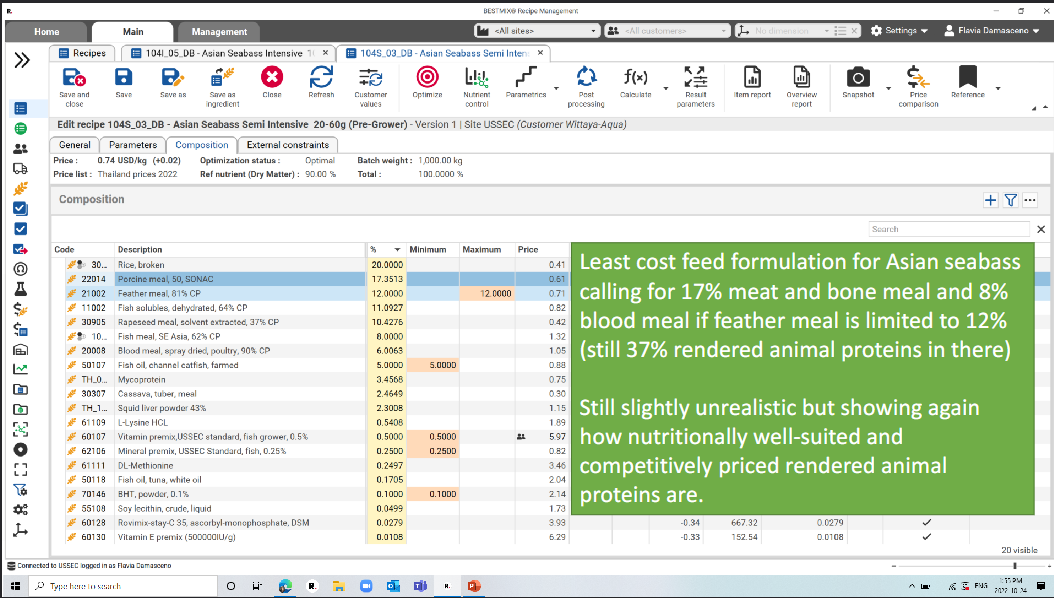
<p><strong>Rendered Animal Protein Inclusion</strong><br>  • Least-cost feed formulation calls for:<br>    • <strong>17% meat and bone meal</strong><br>    • <strong>8% blood meal</strong><br>    • <strong>12% feather meal</strong><br>  • Total → <strong>37% rendered animal proteins</strong></p><p><strong>Significance</strong><br>  • Still <strong>slightly unrealistic</strong><br>  • Shows again how <strong>nutritionally well-suited</strong> and <strong>competitively priced</strong> rendered animal proteins are</p>
25
New cards

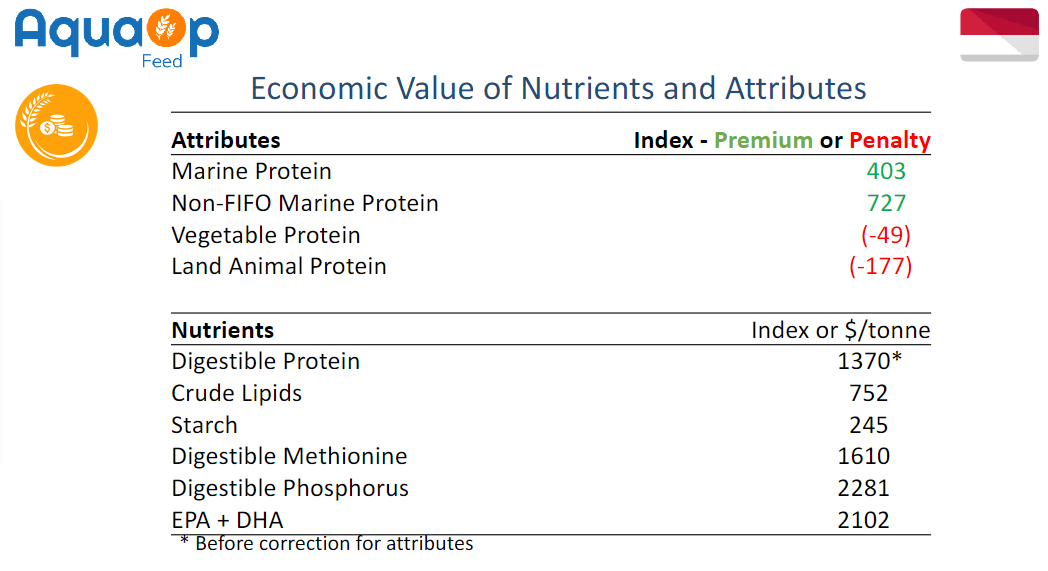
Economic Value of Nutrients and Attributes

Attributes — Index: Premium or Penalty
  • Marine protein403–727
  • Non-FIFO marine protein−49
  • Vegetable protein−177
  • Land animal protein → value shown on slide

Nutrients — Index or $/tonne
  • Digestible protein1370 ^ *
  • Crude lipids752
  • Starch245
  • Digestible methionine1610
  • Digestible phosphorus2281
  • EPA + DHA2102

Note
  • Values for nutrients are before correction for attributes
  • Premium → increases economic value
  • Penalty → decreases economic value
<p><strong>Attributes — Index: Premium or Penalty</strong><br>  • <strong>Marine protein</strong> → <strong>403–727</strong><br>  • <strong>Non-FIFO marine protein</strong> → <strong>−49</strong><br>  • <strong>Vegetable protein</strong> → <strong>−177</strong><br>  • <strong>Land animal protein</strong> → value shown on slide</p><p><strong>Nutrients — Index or $/tonne</strong><br>  • <strong>Digestible protein</strong> → <strong>1370</strong> ^ *<br>  • <strong>Crude lipids</strong> → <strong>752</strong><br>  • <strong>Starch</strong> → <strong>245</strong><br>  • <strong>Digestible methionine</strong> → <strong>1610</strong><br>  • <strong>Digestible phosphorus</strong> → <strong>2281</strong><br>  • <strong>EPA + DHA</strong> → <strong>2102</strong></p><p><strong>Note</strong><br>  • <em>Values for nutrients are </em><strong><em>before correction for attributes</em></strong><br>  • <strong>Premium</strong> → increases economic value<br>  • <strong>Penalty</strong> → decreases economic value</p>
26
New cards

Fermentation Products

Yeast and Derivatives
  • Yeast and derivatives
  • Brewer’s yeast
  • Beta-glucans, mannan oligosaccharides (MOS), nucleotides, etc.

Amino Acids
  • L-Lysine
  • L-Threonine
  • L-Tryptophan
  • L-Arginine
  • L-Histidine
  • L-Isoleucine
  • Etc

Single Cell Proteins
  • Bacteria → e.g. methane-consuming bacteria, CO₂-fixing bacteria
  • Algae → e.g. algae biomass rich in highly unsaturated fatty acids, such as DHA

<p><strong>Yeast and Derivatives</strong><br>  • <strong>Yeast and derivatives</strong><br>  • <strong>Brewer’s yeast</strong><br>  • <strong>Beta-glucans, mannan oligosaccharides (MOS), nucleotides</strong>, etc.</p><p><strong>Amino Acids</strong><br>  • <strong>L-Lysine</strong><br>  • <strong>L-Threonine</strong><br>  • <strong>L-Tryptophan</strong><br>  • <strong>L-Arginine</strong><br>  • <strong>L-Histidine</strong><br>  • <strong>L-Isoleucine</strong><br>  • Etc</p><p><strong>Single Cell Proteins</strong><br>  • <strong>Bacteria</strong> → e.g. <strong>methane-consuming bacteria</strong>, <strong>CO₂-fixing bacteria</strong><br>  • <strong>Algae</strong> → e.g. <strong>algae biomass</strong> rich in <strong>highly unsaturated fatty acids</strong>, such as <strong>DHA</strong></p>
27
New cards

Yeast Market

Global Yeast Market
  • Global yeast market estimated at USD $3.9 billion in 2020

Key Players in Yeast Products for Animal Feeds
  • Alltech → USA
  • Diamond V – Cargill → USA
  • Angel Yeast → China
  • Lallemand Inc. → Canada
  • Lesaffre Group → France
  • Biorigin → Brazil
  • Novonesis → Denmark
    • Formerly Chr. Hansen Holdings A/S + Novozymes

<p><strong>Global Yeast Market</strong><br>  • Global yeast market estimated at <strong>USD $3.9 billion in 2020</strong></p><p><strong>Key Players in Yeast Products for Animal Feeds</strong><br>  • <strong>Alltech</strong> → USA<br>  • <strong>Diamond V – Cargill</strong> → USA<br>  • <strong>Angel Yeast</strong> → China<br>  • <strong>Lallemand Inc.</strong> → Canada<br>  • <strong>Lesaffre Group</strong> → France<br>  • <strong>Biorigin</strong> → Brazil<br>  • <strong>Novonesis</strong> → Denmark<br>    • Formerly <strong>Chr. Hansen Holdings A/S + Novozymes</strong></p>
28
New cards

Product Function: Yeast

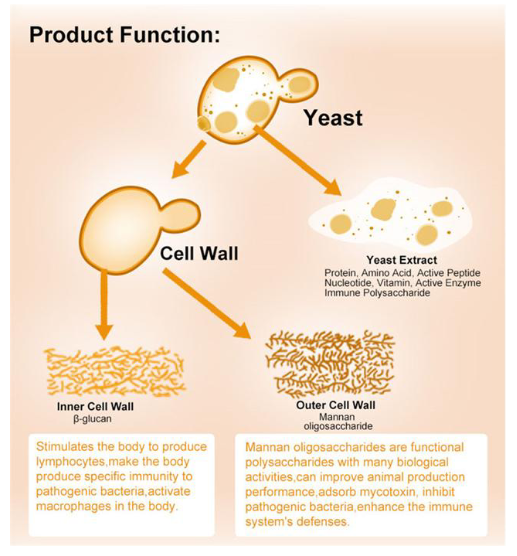
Yeast Components
  • Yeast → contains yeast cell wall and yeast extract

Yeast Extract
  • Contains:
    • Protein
    • Amino acids
    • Active peptides
    • Nucleotides
    • Vitamins
    • Active enzymes
    • Immune polysaccharides

Inner Cell Wall – β-Glucan
  • β-glucan stimulates the body to produce lymphocytes
  • Helps the body produce specific immunity against pathogenic bacteria
  • Activates macrophages in the body

Outer Cell Wall – Mannan Oligosaccharides (MOS)
  • Mannan oligosaccharides (MOS) are functional polysaccharides with many biological activities
  • Can improve animal production performance
  • Can adsorb mycotoxins → bind mycotoxins
  • Can inhibit pathogenic bacteria
  • Can enhance the immune system’s defenses
<p><strong>Yeast Components</strong><br>  • <strong>Yeast</strong> → contains <strong>yeast cell wall</strong> and <strong>yeast extract</strong></p><p><strong>Yeast Extract</strong><br>  • Contains:<br>    • <strong>Protein</strong><br>    • <strong>Amino acids</strong><br>    • <strong>Active peptides</strong><br>    • <strong>Nucleotides</strong><br>    • <strong>Vitamins</strong><br>    • <strong>Active enzymes</strong><br>    • <strong>Immune polysaccharides</strong></p><p><strong>Inner Cell Wall – β-Glucan</strong><br>  • <strong>β-glucan</strong> stimulates the body to produce <strong>lymphocytes</strong><br>  • Helps the body produce <strong>specific immunity</strong> against <strong>pathogenic bacteria</strong><br>  • Activates <strong>macrophages</strong> in the body</p><p><strong>Outer Cell Wall – Mannan Oligosaccharides (MOS)</strong><br>  • <strong>Mannan oligosaccharides (MOS)</strong> are functional <strong>polysaccharides</strong> with many biological activities<br>  • Can improve <strong>animal production performance</strong><br>  • Can <strong>adsorb mycotoxins</strong> → bind mycotoxins<br>  • Can <strong>inhibit pathogenic bacteria</strong><br>  • Can enhance the <strong>immune system’s defenses</strong></p>
29
New cards

Supplemental Amino Acids

Other Names
  • Also known as crystalline, synthetic, or free amino acids

Production
  • Obtained through microbial fermentation

Examples
  • L-Lysine
  • L-Threonine
  • L-Tryptophan
  • DL-Methionine → synthesized chemically

<p><strong>Other Names</strong><br>  • Also known as <strong>crystalline</strong>, <strong>synthetic</strong>, or <strong>free amino acids</strong></p><p><strong>Production</strong><br>  • Obtained through <strong>microbial fermentation</strong></p><p><strong>Examples</strong><br>  • <strong>L-Lysine</strong><br>  • <strong>L-Threonine</strong><br>  • <strong>L-Tryptophan</strong><br>  • <strong>DL-Methionine</strong> → synthesized <strong>chemically</strong></p>
30
New cards

Algal Biomass

Most Common Examples
  • Schizochytrium sp. algae
  • Corbion’s AlgaPrime DHA
  • Veramaris’ algal oil

<p><strong>Most Common Examples</strong><br>  • <strong>Schizochytrium sp. algae</strong><br>  • <strong>Corbion’s AlgaPrime DHA</strong><br>  • <strong>Veramaris’ algal oil</strong></p>
31
New cards

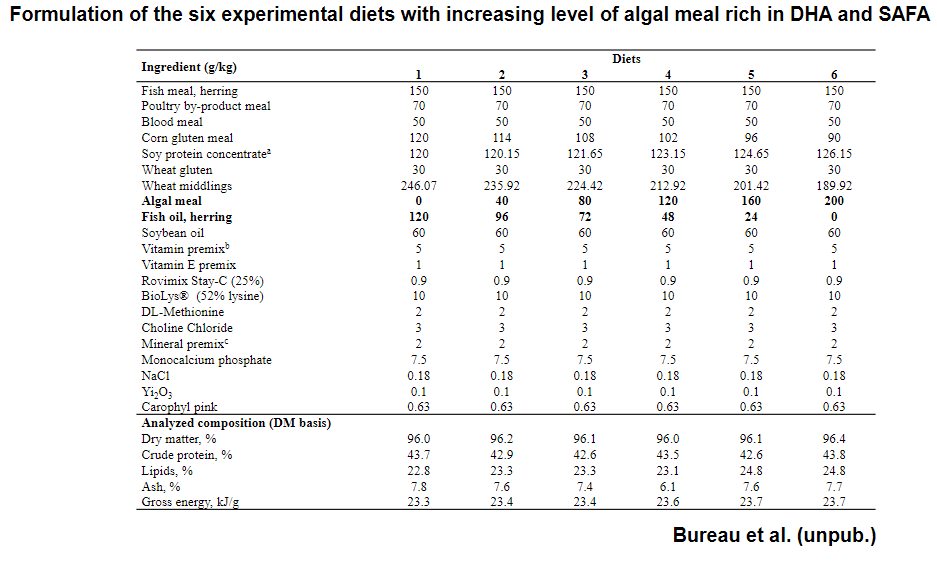
Formulation of the six experimental diets with increasing level of algal meal rich in DHA and SAFA
knowt flashcard image
32
New cards

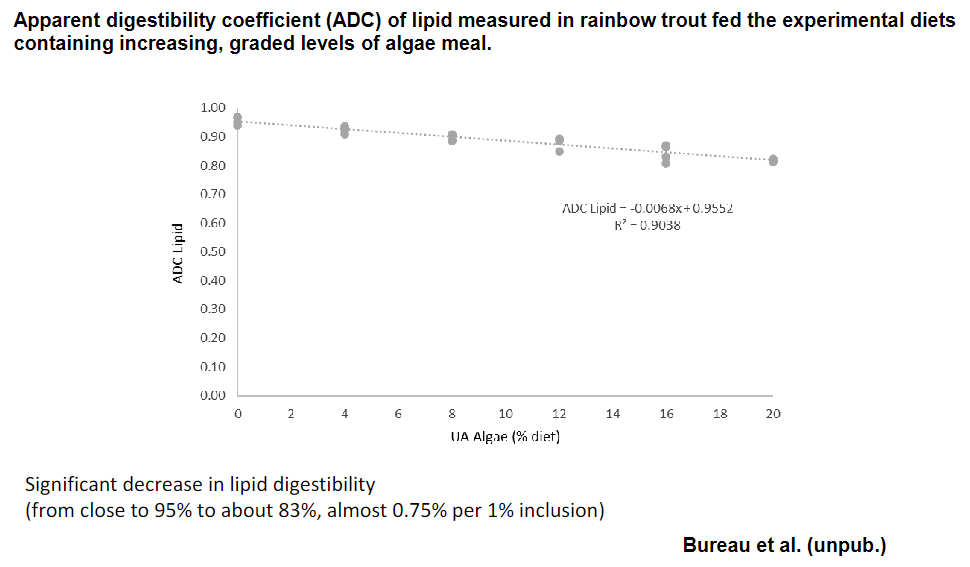
Apparent Digestibility Coefficient (ADC) of Lipid

Study
  • Rainbow trout were fed experimental diets containing increasing, graded levels of algae meal
  • Source → Bureau et al. (unpub.)

Lipid Digestibility
  • Significant decrease in lipid digestibility as algae meal inclusion increased
  • Decreased from close to 95% to about 83%
  • Almost 0.75% decrease in lipid digestibility per 1% algae meal inclusion
<p><strong>Study</strong><br>  • <strong>Rainbow trout</strong> were fed experimental diets containing <strong>increasing, graded levels of algae meal</strong><br>  • Source → <strong>Bureau et al. (unpub.)</strong></p><p><strong>Lipid Digestibility</strong><br>  • <strong>Significant decrease in lipid digestibility</strong> as algae meal inclusion increased<br>  • Decreased from <strong>close to 95%</strong> to about <strong>83%</strong><br>  • Almost <strong>0.75% decrease in lipid digestibility per 1% algae meal inclusion</strong></p>
33
New cards

Growth Performance of Rainbow Trout

Study
  • Rainbow trout with initial average body weight of 35 g/fish
  • Fish were fed the experimental diets for 12 weeks
  • Source → Bureau et al. (unpub.)

Results
  • Lower digestible lipid intake
    • Due to lower digestibility of saturated fatty acids
  • No effect on growth
  • No effect on feed efficiency

<p><strong>Study</strong><br>  • <strong>Rainbow trout</strong> with initial average body weight of <strong>35 g/fish</strong><br>  • Fish were fed the experimental diets for <strong>12 weeks</strong><br>  • Source → <strong>Bureau et al. (unpub.)</strong></p><p><strong>Results</strong><br>  • <strong>Lower digestible lipid intake</strong><br>    • Due to lower <strong>digestibility of saturated fatty acids</strong><br>  • <strong>No effect on growth</strong><br>  • <strong>No effect on feed efficiency</strong></p>
34
New cards

Single Cell Proteins / Microbial Biomass

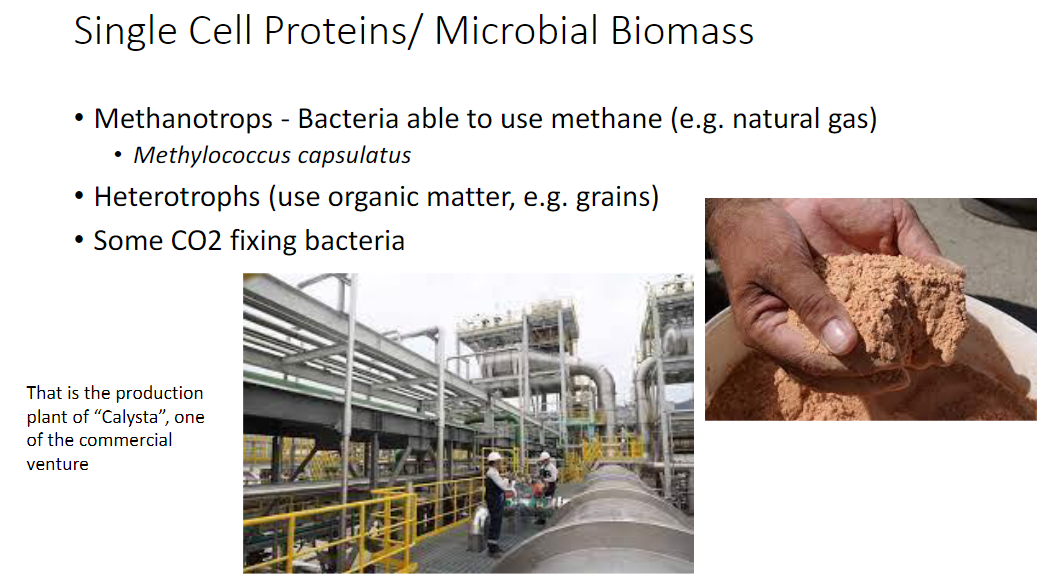
Methanotrophs
  • Bacteria able to use methane → e.g. natural gas
  • Example → Methylococcus capsulatus

Heterotrophs
  • Microorganisms that use organic matter as a source → e.g. grains

CO₂-Fixing Bacteria
  • Some bacteria are able to fix CO₂
<p><strong>Methanotrophs</strong><br>  • <strong>Bacteria able to use methane</strong> → e.g. <strong>natural gas</strong><br>  • Example → <strong>Methylococcus capsulatus</strong></p><p><strong>Heterotrophs</strong><br>  • Microorganisms that use <strong>organic matter</strong> as a source → e.g. <strong>grains</strong></p><p><strong>CO₂-Fixing Bacteria</strong><br>  • Some bacteria are able to <strong>fix CO₂</strong></p>
35
New cards

Insect Biomass

1. Black Soldier Fly (BSF)
  • Black Soldier Fly (BSF)Hermetia illucens larvae
  • Able to grow on a wide variety of substrates → e.g. wastes

2. Superworm
  • SuperwormTenebrio molitor
  • Fed grains / bran
  • Quite specific in food choice

3. Crickets
  • Crickets

<p><strong>1. Black Soldier Fly (BSF)</strong><br>  • <strong>Black Soldier Fly (BSF)</strong> → <em>Hermetia illucens</em> larvae<br>  • Able to grow on a <strong>wide variety of substrates</strong> → e.g. <strong>wastes</strong></p><p><strong>2. Superworm</strong><br>  • <strong>Superworm</strong> → <em>Tenebrio molitor</em><br>  • Fed <strong>grains / bran</strong><br>  • Quite <strong>specific in food choice</strong></p><p><strong>3. Crickets</strong><br>  • <strong>Crickets</strong></p>
36
New cards

Insect Protein Market

Market Potential
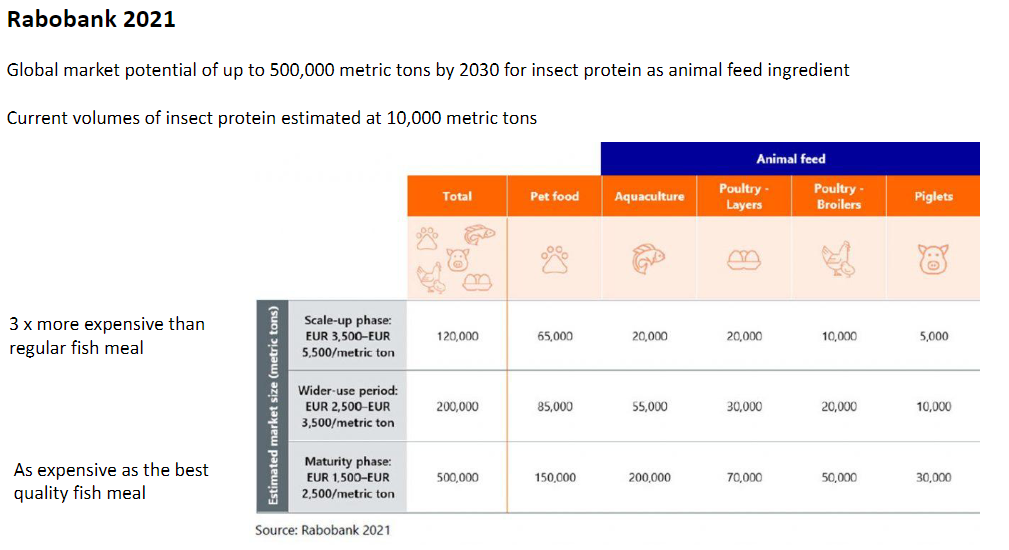
  • Rabobank (2021)
  • Global market potential of up to 500,000 metric tons by 2030 for insect protein as an animal feed ingredient
  • Current volumes of insect protein estimated at 10,000 metric tons

Cost
  • Insect protein is currently about 3× more expensive than regular fish meal
  • As expensive as the best-quality fish meal
<p><strong>Market Potential</strong><br>  • <strong>Rabobank (2021)</strong><br>  • Global market potential of up to <strong>500,000 metric tons by 2030</strong> for <strong>insect protein</strong> as an animal feed ingredient<br>  • Current volumes of insect protein estimated at <strong>10,000 metric tons</strong></p><p><strong>Cost</strong><br>  • Insect protein is currently about <strong>3× more expensive than regular fish meal</strong><br>  • As expensive as the <strong>best-quality fish meal</strong></p>
37
New cards

The exponential increase in capital flowing to insect farming companies

knowt flashcard image
38
New cards

Worldwide oilseed production in 2021/2022, by type

knowt flashcard image
39
New cards

Why Produce More Oilseeds?

Main Reason
  • Oilseeds are produced in very large amounts because they provide both oil and protein
  • After oil is extracted, the remaining oilseed meal is a valuable high-protein animal feed ingredient
  • This makes oilseeds useful for producing multiple valuable productsoil + protein

<p><strong>Main Reason</strong><br>  • Oilseeds are produced in very large amounts because they provide <strong>both oil and protein</strong><br>  • After oil is extracted, the remaining <strong>oilseed meal</strong> is a valuable <strong>high-protein animal feed ingredient</strong><br>  • This makes oilseeds useful for producing <strong>multiple valuable products</strong> → <strong>oil + protein</strong></p>
40
New cards

Omnivorous Fish Feed Formulations

Feed Composition
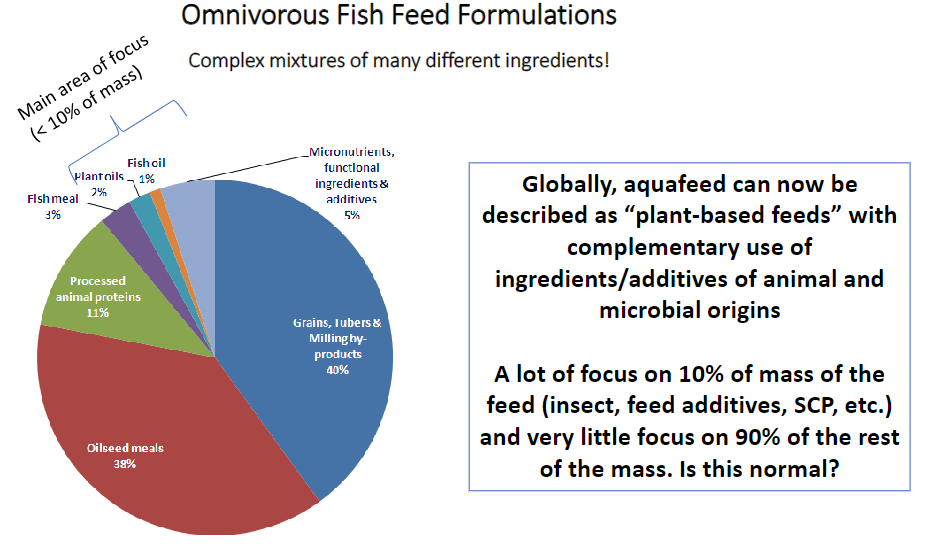
  • Complex mixtures of many different ingredients
  • Globally, aquafeed can now be described as “plant-based feeds”
  • Plant-based feeds use complementary ingredients/additives from:
    • Animal origins
    • Microbial origins

Focus on New Ingredients
  • A lot of focus is placed on the 10% of feed mass → e.g. insects, feed additives, SCP (single cell proteins), etc.
  • Very little focus is placed on the remaining 90% of feed mass
  • Question raised by the slide → Is this normal?
<p><strong>Feed Composition</strong><br>  • <strong>Complex mixtures</strong> of many different ingredients<br>  • Globally, aquafeed can now be described as <strong>“plant-based feeds”</strong><br>  • Plant-based feeds use complementary <strong>ingredients/additives</strong> from:<br>    • <strong>Animal origins</strong><br>    • <strong>Microbial origins</strong></p><p><strong>Focus on New Ingredients</strong><br>  • A lot of focus is placed on the <strong>10% of feed mass</strong> → e.g. <strong>insects, feed additives, SCP (single cell proteins), etc.</strong><br>  • Very little focus is placed on the remaining <strong>90% of feed mass</strong><br>  • <strong>Question raised by the slide → Is this normal?</strong></p>
41
New cards

What’s Next?

Feed Resource Quality
  • Cannot meaningfully discuss the quality of feed resources without considering their specific chemical components and their properties
  • Example → digestibility

Next Steps
  • Review the different chemical components of feeds
  • Learn how we can measure these components
  • Assess whether components are:
    • Digestible → can be digested by the animal
    • Bio-available → usable by the animal
    • Toxic → harmful to animals

Connection to NUTR 3200
  • Some of this material may overlap with NUTR 3200 Fundamentals of Nutrition

Animal Nutrition Perspective
  • Material will be reviewed from an animal nutrition perspective
  • Objectives, emphasis/focus, and methodological approaches are often different from human nutrition
<p><strong>Feed Resource Quality</strong><br>  • Cannot meaningfully discuss the <strong>quality of feed resources</strong> without considering their specific <strong>chemical components</strong> and their properties<br>  • Example → <strong>digestibility</strong></p><p><strong>Next Steps</strong><br>  • Review the different <strong>chemical components of feeds</strong><br>  • Learn <strong>how we can measure</strong> these components<br>  • Assess whether components are:<br>    • <strong>Digestible</strong> → can be digested by the animal<br>    • <strong>Bio-available</strong> → usable by the animal<br>    • <strong>Toxic</strong> → harmful to animals</p><p><strong>Connection to NUTR 3200</strong><br>  • Some of this material may overlap with <strong>NUTR 3200 Fundamentals of Nutrition</strong></p><p><strong>Animal Nutrition Perspective</strong><br>  • Material will be reviewed from an <strong>animal nutrition perspective</strong><br>  • <strong>Objectives, emphasis/focus, and methodological approaches</strong> are often different from <strong>human nutrition</strong></p>