Test 1
 Call Kai
 Learn
Learn Practice Test
 Spaced Repetition
 Match
Match Flashcards
 Knowt Play
1/38

There's no tags or description
Looks like no tags are added yet.
Name | Mastery | Learn | Test | Matching | Spaced | Call with Kai | Chat |
|---|
No analytics yet
Send a link to your students to track their progress
39 Terms
4.5 Billion years old
How old is the Earth?
3.5-3.8 Bilion years old
How old is life on Earth?
Over 600 million years ago
How long have animals been around?
the ability to: reproduce, homeostasis, communication, and response to change
Life on Earth can be defined as…
Eukaryotes, multicellular, and heterotrophs
What are shared traits of animals?
Theory 1: living world is always changing, and changes are passed on through heredity
Theory 2: common descent
Theory 3: multiplication of species over time
Theory 4: gradualism (phenotypic changes occur slowly and gradually)
Theory 5: natural selection (as a mechanism)
What are Darwin’s theories?
similarity attributable to common origin i.e. similarities between (groups of) organisms are explained by a shared common ancestor who passed on the trait
What is homology?
Traits shared by organisms, but due to similar life styles, not a recent common ancestor (wings in insects, birds, and bats)
What is homoplasy?
Two steps: (1) genetic phenotypic variation generated as the result of mutations, genetic recombination, gene shuffling, etc.
(2) sorting: survival of different traits (fitness)
How does natural selection work?
Changes in allele frequencies that lead to different traits within a population over time
What is microevolution?
Changes that lead to new species or taxa over time
What is macroevolution?
Genetic code (ATCG) being universal, and making up all forms of life
Evidence for single origin of life?
(1) Selection (natural and sexual)
(2) Genetic Drift: chance events
(3) Gene flow: migration of alleles (individuals) out of, into, or between populations
(4) Mutations
List the four evolutionary forces
Change of allele frequencies in a population over time
Definition of evolution (modern context)
(1) Protoplasmic: complete organism that can perform all functions of life
(2) Cellular: cells are not capable of independent existence, cells are differentiated and have specific functions
(3) Cell-tissue: aggregation of similar cells into patterns of layers that perform common function
(4) Tissue-organ: aggregation of tissues into larger functional units
(5) Organ system: organs work together to perform a function
Name the five grades of hierarchal animal complexity, and briefly describe them
(1) medial: midline
(2) lateral: sides
(3) ventral: lower (belly)
(4) dorsal: upper (back)
(5) anterior: toward the front
(6) posterior: toward the back
(7) proximal: describes a body part that is close to a point of attachment than another body part
(8) distal: describes a body part that is farther away from a part of attachment than another body part
(9) transverse plane: cross section, anterior and posterior
(10) frontal plane: divides in ventral and dorsal
(11) sagittal plane: divides in left and right
List the terms for body symmetry and what they refer to (11)
zygote →mitosis →(1) morula (ball of cells, no cavity yet)→ (2) blastula (fluid filled cavity and blastoderm)→ (3)gastrula (one side pushes inward and becomes a gut cavity)
Describe the names given to the formulation of body cavities, and briefly describe what they refer to
(1) endoderm: inner layer
(2) ectoderm: outer layer
(3) mesoderm: middle layer
List the 3 germ layers and describe where they are referring to
Diploblastic: Diploblasts possess only two germ layers (endoderm and ectoderm)
Triploblastic: Triploblasts possess a third layer in addition to the two other layers (mesoderm)
What are diploblastic and triploblastic organisms
ASK BECKERSSSS
Describe the development of body cavities
Mesodermal cells completely fill the blastocoel. The cell filled room is called the parenchyma
Define acoelomate
Mesodermal cells line outer edge of blastocoel; two cavities: blastocell (=pseudocell) and gut
Define pseudocoelomate
Mesodermal cells grow as pouches that eventually pinch off and form a true coelom
Define entercoely
Mesoderm cells fills blastocell with band of tissue that then opens up in center and then forms true coelem
Define schizocoely
Embryonic blastopore develops into the mouth, and a second opening later forms the anus. Undergo spiral cleavage
Define a protostome and the type of cleavage they have
Blastopore develops into the anus, while the mouth forms later as a second opening. Undergo radial cleavage
Define a deuterostome and the type of cleavage they have
Epithelial, connective, nervous, and muscle tissues
What are the four types of tissues?
(1) Morphological (typological) species concepts
(2) Biological species concept
(3) Genetic species concept
What are the 3 species concepts?
species are defined by morphological features (shape, size, color, etc)
Problems: species show variation, and do change through time to some degree
Define the morphological species concept, and problems with it
Species are groups of interbreeding natural populations that are reproductively isolated from other such groups (viable and fertile offspring)
Problems: extinct species, asexual reproduction
Define the biological species concept, and problems with it
Geneticist’s equivalent of the morphological concept, but genetic similarity is used
Problems: how much genetic difference constitutes separate species?
Define the genetic species concept, and problems with it
Domain, Kingdom, Phylum, Class, Order, Family, Genus, Species
List the 7 taxonomic ranks in sequence
Character that was present in common ancestors of all species in taxon
What is an ancestral trait?
Variants that arose later in the group
What is a derived trait?
Derived characteristic shared by all members of a clade. Just a new trait
Define synapomorphy
Ancestral shared characteristic of taxon. Old trait
Define symplesiomorphy
This is a monophyletic grouping. Taxon includes most recent common ancestor and all descendants of that ancestor
What kind of phyletic groups are highlighted yellow? Explain it

This is a paraphyletic grouping. Taxon includes most recent common ancestor but not all descendants of that ancestor
What kind of phyletic groups are highlighted blue? Explain how it works.
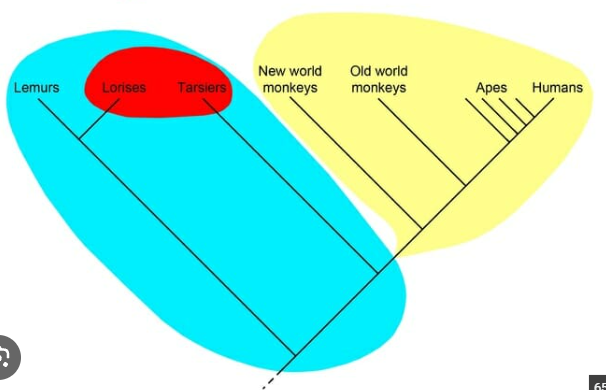
This is a polyphyletic grouping. Taxon does not include most recent common ancestor of all members of the group. Group has at least two separate origins, traits that are similar evolved independently
What kind of phyletic groups are highlighted red? Explain how it works.
