MCAT Biology Practice Questions
 Call Kai
 Learn
Learn Practice Test
 Spaced Repetition
 Match
Match Flashcards
 Knowt Play
1/479

There's no tags or description
Looks like no tags are added yet.
Name | Mastery | Learn | Test | Matching | Spaced | Call with Kai | Chat |
|---|
No analytics yet
Send a link to your students to track their progress
480 Terms
the chemical reaction that breaks down all the major macro-molecules
Hydrolysis
What is the strongest type of INTER-molecular bonds?
Hydrogen bonds are the strongest intermolecular bonds....
diople-dipole bonds are weaker. . . Vander wall bonds are the weakest.
Why is water a liquid at high temperatures?
Hydrogen bonding bonds the water molocules closer together.
What is an ampipathic molecule? give an Example.
A molecule with both hydrophobic and hydrophilic regions.
Example: PhoshpoLipid (Phospho=philic,lipid= phobic)
What is a lipid?
A lipid is a biological molecule with low solubility in water.
Lipid means fat. Liposuction is fat removal.
Peptides are NOT lipids.
What are the 6 major groups of lipids?
1) fatty acids...
the next 3 have a 3 carbon back bone:
2) Tri-glyceride
3) Phospholipids
4) Glycolipids
5) Steroids
6) Terpenes - A large class of organic compounds. examples: smelly pine oils, beer hops aroma and vitamin A.
What is the structure of a Tri-glyceride?
triglicerides are esters. Composed from 3 carbon glycerol backbone and 3 fatty acid chains dangling. Each carbon chain is attached by an ester bond.
What happens if you add water to an ester group in a Tri-glyceride? How is this reaction rate increased?
Water cleaves the ester bond into an alcohol and a carboxylic/ fatty acid. LIPASES speed are the enzyme that speed this reaction.
in terms of water solubility, What is important to know about the longer the carbon chain in a Tri-glyceride when broken down?
longer carbon chains are less water soluble.
In longer chains the polar carboxylic acid are less significant.
How soluble is a Shorter chain fatty acids?
Shorter chain fatty acids are slightly water soluble.
explain what is so special about Saturated Fatty Acids........Also, explain the melting point.
saturated fatty acids have only single, alkane bonds along the carbon chain. They have a straighter chain and have more van der wall forces, and therefor a higher melting point.
explain what is so special about Unsaturated Fatty Acid.... Also, explain the melting point.
Unsaturated fatty acids have at least one double bond. They are not saturated with Hydrogen. they have a LOWER melting point.
At room temperatures unsaturated fatty acids may be oily, like Healthy peanut butter.
explain the phospho-lipids structure. Where are phoshpo lipids common?
Phospholipids are also built on a 3 Carbon backbone.
One of the carbon has a Phosphate PO4 group. the other 2 carbons have carbon chains attached by a ester bond.
This is the lollypop of the cell membrane. Esters have 2 oxygens.
What regions are poplar nonpolar in a membrane?
1)the phosphates are Polar, water lovin, hydro philic regions that face the outside.
2) Nonpolar, hydro phobic carbon chain regions face the inside.
Explain glycolipids structure.
glycolipids have 3 carbon backbone with
2 Carbon chains attached by an ester group.
THe third carbon has a carbohydrate
What do steroids look like?
Slightly amphipathic 4 ring structures
lipids are insoluble. So how do they move through the blood?
They are usually carried by lipoproteins, like HDL or LDL.
What are the major classes of lipoproteins?
1) Chylomicrons which are the largest
2) VLDLs these are low denstiy, but large.
3) LDLs
4) HDLs. these high density lipids are the smallest, and called good proteins.
What are proteins made up of?
one or more chains of amino acids, perhaps in a crazy ass arrangement.
describe amino acid structure.
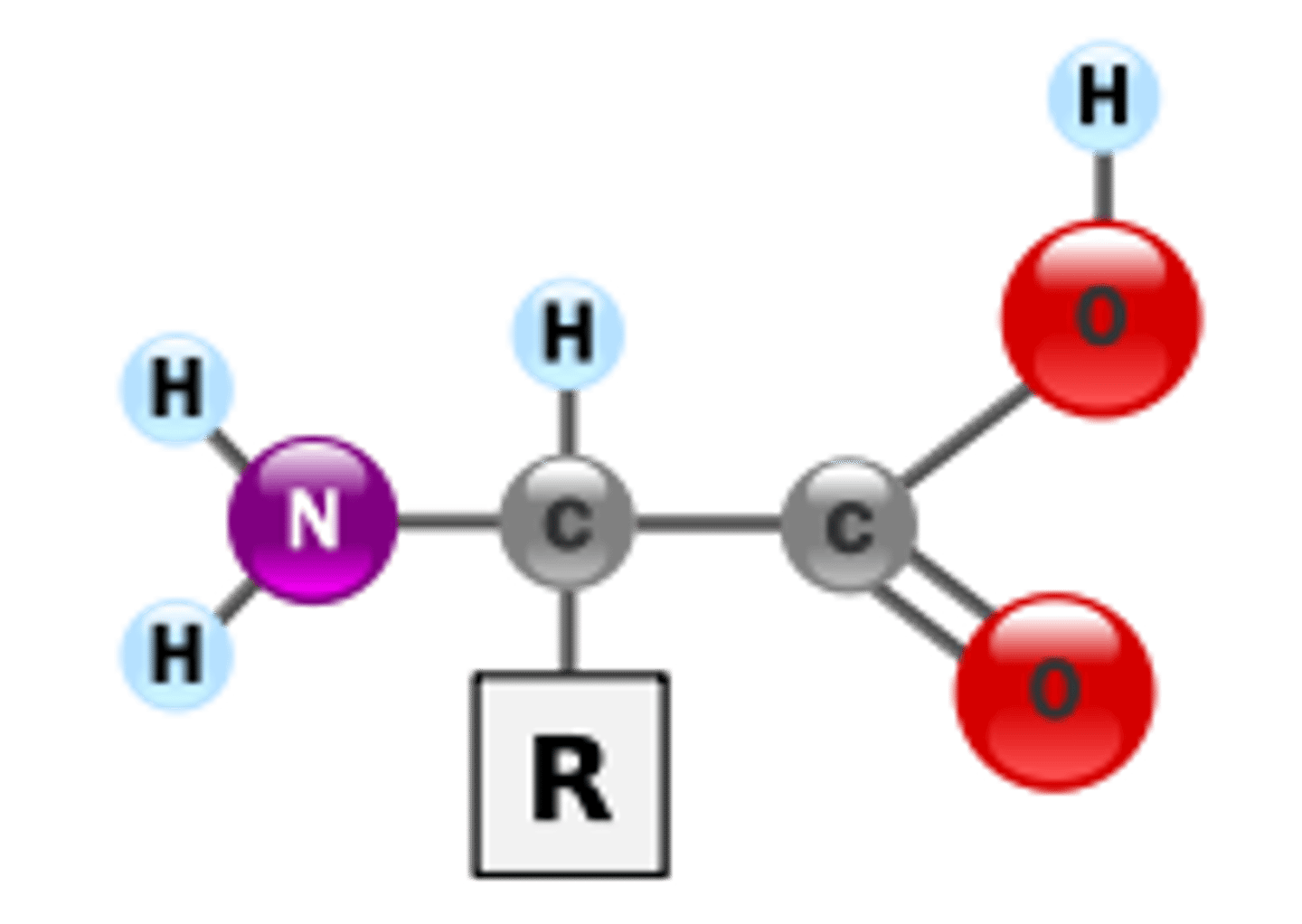
Amino acids have 4 parts attached to the alpha carbon.
1. the amino group, which is NH2
2. the R group, which is one of 20 choices
3. the Carboxylic acid or C O O
the last thing attached to the Carbon is the Hydrogen.
What are the basic amino acids?
Hal
Histidine
Arginine
Lysine
What are the acidic amino acids?
Aspartic acid and Glutamic acid
What are the nonpolar amino acids?
Poor LTMG Is Venezuelan At Parties
1) Phenylalanine
2) Leucine
3) Tryptophan
4) Methionine
5) Glycine
6) Isoleucine
7) Valine
8) Alanine
9) Proline
What is the primary structure of a protein?
Sequence of amino acids and
Location of disulfide bonds between cistine residues
What is the secondary structure of a protein?
1) Twisting of the alpha helix
2) Beta sheets
What is the tertiary structure of a protein?
3D structure including bending
What is the quaternary structure of a protein?
Multiple proteins in formation
What are the five forces that create tertiary structure?
1) Covalent
2) Disulfide bonding between cysteine residues (Bond itself creates tertiary structure)
3) H bonds
4) HPhob away from cytosol and Hphil interactions towards cytosol
5) Van Der Waals (dipoles, instantaneous dipoles)
What levels of structure are disrupted during the denaturation process?
Secondary - quaternary
What is the difference between a proteoglycan and a glycoprotein?
Glycoproteins:
1) Made of protein and carbohydrate
2) More stable than proteins
3) Often used in IS to bridge the cellular membrane.
4) Ratio - have more proteins
Proteoglycans:
1) Special class of glycoprotein
2) Contain extra carbohydrates
3) Structure = protein with one or more glycosaminoglycan chains.
4) Ratio - have more carbs
What is the empirical formula for any carbohydrate?
CH2O
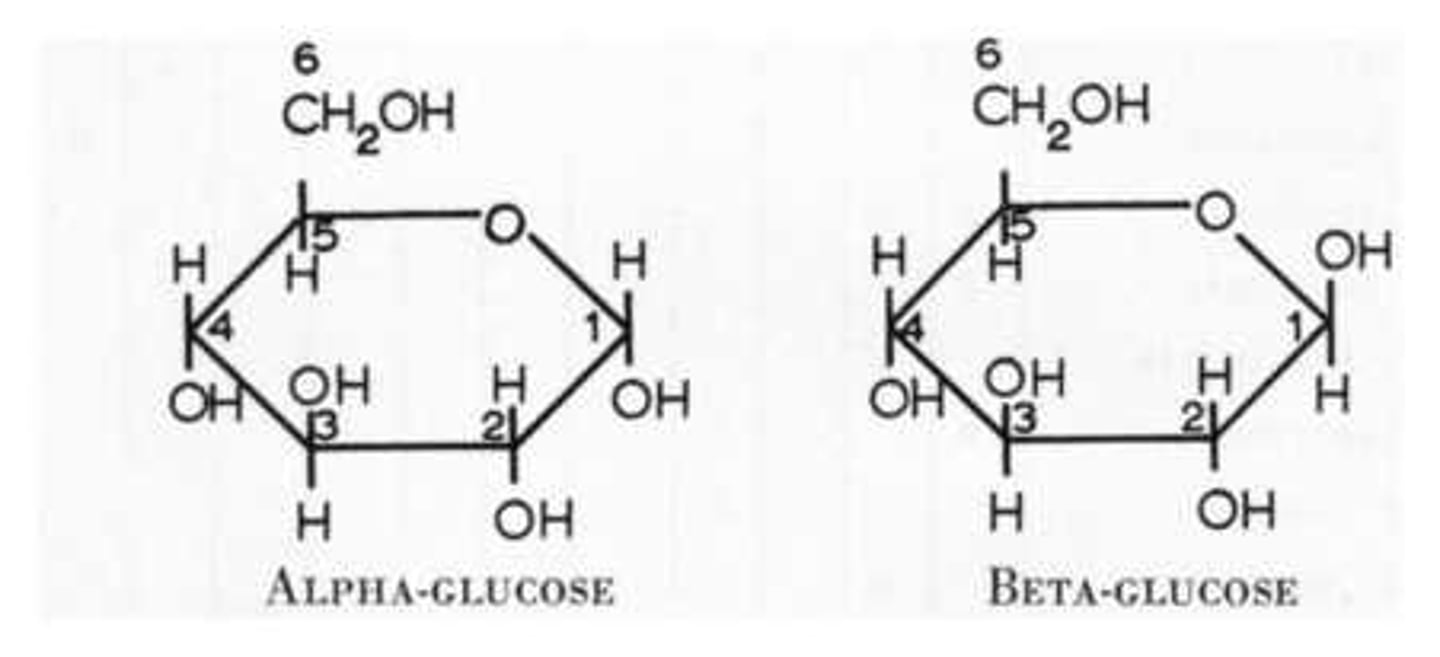
Describe the chemical structure of glucose
1) Aldehyde
2) Has 4 chiral carbons
3) Fischer - R, L, R, R
4) 6 membered ring where one of the ring members is oxygen
5) C1 - anomeric carbon
Where is glucose stored in alpha linkages?
Animals (glycogen) and plants (starch)
Who stores glucose with beta linkages?
beta linkages are in Plant cell walls. Cellulose.
What molecule is added to glycogen, starch, and cellulose to break off individual glucose molecules?
Water
Hydrolysis reaction.
and enzymes like amylase speed it up.
What are the four macromolecules?
Protein
Lipids
Carbohydrates
Nucleic acids
What are the three parts of a nucleotide?
Ribose sugar
Nitrogenous base
PO4 group
What molecule breaks up nucleic acids into nucleotides?
Water.
with the help of nucleases.
What are some other important nucleotides?
FADH, NADH, ATP cyclic AMP
What are minerals?
1) Inorganic elements that typically exist in the form of ions inside and outside of the cell.
2) Function to:
a) Establish electrochemical gradients
b) Act as cofactors to enable protein function
c) Form matrix compounds in bone and etc
What are enzymes?
Typically a protein that Increase the rate of reaction by lowering activation energy.
but ribosomes are enzymes
What is activation energy?
energy needed to break the bonds of the reactants creating the transition state, or the species between the reactants or the products
T/F: enzyme is typically larger than the substrate
True
Where does a substrate attach to an enzyme?
at the active site
What are the two hypotheses of enzyme and substrate interactions?
1) Lock and Key Model
2) Induced Fit Model
T/F: One enzyme is tailor made for one reaction.
True: Enzyme specificity; gives the cell more control in regulating chemical reactions
What are saturation kinetics?
Since a single enzyme molecule works on one set of substrate at a time, the reaction rate increases when we add substrate only as long as there are unoccupied enzyme molecules.
Once we reach saturation, adding more substrate won't increase the reaction rate.
Enzyme is not used up!
What are the factors that affect enzymatic reactions?
1) Optimal temp (rate increases as temp incr until end is denatured)
2) Optimal pH
How do cells regulate enzymes?
1) Inhibition
2) Production of inactive form, activate only when needed
What are the general types of enzyme inhibition?
1) Feedback inhibition
2) Chemical inhibition (poisons)
What is feedback inhibition?
When the product of a reaction near the end of a chain of reactions inhibits the function of an enzyme in an earlier reaction of the chain.
What are specific ways in which enzymes are inhibited (mechanism)?
1) Competitive
2) Non-competitive
3) Irreversible
What is competitive inhibition?
1) Compete for active site.
2) Can be overcome by increasing substrate concentration.
What is non-competitive inhibition?
1) Doesn't attach to active site, but changes the shape of the enzyme so the substrate doesn't fit as well.
2) Reduces affinity for enzyme to substrate
What is irreversible inhibition?
1) Something covalently bonds to active site.
2) Cannot be removed.
What is respiration?
The E requiring stages of metabolism
Where does glycolysis take place?
In the cytosol of the cell
Does glycolysis require oxygen?
No
Is glycolysis poisoned by oxygen?
No
What is the net ATP produced by glycolysis?
1) 2 ATP
2) 2 NADH
3) 2x 3C pyruvates
If oxygen is not present, or the organism is incapable of aerobic respiration, what happens to the NADHs at the end of glycolysis?
Fermentation: The NADHS are oxidized back to NAD+ in a process that removes 1C from each pyruvate to produce CO2 and EtOH(yeast)/Lactic acid
If oxygen is present, what happens to the products of glycolysis?
They enter the mitochondria.
What is the E cost of transporting one NADH into the mitochondria?
1 ATP per NADH across inner membrane
How many ATPs does each NADH produce during the ETC?
Each NADH produces 3 ATPs via ETC
In the mitochondrial matrix, what happens to the pyruvates?
Each pyruvate is converted to acetyl-CoA, which transfers 2C to oxaloacetate to make citrate, beginning the TCA cycle.
What are the energetic products of the TCA cycle?
1 ATP
3 NADH (Each NADH is converted to 3 ATPS via ETC)
1 FADH (Each FADH is converted to 2 ATPs via ETC)
Overall, aerobic respiration of a single glucose molecule results in a net of how many ATPs?
36
What is the ETC?
1) Series of proteins called cytochromes embedded in the inner membrane of the mitochondria.
2) These proteins pass down high E electrons from one protein to the next, using the energy of the electron to pump protons into the inter membrane space. Leaving the intermembrane space with a low pH.
3) ATP synthase allows protons to flow back into the matrix. Uses E of electrochemical gradient to produce ATP.
What is aerobic respiration?
Oxidation or combustion of glucose.
What is the final electron acceptor in the ETC?
Oxygen
How are Tri-glycerides burned for E?
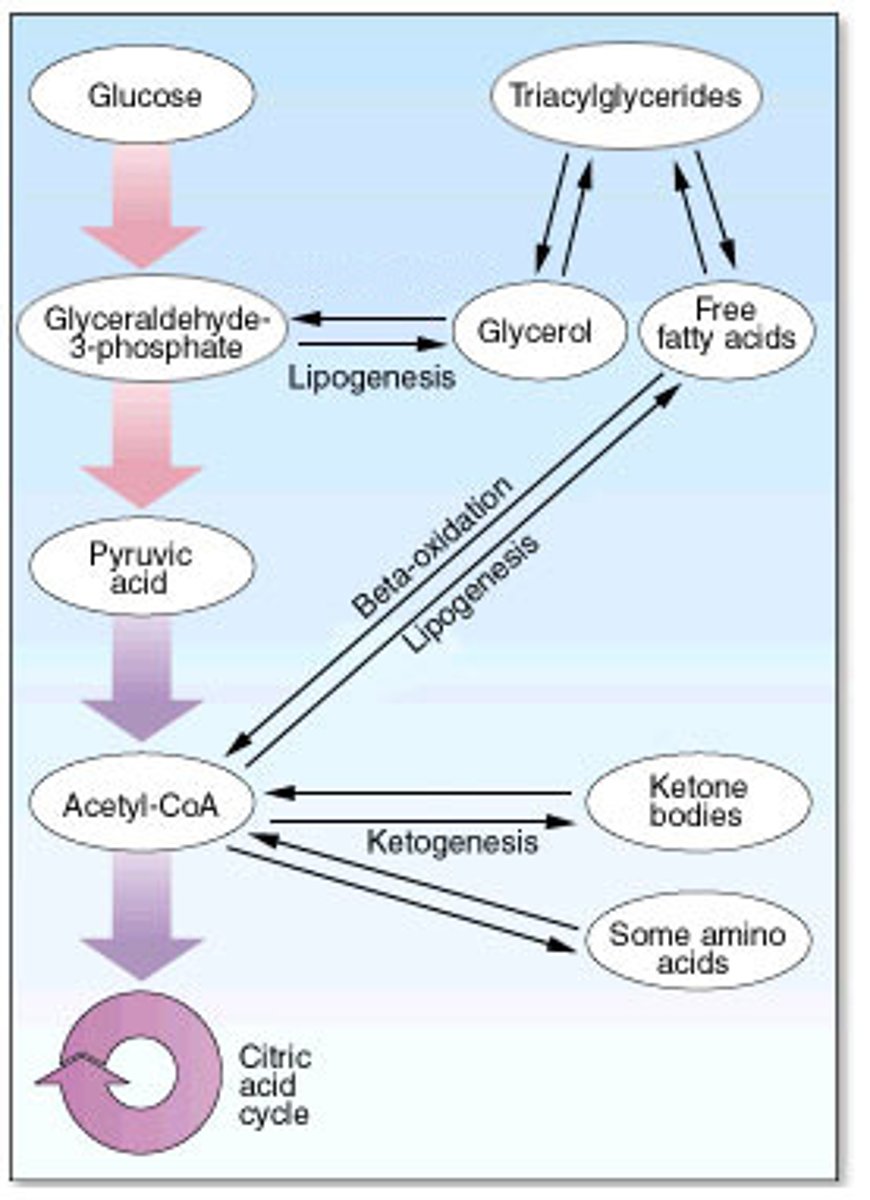
Tri-glyceride broken down into Fatty Acid and glycerol.(glycerol is an alcohol)
Glycerol enter glycolysis in the middle.
Fatty Acid transported into mito matrix and converted to acetyl-CoA (Makes NADH for every 2C per Fatty Acid)
How are proteins burned for E?
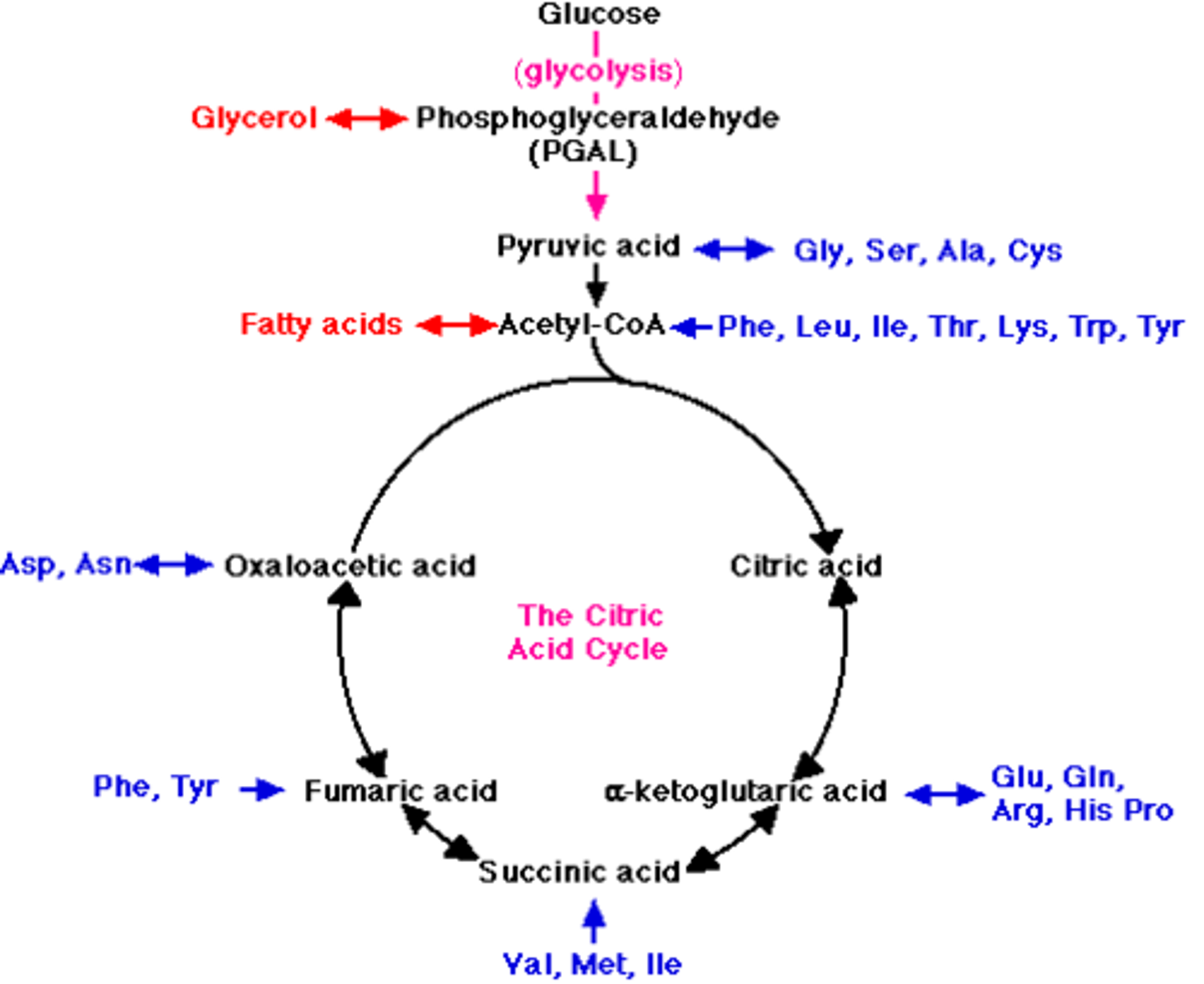
Amino acids enter at various portions, depending on the amino acid in question.
What is rule of the ratio of gene to polypeptide?
One gene makes One polypeptide
How many copies of a gene do prokaryotes have?
One
How many copies of a gene do prokaryotes have?
For most genes, eukaryotes only have one copy.
For some genes, (tRNA, rRNA, heterochromatin) eukaryotes have multiple copies.
What are the three main components of a nucleotide?
1) Nitrogenous base
2) Pentose sugar
3) PO4 group
What are the 4 nitrogenous bases?
1) Adenine
2) Thymine
3) Cytosine
4) Guanine
What are the 4 nucleosides?
1) Adenosine
2) Cytidine
3) Guanosine
4) Thymidine
What is the difference between a nucleotide and a nucleoside?
Nucleosides are nucleotides without the 3 PO4 groups.
What are the purines?
1) Adenine
2) Guanine
What are the pyrimidines?
1) Cytosine
2) Thymine
Which carbon is the PO4 group attached to?
The 5th carbon on each pentose sugar.
What kind of bond connects the PO4 group to the 3rd carbon on the pentose sugar of the net nucleotide in the chain?
Phosphodiester
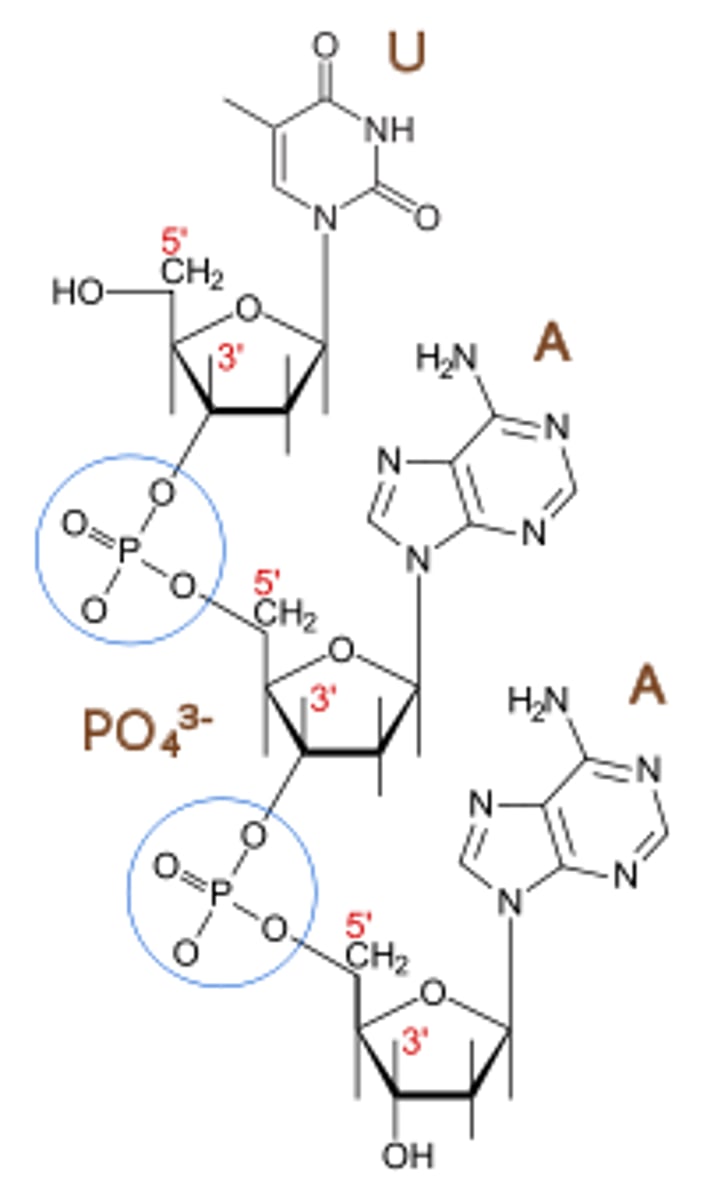
In a phosphodiester bond, which numbered carbons are connected by what?
PO4 group is connected to the 3rd carbon on the pentose sugar at one end, and the 5th carbon on the pentose sugar at the other end.
How do the nitrogenous bases bond to each other?
Hydrogen bonds
How many bonds are formed between A and T?
2
How many bonds are formed between C and G?
3
Why is replication a semi-conservative replication?
Each original strand is added to one newly synthesized strand to form 2 new double helices.
In what direction does replication occur?
Bidirectional - the process begins at the middle of the double strand.
What enzyme separates the two strands of DNA?
DNA helicase
In what direction does DNA polymerase move?
3' to 5'
In what direction does DNA polymerase polymerize the complementary strand?
5' to 3'
In what direction does the replisome move?
It follows the direction of the unzipping strand.
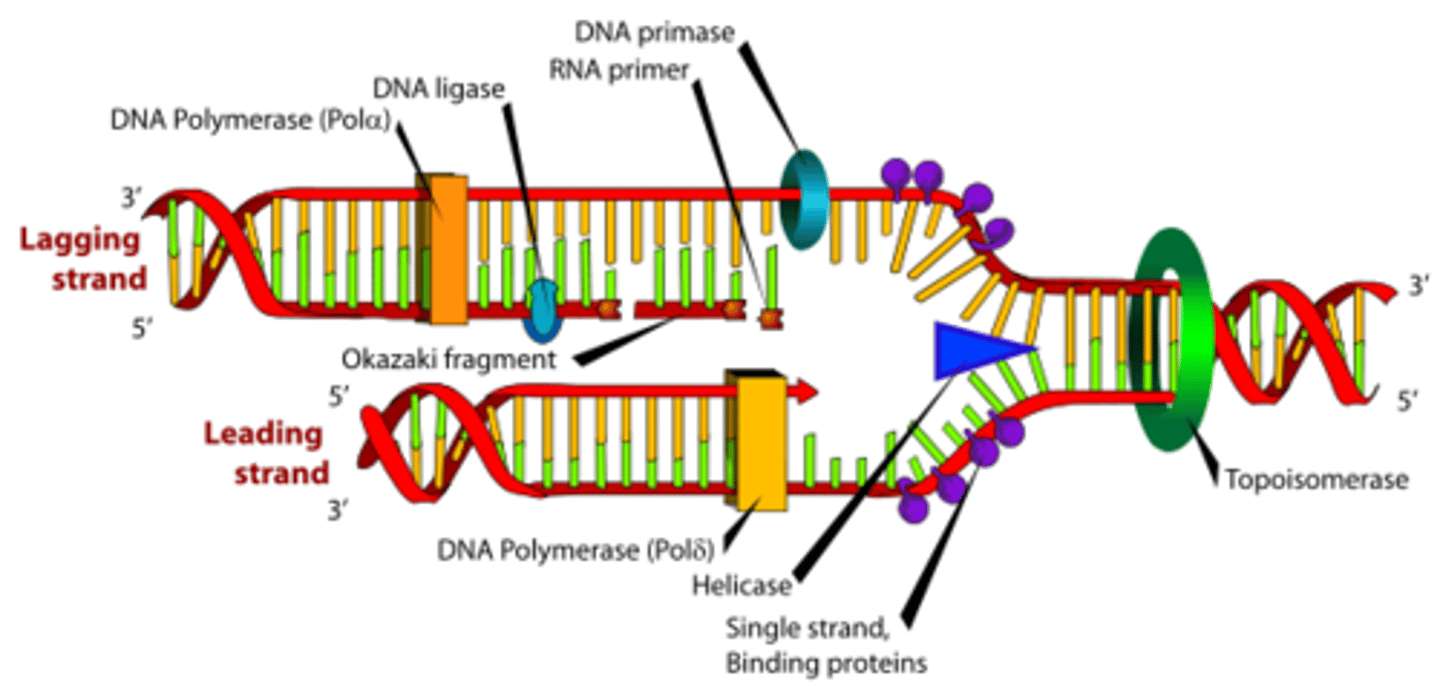
What is the replisome composed of?
Two replicative polymerase complexes, one of which synthesizes the leading strand, while the other synthesizes the lagging strand. The replisome is composed of a number of proteins including helicase, RFC, PCNA, gyrase/topoisomerase, SSB/RPA, primase, DNA polymerase I, RNAse H, and ligase.
Which polymerase polymerizes the leading strand?
Pol delta
Which polymerase polymerizes the lagging strand?
Pol alpha
What are okazaki fragments?
Relatively short fragment of DNA synthesized on the lagging strand during DNA replication.
How does RNA differ from DNA?
1) DEOXY in DNA
2) RNA is ss
3) RNA has U instead of T
What are the types of RNA?
mRNA
tRNA
rRNA
Where is RNA synthesized?
Nucleus
rRNA = nucleolus