MBB222 - Lecture 29/30: Eukaryotic transcription and processing (pt.2)
 Call Kai
 Learn
Learn Practice Test
 Spaced Repetition
 Match
Match Flashcards
 Knowt Play
1/32

There's no tags or description
Looks like no tags are added yet.
Name | Mastery | Learn | Test | Matching | Spaced | Call with Kai | Chat |
|---|
No analytics yet
Send a link to your students to track their progress
33 Terms
what does hnRNA (pre-mRNA) acquire when processed to mRNA
5’ cap
3’ poly-A tail
spliced as it is processed into mRNA
why is the 5’ cap added early on before the synthesis of the primary mRNA is done
to protect the pre-mRNA from degrading - helps in early processing steps (i.e. splicing) and ensure proper translation later
why is the 5' cap only added to RNA polymerase II (mRNA) transcripts
RNA polymerase II has a unique tail structure that physically carries and recruits the capping enzymes
how does the 5’ cap help in initiating protein synthesis
5’ cap helps in the binding of mRNA to ribosomes → initiates protein synthesis
how can mRNA capping also stabilize the mRNA
by protecting it from the nuclease
what are the mRNA processing enzymes associated with
C-terminal domain (CTD) of RNA polymerase II
which enzymes allows processing to occur as the transcript is being synthesized
capping factors / enzymes
enzymes / factors involved in splicing
polyadenylation enzymes
what happens during transcription termination and poly A tailing (polyadenylation)
enzyme complex (includes: endonuclease, polyadenylate polymerase, other proteins) binds to both the cleavage signal sequence in the mRNA + C-terminal domain of the RNA polymerase II
endonuclease cleaves the transcript 10-30 bases downstream from the 3’ end of the sequence - AAUAA
polyadenylate polymerase adds 80-250 A residues (poly A tail)
why is the 3’ polyA tail important for mRNA
helps in the export from the nucleus → ensure only fully processed mature messages reach the cytoplasm
protein translation → forms a loop that helps ribosomes efficiently restart and read the message over again
stability → long ends of adenosines acts as a buffer against cell enzymes (nucleases) that degrade RNA
how can you purify mRNA away from tRNA and rRNA
by exploiting the unique poly(A) tail found on most mRNA → mRNA will hybridize to beads with covalently attached poly T RNA segments (A-T binding)
why is it difficult to purify any one type of mRNA out of a mixture of many RNA’s
chemical similarity → identical backbones / shared features (i.e. polyA tails)
high instability / degradation
size and conformation → mRNA molecules can fold into complex + tight secondary / tertiary structures - overlapping or aggregation can occur to prevent clean separation
where is eukaryotic mRNA processed
in the nucleus
what happens in the nucleus
intro sequences are removed by splicing
5’ ends are protected with a m7G cap
polyAtail added at 3’ end → facilitates mRNA translation
what are introns
non-coding regions
what are exons
coding regions
which (exon or intron) are initially transcribed into pre-mRNA (hnRNA)
both are initially transcribed
which (exon or intron) are excised
introns are excised - exons are covalently linked to form the mature mRNA → process called splicing
why does splicing reduces the size of mRNA substantially
removes large non-coding sections (introns) while keeping only the protein-coding sections (exons)
how was splicing first detected by R-looping
ssDNA was hybridized to its corresponding mRNA
large loops of DNA were observed - did not anneal
loops encode introns that are excised out of the pre-mRNA to make the mRNA molecule
what is the mechanism of spliceosome-mediated splicing of precursor mRNA
spliceosome performs the cleaving
cleavage of 5’ splice site and formation of lariat ( cowboy - lasso ) RNA structure
cleavage of 3’ splice site and ligation of splice exons
what is the branch point in splicing
a specific nucleotide sequence inside an intron that contains a key adenine residue - acts as the chemical attack point to help remove non-coding RNA
what is the highly conserved nucleotide in the precursor mRNA transcript at the:
5’ end of the intron
branch point
3’ end of the intron
GU / A / AG
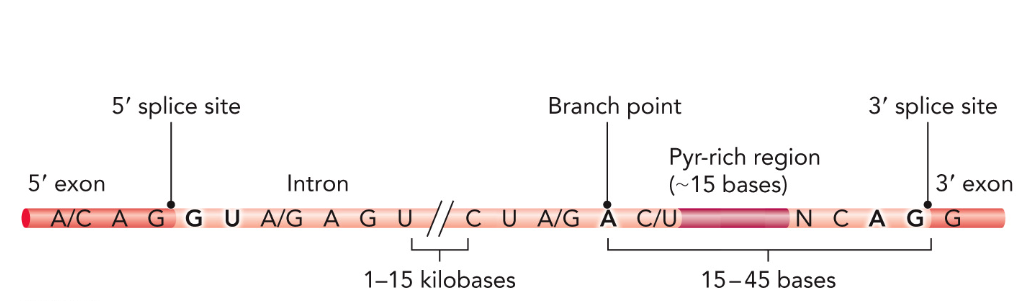
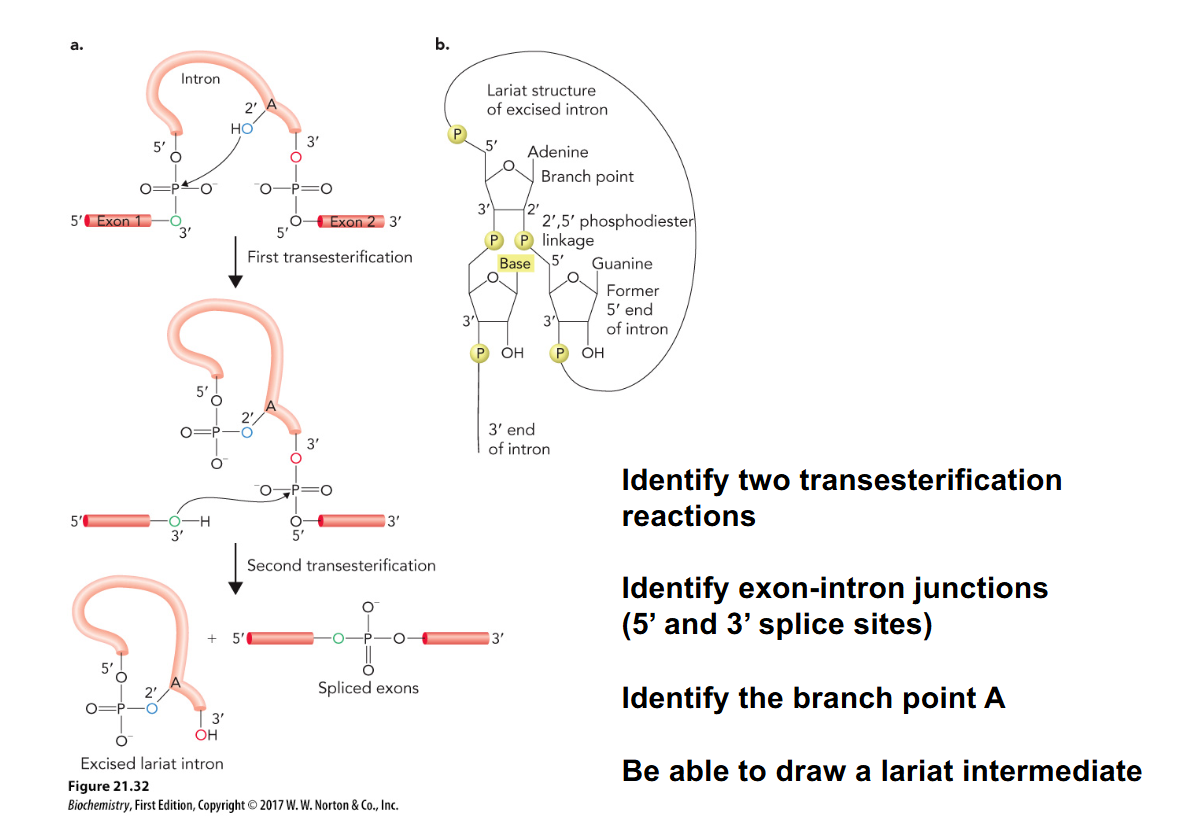
draw out the reaction of the spliceosome-mediated splicing of precursor mRNA
identify:
identify the two transesterification reactions
identify exon-intro junctions (5’ + 3’ splice sites)
identify the branch point A
be able to draw a lariat intermediate
describe how the spliceosome assembly forms
U1 snRNP → recognizes and binds to the conserved 5’ splice site on the pre-mRNA
U2 snRNP → attaches to the branch point sequence containing a conserved adenosine near the 3’ end of the intron
U4 / U5 / U6 → complex joins the assembly - loops the intron and brings the splice sites into proximity
U1 / U4 → dissociates and allows U6 to pair with U2 and the 5’ splice site → creates an active RNA - based catalytic center with metal ions
describe the catalytic steps (transesterification)
2 OH groups of the branch point adenosine attacks the 5’ splice site phosphate - cuts the 5’ exon free and forms a looped intermediate (intron lariat)
newly freed 3’OH group of the 5’ exon attacks the 3’ splice site at the boundary of the next exon
two exons join together into mature mRNA - excised intron lariat is released and degraded
why is the U2 base pairing with branch site mRNA sequence important in spliceosome mediated splicing
forces the specific branchpoint adenosine to bulge outward from the RNA helix → exposes its 2 OH groups to attack the 5’ splice site
what does self-splicing require
pre-mRNA
magnesium (mg 2+)
free G [ Guanosine cofactor ] → GDP, GMP, GTP, guanosine
which group of introns are spliceosome independent (self-splicing)
group I / group II introns
describe how group I self-splices
3’ OH of an exogenous guanosine cofactor (G) participates in a transesterification reaction with the phosphoryl group at the 5’ end of the intron
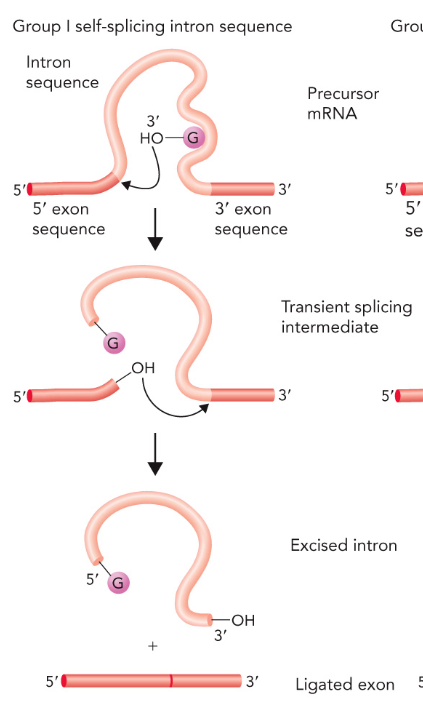
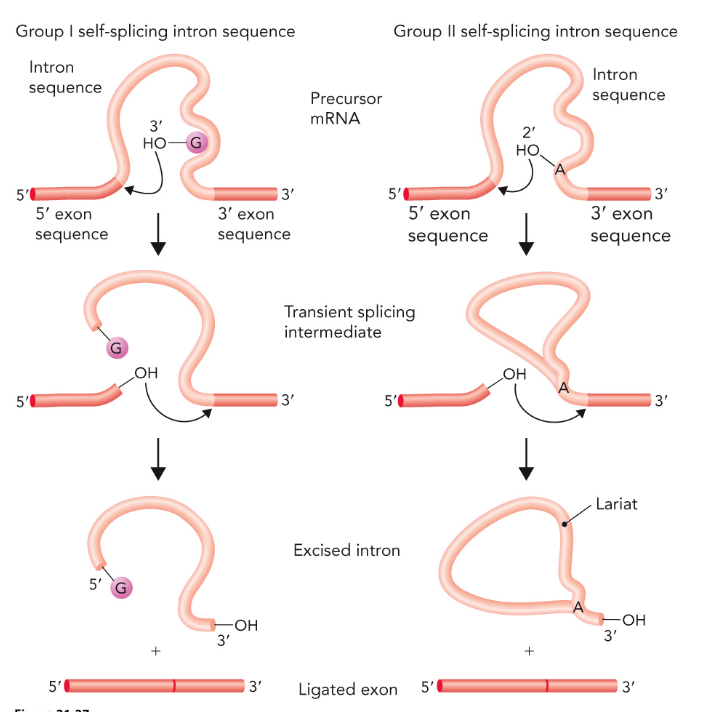
what is the difference between group 1 and group 2 intron self-splicing
group 1 introns:
uses an exogenous guanosine cofactor
excised intron is linear
group 2 introns:
uses an internal adenine nucleotide
forms a lariat shape
why are introns and alternative splicing important
splicing at alternative splice sites to include/exclude different exons can lead to the production of several protein products from one gene
is a powerful mechanisms for expanding the diversity of genomic sequences - one gene can produce multiple products
alternative splicing can be regulated → gives differential splicing at different times
what are isoforms
alternative splice products from the same pre-mRNA
how are isoforms formed by alternative splicing
all introns are removed while some exons can also be removed along with the introns → allowing the formation of distinct mRNA molecules that code for proteins with different structures / jobs