Topic 4 - Photosynthesis
 Call Kai
 Learn
Learn Practice Test
 Spaced Repetition
 Match
Match Flashcards
 Knowt Play
1/21

There's no tags or description
Looks like no tags are added yet.
Name | Mastery | Learn | Test | Matching | Spaced | Call with Kai | Chat |
|---|
No analytics yet
Send a link to your students to track their progress
22 Terms
What type of reaction is Photosynthesis?
Endothermic
What does endothermic mean?
Means energy is transferred from the environment in the process
Where does photosynthesis take place?
In chloroplasts
What absorbs the light in chloroplasts?
A green pigment called chlorophyll
What is the word equation for photosynthesis?

What is the balanced symbol equation for photosynthesis?

What are the 5 uses of glucose in plants?
C - Cellulose - glucose is converted into cellulose for making strong plant cell walls
R - Respiration - transfers energy from glucose, enables plants to convert glucose into other useful substances.
O - Oils/fats - glucose is turned into lipids for storing in seeds
P - Proteins - Glucose is combined with nitrate ions to make amino acids.
S - Starch - Glucose is turned into starch and stored in roots, stems and leaves.
When might a plant use starch?
Ready for when photosynthesis isn’t happening, like in winter
What is the advantage of using starch to store glucose
Starch is insoluble - a cell with lots of glucose would draw lots of water and swell up
What is meant by a limiting factor in photosynthesis?
A factor that limits the rate of photosynthesis
What are the limiting factors for the rate of photosynthesis?
Intensity of light
Concentration of carbon dioxide
Temperature
Water available
Amount of chlorophyll
How can the amount of chlorophyll be affected?
Diseases
Environmental stress (lack of nutrients)
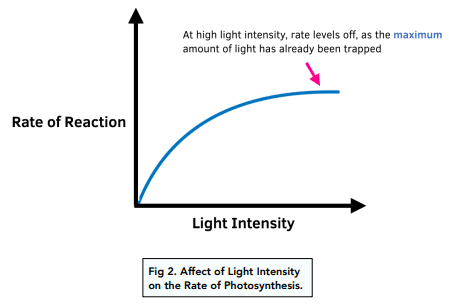
Describe how the light intensity affects the rate of photosynthesis?
As the light level is raised, the rate of photosynthesis increases steadily, but only until a certain point - when the light intensity is no longer the limiting factor, as shown by the flat line.
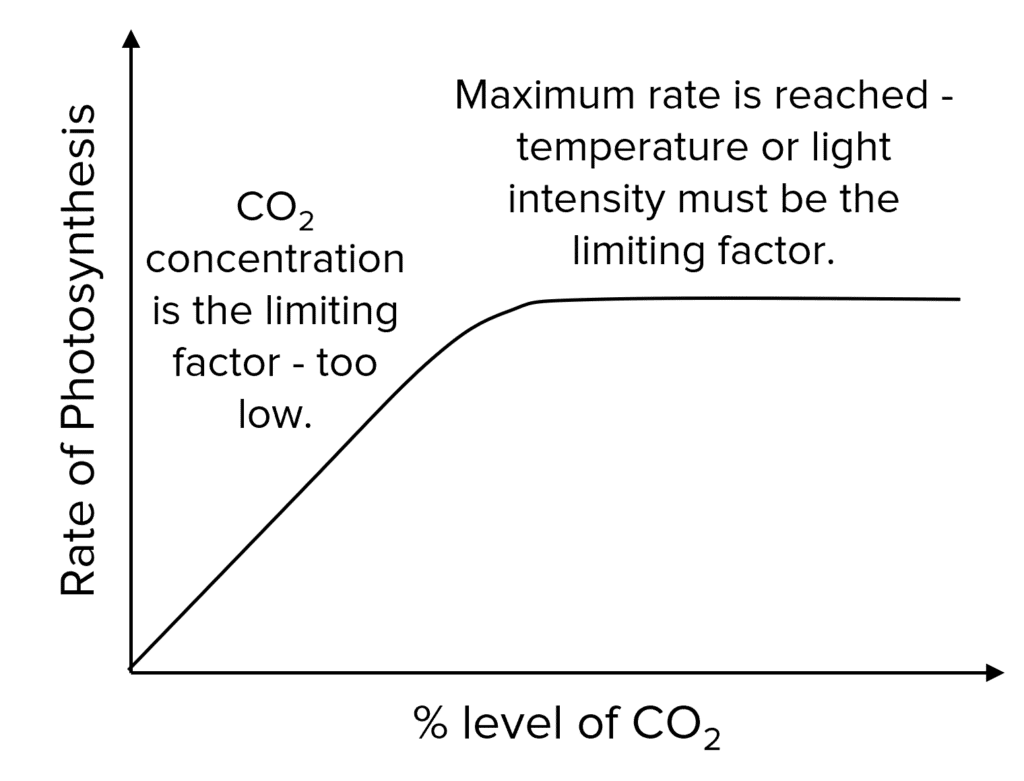
Describe how the % level of carbon dioxide affects the rate of photosynthesis?
As the % level of carbon dioxide increases, the rate of photosynthesis increases steadily - but only until a certain point when the carbon dioxide is not the limiting factor anymore - as shown by the flat line.
Describe how the temperature affects the rate of photosynthesis
Since photosynthesis uses enzymes, if the temperature is too low, enzymes work slower. As the temperature increases, the rate of photosynthesis increases steadily, until it reaches the optimum temperature. After the optimum temp, the rate of photosynthesis rapidly decreases as the enzymes are destroyed in too hot conditions.
What is the independent variable (change) of the measuring the rate of photosynthesis practical
What is the dependent variable (measure)
What is the control variable
Light intensity - power of lamp/distance between light and plant
Rate of photosynthesis - time/number of bubbles/volume of oxygen
Temp/pond weed (length or species)/power of lamp/sodium hydrogencarbonate solution
USE PMT FLASHCARDS FOR R.P 6
What is the inverse square law?
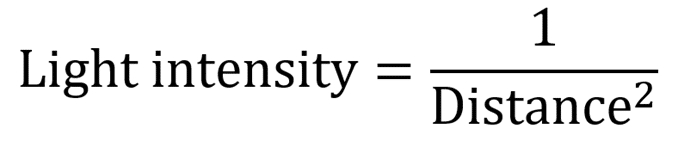
What might a farmer use in the winter for a greenhouse?
A paraffin heater - heats the greenhouse and makes carbon dioxide as a by - product
What might a farmer use in the summer for a greenhouse?
Use shades and ventilation
What might farmers use in the night/winter?
Artificial light
What is an advantage of using a green house?
Prevents diseases and pests.