2.4.2 Enzyme-Linked Immunosorbent Assay
 Call Kai
 Learn
Learn Practice Test
 Spaced Repetition
 Match
Match Flashcards
 Knowt Play
1/43

There's no tags or description
Looks like no tags are added yet.
Name | Mastery | Learn | Test | Matching | Spaced | Call with Kai | Chat |
|---|
No analytics yet
Send a link to your students to track their progress
44 Terms
What is a monoclonal antibody?
An antibody produced from genetically identical or cloned B plasma cells, so all have the same tertiary structure.
Outline the uses of monoclonal antibodies
Medical diagnosis
Therapeutic drug delivery
Block antigens or receptors
Detection
What property of monoclonal antibodies allows them to target specific cells?
They have a specific tertiary structure, so the variable region is complementary to a receptor, protein, or antigen found only on a specific cell type, for example a cancer cell.
How are monoclonal antibodies used to deliver drugs to specific cells?
A therapeutic drug is attached to the antibody.
The antibody binds to the cell’s target receptor, protein, or antigen, forming an antigen-antibody complex and delivering the drug.
What is another way monoclonal antibodies are used in treatment?
Some monoclonal antibodies are designed to block antigens or receptors on cells.
What property allows monoclonal antibodies to be used in medical diagnosis?
They have a specific tertiary structure, so the variable region is complementary to a receptor, protein, or antigen found only on a specific cell type associated with the diagnosis.
How are monoclonal antibodies used to detect specific molecules?
A dye, stain, or fluorescent marker is attached to the antibody.
The antibody binds to the cell’s target receptor, protein, or antigen, forming an antigen-antibody complex that can be visualised.
Briefly outline the difference between direct, indirect and sandwich ELISA.
Direct ELISA: antigen from sample attached to well; enzyme-linked antibody binds directly to antigen.
Indirect ELISA: antigen attached to well; sample antibody binds to antigen; enzyme-linked secondary antibody binds to sample antibody.
Sandwich ELISA: antibody attached to well; antigen from sample binds; enzyme-linked secondary antibody binds to antigen.
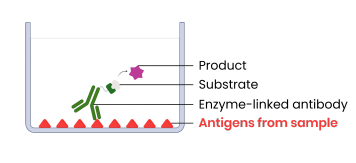
What is the first step in direct ELISA?
Attach the sample with potential antigens to the well.
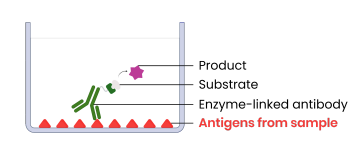
What is the second step in direct ELISA?
Add complementary monoclonal antibodies with enzymes attached, which bind to the antigens if present.
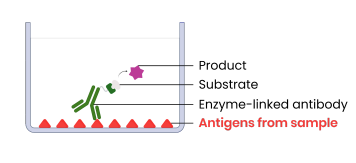
What is the third step in direct ELISA?
Wash the well to remove unbound antibodies, preventing false positives.
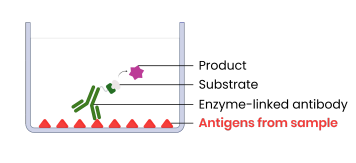
What is the fourth step in direct ELISA?
Add substrate, which the enzymes act on to create products that cause a colour change, indicating a positive result.
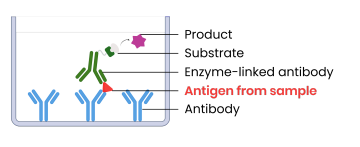
What is the first step in sandwich ELISA?
Attach specific monoclonal antibodies to the well.
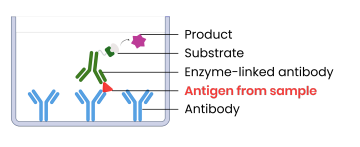
What is the second step in sandwich ELISA?
Add the sample with potential antigens, then wash the well.
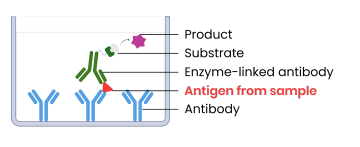
What is the third step in sandwich ELISA?
Add complementary monoclonal antibodies with enzymes attached, which bind to the antigens if present.
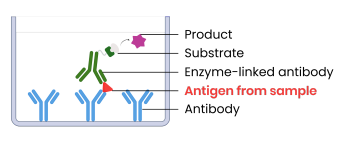
What is the fourth step in sandwich ELISA?
Wash the well to remove unbound antibodies, preventing false positives.
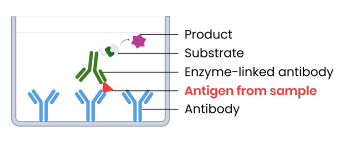
What is the fifth step in sandwich ELISA?
Add substrate, which the enzymes act on to create products that cause a colour change, indicating a positive result.
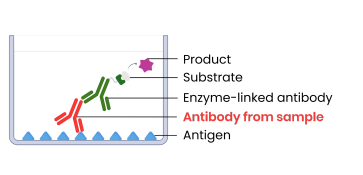
What is the first step in indirect ELISA?
Attach specific antigens to the well.
What is the second step in indirect ELISA?
Add the sample with potential antibodies, then wash the well.
What is the third step in indirect ELISA?
Add complementary monoclonal antibodies with enzymes attached, which bind to the antibodies if present.
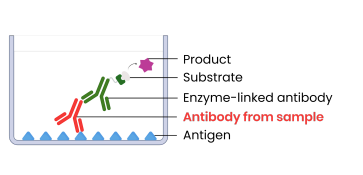
What is the fourth step in indirect ELISA?
Wash the well to remove unbound antibodies, preventing false positives.
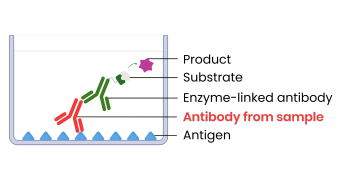
What is the fifth step in indirect ELISA?
Add substrate, which the enzymes act on to create products that cause a colour change, indicating a positive result.
What is one purpose of a control well in the ELISA test?
To compare to the test and show that only the enzyme causes the colour change.
What is another purpose of a control well in the ELISA test?
To compare to the test and show that all unbound antibodies have been washed away.
Why can failure to thoroughly wash the well result in a false positive?
Antibodies with enzymes attached remain and are not washed out, so the substrate is converted into a coloured product.
What is one ethical issue associated with pre-clinical testing of vaccines and monoclonal antibodies?
Pre-clinical testing on animals causes potential stress, harm, or mistreatment.
However, animals are not killed and it helps produce new drugs to reduce human suffering.
What is an ethical issue associated with clinical trials on humans?
Potential harm or side-effects.
What is a potential ethical issue with vaccines?
People may continue high-risk activities and still develop or pass on the pathogen.
What is an ethical issue associated with using drugs?
Potentially dangerous side effects.
What question should be asked about sample size when evaluating methodology?
Was the sample size large enough to be representative of the population?
What question should be asked about participant diversity?
Were participants diverse in terms of age, sex, ethnicity, and health status?
What question should be asked about control groups?
Were placebo or control groups used for comparison?
What question should be asked about study duration?
Was the duration of the study long enough to show long-term effects?
What question should be asked about reducing bias?
Was the trial double-blind, meaning neither the doctor nor the patient knew who was given the drug or placebo, to reduce bias?
What question should be asked about side effects?
What side effects were observed, and how frequently did they occur?
What question should be asked about control variables?
Were factors such as health and previous medications controlled to ensure validity?
What question should be asked about statistical analysis?
Was a statistical test used to see if there was a significant difference between the start and final results?
What can a large standard deviation in final results indicate?
Large standard deviation shows that some patients did not benefit from the treatment.
What does overlap between standard deviations of start and final results suggest?
Overlap suggests there may not be a significant difference in start and final results.
What questions should be asked about dosage?
What dosage was optimum?
Does increasing the dose increase effectiveness enough to justify the extra cost?
What question should be asked about production and distribution?
Was the cost of production and distribution low enough?
If two variables change together in a way that can be seen on a scatter diagram, what is this called?
Correlation = a change in one variable is reflected by a change in another variable, which can be identified on a scatter diagram.
What term describes when a change in one variable directly causes a change in another variable?
Causation = a change in one variable causes a change in another variable.
Why is it incorrect to assume that because two variables are correlated, one must cause the other?
Correlation does not mean causation → there may be other factors involved.