The Microbial World – Viruses, Viroids, Virusoids, and Prions Week 6 STUDY
 Call Kai
 Learn
Learn Practice Test
 Spaced Repetition
 Match
Match Flashcards
 Knowt Play
1/37

There's no tags or description
Looks like no tags are added yet.
Name | Mastery | Learn | Test | Matching | Spaced | Call with Kai | Chat |
|---|
No analytics yet
Send a link to your students to track their progress
38 Terms
Ontario’s Current Vaccine Recommendation Eligible for free
Youth in grade seven
Two injections, 6 months apart
Not mandatory (not part of the Immunization of School Pupils Act)
Males up to 26 years of age who self-identify as having sex with men (self-identify as gay, bisexual, or trans*) (free)
Anyone born in 2002, 2003, or 2004, 2005 and 2006 that have missed HPV vaccine doses due to the pandemic, have extra time to get vaccinated for free until August 31, 2024.
Males born in 1993, 1994, 1995, 1996, and 1997 who have missed doses due to the pandemic, can get vaccinated for free until December 31, 2024.
Ontario’s Current Vaccine Recommendation Paid out of pocket
Recommended for those under age 26 who have not received the vaccine (paid out of pocket).
Viral Characteristics
Viruses are infectious, acellular, obligate pathogens
They contain a DNA or RNA genome (never both)
Lack the ‘machinery’ needed for their own reproduction and therefore need to ‘commandeer’ a host cell in order to reproduce
Can infect every type of organism
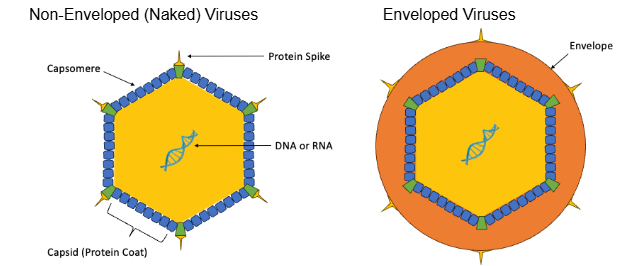
General Viral Structure
Non-Enveloped (Naked) Viruses
Enveloped Viruses
Common Viral Shapes
Helical: Ebola, Influenza, measeles, mumps rabies
Isosahedral: Covid-19, Adenovirus, polio virus, HPV
Complex: Herpes, Simplex, Variola, HIV
Viral Replication
Viruses rely on host cells for reproduction and metabolic processes, as they lack the necessary enzymes for replication.
Bacteriophages replicate only in the cytoplasm of prokaryotic cells, which lack a nucleus and organelles.
Most DNA viruses that infect eukaryotic cells replicate in the nucleus, except for large DNA viruses like poxviruses, which replicate in the cytoplasm.
RNA viruses typically replicate in the cytoplasm of animal cells.
Lytic (Virulent) Phage Infections STEPS
Step 1: Attachment
Step 2: Penetration
Step 3: Biosynthesis
Step 4: Maturation
Step 5: Lysis
Lytic (Virulent) Phage Infections
When the bacteriophage DNA is expressed, this can lead to the production of phage proteins, which may include virulence factors such as toxins (e.g., the cholera toxin in Vibrio cholerae).
The bacterial host may also enter the lytic cycle if environmental conditions trigger the phage to replicate and cause the host cell to lyse, releasing new phages.
EXAMPLE: Diphtheria, Corynebacterium diphtheriae
Non-toxigenic infections. Rarely cause clinical disease, however, could cause:
Pharyngitis
Skin infections
Endocarditis
Septic arthritis
Bacteremia
Sepsis
Osteomyelitis
Treatment:
Antibiotics
1Viral Attachment and Penetration (Transduction)
The phage infects a cell
2Integration (Transduction)
The phage DNA becomes incorporated into the host genome
3Excision (Transduction)
The phage is excised from the bacterial chromosome along with a short piece of bacterial DNA. The DNA is then packaged into newly formed capsids.
4Infection (Transduction)
Phages containing both viral and bacterial DNA infect a new host cell
5Recombination (Transduction)
The phage DNA, along with the attached bacterial DNA are incorporated into the new cell
Life Cycle of Viruses with Eukaryotic Hosts
Similar to the life cycle of prokaryotes, with a few exceptions:
Penetration:
Eukaryotic viruses can enter host cells either through endocytosis (the virus is engulfed by the host cell) or membrane fusion (the viral envelope fuses with the host cell membrane).
Nucleic acid biosynthesis:
Eukaryotic viruses have more complex genome types (see next slide) and have different strategies for replication and protein biosynthesis.
Release:
These viruses can be released through budding (if they are enveloped, like HIV), where they take part of the host cell membrane as they exit, or through lysis, bursting the host cell.
DNA: Deoxyribonucleic acid (Genome Types (A Review))
DNA: Deoxyribonucleic acid
Typically double-stranded with two strands that run in opposite directions
Contains a sugar called deoxyribose
Bases: The nitrogenous bases in DNA are adenine (A), thymine (T), cytosine (C), and guanine (G).
Base Pairing A pairs with T, C pairs with G
RNA: Ribonucleic Acid (Genome Types (A Review))
Typically single-stranded
Contains a sugar called ribose
Bases: The nitrogenous bases in RNA are adenine (A), uracil (U), cytosine (C), and guanine (G)
Base pairing: A pairs with U, C pairs with G
dsDNA (DNA)
Double-stranded DNA
ssDNA (DNA)
Single-stranded DNA
dsRNA (RNA)
Double-stranded DNA
+ssRNA (RNA)
Positive single-stranded RNA
-ssRNA (RNA)
Negative single-stranded RNA
Background
In 1985, Thomas S. Alexander received a phone call from an oncologist asking if it was possible to order an “AIDS test on one of my patients.”
AIDS was first recognized as a disease in 1981
Human Immunodeficiency Virus (HIV) was first isolated in 1983
Initial testing for HIV/AIDS was to protect the blood supply
First HIV tests were approved for use in March 1985
Early HIV Blood Screening and High Sensitivity
Early HIV tests, such as the first-generation ELISA (enzyme-linked immunosorbent assay), were designed to be highly sensitive to protect the blood supply; to prevent the transmission of HIV through transfusion.
If a test has a high sensitivity, and the result comes back negative, then you can be fairly certain that the patient does not have the disease that you are testing for; the test is likely to detect HIV antibodies if they are present
Heightened sensitivity can sometimes yield a 'false positive' result, indicating HIV when it is not actually present.
Early false positives occurred for various reasons, including infections, pregnancy, autoimmune conditions, etc.
Persistent Infections
Occur when a virus is not fully cleared, remaining in certain tissues or organs without causing immediate harm. It can involve the regulation of viral/host gene expressions or immune response alterations. Two main types: latent and chronic infections.
Latent Infections
The virus remains dormant after an initial acute infection. It may stay inactive for years before reactivating
Latent Infections Examples
Varicella-zoster virus: Causes chickenpox, can reactivate as shingles.
Herpes simplex virus: Responsible for oral and genital herpes.
Epstein-Barr virus: Leads to mononucleosis.
Chronic infections
Characterized by long-term persistence with recurring or ongoing symptoms. Viruses may evade the immune system, leading to prolonged infections.
Chronic infections Examples
HIV: After latency, it can persist and eventually lead to AIDS.
Hepatitis C virus: Causes long-term liver infection.
Viral Growth Curve
1) Inoculation: inoculum of virus binds to cells
2) Eclipse: Virions penetrate the cells
3) Burst: host cells release many viral particles
4) Burst Size: number of virions released per bacterium
Viroids
Viroids are small, circular RNA molecules that lack a protein coat that is typical of viruses.
They are the smallest infectious agents known and are comprised of only a few hundred nucleotides.
Viroids do not code for any proteins and replicate within plant cells by hijacking the host's RNA polymerase.
Unlike viruses, viroids solely infect plants and are responsible for several agricultural diseases, including Potato spindle tuber and Apple scar skin.
Their mode of action involves interfering with the normal regulatory processes of the host plant, leading to disease symptoms.
Lack protein coding really only able to infect plant cells
Virusoids
can technically get inside the cell but need an additional virus in it to replicate it does more damage with this added with another would mostly do nothing on their own
Virusoids are subviral particles that predominately infect plants
Unlike viroids, virusoids cannot replicate on their own (non-self-replicating).
Only five types of virusoids, and their associated helper viruses, have been identified
Virusoids are part of a larger group called satellite RNAs, which require co-infection with a helper virus.
An example in humans is the Hepatitis Delta Virus (HDV), which depends on the Hepatitis B virus (HBV) for replication and causes more severe liver disease when both viruses co-infect (some debate over this)
Prions (NASTY)
Are caused by a misfolding of the prion protein (PrPc).
May be caused by a genetic mutation, can occur spontaneously (no known cause), or can be infectious
Can interact with other normal proteins in the body, causing them to misfold in the same abnormal way
Leads to the accumulation of defective proteins that cause plaques in the brain and lead to neurodegenerative disease. No way to detect and just randomly happen and can be infectious. Neuro degenerative disease
Creutzfeldt-Jakob Disease
The most common human prion disease
Animal prion diseases:
Scrapie (sheep and goas)
Chronic wasting disease (cervids)
Bovine spongiform encephalopathy (cattle)
Treatment: Supportive therapy only
Kuru (Other Prion Diseases)
Historically found in the Fore people of Papua New Guinea, transmitted through ritualistic cannibalism.
Gerstmann-Sträussler-Scheinker syndrome (Other Prion Diseases)
A rare, inherited prion disease that affects coordination and causes dementia.
Fatal Familial Insomnia (FFI) (Other Prion Diseases)
A genetic prion disease that causes severe sleep disturbances, leading to death.
Global Public Health Intelligence Network
Started in 1997 in collaboration with the World Health Organization
Event-based early warning system
Canada is the leading country with active users