Conformity
 Call Kai
 Learn
Learn Practice Test
 Spaced Repetition
 Match
Match Flashcards
 Knowt Play
1/59

There's no tags or description
Looks like no tags are added yet.
Name | Mastery | Learn | Test | Matching | Spaced | Call with Kai | Chat |
|---|
No analytics yet
Send a link to your students to track their progress
60 Terms
name 2 types of conformity
internalisation and compliance
what is internalisation
genuinely accepting group norms, results in private and public change of behaviour/opinions
what type of change does internalisation result in
usually permanent and persists in the absence of group members
what are the 2 explanations for conformity
ISI and NSI
what is ISI (informational social influence)
desire to be right
what is an example of ISI
not knowing an answer in class but going along with what everyone else thinks the answer is
what type of process is ISI
cognitive because people want to be right. leads to internalisation
what type of situations does ISI occur in
ambiguous so its not clear what is right
When may ISI happen
when decisions have to be made quickly and assume group is right
what is NSI
desire to be liked
NSI: what do norms regulate
behaviour of groups and individuals
what is NSI concern with
what is ‘normal’ behaviour for a social group, i.e norms
what type of process is NSI
emotional because people prefer social approval rather than rejection
what does NSI lead to
compliance
what type of situations is NSI likely to occur in
unfamiliar situations with unknown norms, people you know, or with strangers
in which type of situation is NSI most likely to be more pronounced
stressful situations where people need more social support
who proposed the 2 process theory
Deutsch and Gerard 1955
2 process theory: what did Deutsch and Gerard propose and do
brought ISI and NSI together and argued that people conform due to the desire to be liked and to be right
one strength of internalisation is that there is research support why is this?
Bokemper et al. 2021 told one group of participants during covid that other community members were wearing masks. Participants were more likely to wear masks correctly and express dissaproval towards those not wearing one.
What does Bokemper et als covid study show about conformity
some confromity involves acceptance of the norms of mask wearing and not just compliance
There is research support for ISI why is this?
Lucas et al’s (2006) participants conformed to incorrect answers when maths questions got harder. Harder problems=ambiguous situation so participants relied on answers they were given
What is a counterpoint for Lucas et al’s study for ISI
unclear is NSI or ISI operate in studies and in real life, dissenter may reduce power of NSI or ISI
One limitation for NSI is individual differences why is this?
McGhee and Teevan (1967) found that students who were nAffiliators were more likely to conform. shows that NSI underlies conformity for some people more than others
what are nAffiliators
strong need for affiliation (need to relate to other people)
What was the aim of Asch’s (1951) baseline procedure
devised a procedure to measure the extent that people conformed to the opinions of others, even when they were clearly wrong
ASCH’S BASELINE PROCEDURE: how many participants were in Asch’s study
123 American males
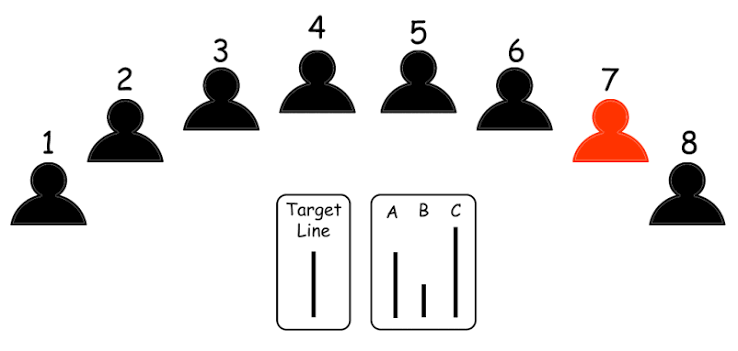
ASCH’S BASELINE PROCEDURE: how were the participants tested
individually, sitting last or next to last in a group of 6 to 8 confederates
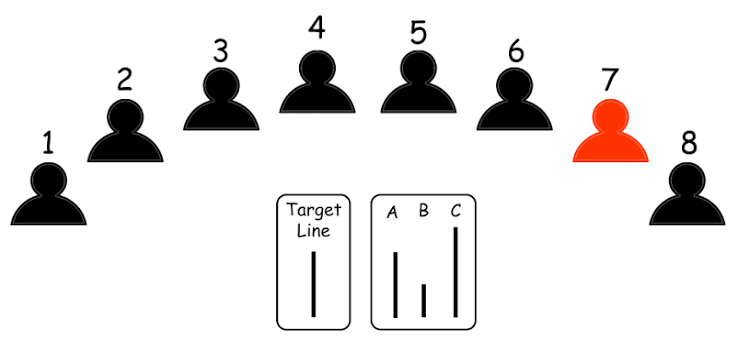
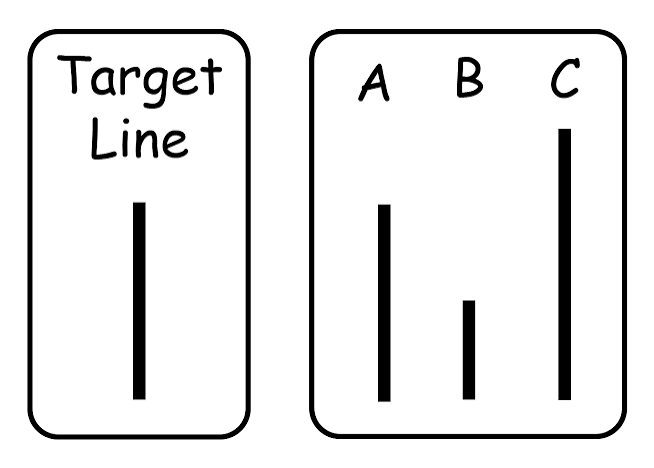
ASCH’S BASELINE PROCEDURE: what were the participants shown
2 large cards, one card had a standard line and the other card had 3 comparison lines
ASCH’S BASELINE PROCEDURE: what did each group have to do with the cards/lines
state which comparison line matched the standard line
ASCH’S BASELINE PROCEDURE: how many trials where there
18 trials with different pairs of cards each time
ASCH’S BASELINE PROCEDURE: what happened on 12/18 critical trials
confederates all gave the same wrong answer
FINDINGS OF ASCH’S BASELINE STUDY: what did Asch find with naïve participants
conformed 36.8%, shows a high level of conformity in ambiguous situations
FINDINGS OF ASCH’S BASELINE STUDY: how many participants never gave a wrong answer
25%
FINDINGS OF ASCH’S BASELINE STUDY: how many participants conformed at least once
75%
FINDINGS OF ASCH’S BASELINE STUDY: what type of differences did Asch discover there was
individual differences
after the baseline procedure what did Asch investigate next
variables that lead to more or less conformity
what variables did Asch investigate (IN ORDER)
group size, unanimity, task difficulty
ASCH’S VARIABLE 1 GROUP SIZE: what procedure was conducted
in each group there were between 1-15 confederates in a group size between 2-16
ASCH’S VARIABLE 1 GROUP SIZE FINDINGS: what was the relationship between group size and level of conformity
group size and level of conformity = curvilinear
ASCH’S VARIABLE 1 GROUP SIZE FINDINGS: what happened if there were 2 confederates
conformity to wrong answer was 13.6%
ASCH’S VARIABLE 1 GROUP SIZE FINDINGS: what happened if there were 3 confederates
conformity rose to 31.8%
ASCH’S VARIABLE 1 GROUP SIZE FINDINGS: what happened if there were more than 3 confederates
conformity rate levelled off
WHAT WAS ASCH’S VARIABLE 1 GROUP SIZE EXPLANATION
people are very sensitive to others opinions because one confederate was enough to sway opinions
ASCH’S VARIABLE 2 UNANIMITY: What procedure did Asch conduct
introduced a dissenting confederate who sometimes gave correct answers and sometimes a different wrong answer
ASCH’S VARIABLE 2 UNANIMITY PROCEDURE: what did the dissenting confederate always disagree with
the majority
ASCH’S VARIABLE 2 UNANIMITY FINDINGS: what happened to conformity when dissenter was present
conformity reduced to less than ¼ of the level it was when majority was unanimous
ASCH’S VARIABLE 2 UNANIMITY FINDINGS: what happened to conformity when dissenter gave a right or wrong answer
conformity reduced
ASCH’S VARIABLE 2 UNANIMITY EXPLANATION: what did having a dissenter enable
enabled the naïve participant to behave independently
VARIABLE 3 ASCH’S TASK DIFFICULTY: what was Asch’s procedure for task difficulty
He made the line judging task harder by making standard line and comparison lines more similar in length so it was harder to see a difference
VARIABLE 3 ASCH’S TASK DIFFICULTY: What were Asch’s findings for task difficulty
conformity increased
VARIABLE 3 ASCH’S TASK DIFFICULTY EXPLANATION: what happened when the situation was more ambiguous
more likely to look for others for guidance and assume they are right
VARIABLE 3 ASCH’S TASK DIFFICULTY EXPLANATION: what plays a role when the task is harder
ISI
ONE limitation of Asch’s baseline procedure is that the situation and task was artificial why is this?
participants knew they were in a study, task was trivial and there was no reason not to conform, Fiske (2014) argued that Asch’s groups were not like real life groups, findings dont generalise to everyday life
What is SECOND limitation for Asch’s baseline procedure
his findings have limited application
Why does Asch’s baseline procedure findings have limited application
only American men were tested, Neto (1995) said that women might be more conformist, the US is a individualistic culture and studies in collectivist cultures have high conformity, so his findings tell us little about women and people from other cultures
what is an individualistic culture
value personal independence, autonomy, and individual goals over group harmony
what is a collectivist culture
society that puts the needs, goals, and well being of the group above personal desires
One strength of Asch’s baseline procedure is that there is evidence to support his findings why is this?
Wijenayake et al (2020) gave participants a quiz showed them fake results and then were offered to change their answers, results were similar to Asch’s, confirms Asch’s original findings
Which evaluation points can be used for both baseline procedure and variable investigation by Asch?
artificial situation/task, limited application, individual differences
How does Asch’s research raise ethical issues
participants were deceived so didnt give informed consent to take part and may have had a bad experience