Honors Bio - Unit 10
 Call Kai
 Learn
Learn Practice Test
 Spaced Repetition
 Match
Match Flashcards
 Knowt Play
1/101

There's no tags or description
Looks like no tags are added yet.
Name | Mastery | Learn | Test | Matching | Spaced | Call with Kai | Chat |
|---|
No analytics yet
Send a link to your students to track their progress
102 Terms
DNA (deoxyribonucleic acid)
The molecule that carries genetic information; structured as a double helix.
Nucleotide
The building block of DNA/RNA, consisting of a sugar, a phosphate group, and a nitrogenous base.
Helical / Helix
The twisted ladder shape of DNA
Antiparallel
The orientation of DNA strands where they run in opposite directions (5′ to 3′ vs. 3′ to 5′).
Base Pairing
The rule that Adenine pairs with Thymine (or Uracil in RNA) and Cytosine pairs with Guanine.
Chromatin
A substance within a chromosome consisting of DNA and protein (histones).
Chromosome
A threadlike structure of nucleic acids and protein found in the nucleus, carrying genetic information in the form of genes.
Gene
A specific segment of DNA that codes for a protein.
James Watson & Francis Crick
Scientists credited with discovering the double-helix structure of DNA.
Rosalind Franklin
The scientist whose X-ray diffraction images (Photo 51) were critical to discovering the DNA structure.
Erwin Chargaff
Developed "Chargaff's Rules," stating that [A]=[T] and [G]=[C].
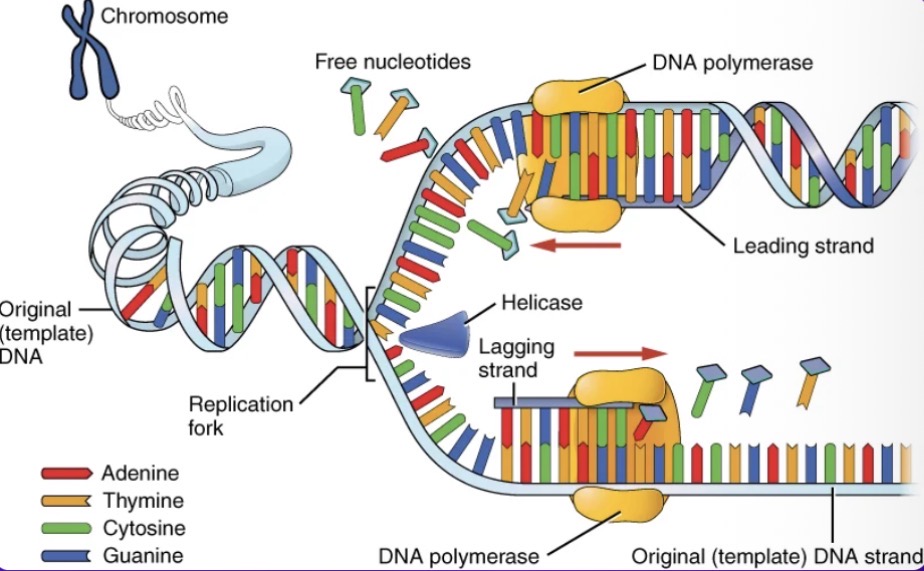
DNA replication
The process of making an identical copy of a DNA molecule.
Semi-conservative
The mechanism of DNA replication where each new DNA molecule consists of one "old" strand and one "new" strand.
Helicase
The enzyme that "unzips" the DNA double helix by breaking hydrogen bonds.
DNA polymerase
The enzyme that adds new nucleotides to the growing DNA strand and proofreads for errors.
RNA primer
A short strand of RNA that serves as a starting point for DNA synthesis.
Leading & Lagging strands
The leading strand is synthesized continuously; the lagging strand is synthesized in short bursts.
Okazaki fragments
Small sections of DNA formed on the lagging strand during replication.
Ligase
The enzyme that "glues" DNA fragments (like Okazaki fragments) together.
Denaturation
The process of separating the two strands of DNA (often via heat).
RNA (ribonucleic acid)
A single-stranded nucleic acid involved in protein synthesis.
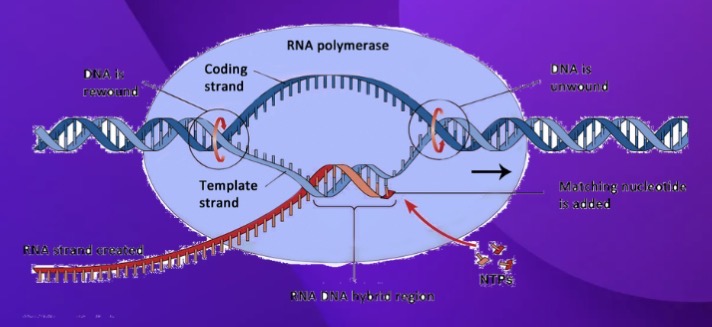
Transcription
The process of copying a segment of DNA into mRNA.
RNA polymerase
The enzyme responsible for creating mRNA from a DNA template.
mRNA
The messenger that carries the genetic code to the ribosome
tRNA
Transfers / brings amino acids to the ribosome
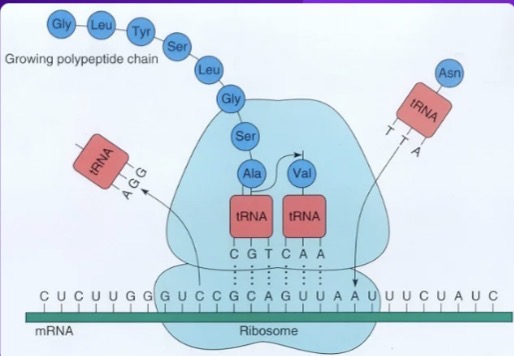
Translation
The process where ribosomes use mRNA and tRNA to build a protein.
Codon
A 3-base sequence on mRNA
Anticodon
The complementary 3-base sequence on tRNA
Protein synthesis
The multi-step process of creating functional proteins from DNA instructions.
Amino acid
The monomer (building block) of proteins.
Polypeptide
A chain of amino acids linked by peptide bonds.
Primary structure
The specific sequence of amino acids in a polypeptide chain.
Protein
A functional biological molecule made of one or more polypeptide chains.
Mutation
Any change in the DNA sequence
Mutagen
An agent (like UV light or chemicals) that causes genetic mutations.
Point mutation
A mutation affecting only one or very few nucleotides in a gene sequence.
Substitution
A mutation where one base is swapped for another.
Frameshift mutation
A mutation caused by insertion or deletion that shifts the "reading frame" of the genetic message.
Chromosomal mutation
A mutation that involves changes in the number or structure of whole chromosomes.
Deletion
Loss of a part of a chromosome or DNA sequence.
Duplication
Production of one or more copies of a gene or chromosome region.
Insertion
The addition of one or more nucleotide base pairs into a DNA sequence.
Translocation
When a piece of one chromosome breaks off and attaches to another.
Aneuploidy
A condition where a cell has an abnormal number of chromosomes (e.g., 45 or 47 instead of 46).
Polyploidy
A condition in which an organism has extra sets of chromosomes (common in plants).
Nucleotide
What is the monomer of DNA?
Erwin Chargaff
Who helped us learn which bases partner together?
Rosalind Franklin
Who took a picture of DNA using x-ray crystallography?
Helix (not double)
Rosalind Franklin helped determine that DNA's shape is a...
James Watson & Francis Crick
Who built a model of DNA and won a Nobel prize?
c. Has adenine-guanine pairs
Which of the following does NOT describe the structure of DNA?
a. Double helix
b. Nucleotide polymer
c. Has adenine-guanine pairs
d. Sugar-phosphate backbone
Nucleotide
What is the name of the monomer that makes up nucleic acids?
b. An amino acid
A nucleotide does NOT contain…
a. A sugar
b. An amino acid
c. A nitrogen base
d. A phosphate group
c. T=A and G=C
Which of the followings shows the correct pair of bases?
a. A=C and T=G
b. G=A and C=T
c. T=A and G=C
d. T=A and C=G
True
T or F: Nucleotides can occur in any order in DNA.
False
T or F: Nitrogen bases bond to sugars and phosphates.
True
T or F: Sugars bond to nitrogen bases and phosphates.
Hydrogen bonds
What type of bond forms between nitrogenous base pairs?
Chromosome
A tightly coiled, compact, and organized structure of DNA = ?
46
How many total chromosomes do humans have?
Replication
The process of DNA duplicating itself = ?
DNA helicase
This enzyme unwinds and unzips DNA during replication...
DNA ligase
This enzyme joins fragments of DNA together to make them a continuous strand...
DNA polymerase
This enzyme adds nitrogen bases to the new DNA strand during replication...
Primase
This enzyme adds an RNA primer to help identify where replication should start...
TGACA
What would the complementary sequence of DNA be for ACTGT during replication?
Adenine and guanine
Which nitrogen bases are purine bases?
Cytosine and thymine
Which nitrogen bases are pyrimidine bases?
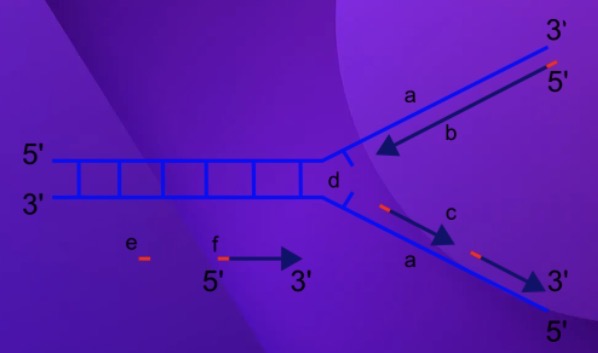
D
Which letter best represents the replication fork?
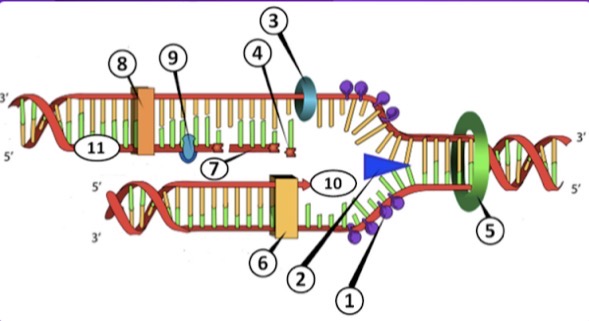
11
Which number best represents the lagging strand?
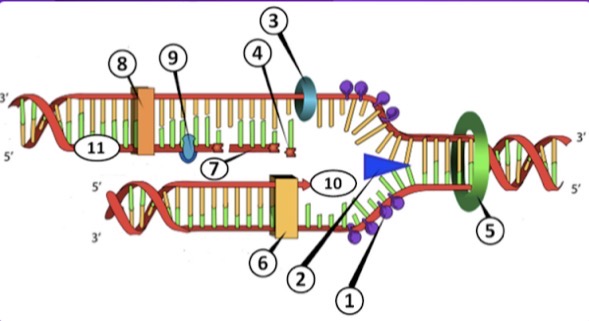
10
Which number best represents the leading strand?
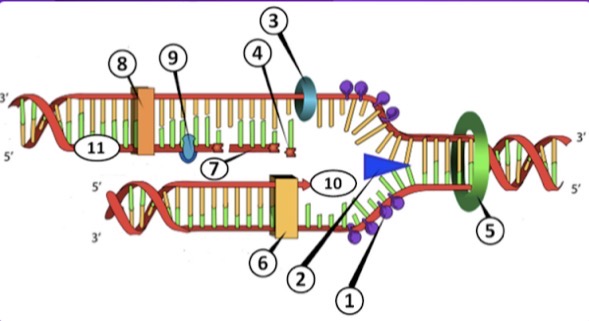
7
Which number best represents an Okazaki fragment?
True
T or F: Replication is semiconservative because every new DNA helix contains one strand of old DNA and one new strand.
Amino acid
What is the monomer of a protein?
DNA replication
Which process is shown in the diagram
Transcription
Which process is shown in the diagram?
Translation
Which process is shown in the diagram?
Phenylalanine
Which amino acid is coded for by the mRNA codon UUC?
AUG
Which mRNA codon is methionine?
TAC TTG
Reverse transcribe the following sequence into DNA: AUG AAC
met - asn - stop
Translate the following sequence: AUG AAC UGA
A complementary copy of mRNA
What is the end product of transcription?
A growing protein chain
What is the end product of translation?
A codon
The three base sequence on mRNA = ?
An anti-codon
The three base sequence on a tRNA = ?
GCAT
Which nitrogenous bases are found in DNA?
UAGC
Which nitrogenous bases are found in mRNA?
Carries instructions from the nucleus to the ribosomes
What is the function of mRNA?
Carries amino acids to the ribosome
what is the function of tRNA
30
If a protein had 10 amino acids, how many nucleotides were transcribed?
TCA TTG
What is the complementary strand of DNA to the sequence AGT AAC?
RNA
Which molecule has the structural design of a single helix?
RNA polymerase
Which enzyme is responsible for transcribing DNA into mRNA?
Polymerase chain reaction
Which process is used to make millions of copies of a specific region of DNA?
All of the above
Which of the following could the process of PCR be used for?
a. Detecting and identifying viruses
b. Analyzing genetic variation
c. Paternity testing
d. Crime scene analysis
Heat
What variable drives the PCR process?
DNA has a negative charge
In gel electrophoresis, DNA pieces move through a gel because...
DNA fingerprint
Gel electrophoresis is often used to produce a...
Shorter fragments
During gel electrophoresis, which DNA fragments travel further in the gel?
Separates DNA fragments by size
What does gel electrophoresis do?