BioLAB Quiz 2
 Call Kai
 Learn
Learn Practice Test
 Spaced Repetition
 Match
Match Flashcards
 Knowt Play
1/24

Earn XP
Description and Tags
Vocabulary flashcards covering taxonomy, characteristics, media, colony morphology, and Gram staining for Burkholderia thailandensis.
Name | Mastery | Learn | Test | Matching | Spaced | Call with Kai | Chat |
|---|
No analytics yet
Send a link to your students to track their progress
25 Terms
Burkholderia thailandensis
A model bacterial organism in the phylum Pseudomonadeta and class Betaproteobacteria that is bacillus (rod-shaped), motile, obligate aerobic, and rarely pathogenic in humans.
Pseudomonadeta
The taxonomic phylum to which Burkholderia thailandensis belongs.
Betaproteobacteria
The taxonomic class of Burkholderia thailandensis.
B. mallei and B. pseudomallei
More virulent, pathogenic species closely related to Burkholderia thailandensis.
L-arabinose Assimilation
A key functional characteristic that differentiates Burkholderia thailandensis from its pathogenic relatives B. mallei and B. pseudomallei.
Polar Flagella
Structures formed by motile Burkholderia thailandensis cells that enhance chronic infections.
Obligate Aerobes
Organisms that require oxygen to survive and grow, such as Burkholderia thailandensis.
Agar
A substance used as a solidifying agent in solid culture media.
B. thailandensis Incubation Temperature
The standard temperature at which Burkholderia thailandensis is typically incubated, which is 37∘C.
Luria Agar (LA) and Luria Broth (LB)
Common media types used in the laboratory for bacterial growth and culturing.
Colony
A visible mass formed when a single parent cell replicates on solid media.
Whole Colony Shape
A physical property used for colony identification, with examples including Round, Irregular, and Rhizoid.
Margin Shape
A physical property describing the edge of a colony, with examples including Smooth, Lobate, and Filamentous.
Elevation
A physical property describing the profile height of a colony, with examples including Convex, Umbonate, and Flat.
Optical Properties
Light-transmitting characteristics of a colony used for identification, such as Opaque or Translucent.
Surface Characteristics
Physical exterior properties of a colony used for identification, such as Dull, Shiny, or Wrinkled.
Bacterial Water Content
Bacterial cells are 90% water, making them difficult to see under a microscope without stains to create contrast.
Primary Stain (Gram Staining)
Crystal violet, which stains all bacterial cells purple.
Mordant (Gram Staining)
Iodine, which forms a complex with crystal violet dye to increase its retention in cells.
Decolorizer (Gram Staining)
Ethanol, which removes stain from Gram-negative cells.
Counterstain (Gram Staining)
Safranin, which stains Gram-negative cells pink.
Gram-Positive Cells
Cells that retain the primary stain during Gram staining and appear dark purple under the microscope.
Gram-Negative Cells
Cells that are decolorized and take up the counterstain during Gram staining, appearing pink/red under the microscope.
Taxonomic Hierarchy

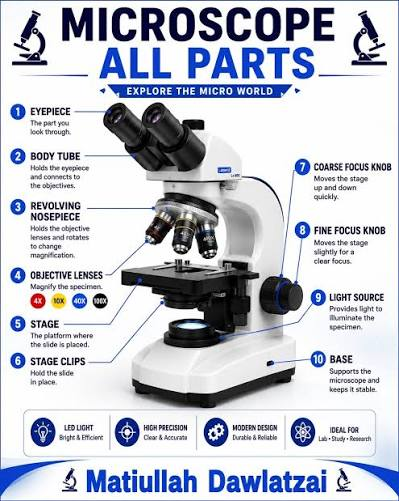
Microscope