AIS Chapter 13
 Call Kai
 Learn
Learn Practice Test
 Spaced Repetition
 Match
Match Flashcards
 Knowt Play
1/34

There's no tags or description
Looks like no tags are added yet.
Name | Mastery | Learn | Test | Matching | Spaced | Call with Kai |
|---|
No analytics yet
Send a link to your students to track their progress
35 Terms
Operating System (OS)
Ensure the integrity of the system.
Control the flow of multiprogramming and tasks of scheduling in the computer.
Allocate computer resources to users and applications.
Manage the interfaces with the computer.
Five Fundamental Control Objectives
Protect itself from users
Protect users from each other
Protect users from themselves
Be protected from itself
Be protected from its environment
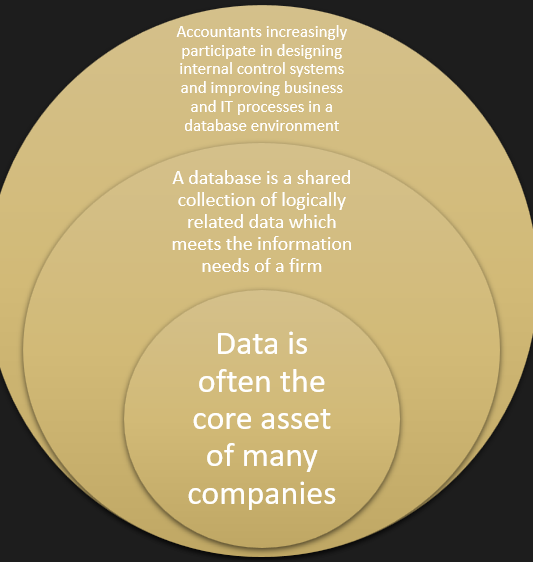
Database Systems
Data warehouse
a centralized collection of firm-wide data for a relatively long period of time
Operational databases
used for daily operations and often includes data for the current fiscal year onlyDat
Data Mining
the process of searching for patterns in the data in a data warehouse and data analyzing these patterns for decision making
Data governance
the convergence of data quality, data management, data policies, business process management, and risk management surrounding the handling of data in a firm
Local Area Network (LAN)
a group of computers, printers, and other devices connected to the same network that covers a limited geographic range
LAN Hubs
Broadcasts through multiple ports
LAN Switches
provides a path for each pair of connections
Wide Area Network (WAN)
Link different sites together, transmit information across geographically and cover a broad geographic area
WAN uses
to provide remote access to employees or customers
to link two or more sites within the firm
to provide corporate access to the Internet routers and firewalls
Routers
connects different LANs software-based intelligent devices, examines the Internet Protocol (IP) address
Firewalls
a security system comprised of hardware and software that is built using routers, servers, and a variety of software; allows individuals on the corporate network to send/receive a data packet from the Internet
Virtual Private Network (VPN)
Securely connects a firm’s WANs by sending/receiving encrypted packets via virtual connections over the public Internet to distant offices, salespeople, and business partners.
Wireless Network
comprised of two fundamental architectural components
Access Point
Logically connects stations to a firm’s network.
Station
a wireless endpoint device equipped with a wireless Network Interface Card (NIC)
Benefits of using wireless technology
Mobility
Convenient online access without a physical network using cables for connections.
Rapid Deployment
Time saving on implementing networks because of reduction in using physical cables/media.
Flexibility and Scalability
Freely setting up or removing wireless networks at different locations.
Security Objectives for LAN & wireless
Confidentiality
Ensure that communication cannot be read by unauthorized parties.
Integrity
Detect any intentional or unintentional changes to the data during transmission.
Availability
Ensure that devices and individuals can access a network and its resources whenever needed.
Access Control
Restrict the rights of devices or individuals to access a network or resources within a network.
Security Controls in Wireless Network
Management controls
assigning roles/responsibilities
creating policies/procedures
conducting risk assessment on a regular basis
Operational controls
protecting a firm’s premise and facilities,
preventing and detecting physical security breaches
providing security training to employees, contractors, or third party users.
Technical controls
implemented and executed through mechanisms contained in computing-related equipment, including access-point management and encryption setup (using WPA/WPA2).
Computer-assisted Audit Techniques
imperative tools for auditors to conduct an audit in accordance with heightened auditing standards
Generally Accepted Auditing Standards (GAAS)
broad guidelines regarding an auditor’s professional responsibilities
Information Systems Auditing Standards (ISASs)
provides guidelines for conducting an IS/IT audit (issued by ISACA)
Institute of Internal Auditors’ (IIA) professional practice standard section 1220.A2
internal auditors must consider the use of computer-assisted, technology-based audit tools and other data analysis techniques when conducting internal audits
Black-Box Approach
Auditing around the computer
White-box approach
Auditing through the computer
Steps for Black-Box Approach
First calculating expected results from the transactions entered into the system
Then comparing these calculations to the processing or output results
The advantage of this approach is that the systems will not be interrupted for auditing purposes. The black-box approach could be adequate when automated systems applications are relatively simple.
Process for White-Box Approach
test data technique: uses a set of input data to validate system integrity.
Parallel simulation: attempts to simulate the firm’s key features or processes
(Integrated Test Facility) ITF: approach is an automated technique that enables test data to be continually evaluated during the normal operation of a system
Embedded audit module: a programmed audit module that is added to the system under review
Generalized Audit Software (GAS)
Frequently used to perform substantive tests and is used for testing of controls through transactional-data analysis
Provides auditors an independent means to gain access to data for analysis and the ability to use high-level, problem-solving software to invoke functions to be performed on data files
ACL
Audit Control Language
IDEA
Interactive Data Extraction and Analysis
Continuous Audit
performing audit-related activities on a continuous basis
General Steps for Continuous Audit
Evaluate the overall benefit and cost
Develop a strategy
Plan and design
Implement continuous auditing
Performance monitoring