Dose Calculations
 Call Kai
 Learn
Learn Practice Test
 Spaced Repetition
 Match
Match Flashcards
 Knowt Play
1/22

There's no tags or description
Looks like no tags are added yet.
Name | Mastery | Learn | Test | Matching | Spaced | Call with Kai | Chat |
|---|
No analytics yet
Send a link to your students to track their progress
23 Terms
What is the MRD?
The Maximum Recommended Dose (MRD) represents the FDA recommended maximum quantity of drug that can be safely administered during an appointment.
MRDs can be measured in 2 ways ... how?
They are either based on the patient weight (mg/lb or mg/kg) or they can be an absolute maximum.***
What do you do when your patient's calculated maximum dose based on weight exceeds the absolute MRD?
You should respect the absolute MRD, since that is the maximum ANY patient should be receiving, regardless of weight.**
The concentration of a drug is expressed as a percentage which refers to ...?
grams of drug / 100 mL solution
(but all calculations are mg/mL so convert to miligrams)
How many mg/mL of a drug are in a 3% and 1% solution, respectively?
30 mg/mL and 10 mg/mL
A standard North American cartridge contains _________ mL.
1.8 mL
How many mg of a drug are contained in a standard cartridge if the drug is dosed at 2% per cartridge?
36 mg/cartridge (20 x 1.8)
How many mg of a drug are contained in a standard cartridge if the drug is dosed at 4% per cartridge?
72 mg/cartridge (40 x 1.8)
How many mg of a drug are contained in a standard cartridge if the drug is dosed at 3% per cartridge?
54 mg/cartridge (30 x 1.8)
How much articaine have you injected if you used a 4 cartridges of a 4% solution?
72 mg/cartridge x 4 cartridges = 288 mg articaine delivered
How do we determine weight based MRD?
refer to the weight-based MRD for 2% lidocaine (3.2 mg/lb) and multiply it by the patient's weight: 3.2mg/100lbs = 320 mg
The potential risks associated with using LA drug combinations is _________ and not __________.
synergistic ; additive
T of F? The risk of the combined drugs is greater than the risk associated with the sum of each individual drug
TRUE - follow absolute MRD for most toxic drug used in the combination (lowest MRD)
A 45kg healthy patient presents for a large amalgam restoration. You have given her 2 cartridges of 2% mepivacaine, 1:20,000 levonordefrin but the anesthesia is inadequate. You know wish to change to 4% articaine, 1:100k epinephrine. How much articaine can you give her?
1. Determine which of the MRDs you should adhere to.
- Mepivacaine 2% = 6.6mg/kg x 45kg = 297mg (use this one due to lower MRD/more toxic)
-Articaine 4% = 7.0mg/kg x 45kg = 315mg
2. The patient has received 2 carps of mepivacaine (36mg/cartridge x 2 cartridge = 72mg). So now, we can only administer 297mg - 72mg = 225mg of articaine.
3. 225mg divided by 72mg/cartridge = ~*** 3.0 carpules of articaine.***
Vasoconstrictor doses are measured as ____________ and not percentages
dilution ratios
What does a 1:100,000 ratio signify?
There is 1g of epinephrine per 100L = 1,000mg/100,000mL = 1mg/100mL = 0.01mg/mL.
How much epinephrine will the MRD of 2% lidocaine, 1:100,000 epinephrine contain on a 100lb patient?
1. Calculate the MRD for this patient: 100lbs x 3.2mg/lb = 320mg
2. Amount of lidocaine in one cartridge = 36
3. Calculate the number of cartridges you will use: 320mg divided by 36mg/cartridge = 8.88 cartridges
4. Calculate the total amount of epinephrine: 8.88cartridges x 0.018mg epinephrine per cartrdige = **0.16mg**, which is less than the absolute maximum recommended dose of epinephrine (0.2mg)
Since both LA and vasoconstrictors have MRDs, it makes sense that one will reach its MRD before the other. Which is the limiting factor?
The agent which reaches its MRD first is the limiting factor and determines the amount of solution that can be given.
What is Clark's rule?
a child's weight (in lbs) should be divided by 150 to obtain the fraction of the adult dose that should be given to the child!!!!!
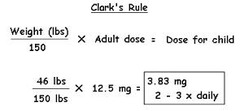
How do we use Clark's rule? (example)
10 year-old, 70 lb child using 2% lidocaine would only use 70/150 = 0.47 of the adult MRD for 2% lidocaine.
The absolute MRD (child's dose) is multiplied by the fraction to obtain the calculated MRD: 500mg x 0.47 = 235mg.
Therefore, 141mg is the calculated MRD
What is Young's rule?
Does NOT consider weight!!! This rule states that a child's dosage is equal to the adult dosage multiplied by the child's age in years divided by the sum of 12 + child's age
How do we use Young's rule? (example)
10yo 70lb patient requiring 2% lidocaine would have a calculated MRD of 227
500 x 10 / 12+10 = 227
What about children that are overweight?
The current standard of care is to use the ideal body weight (the weight expected of a child a certain age regardless of their actual weight).