SR12 - Product Processing & Biomining
 Call Kai
 Learn
Learn Practice Test
 Spaced Repetition
 Match
Match Flashcards
 Knowt Play
1/19

There's no tags or description
Looks like no tags are added yet.
Name | Mastery | Learn | Test | Matching | Spaced | Call with Kai | Chat |
|---|
No analytics yet
Send a link to your students to track their progress
20 Terms
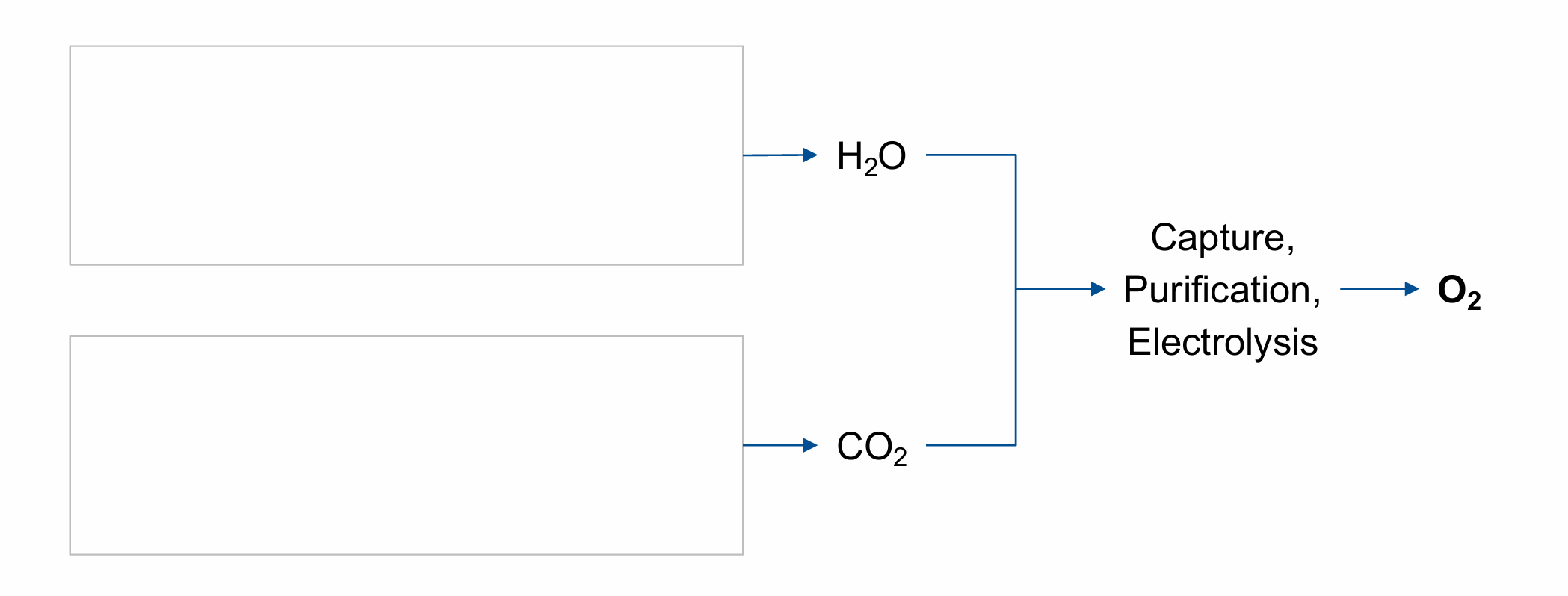
Complete the boxes
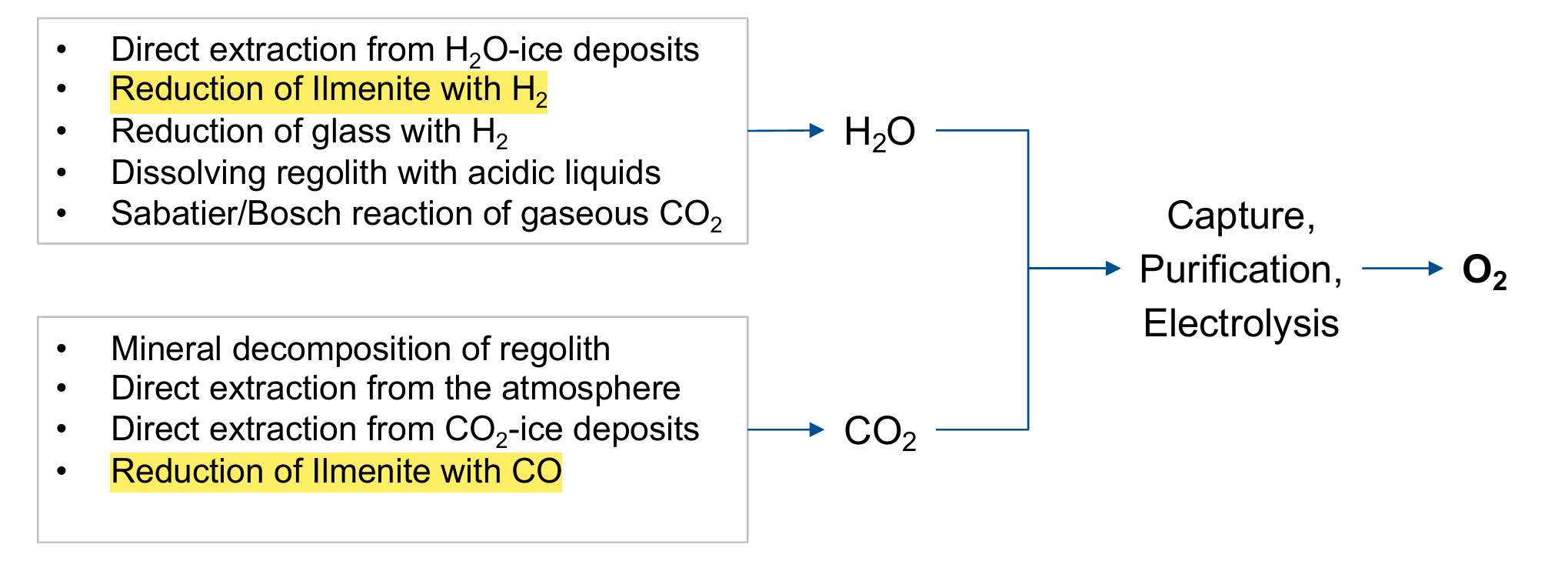
What are requirements to capture and purifiy water
No chem. contamination
No microbial contamination
Specific pH range
Removal of e.g. Cu, Mo, Ag, Cd, Sn, P for PEM electrolysis (to avoid electrode poisoning
Set up the redox-reaction occuring in a H2O-Electrolysis. What is its minimum p.d. ?
What are strengths/results of using zero-gap setup over a classical (Alkaline) electrolysis setup
→ results in larger current densities & higher cell efficiencies
What are the drawbacks of zero-gap setups? How does the dual-membrane approach correct this ?
→ Zero Gap: Maintenance of gas phase seperation by porous electrodes and transport layer
Dual Membrane: Aims to improve gas phase seperation
What is the main difference of a Proton Exchange Membrane (PEM) Electrolysis to a classical Alkaline (liquid) electrolyte ?
→ Employs a polymer electrolyte membrane instead of a liquid electrolyte, operates at higher pressure & higher current density
BUT requires corrosion-resistant iridium or platinum electrodes
Define the term … Reversible Potential (E_rev)
→ Minimum potential to apply between two electrodes to make the water dissociation reaction occur
Define the term … Activation Overpotential at anode and cathode (E_act,an and E_act,cat)
→ Kinetics of the electronic charge transfer reactions
Define the term … Ohmic Overpotential (E_ohm)
→ Caused by non-infinite conductivity of the electrolysis cell
Define the term … Diffusion Overpotential (E_diff)
→ For high current densities, the reaction is no longer controlled by electronic transfer but by matter transfer
Define the term … Bubble Overpotential (E_bub)
→ Increased resistance due to non-conductive bubbles covering parts of the electrodes
What are the characteristics of Solid Oxide Electrolysis (SOE)
High-temperature process (650-1000°C) that employs a solid electrolyte
Efficiencies of around 80% achievable
uses a porous cathode to allow H2O vapour to react to H2 and oxygen ions
Problem: Anode delamination due to O2 pressure buildup
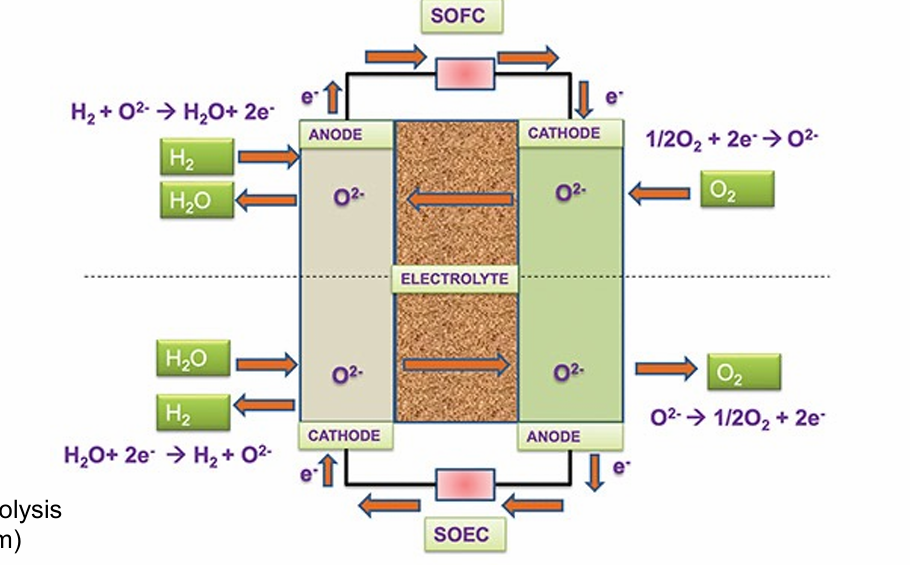
How do AEL,PEM and SOE differ in terms of charge carrier & transport direction ?
AEL → Hydroxide ions (OH-) carry the charge from cathode to anode
PEM → Protons (H+) carry the charge from anode to cathode
SOE → Oxide ions (O2-) carry the charge from cathode to anode
What is the main problem of H2O-Electrolysis for space application and what countermeasure could be enforced ?
Problem:
Reduced buoyancy and bubble detachement induces overpotentials due to increased ohmic resistance
Countermeasure:
Nanopattering
UV irradiation
Pressure swings
Vibration
other issues: Gas-Liquid phase seperation → can be counteracted by centrifugal pumps, porous membranes
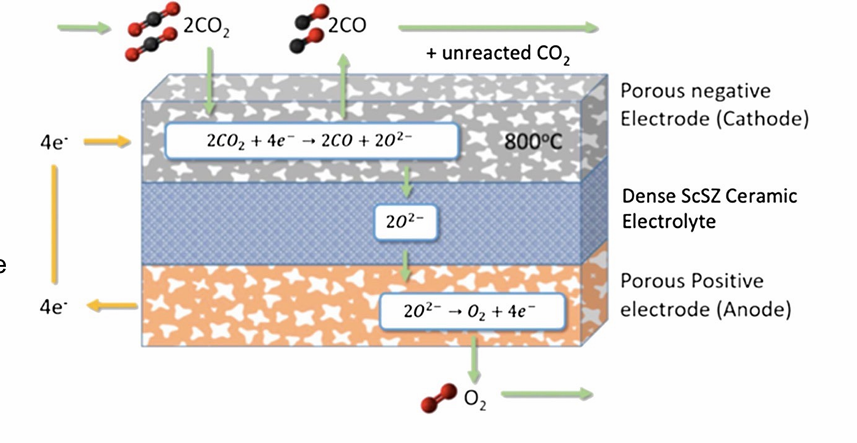
What are the characteristics of “Solide Oxide Electrolysis” (SOE) Process for CO2 Electrolysis ?
Heated CO2 (800°C) flows over the nickel-catalysed cathode surface under an applied electric potential CO2 + 2e- → CO + O²-
CO and any unreacted CO2 are exhausted through an outlet tube
O²- ions are electrochem. driven through the solid oxide electrolyte to the anode and combine there to produce the gaseous O2 that is relased from the anode cavity at a rate proportional to the current
What are the risks involved with electrode coking ?
Principal Reactions:
(1) CO2 + electricity → CO + 0.5 O2
(2) CO + electricity → C + 0.5 O2
If carbon is produced it will coat the electrodesm interferring with electrolysis process. Nickel in cathode a well-known catalyst for that
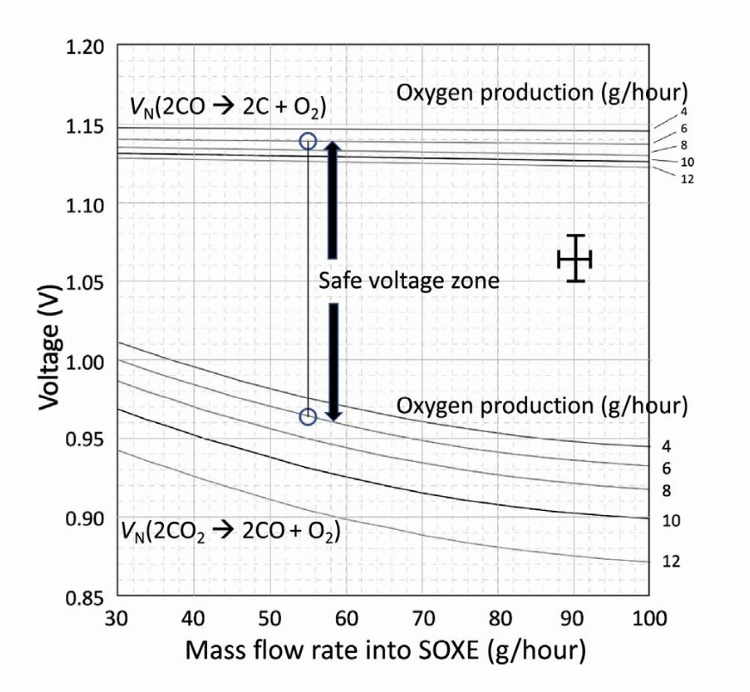
What does the Safe Voltage Zone represent ?
→ Represents Zone of NO electrode coking
What are challenges faced with Biomining in space
Survival of bacteria in space environment (main factor is radiation)
Requires Water
What primary bacteria is used for biomining in space ?
Acidithiobacillus ferroxidans uses elementary sulfur, tetrathionate and ferrous iron as electron donors
+able to grow anaerobically
+able to solubilise metals from lunar & martian regolith
What is the correlation between lunar regolith & terrestrial plant growth
→ More mature regolith provides poorer substrate for plant growth than immature regolith (higher surface area, higher nanophase iron content)
On lunar regolith simulants, plantrs grow comparatively well