SIE - Chapter 3 - Equity Securities
 Call Kai
 Learn
Learn Practice Test
 Spaced Repetition
 Match
Match Flashcards
 Knowt Play
1/70

There's no tags or description
Looks like no tags are added yet.
Name | Mastery | Learn | Test | Matching | Spaced | Call with Kai | Chat |
|---|
No analytics yet
Send a link to your students to track their progress
71 Terms
common stock
traditional form of equity and common stockholders are the last to be paid if the corporation declares bankruptcy. Common stockholders may receive dividends but only after the corps bondholders (if any) and the preferred stockholders (if any) have been paid
-does have voting rights
preferred stock
-considered a senior security above the common stockholders, but it still ranks below the bondholders
-owners have preference over common stockholders regarding payment of dividends
-does not have voting rights
corporations
-file articles of incorporation
-solicit individuals to serve as members of the board of directors
-board member responsibilities include overseeing the management team, corporate governance, declaring dividends
-shareholders do not declare dividends - the board of directors do
proxy vote
a vote cast by one person for or in place of another
(i.e., When Kendall called from the phone in succession to get Roman to say his vote)
how corporations raise money
debt financing and equity financing
-equity financing = stocks
-debt financing = bonds
who gets paid first?
bondholders, preferred, common
authorized shares
shares of common stock that a firm's corporate charter allows it to issue
issued shares
represent the total number of shares of stock that have been sold
treasury stock
A corporation's own stock that has been reacquired by the corporation and is being held for future use.
-has no voting rights and doesn't receive dividends
-appears as an informational item on the balance sheet
outstanding stock
-refers to the number of shares that have been issued to the public, minus any stock that has been repurchased by the company, its referred to as treasury stock
-has voting rights and receives dividends
-Issued stock - treasury stock = outstanding stock
rights of common shareholders
Right of inspection
Right to vote
Right to receive dividends
Right to evidence of ownership
Right of transfer
Important note when shareholders vote:
shareholders vote on whether the corporation may execute a stock split, but NOT on whether the corporation should pay cash and/or stock dividends
two main voting methods on the board of directors
-statutory
-cumulative
statutory voting
-beneficial for large shareholders
-one vote, per share, per issue
cumulative voting
-shareholders are able to multiply the number of shares that they own by the number of voting issues
-beneficial for small shareholders
-allows shareholders to multiply the number of shares owned by the number of voting issues
As it relates to the corporate capitalization, which of these statements is/are true?
i. the number of outstanding shares is always equal to the number of issued shares
ii. treasury stock is previously issued shares that are no longer outstanding
iii. shareholders vote to authorize the payment of dividends
iv. cumulative voting is most beneficial for small shareholders
ii. treasury stock is previously issued shares that are no longer outstanding
iv. cumulative voting is most beneficial for small shareholders
dividend
The portion of corporate profits paid out to stockholders
restricted securities
-when securities are purchased through a private placement
-unregistered securities that are typically acquired by the investors thorough private placements
-restricted from being sold for a certain period of time
how can you tell a security is unregistered?
stop-transfer instructions are issued and a legend on the certificate
Investment Letter or Lock-up Agreement
Purchasers must sign the letter to acknowledge that the shares cannot be resold within a defined period
How long do lock up agreements last?
they generally expire six months following the closing of the IPO, there's no statutory time limit
How does the legend get removed on a restricted security?
via SEC Rule 144
SEC Rule 144
-regulates the sale of restricted securities and control (affiliated) securities
Control Securities
registered securities that are acquired by control (affiliated) persons in the secondary market
how long is the holding period on restricted securities
-mandatory six months
-starts from the time the securities were fully paid for (no margin) by the original purchaser
how long is the holding period on control securities
no minimum holding period
what form does one need to file when a person intends to sell either restricted or control securities?
-Form 144 at the time the sell order is placed to notify the SEC
Once Form 144 is filed, owners have __________ to sell their securities.
90 days
-if shares are not sold during this time an amended notice must be filed
Securities may be sold over ______ through unsolicited broker's trades or to a dealer that is acting as principal
90 days
When is the exemption from the notice of sale requirement (Form 144) available?
-if the sale doesn't exceed 5,000 shares and $50,000 of securities
What is the maximum amount of securities a control person can sell over any 90 day period?
-the greater of 1% of the total shares outstanding or the average weekly trading volume over the last four weeks preceding the filing
Example of Rule 144 Maximum Sale
For example, an issuer has 7,000,000 shares outstanding and the average weekly trading volume for the past four weeks was 60,000 shares. Since 1% of the total shares outstanding is 70,000 shares and the four-week average is 60,000 shares, the holder can sell the greater of these two amounts, which is 70,000 shares.
Example 2 of Rule 144 Maximum Sale
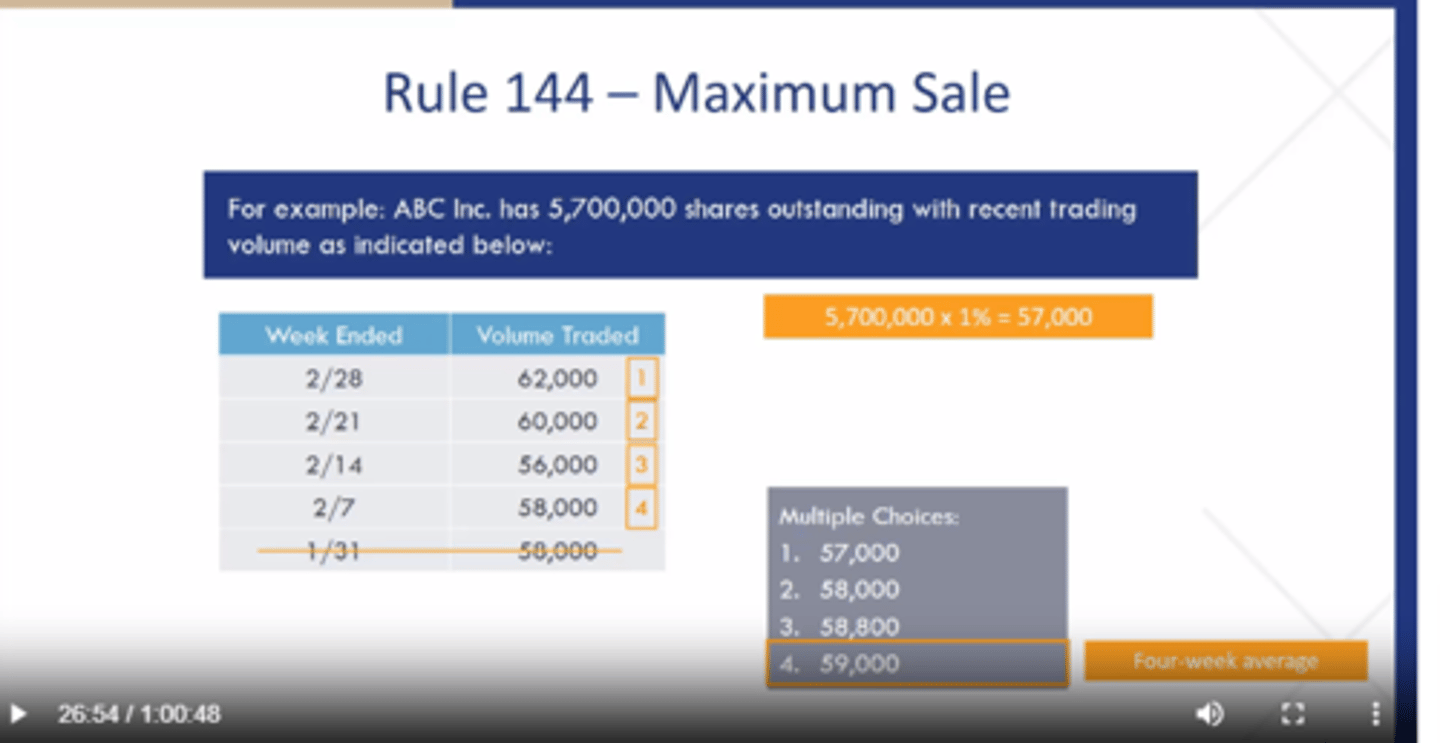
American Depositary Receipts (ADRs)
-facilitate the trading of foreign stocks in the US
-represents a claim to foreign securities while the actual underlying shares are held by US banks overseas
-they trade in US markets, either on an exchange or over the counter, and are priced and pay dividends in US dollars, rather than in a foreign currency.
-ADR shareholders have dividend rights, but don't directly receive preemptive rights
Sponsored ADRs
- Issued in cooperation with the foreign company
- May trade on US exchanges (NASDAQ or NYSE)
Unsponsored ADRs
-Issued without involvement of the foreign company
-Generally trade in OTC market (OTCBB or OTC Pink Markets)
What type of securities are acquired through private placement?
restricted securities
What is the holding period for restricted stock? and control stock?
six months; no holding period
How many shares can be sold when filing Form 144?
When Form 144 is filed, the maximum sale allowed is the greater of 1% of the outstanding shares or the average weekly trading volume over the previous four weeks
Cyclical Stocks
stock of companies whose value fluctuates with the business cycle (e.g., household appliances, automobile)
Defensive Stocks
stock of companies that are resistant to recession (e.g., utilities, tobacco)
-things you always need
Blue Chip Stocks
stock of strong, well-established, dividend paying companies
Income Stocks
stock of companies that pay higher than average dividends in relation to market price
American Depository Receipts
facilitates the trading of foreign stock in US markets
Growth Stocks
stock of companies with sales and earnings that are expanding faster than the economy; pay little (if any) dividends
Does preferred stock have voting rights?
no
Does common stock have voting rights?
yes
What is par value of preferred stock?
$100
types of preferred stock
-Non-Cumulative
-Cumulative
-Callable
-Participating
-Convertible
non-cumulative preferred stock
-Investor is only entitled to the current dividend; the investor is NOT entitled to unpaid dividend (dividends in arrears)
-any missed payments don't accumulate. Instead, only the current year's dividend must be paid before common stock dividends are paid.
cumulative preferred stock
-Investor is entitled to unpaid dividends (those "in arrears") before common stock dividends may be paid
-corporation fails to pay the full dividend
-most preferred stock is cumulative
callable preferred stock
-issuer has the ability to repurchase the stock
-typically repurchased at a premium over par value
participating preferred stock
-Investor may receive additional dividends based on the company's profits
convertible preferred stock
-Investor may convert into a predetermined number of common shares
conversion ratio = par value of preferred stock ($100) / conversion price
convertible preferred stock example:
An investor bought 4%, $100 par convertible preferred stock at $110. The stock is convertible at $10 and the common stock's price has risen to $12.
What is the conversion ratio to convert preferred stock into common stock?
par ($100) / conversion price ($10) = 10 shares of common stock for every share of preferred stock
Based on the increased price of the common stock, at what price should the preferred stock be trading?
market value of common stock ($12) x conversion ratio (10 shares) = price of preferred stock ($120 per share)
Since the price of the common stock has risen to $12, the convertible preferred stock should be trading at $120
participating
allows stockholders to share in dividends paid to common stockholders
callable
permits the issuer to remove the stock from the market
cumulative
makes up for dividends that not paid in previous years
convertible
can be exchanged for common stock
preemptive rights
-a shareholders right to maintain percentage ownership; no dilution
-only if you own shares of common stock will you receive any rights (only for common shareholders not preferred)
-distributed through a rights offering
-one right for each share owned
-shareholders exercise rights at a price below the current market value prior to a public offering
-short term - typically must be exercised within 4-6 weeks
-tradable
-immediate discount with a below average current market value
rights offering
provides current shareholders with the opportunity to buy the shares at a lower price before they are offered to the public
-by participating in the offering the current shareholders are able to maintain their current percentage of ownership in the company
-if they choose not to participate their ownership and will be diluted by the new stock offering
subscription price
Price at which existing shareholders of a corporation are entitled to purchase common shares in a RIGHTS OFFERING.
warrants
-another type of derivative on an equity security that may be issued by corporations to purchasers of the issuer's stocks or bonds
-like rights, warrants give holders the ability to buy common stock at the subscription price in the future
-attached to bonds or stocks; act as "sweeteners"
-they are long term - may be exercised years after original issuance
-may be "detached" from securities with which they were originally issued and traded separately
-initial premium with an above average current market value
intrinsic value
if the stock's market price rises above the warrant's subscription price, then the warrant has intrinsic value
FINRA Rule 2261 - Disclosure of Financial Condition
-upon request, a member firm must make its balance sheet available to customers in either physical or electronic form
FINRA Rule 2262 - Disclosure of Control Relationship with Issuer
-before executing a trade in the issuer's securities, a broker dealer must disclose to its customers if it has a control relationship with the issuer
SEC Rule 10b-18 - Purchases of Certain Equity Securities by the Issuer
-an issuer of securities may be tempted to purchase its stock in an effort to increase the price
For the issuer's purchases to not be considered manipulative, the following conditions must be met:
-only one broker dealer used
-purchases made late in the day are prohibited
-purchase price is restricted (the price may not be higher than the highest independent bid or the last independent transaction price, whichever is higher)
-single-day purchase amount is limited (the total volume on any single day may not exceed 25% of the average daily trading volume for that security)
T/F: preemptive rights have immediate intrinsic value
T
T/F: warrants must be exercised within a short period from issuance
F
T/F: customers must be made aware of a broker-dealer's control relationship after the trade
F
T/F: only one broker-dealer can be used when an issuer is purchasing its own stock
T