Biochem exam 1
 Call Kai
 Learn
Learn Practice Test
 Spaced Repetition
 Match
Match Flashcards
 Knowt Play
1/445

There's no tags or description
Looks like no tags are added yet.
Name | Mastery | Learn | Test | Matching | Spaced | Call with Kai | Chat |
|---|
No analytics yet
Send a link to your students to track their progress
446 Terms
What are the four major macromolecules
proteins, nucleic acids, lipids and carbohydrates
proteins are polymers of —- ——-
amino acids
there are 20 different amino acids incorporated into proteins, hald of them are ——- and must be obtained from the diet
essential
five uses for proteins in the body
structural, enzymes, transport, defense, contractile
proteins can be modified by lipids, sugars and phosphates to make:
lipoproteins, glycoproteins, and phosphoproteins
The most important carbohydrate and a major source of fuel
glucose
What is the structure of glucose
a hexose sugar c6h12o6
What type of isomers of carbohydrates are utilizes in plants and animals
D isomers
carbohydrates can be monosaccharides, disaccharides and ——
polysaccharides
glucose, fructose, galactose and ribose are all examples of
monosaccharides
Maltose, sucrose and lactose are all examples of
disaccharides
maltose is made of
2 glucose
sucrose is made of
a glucose and a fructose
lactose is made of a
galactose and a glucose
glycogen, starch, cellulose and chitin are all examples of
polysaccharides
Nucleic acids are polymers of
nucleotides
Nucleic acids, DNA and RNA, store —- ——, direct protein synthesis and sometimes (RNA) act as enzymes
genetic information
All lipids can be formed in vivo from —- —— except essential fatty acids
acetyl CoA
most lipids are —- in water meaning they are nonpolar
insoluble
lipids can be classified as ——, —— or ——-
simple, complex or derived
tryglycerides are an an example of —- lipids
simple
phospholipids and glycolipids are — lipids
complex
fatty acids, steroids, fat soluble vitamins, ketone bodies and eicosanoids are all examples of —— lipids
derived
lipids play a role in: (6)
membrane, energy storage, cell signaling, fuel, vitamins and steroid hormones
cholesterol, glycolipids, and phospholipids are all —— components
membrane
triglycerides play a role in —— -storage
energy
eicosanoids are key for cell ——-
signaling
fatty acids and ketones help with
fuel
glucocorticoids, androgens and estrogens are important —— hormones
steroid
Trace elements like Iron, zinc, copper, Mn, Selenium, Iodine and Co are important for absorbtion, biochemical reactions and —- and —— can cause disease states
deficiencies and toxicities
water is a part of ——% of all molecules in the body
99
water makes up for between — and —% of total body weight
50 and 70
water is —- meaning there is a separation of charges within a molecule between two bonded atoms
dipolar
— bonds between water molecules contribute to structure
hydrogen
water can form hydrogen bonds with other —— molecules
polar
— and — compounds are soluble in water
ionic and polar
means water loving
hydrophillic
— substances are usually insoluble in water
nonpolar
means water fearing
hydrophobic
pH is the negative log of the —- —- concentration
hydrogen ion
the pH of pure water at 25C is —
7.0
Low pH values (less than 7) are —— (higher H+ ion concentration)
acidic
High pH values are —— means a lower concentration of H+ — blood pH is slightly alkaline at 7.4
basic
acids are proton ——
donors
bases are proton ——
acceptors
weak acids do or do not completely disassociate in water
do not
at hald neutralization pH= —- meaning there is an equal number of associated and dissasociated ions
pka (disassociation constant)
pKa is a measure of —- ——
acid strength
stronger acids more readily dissociate in water and they have —- pKa values compared to weaker acids.
lower
A buffer is a substance that —— change in the pH of a solution when an acid or base is added to the solution
minimizes
weak acids and their conjugate bases act as ——
buffers
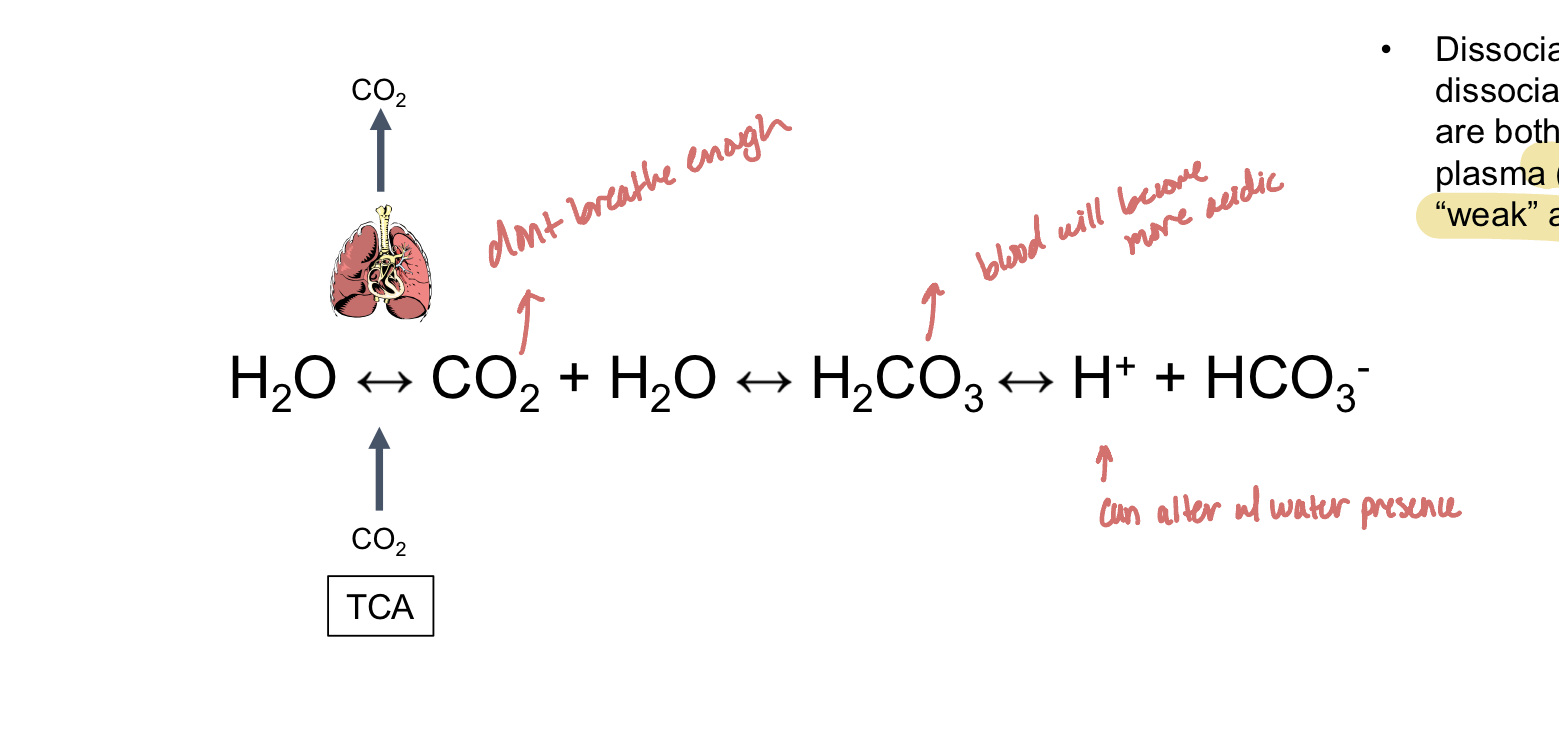
Read for review: The role of Co2 in blood pH: carbon dioxide is constantly produced by the TCA cycle and transported to the blood/plasma then removed by the lungs, dissolved co2 in the blood (levels can change with breathing and metabolism) can act as a buffer if reacted with water. Co2 and water form carbonic acid in a reversible reaction to also create free hydrogen and bicarbonate ions — carbonic acid is our weak acid or buffer
n/a
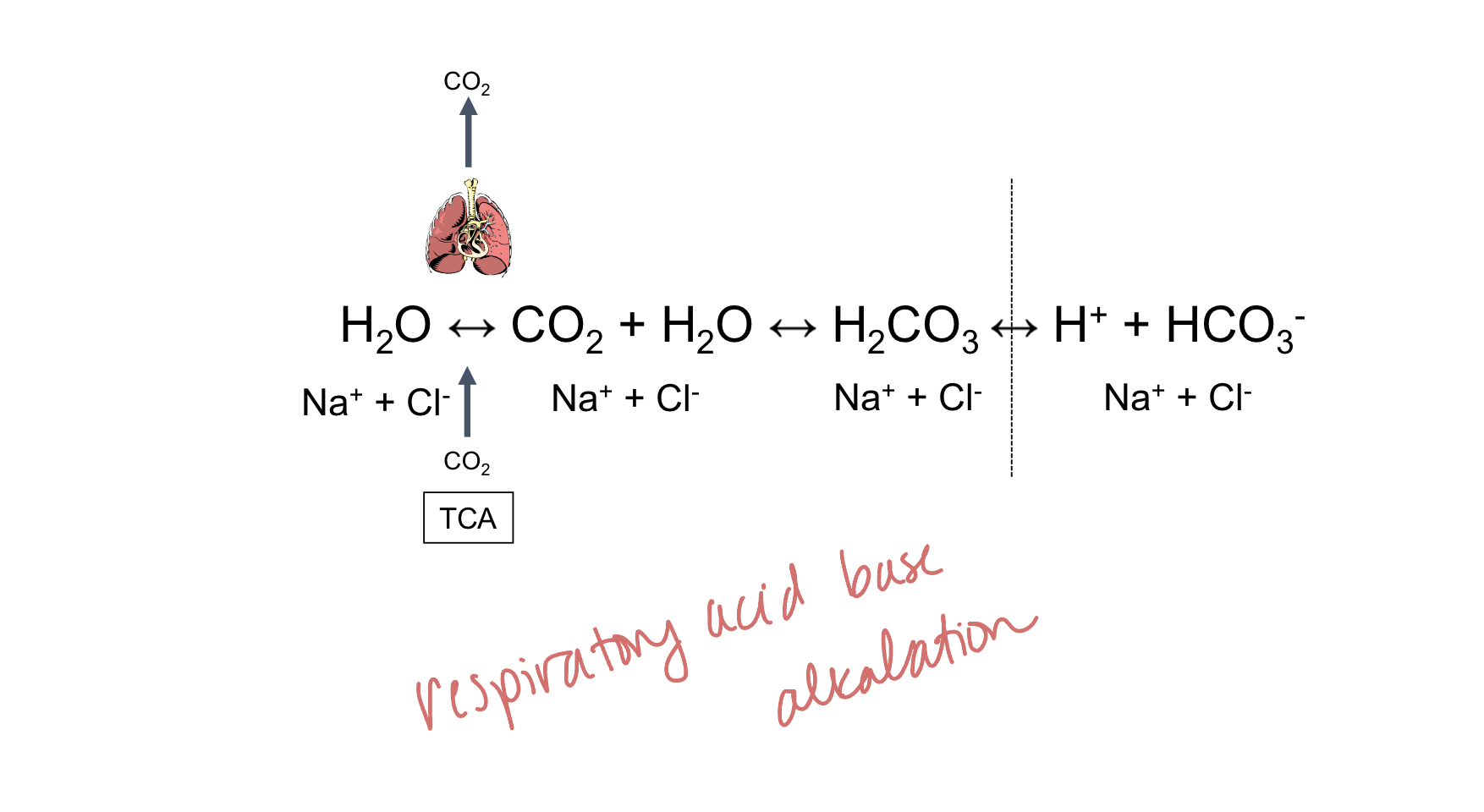
respiratory acid base alkylation
n/a

How the kidney affects the buffer system
n/a
amino acids are organic compounds that contain both an ——- group (R-NH2) and a ——- group (R-COOH) where R is a variable side chain
amine, carboxylic acid
— was the first amino acid discovered and was initially found in asparagus juice
asparagine
is the simplest amino acid and the R group is a single hydrogen atom
Glycine
amino acids are —- where they are diploar and have both - and + charge on the same molecule
zwitterions
all amino acids have at least — pka values (for the COOH and NH3+) some have a third for the r group
2
amino acids and some r groups can act as —-
buffers
most amino acids are — (a property of asymmetry)
chiral
Only — amino acids are used as building blocks for animal proteins (other form can be found in bacterial cell walls or antibodies from microorganisms)
L
there are — canonical or standard amino acids
20
there are some nonprotein amino acids that are not incorporated into proteins like ornithine, citrulline (urea cycle intermediates), GABA (a neurotransmitter) and —- (essential for cats synthesized from cysteine)
taurine
— amino acids can be synthesized from the body
nonessential
— amino acids must be obtained from the diet
essential
— is an essential amino acid for cats
taurine
growing chickens cannot synthesize all of the —- and —- they need (so it is conditionally essential)
glycine and proline
Taurine is found in high levels in — and —— (not found in plants)
fish and meat
taurine is involved in many biological processes including conjugation of bile acids, calcium signalling, CNS and cardiovascular function and the development of the —-, skeletal muscle and CNS
retina
taurine deficiency in cats can lead to
retinal degeneration and blindness
Dilated Cardiomyopathy (—) was also observed in cats with low plasma taurine. Reproductive failure, growth reduction and skeletal deformities can also occur.
DCM
— amino acid catabolism yields pyruvate or intermediates in the TCA cycle
glucogenic
— amino acid catabolism yields either acetoacetate or one of its precursors (acetyl coA or aceotacetyl coA)
ketogenic
nonpolar or hydrophobic amino acids mainly have —— r groups and cluster inside protein structures and interact via hydrophobic interactions. They are crucial for protein folding and 3d protein structure (minimize negative interactions with water/aqueous env)
hydrocarbon
Hydrophilic amino acids have polar r groups where there is at least one heteroatom in the side chain with —- pairs available for hydrogen bonding. They will be found on the external surface of the protein.
electron
proteins in their primary structure are —- of the 20 standard amino acids.
polymers
the alpha carbon of the carboxyl group of one amino acid reacts with the alpha amino group of another to form a —- bond (in a dehydration synthesis reaction)
peptide
the amino acid at one end which contains a free amino group is the amino —- end or the N terminus.
terminal
the amino acid at the other end which contains a free carboxyl group is the — terminal end or the c terminus
carboxyl
the numbering of animo acids in a protein starts at the — terminus
N
hydroxylation of proline and lysine in — is important for proper — structure and function.
collagen
hydroxylation of proline requires — —
ascorbic acid (vitamin c)
deficiency of vitamin c leads to decreased collagen and signs of —-
scurvy
ascorbic acid is required in the diet of —, —- and ——
primates, guinea pigs and bats
desmosine and isodesmosine are formed from — residues in proteins and are prevalent in elastin (smooth muscle)
lysine
phosphorylation is a key regulator of protein activity, for example phosphoserine, phosphoserine, and phosphorene and they are important for —— —-
cell signalling
activation of proteins by carboxylation of glutamic acid residues is involved in the — —— or chelation of calcium ions
clotting cascade
amino acid sequence is —— protein structure
primary
the localized areas of structural arrangements including B sheets and a helixes are —— protein structure
secondary
the packing of secondary structures into a more complex three d shape is —- protein structure
tertiary
the interaction of multiple protein subunits is — protein structure
quaternary
a noncovalent intermolecular interaction between animo acids with polar R groups
hydrogen bonding
a noncovalent intermolecular interaction between amino acids with charged R groups
ionic bonding
a noncovalent intramolecular interactions between amino acids with nonpolar R groups
hydrophobic
Covalent bonding of intramolecular interactions include the disulfide bonds between 000
cysteines
Hydrogen bonding between backbone animo acids/along vertical axis forms a coil
alpha helix
adjacent protein chains held in a pleated structure by hydrogen bonding along the backbones
B pleated sheet
In tertiary structure protein folding, noncovalent interactions and covalent bonding stabilize the structure. Initial folding is guided by —— proteins that help other proteins fold properly
chaperone
misfolding in proteins can cause —-
pathologies