Interoception
0.0(0)
Studied by 0 people Call Kai
 Learn
Learn Practice Test
 Spaced Repetition
 Match
Match Flashcards
 Knowt Play
Card Sorting
1/54

Earn XP
Description and Tags
BB2 lecture content revision
Last updated 11:36 AM on 5/7/23
Name | Mastery | Learn | Test | Matching | Spaced | Call with Kai | Chat |
|---|
No analytics yet
Send a link to your students to track their progress
55 Terms
1
New cards
what is interoception?
* feelings we receive from the body - signals about physical state
* distinct from the 5 senses e.g. HR, trouble breathing, hunger
* contributes to homeostasis
* self awareness and emotion
* restrictive- purely visceral (old definition)
* inclusive- general homeostatic capacity including broader sensations (recent definition)
* distinct from the 5 senses e.g. HR, trouble breathing, hunger
* contributes to homeostasis
* self awareness and emotion
* restrictive- purely visceral (old definition)
* inclusive- general homeostatic capacity including broader sensations (recent definition)
2
New cards
what does afferent mean?
* sensory info from body → brain/ sensory neurons
3
New cards
what does efferent mean?
* regulatory signals from brain → body/ motor neurons
4
New cards
what is the neural anatomical pathway?
* signals about physiological state of the body , categories of afferent nerves
* ascending pathway: afferents → lamina I → brainstem / lateral spinothalamic tract→ thalamus, hypothalamus and amygdala → cortex (insula and anterior cingulate)
* signals that travel on this pathway are classed as interoception
* ascending pathway: afferents → lamina I → brainstem / lateral spinothalamic tract→ thalamus, hypothalamus and amygdala → cortex (insula and anterior cingulate)
* signals that travel on this pathway are classed as interoception
5
New cards
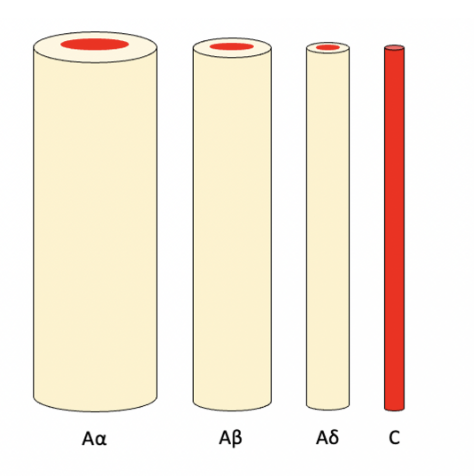
fibres in the neural anatomical pathway
* different fibres carry different info and follow different pathway s
* afferent nerves tend to travel along the 2 smaller ones - A delta (for pain) and C (for affective touch)
* Small diameter A-delta and C afferent nerves, including Nociceptors (pain), thermoreceptors (temperature), osmoreceptors (thirst), baroreceptors (heart rate).
* C afferents are unmyelinated - slower
* afferent nerves tend to travel along the 2 smaller ones - A delta (for pain) and C (for affective touch)
* Small diameter A-delta and C afferent nerves, including Nociceptors (pain), thermoreceptors (temperature), osmoreceptors (thirst), baroreceptors (heart rate).
* C afferents are unmyelinated - slower
6
New cards
afferent projections from the dorsal horn provide …
… the somato-autonomic reflexes crucial for maintaining homeostasis
* reflexes don’t need to go to the cortex- not conscious
* reflexes don’t need to go to the cortex- not conscious
7
New cards
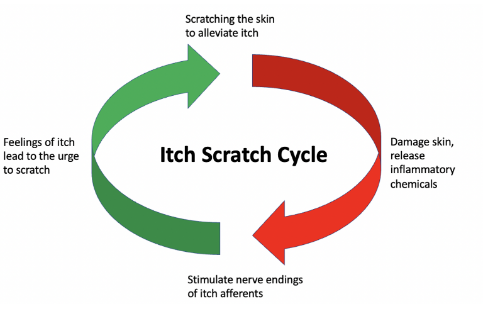
scratching and itching - the cycle
* Scratching inhibits itch via inhibitory interneurons in the dorsal horn of the spinal cord
* the pain caused by scratching inhibits the itching sensation
* but can make it worse e.g. if its a rash
* the pain caused by scratching inhibits the itching sensation
* but can make it worse e.g. if its a rash
8
New cards
interoception and emotion
* emotions can be felt in the body
* panic or excitement → increase HR
* fear or surprise → muscle tension
* can be mapped by colouring in how emotions feel , patterns are universal across cultures
* panic or excitement → increase HR
* fear or surprise → muscle tension
* can be mapped by colouring in how emotions feel , patterns are universal across cultures
9
New cards
gut feelings
* interconnection between the gut and the brain is deeply rooted in our language
* Neural network communicates with the brain about gastrointestinal homeostasis. ALSO emotion motivation and decision making
* Bidirectional – emotions can influence digestive system
* Neural network communicates with the brain about gastrointestinal homeostasis. ALSO emotion motivation and decision making
* Bidirectional – emotions can influence digestive system
10
New cards
where is the self? - different views
* suggested interceptive signals are intrinsic to the self, everything we do is in the context of the body - difficult to seperate body and self
* Aristotle - self in the heart
* Limanowski & Hecht (2011) – Head and heart
* Alsmith & Longo, 2014 – between the head and the torso
* study had people point to where they thought the self was, generally between the head and the heart
* Aristotle - self in the heart
* Limanowski & Hecht (2011) – Head and heart
* Alsmith & Longo, 2014 – between the head and the torso
* study had people point to where they thought the self was, generally between the head and the heart
11
New cards
does the body shape behaviour?
* Affective experience influenced by the current body state
* Drive behaviour = achieve homeostasis (desirable physical state)
* Interoception drives emotion and helps maintain homeostasis
* Drive behaviour = achieve homeostasis (desirable physical state)
* Interoception drives emotion and helps maintain homeostasis
12
New cards
Garkinkel et al - Attentional Blink study- study 1
* rapid images, 2 targets you need to identify
* gap so that when you detect target 1 its difficult to detect target 2
* identification of T1 during RSVP of stimuli impairs ability to detect T2- T2 was a kind of facial expression
* they presented the stimuli at different stages of the heart beat, either when it contracts (systole) or relaxed (diastole)
* systole presentation led to greater proportion of fear faces detected, whne heart working harder it recognised more
* gap so that when you detect target 1 its difficult to detect target 2
* identification of T1 during RSVP of stimuli impairs ability to detect T2- T2 was a kind of facial expression
* they presented the stimuli at different stages of the heart beat, either when it contracts (systole) or relaxed (diastole)
* systole presentation led to greater proportion of fear faces detected, whne heart working harder it recognised more
13
New cards
Garkinkel et al - Attentional Blink study- study 2, MRI
* Neutral or fear faces presented briefly (100ms).
* Time locked to heartbeat (Diastole or Systole)
* asked ppts to give Emotion intensity ratings of stimuli
* systole stimuli lead to greater intensity for fear faces
* when heart is contracting it effects how easily you detect something and the intensity of what you detect
* related to individual differences in state anxiety
* anxiety → greater arousal → more time in systole → higher intensity perception state
* Time locked to heartbeat (Diastole or Systole)
* asked ppts to give Emotion intensity ratings of stimuli
* systole stimuli lead to greater intensity for fear faces
* when heart is contracting it effects how easily you detect something and the intensity of what you detect
* related to individual differences in state anxiety
* anxiety → greater arousal → more time in systole → higher intensity perception state
14
New cards
Azevedo et al (2017)- study 1 of more complex behaviours and effect of cardiac cycle on racial stereotyping
* Comparing stimulus presentation when the muscle is contracting (Systole) with when it is relaxing (Diastole).
* Identify targets (tool or a weapon)
* Primed by Black or White males faces
* Stimuli were presented at Systole or Diastole
* systole exacerbated racially stereotyped responses
* more accurate detecting tools with white primes compared to black primes but only when in systole
* more accurate with weapon with a black face prime compared to white but again only in systole
\
* Identify targets (tool or a weapon)
* Primed by Black or White males faces
* Stimuli were presented at Systole or Diastole
* systole exacerbated racially stereotyped responses
* more accurate detecting tools with white primes compared to black primes but only when in systole
* more accurate with weapon with a black face prime compared to white but again only in systole
\
15
New cards
Azevedo et al (2017)- study 2 , 1st person shooter task
* task to decide when to shoot of not- more active behaviour than study 1
* all ppts are white
* task: correct to shoot if they had a weapon and incorrect when they were unarmed
* either black or white unarmed man with a tool or black or white man with a weapon, presented in systole or diastole
* Participants chose to shoot unarmed Black men more often than unarmed White men
* about the same when armed, but unarmed changes when in systole and heart is working hard
\
* all ppts are white
* task: correct to shoot if they had a weapon and incorrect when they were unarmed
* either black or white unarmed man with a tool or black or white man with a weapon, presented in systole or diastole
* Participants chose to shoot unarmed Black men more often than unarmed White men
* about the same when armed, but unarmed changes when in systole and heart is working hard
\
16
New cards
interceptive accuracy
* How accurate an individual is at detecting and interpreting interoceptive signals when compared with objective measures. (heartbeat monitoring tasks)
* Measure what is happening and compare to what they think is happening to see how accurate they are
* HR monitoring
* high mechanoreceptive sensitivity may be able to feel and count their own heartbeats and estimate their heart rate.- high mechanoreceptive sensitivity → better interoceptive accuracy
* Measure what is happening and compare to what they think is happening to see how accurate they are
* HR monitoring
* high mechanoreceptive sensitivity may be able to feel and count their own heartbeats and estimate their heart rate.- high mechanoreceptive sensitivity → better interoceptive accuracy
17
New cards
interoceptive sensibility
* The subjective experience of interoception - how interoceptive signals are experienced irrespective of their objective reality. (Questionnaires: e.g. Multidimensional Assessment for Interoceptive Awareness, Body Awareness Questionnaire)
* ask people about their body awareness
* ask people about their body awareness
18
New cards
interceptive awareness
* The correspondence between objective interoceptive accuracy and subjective reports.
* A metacognitive awareness of one’s own interoceptive accuracy.
* How good your are at detecting signals
* How good you think you are at detecting signals
* meta cognition about own interoceptive state
* A metacognitive awareness of one’s own interoceptive accuracy.
* How good your are at detecting signals
* How good you think you are at detecting signals
* meta cognition about own interoceptive state
19
New cards
what are the 3 ways of measuring neural sigature of intercpetion?
* fMRI- can locate insula
* EEG- can’t locate insula but can time with heartbeats
* Heartbeat evoked potential (HEP)- time-locked to R wave
* EEG- can’t locate insula but can time with heartbeats
* Heartbeat evoked potential (HEP)- time-locked to R wave
20
New cards
Pollatos & Schandry, (2004)- EEG and HEP study
* Participants counted their felt heartbeats during EEG
* Objectively measure heartbeats with ECG
* Use recorded actual heartbeats for examining interoceptive accuracy and identifying HEP
* Participants divided into good and poor perceivers
* HEP magnitude was larger than poor perceivers
* HEP magnitude (C4) positively correlated with accuracy of heartbeat detection
* good HR perceivers → higher HEP magnitude
* suggetss this is a neural signature of neural processing of heart beats in the brain
* Objectively measure heartbeats with ECG
* Use recorded actual heartbeats for examining interoceptive accuracy and identifying HEP
* Participants divided into good and poor perceivers
* HEP magnitude was larger than poor perceivers
* HEP magnitude (C4) positively correlated with accuracy of heartbeat detection
* good HR perceivers → higher HEP magnitude
* suggetss this is a neural signature of neural processing of heart beats in the brain
21
New cards
neural correlates of interoception - Critchley et al study
* HR detection task vs external task whilst in an fMRI
* presented with audio tones either synched to their HR or not and then asked them if they were synched (testing interoception) and if the notes were the same (testing exteroception)
* when attending to HR there was greater activation in the anterior insula when detecting a mismatch between notes and HR
* insula activity correlated with accuracy of HR detection and anxiety
* grey matter vol in the insula correlated with accuracy of HR detection and interoceptive sensibility
* presented with audio tones either synched to their HR or not and then asked them if they were synched (testing interoception) and if the notes were the same (testing exteroception)
* when attending to HR there was greater activation in the anterior insula when detecting a mismatch between notes and HR
* insula activity correlated with accuracy of HR detection and anxiety
* grey matter vol in the insula correlated with accuracy of HR detection and interoceptive sensibility
22
New cards
the insula cortex
* a fold within the cortex below the lateral sulcus, divided into anterior and posterior parts by the central insula sulcus
* associated with many cognitive and emotional task e.g. disgust, salience and bodily-related tasks e.g. perception, action awareness , internal body signals
* posterior connectivity- to thalamus
* anterior connectivity - to limbic system and amygdala
* its an anatomical hub
* involved in pain, emotion, cognition, social
* associated with many cognitive and emotional task e.g. disgust, salience and bodily-related tasks e.g. perception, action awareness , internal body signals
* posterior connectivity- to thalamus
* anterior connectivity - to limbic system and amygdala
* its an anatomical hub
* involved in pain, emotion, cognition, social
23
New cards
How does interoceptive experience map onto the insula?- Avery et al fMRI study
* did an interoceptive task - attend to viscera
* and an exteroceptive task - asked to distinguish sweet and neutral taste
* examined the neural maps
* exteroceptive = more anterior insula activation
* interoceptive= more posterior insula activation
* found regions where exteroceptive and interoceptive overlapped- these were in the mid to posterior regions
\
* and an exteroceptive task - asked to distinguish sweet and neutral taste
* examined the neural maps
* exteroceptive = more anterior insula activation
* interoceptive= more posterior insula activation
* found regions where exteroceptive and interoceptive overlapped- these were in the mid to posterior regions
\
24
New cards
If insular integrates sensory information in to a coherent experience how does this relate to behaviour?- Accolla & Carleton (2008) study
* Conditioned Taste Aversion (CTA) for sweet stimuli in rats
* uses conditioning to create aversions to certain tastes
* Adding malaise (induced sickness) to saccharin (artificial sweetener) induce aversion of saccharin.
* looked at the sweet and bitter maps in the rats gustatory cortex (insula) before, and after conditioning and after extinction
results:
* becomes a greater overlap once the aversion was created
* then goes back to separated after extinction (removal) of the taste aversion
this means:
* The insula integrates experience into valence maps.
* Insula integrates taste perception with physiological state and hedonic value.
* Changes in insular cortex maps corresponded with behaviour
* uses conditioning to create aversions to certain tastes
* Adding malaise (induced sickness) to saccharin (artificial sweetener) induce aversion of saccharin.
* looked at the sweet and bitter maps in the rats gustatory cortex (insula) before, and after conditioning and after extinction
results:
* becomes a greater overlap once the aversion was created
* then goes back to separated after extinction (removal) of the taste aversion
this means:
* The insula integrates experience into valence maps.
* Insula integrates taste perception with physiological state and hedonic value.
* Changes in insular cortex maps corresponded with behaviour
25
New cards
26
New cards
cravings
* integrated with key reward circuit (ventral striatum)
* links physiological state and hedonic response
* cravings = physiological urges . desire to maintain homeostasis . links to addiction
* study compared smokers with insula lesions to smokers with other brain damage, those with insula damage >100 times more likely to quit smoking without relapse!
* links physiological state and hedonic response
* cravings = physiological urges . desire to maintain homeostasis . links to addiction
* study compared smokers with insula lesions to smokers with other brain damage, those with insula damage >100 times more likely to quit smoking without relapse!
27
New cards
insula, cravings and addiction
* urges are associated with memories of body states
* links to reward network
* withdrawal disturbs homeostasis - intensifying cravings and an unpleasant physiological state
* links to reward network
* withdrawal disturbs homeostasis - intensifying cravings and an unpleasant physiological state
28
New cards
Interoceptive accuracy meta analysis with anxiety
* 55 studies using different measures of IA
* Clinical and subthreshold (healthy controls) samples
* found no relationship between IA and anxiety
* No effect of task or sample
* might suggest anxiety isn’t associated with actual detection of these signals but instead the way in which they are interpreted and thought about
* Clinical and subthreshold (healthy controls) samples
* found no relationship between IA and anxiety
* No effect of task or sample
* might suggest anxiety isn’t associated with actual detection of these signals but instead the way in which they are interpreted and thought about
29
New cards
interoceptive awareness and anxiety study
* 21 anxiety patients with panic attacks, 13 HC
* Heartbeat monitoting task
* measured metacognitions about interoception
* No difference in interoceptive accuracy
* Difference in metacognition (threatening beliefs about the body)
* Not detection of symptoms but how they are interpreted
* Heartbeat monitoting task
* measured metacognitions about interoception
* No difference in interoceptive accuracy
* Difference in metacognition (threatening beliefs about the body)
* Not detection of symptoms but how they are interpreted
30
New cards
HEP and anxiety study
* Generalised Anxiety Disorder (GAD) and health controls (HC)
* Examined HEP during resting state in 2 conditions:
* Eyes open (exteroception)
* Eyes closed (interoception) thought would be more in tune with interoceptive symptoms
* In HC HEP greater in eyes closed compared to eyes open rest- suggest better at interocpetion when the eyes were closed fior HC but no difference for people with GAD
* Greater focus in interoception with eyes closed
* In GAD, no difference between condition
* Cortical response to heartbeats greater in GAD
* Suggests people with GAD have heightened interoception compared to HC and thats why there isn’t a significant difference
* Examined HEP during resting state in 2 conditions:
* Eyes open (exteroception)
* Eyes closed (interoception) thought would be more in tune with interoceptive symptoms
* In HC HEP greater in eyes closed compared to eyes open rest- suggest better at interocpetion when the eyes were closed fior HC but no difference for people with GAD
* Greater focus in interoception with eyes closed
* In GAD, no difference between condition
* Cortical response to heartbeats greater in GAD
* Suggests people with GAD have heightened interoception compared to HC and thats why there isn’t a significant difference
31
New cards
the insual cortex and anxiety
* found to have abnormalities in structure and function across different forms of anxiety disorders
* Etkin et al (2007)- meta analysis of brain activation for emotional processign across different anxiety disorders
* Social Phobia
* Specific Phobia
* PTSD
* Patients with all three disorders demonstrated hyperactivity (patients > comparison subjects) in the amygdala and insula
* This pattern of activation was also noted for healthy subjects experiencing anticipatory anxiety during fear conditioning
* An exaggerated fear response—might be reflected in shared neurobiology
* Etkin et al (2007)- meta analysis of brain activation for emotional processign across different anxiety disorders
* Social Phobia
* Specific Phobia
* PTSD
* Patients with all three disorders demonstrated hyperactivity (patients > comparison subjects) in the amygdala and insula
* This pattern of activation was also noted for healthy subjects experiencing anticipatory anxiety during fear conditioning
* An exaggerated fear response—might be reflected in shared neurobiology
32
New cards
experience of body state
* Inaugural moment – initial sensory map from the body without prior experience, when you are first born have no experience to make predictions from
* Map then modified by life experience – predicted sensory experience of encountering stimuli
* Insular cortex, amygdala, anterior cingulate, ventral medial prefrontal cortex
* Map then modified by life experience – predicted sensory experience of encountering stimuli
* Insular cortex, amygdala, anterior cingulate, ventral medial prefrontal cortex
33
New cards
Geuter et al - heat pain paradigm
* gave a cue of whether to expect warm or painful stimuli: low medium or high intensity
* gave them a stimuli- warm or painfully hot and asked if they thought it was painful or not
* Posterior insula exhibited neural patterns in line with detecting pain intensity – receives afferents from body (interoception)
* Anterior insula exhibited neural patterns in line with predictive coding of pain - integrates information with other modalities
* These predictions are modality specific (pain) rather than a general expectation of an aversive outcome
* gave them a stimuli- warm or painfully hot and asked if they thought it was painful or not
* Posterior insula exhibited neural patterns in line with detecting pain intensity – receives afferents from body (interoception)
* Anterior insula exhibited neural patterns in line with predictive coding of pain - integrates information with other modalities
* These predictions are modality specific (pain) rather than a general expectation of an aversive outcome
34
New cards
psychiatric disorders and interoception
* proposed individuals who focus on their bodily sensations more may exhibit greater interoceptive prediction signals
* prediction of aversive states may trigger aversive states
* if someone experiences a panic attack in a lecture they then predict that will happen again due to the association, so then they worry and might lead them to avoid lectures
* might be fine walking into the lecture and HR is normal but because you’re predicting that it isn’t you have this big mismatch
* in order to rectify the mismatch your insula cortex might increase your heart rate to meet the prediction
* you basically predict yourself into the panic
* prediction of aversive states may trigger aversive states
* if someone experiences a panic attack in a lecture they then predict that will happen again due to the association, so then they worry and might lead them to avoid lectures
* might be fine walking into the lecture and HR is normal but because you’re predicting that it isn’t you have this big mismatch
* in order to rectify the mismatch your insula cortex might increase your heart rate to meet the prediction
* you basically predict yourself into the panic
35
New cards
Uchida et al (2008)- study comparing HC and panic disorder
* Increased grey matter volume in the insula in PD compared to HC
* Misattribute symptoms as a heart attack despite physiologically heart is healthy
* Catastrophising normal things, you’re actually fine physiologically but think you’re having a heart attack
* Misattribute events occurring at the same time as associated (triggers) – avoidance behaviours
* Anxiety over bodily signals, maladaptive behaviours and cognitions
* Misattribute symptoms as a heart attack despite physiologically heart is healthy
* Catastrophising normal things, you’re actually fine physiologically but think you’re having a heart attack
* Misattribute events occurring at the same time as associated (triggers) – avoidance behaviours
* Anxiety over bodily signals, maladaptive behaviours and cognitions
36
New cards
Pauli et al (1991)- study of patients with panic attacks compared to HC
* monitored 28 patients with panic attacks and 20 healthy controls
* 24 hours ECG monitoring (HR/heart rate)
* asked ppts to note cardiac perceptions, anxiety and activities (not sports)
results:
* found similar variations in actual heart rate, everyone has these variations in HR it wasn’t that people with PD had varying HR more
* however, Panic attacks patients rated higher anxiety associated with cardiac perceptions
* Anxiety experienced in relation to heart perceptions related to subsequent shortening between heartbeats- so difference in HR once the person with PD because aware of it
* Heartbeat variations prior to cardiac perception not related to anxiety level
* supports notion that its a misattribution of a normal change in HR
* vicious cycle
* 24 hours ECG monitoring (HR/heart rate)
* asked ppts to note cardiac perceptions, anxiety and activities (not sports)
results:
* found similar variations in actual heart rate, everyone has these variations in HR it wasn’t that people with PD had varying HR more
* however, Panic attacks patients rated higher anxiety associated with cardiac perceptions
* Anxiety experienced in relation to heart perceptions related to subsequent shortening between heartbeats- so difference in HR once the person with PD because aware of it
* Heartbeat variations prior to cardiac perception not related to anxiety level
* supports notion that its a misattribution of a normal change in HR
* vicious cycle
37
New cards
beliefs in panic disorder
* all begin with maladaptive beliefs
* A change in the internal state of the individual, which may be due to an increased attentional biases toward threat
* Beliefs used to interpret internal body signals
* sets up a bodily prediction error
* External cues or internal thought generate anticipation of aversive body states that - sets up a body prediction error
* A change in the internal state of the individual, which may be due to an increased attentional biases toward threat
* Beliefs used to interpret internal body signals
* sets up a bodily prediction error
* External cues or internal thought generate anticipation of aversive body states that - sets up a body prediction error
38
New cards
self processing in panic disorder
* relating these maladaptive states to insula activity
* Worrying is associated with increased activity in prefrontal cortex, striatum, and insula (Hoehn-Saric et al. 2004)
* Guilt was linked to left anterior insular cortex (Shin et al. 2000)
* Sad self-relevant autobiographical memories linked to activation the ventral insula (Liotti et al. 2000)
* Worrying is associated with increased activity in prefrontal cortex, striatum, and insula (Hoehn-Saric et al. 2004)
* Guilt was linked to left anterior insular cortex (Shin et al. 2000)
* Sad self-relevant autobiographical memories linked to activation the ventral insula (Liotti et al. 2000)
39
New cards
Somatic Error Hypothesis
* Psychiatric disorders, such as anxiety, may be a result of mismatches between anticipated and incoming bodily signals
* **Somatic error** – the body state predicted by the brain differs from the afferent signals of the body state
* Compensatory behaviour = psychiatric symptomology
* how we compensate for the error are the symptoms of disorders
* Actions to reduce the discomfort and distress (e.g. agoraphobia and other maladaptive behaviours )
* **Somatic error** – the body state predicted by the brain differs from the afferent signals of the body state
* Compensatory behaviour = psychiatric symptomology
* how we compensate for the error are the symptoms of disorders
* Actions to reduce the discomfort and distress (e.g. agoraphobia and other maladaptive behaviours )
40
New cards
Dresler et al (2011)- fMRI from when patients had a panic attack in the scanner
* 2 Patients suffering panic attacks in the fMRI scanner leading to termination of testing (must have happened in another study)
* One removed beginning of discomfort
* One removed once in full panic attack
* Patient removed from the scanner first only observed a decrease in prefrontal cortex activity during their discomfort- top-down onset of panic attacks
* ppt who has the Full panic attack demonstrated significant insula and amygdala activity
* Insula activity linked to feelings of discomfort
* Amygdala related to feelings of panic
* One removed beginning of discomfort
* One removed once in full panic attack
* Patient removed from the scanner first only observed a decrease in prefrontal cortex activity during their discomfort- top-down onset of panic attacks
* ppt who has the Full panic attack demonstrated significant insula and amygdala activity
* Insula activity linked to feelings of discomfort
* Amygdala related to feelings of panic
41
New cards
DSM-5 criteria for anorexia nervosa
* restriction of energy intake to be less than what the body needs leading to sig low body weight relative to age, sex and developmental trajectory
* intense fear of gaining weight
* disturbance in they way the body weight or shape is experienced, self objectification
* reduced capacity to soothe self or empathise with others
* emotionally inhibited- flattening of affect
* depression
* alexithymia- can’t describe or recognise emptional distress
* intense fear of gaining weight
* disturbance in they way the body weight or shape is experienced, self objectification
* reduced capacity to soothe self or empathise with others
* emotionally inhibited- flattening of affect
* depression
* alexithymia- can’t describe or recognise emptional distress
42
New cards
interoception and AN
* Intuitive link between interception and eating disorders in general like AN (through hunger association )
* eating dirsorder inventory asks about intercopetive asepcts e.g. “ I get confused about what emotion I am feeling” or “I feel bloated after a normal sized meal”
* however, Interoceptive sensibility and Interoceptive accuracy were not correlated in patients with AN
* eating dirsorder inventory asks about intercopetive asepcts e.g. “ I get confused about what emotion I am feeling” or “I feel bloated after a normal sized meal”
* however, Interoceptive sensibility and Interoceptive accuracy were not correlated in patients with AN
43
New cards
interceptive sensibility and AN
**Jenkinson et al 2018**
* Meta-analysis across all EDs
* EDI interoceptive scale
* anorexia and bulimia - significant deficits in interoceptive sensibility
* Lower BMI = greater deficits
* Meta-analysis across all EDs
* EDI interoceptive scale
* anorexia and bulimia - significant deficits in interoceptive sensibility
* Lower BMI = greater deficits
44
New cards
interoceptive accuracy and AN
**Pollatos et al (2008)**
* The heartbeat perception task was performed using four intervals of 25 s, 35 s, 45 s and 100 s
* asked to count each heart beat across these different intervals
* AN performed worse than HC
* Patients with AN exhibit a generally reduced capacity to accurately perceive bodily signals
* Less intense emotional experiences in many everyday situations
* Potential importance of interoception in the pathogenesis of AN
* The heartbeat perception task was performed using four intervals of 25 s, 35 s, 45 s and 100 s
* asked to count each heart beat across these different intervals
* AN performed worse than HC
* Patients with AN exhibit a generally reduced capacity to accurately perceive bodily signals
* Less intense emotional experiences in many everyday situations
* Potential importance of interoception in the pathogenesis of AN
45
New cards
interoceptive awareness and AN
**Lernia et al (2018)**
* Case study 1 AN, against 4 HCs
* Heart beat counting task (interoceptive accuracy)
* Confidence measure (Interoceptive Awareness – when compared to accuracy score)
* MAIA (Interoceptive sensibility)
* results found a trend towards lower interoceptive accuracy
* but they had an enhanced confidence of interoception- 93/100 in their belief
* Less able to regulate distress and distract from bodily signals, reduced body trust
* Detachment between ability to perceive the body and the awareness- think they are aware of their bodily sensations but clearly they are not
* Case study 1 AN, against 4 HCs
* Heart beat counting task (interoceptive accuracy)
* Confidence measure (Interoceptive Awareness – when compared to accuracy score)
* MAIA (Interoceptive sensibility)
* results found a trend towards lower interoceptive accuracy
* but they had an enhanced confidence of interoception- 93/100 in their belief
* Less able to regulate distress and distract from bodily signals, reduced body trust
* Detachment between ability to perceive the body and the awareness- think they are aware of their bodily sensations but clearly they are not
46
New cards
neural indicators of interoception and AN
lutz et al (2019)
* Heartbeat counting task during EEG HEP
* interoceptive sensibility- found no diff in confidence but difference in interpretation
* interoceptiove accurary (heartbeat counting)- non sig trend for better IA in AN
* higher HEP amplitude
* \
* Heartbeat counting task during EEG HEP
* interoceptive sensibility- found no diff in confidence but difference in interpretation
* interoceptiove accurary (heartbeat counting)- non sig trend for better IA in AN
* higher HEP amplitude
* \
47
New cards
evidence for insula involvement in ED
Murialdo et al (2007)
* regulatory control of HR variability in ED using tilt table test
* Lie on a table that adjusts your body position from horizontal to vertical to simulate standing up
* Monitor changes in heart rate and blood pressure
* patients had lower blood pressure than HC
* sympathetic cardiac activity did not increase from lying to standing as it did in HC
* cardian abnormalities are simialr in AN and BN even though only AN are emaciated (so not linked to BMI)
* regulatory control of HR variability in ED using tilt table test
* Lie on a table that adjusts your body position from horizontal to vertical to simulate standing up
* Monitor changes in heart rate and blood pressure
* patients had lower blood pressure than HC
* sympathetic cardiac activity did not increase from lying to standing as it did in HC
* cardian abnormalities are simialr in AN and BN even though only AN are emaciated (so not linked to BMI)
48
New cards
Fisher et al (2016) - AN and CBT
* 15 AN patients
* given CBT with special attention to maladaptive emotional processing
* tested at the beginning, 4-6 weeks in and then again at the end of therapy, measuring interoceptive accuracy
* found BMI increased and depression decreased
* but interceptive accuracy and sensibility didn’t improve so recovery was small and inconsistent
* interception doesn’t improve with other symptoms which makes ED so difficult to recover from
* given CBT with special attention to maladaptive emotional processing
* tested at the beginning, 4-6 weeks in and then again at the end of therapy, measuring interoceptive accuracy
* found BMI increased and depression decreased
* but interceptive accuracy and sensibility didn’t improve so recovery was small and inconsistent
* interception doesn’t improve with other symptoms which makes ED so difficult to recover from
49
New cards
Kerr et al (2016)- AN patient study with interoceptive trials, anxious rumination trials and exteroceptive trials
* Interoceptive attention task - focused on sensations in their heart, stomach, and bladder.
* Anxious Rumination- given primes to trigger ruminations
* Exteroceptive trials- rate intensity of colou
* Activity in the dorsal mid-insula was reduced in AN patients during stomach interoception
* Activity in the anterior insula was relatively higher in AN patients during heart interoception
* shows dissociation- can’t use HR tasks for everything
* increased activation during anxious rumination in the dorsal mid-insula, in stomach interception correlated with anxiety
* abnormal dorsal mid-insual activity during gastric interception
* Anxious Rumination- given primes to trigger ruminations
* Exteroceptive trials- rate intensity of colou
* Activity in the dorsal mid-insula was reduced in AN patients during stomach interoception
* Activity in the anterior insula was relatively higher in AN patients during heart interoception
* shows dissociation- can’t use HR tasks for everything
* increased activation during anxious rumination in the dorsal mid-insula, in stomach interception correlated with anxiety
* abnormal dorsal mid-insual activity during gastric interception
50
New cards
prediction mechanisms in AN
* Somatic error hypothesis and other prediction theories suggest inaccurate interoceptive predictions in psychiatric disorders
* Gastric abnormalities not sensory input but interpretation
* Unclear mechanisms for how interoception underlies a complex disorder such as AN
* Gastric abnormalities not sensory input but interpretation
* Unclear mechanisms for how interoception underlies a complex disorder such as AN
51
New cards
interoception and eating - HC vs AN
* double blind trial either given saline of isoproterenol (an adrenoceptor agonist)
* measured pre and post meal HR and breathing and their interoceptive detection
* AN experienced more intense cardiorespiratory sensations before consuming a meal
* AN more likely to report interoceptive experiences in all conditions, particularly in low arousal condition
* AN could be anticipating meal eating → anxiety
* measured pre and post meal HR and breathing and their interoceptive detection
* AN experienced more intense cardiorespiratory sensations before consuming a meal
* AN more likely to report interoceptive experiences in all conditions, particularly in low arousal condition
* AN could be anticipating meal eating → anxiety
52
New cards
Interoception and restrictive symptoms of AN
* AN patients can’t use internal signals to perceive physical changes of weight loss
* don’t recognise satiety or hunger
* continue to restrict food despite emaciation- not getting signals from their body that something is wrong
* intense fear of gaining weight
* can’t self regulate emotions
* don’t recognise satiety or hunger
* continue to restrict food despite emaciation- not getting signals from their body that something is wrong
* intense fear of gaining weight
* can’t self regulate emotions
53
New cards
Objectification theory of AN
**Fredrickson & Roberts (1997)**
* Bodies are viewed and evaluated based on appearance
* The body as an object (sexual)
* The body and sexuality are separate from the person
* Objectifying others and objectifying the self
* The more you self objectify, the more important body appearance and deviations form social ideas is important for self worth
* Bodies are viewed and evaluated based on appearance
* The body as an object (sexual)
* The body and sexuality are separate from the person
* Objectifying others and objectifying the self
* The more you self objectify, the more important body appearance and deviations form social ideas is important for self worth
54
New cards
AN and the insula
* Insular cortex is a neural hub connecting interoceptive signals with other modalities including exteroception, cognition and emotion
* Potential mechanism in AN of interoception underpinning many of the key symptomology in AN
* As it isn’t addressed in treatments high chance of relapse
* Potential mechanism in AN of interoception underpinning many of the key symptomology in AN
* As it isn’t addressed in treatments high chance of relapse
55
New cards
interoception and anorexia relapse
* Interoceptive prediction errors may lead to further errors and negative affective that is unresolved lead to risk of relapse particularly with certain triggers
* Weight restored AN patients to show differences in insula activity when anticipating food as well as decreased response to the taste of food stimuli
* Both exteroceptive and interoceptive bodily symptoms continue following weight restoration
\
* Weight restored AN patients to show differences in insula activity when anticipating food as well as decreased response to the taste of food stimuli
* Both exteroceptive and interoceptive bodily symptoms continue following weight restoration
\