2) The Digestive System PCF
 Call Kai
 Learn
Learn Practice Test
 Spaced Repetition
 Match
Match Flashcards
 Knowt Play
1/90

There's no tags or description
Looks like no tags are added yet.
Name | Mastery | Learn | Test | Matching | Spaced | Call with Kai | Chat |
|---|
No analytics yet
Send a link to your students to track their progress
91 Terms
The Digestive Process
The digestive process begins in the oral cavity and proceeds through the esophagus, stomach, small intestine and the large intestine
The primary function is to supply the body with nutrients, water, and electrolytes through the sequential processes of ingestion, motility, secretion, digestion, and absorption
The digestive process requires second to second coordination across nearly nine meters of tube, from the striated muscle of the _____ to the _____ of the internal anal sphincter
pharynx; smooth muscle
The digestive process requires second-to-second coordination across:
nearly nine meters of tube, from the striated muscle of the pharynx to the smooth muscle of the internal anal sphincter
And which 4 organs - that must release their products into the lumen at precisely the right moment?
Stomach
Pancreas
Liver
Gallbladder
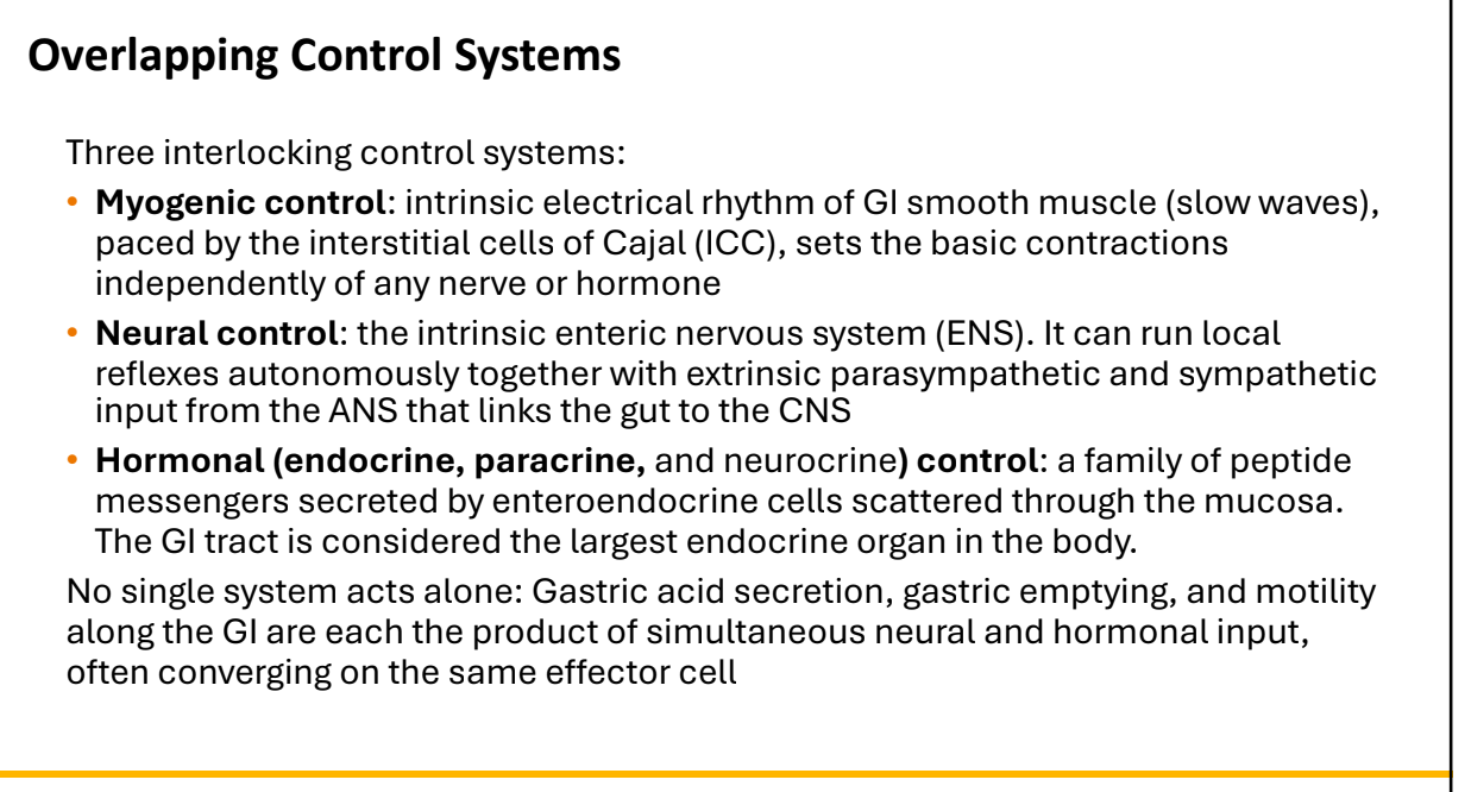
The digestive process’s coordination is achieved by three overlapping control systems. What are they?
Myogenic control
Neural contorl
Hormonal (endocrine, paracrine, and neurocrine) control
Myogenic control: GI smooth muscle has its own natural electrical rhythm (slow waves) created by the_____ , which helps control contractions without?
interstitial cells of Cajal (ICC); nerves or hormones.
Neural control: The enteric nervous system (ENS) can control digestion on its own through?
while the autonomic nervous system (ANS) can also influence it through parasympathetic and sympathetic nerves connecting ____ to the ____
local reflexes
the gut to the brain
Hormonal (endocrine, paracrine, and neurocrine) control: a family of ____ messengers secreted by ______ cells scattered through the mucosa.
The GI tract is considered the largest endocrine organ in the body.
peptide; enteroendocrine cells
No single system works alone: What three processes are each the product of simultaneous neural and hormonal input often converging on the same effector cell?
Gastric acid secretion
gastric emptying
motility
General organization of the ENS: The myenteric plexus lies between what two layers?
longitudinal and circular muscle layers
The submucosal plexus lies in the _____ and in larger animals (not shown) consists of an?
submucosa; outer and an inner component
ENS: Nerve fibers connect the ganglia and form nerve plexuses that innervate the what 4 areas?
longitudinal muscle
circular muscle
muscularis mucosa
mucosa
There are also enteric nerves innervating arteries in the ____ , as well as the gut-associated?
submucosa; lymphoid tissues
The mucosa is densely innervated. What are found associated with enteric nerves throughout the wall of the gut
Enteric glia

Interstitial Cells of Cajal, specialized mesenchymal pacemaker cells, are interposed within what layer?
muscularis externa
ICC couple electrically to? via?
smooth muscle via gap junctions
ICC generate spontaneous, rhythmic?
depolarizations (slow waves)
ICC generate spontaneous, rhythmic depolarizations (slow waves) → propagate through the smooth muscle and set the maximal frequency of?
contraction for each region of the gut
(roughly 3 cycles/min in the stomach and up to 12 cycles/min in the duodenum)
Slow waves alone do not always produce a contraction! Only when neural or hormonal input pushes the ____ past threshold does a superimposed spike (action potential) trigger an actual contraction
membrane potential

The Enteric Nervous System: A Semi-Autonomous “Second Brain”: What is the enteric nervous system?
the intrinsic nervous system of the gut
The Enteric Nervous System comprises which two plexuses and contains hundreds of millions of neurons (similar number to spinal cord)
myenteric and submucosal
~30% of myenteric neurons are sensory; allows the ENS to sense luminal ____ and ___ stimuli
mechanical and chemical
~30% of myenteric neurons are sensory; allows the ENS to sense luminal mechanical and chemical stimuli and to complete entire? without any input from brain or spinal cord
reflex arcs (sensory neuron → interneuron → motor neuron)
The reflex capacity allows isolated segments of intestine to continue coordinated peristalsis even when?
extrinsic nerves are severed, hence the term “second brain”

The ENS integrates two further inputs which are?
Information reaching it indirectly from the CNS (evoked by cues such as the sight or smell of food)
local mechanical and chemical stimuli detected within the gut wall itself

The Enteric Nervous System: Myenteric plexus controls GI muscle along which two axes
Excitatory
Inhibitory
Myenteric plexus controls GI muscle along two axes: Excitatory: Excitatory motor neurons (releasing ____ and ____ ) innervate the longitudinal muscle, producing ____, _____, and ____ widening of a segment
acetylcholine; tachykinins
contraction; shortening; radial
Myenteric plexus controls GI muscle along two axes: Inhibitory: A separate population of inhibitory motor neurons relaxes the______ immediately ahead (distal) of an advancing bolus, mainly via what two neurotransmitters
circular muscle;
nitric oxide
VIP
The peristaltic reflex is the precise polarized sequence of ___ behind and ___ ahead of a bolus.
It is the basic unit of propulsive GI motility from the ___ to the ___
contraction; relaxation
esophagus; rectum

While The ENS can operate independently, it is continuously modulated by the?
which links gut function to the ____ and to the whole-body _____ state
autonomic nervous system
CNS; physiological state

Vagal Efferent Signals (brain to GI): Vagal efferents do not synapse directly on smooth muscle; rather, they synapse on what type of neurons?
myenteric motor neurons
Vagal efferents do not synapse directly on smooth muscle; rather, they synapse on myenteric motor neurons, which then relay excitatory (acetylcholine, neurokinins) or inhibitory (nitric oxide) signals onward to what two things?
ICC; smooth muscle
This arrangement means the vagus nerve principally sets the ___ and gain of ____ rather than driving contraction directly
tone; enteric reflexes
It means the vagus nerve does not directly tell GI smooth muscle to contract or relax. Instead, it signals myenteric neurons, and those neurons then control the muscle.

Segmental Neural Control Along the Gastrointestinal Tract: The body of the esophagus is controlled through?
brain stem circuits
The body of the esophagus is controlled through brain stem circuits located in the ____
medulla oblongata
The stomach is controlled through the ___ and ____ reflexes
brain stem; vago-vagal
Small intestine motility is primarily controlled through the?
ENS
Large bowel motility is controlled through? EXCEPT for the essntial role of the ___ in defecation
ENS; CNS

Esophagus: Swallowing is initiated voluntarily but, once triggered, proceeds as an involuntary reflex coordinated by the?
the swallowing center in the medulla
What induces sequential contraction of esophageal segments:
Peripheral vagal efferents
Peripheral vagal efferents: cause an initial inhibitory wave that ?
and then followed by sequential excitatory contractions that create a?
with _____ proximal to the bolus and ______ distal to it
relaxes the esophagus;
peristaltic contraction wave;
contraction ;relaxation
What plexus directly controls _____ and ____ muscles of the esophagus to produce the contraction and relaxation needed for peristalsis.
myenteric plexus; circular and longitudinal
The lower esophageal sphincter (LES), tonically contracted at rest via ___ input, ___ just ahead of the peristaltic wave to admit the bolus into the stomach
cholinergic; relaxes

The stomach performs what three tasks under combined neural and hormonal control:
Acting as a reservoir
Mechanically breaking down and mixing food with gastric secretions
Metering gastric emptying
What accomdates incoming bolus into the stomach without a large rise in intraluminal pressure?
Receptive relaxation of the proximal stomach
Receptive relaxation of the proximal stomach is mediated by ______ fiber triggered first by swallowing itself and then by ______ receptors
inhibitory vagal ; gastric strech
Distally, ___ activity in the fundus generates a basal electrical rhythm of roughly 3 to 8 contractions per minute that propagates toward the ___
ICC pacemaker; pylorus

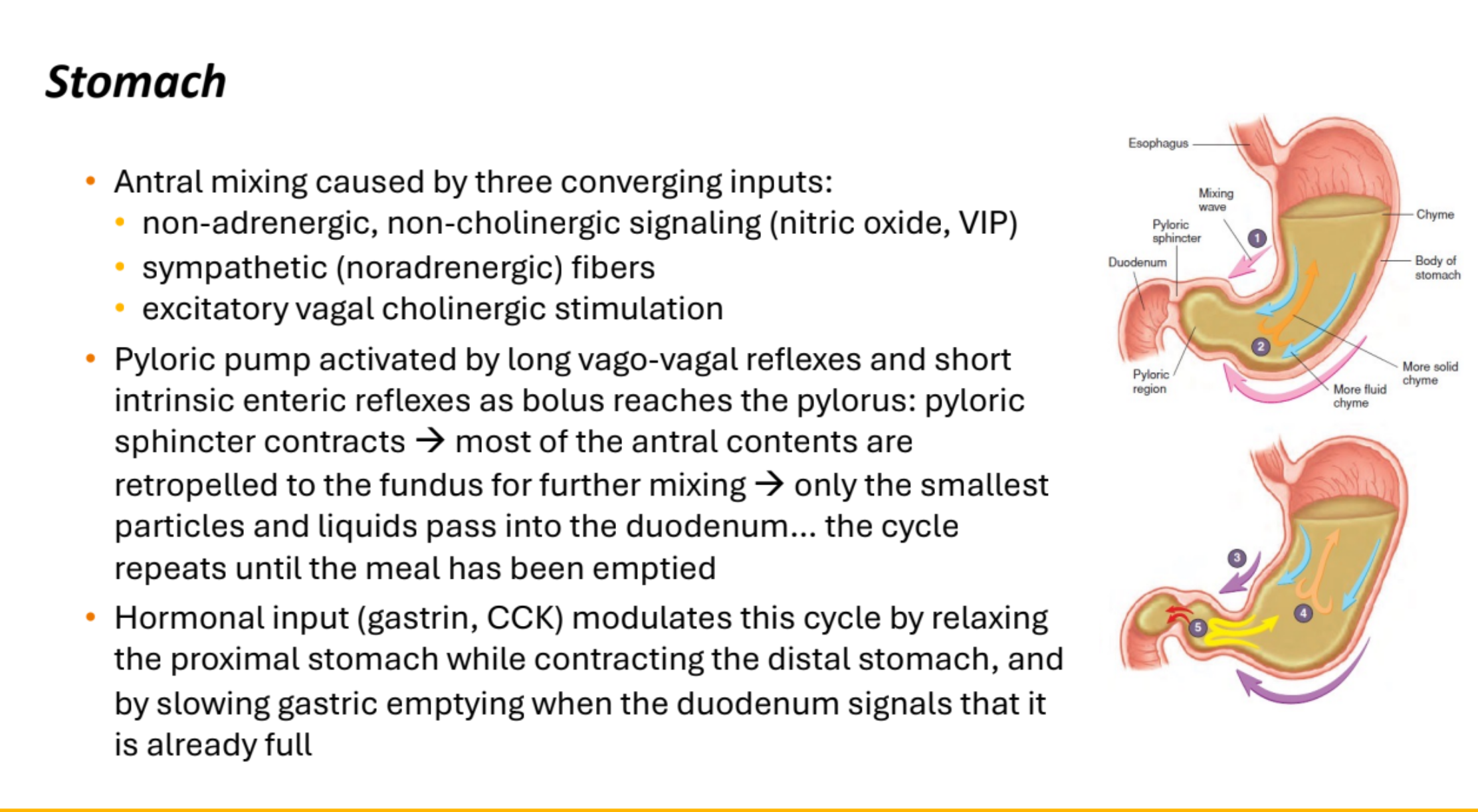
Stomach: Antral mixing caused by three converging inputs which are?
non-adrenergic, non-cholinergic signaling (nitric oxide, VIP)
sympathetic (nonadrenergic) fibers
excitatory vagal cholinergic stimulation
Pyloric pump activated by what two reflexes as bolus reaches the pylorus
long vago-vagal and short intrinsic enteric
Pyloric pump activated by long vago-vagal reflexes and short intrinsic enteric reflexes as bolus reaches the pylorus: pyloric sphincter contracts, then most of the antral contents are?
retropelled to the fundus for further mixing
only the smallest particles and liquids pass into the duodenum... the cycle repeats until the meal has been emptied
What 2 hormones modulate this cycle by relaxing the ___ stomach while contracting the ___ stomach,
gastrin
CCK
proximal; distal
When the duodenum is full, what slows down?
gastric emptying
The small intestine displays two distinct neuromuscular programs. Which are?
During and shortly after a meal
Between meals
Small intestine: During and shortly after a meal: What pattern of contractions predominates,
unsynchronized (“segmenting”)
During and shortly after a meal: unsynchronized (“segmenting”) pattern of contractions predominates, to maximize mixing ____ with ____ and ____ for absorption? with only slow net aboral progression
chyme; digestive enzymes; contact time
First portion of a meal reaches the terminal ileum in roughly 90-120 minutes, while the last portions may not arrive for five hours
Small Intestine: Between meals the small intestine instead generates an ____ dependent cyclical program, called the?
ENS; migrating motor complex (MMC)
Small Intestine: Between meals. The migrating motor complex (MMC), is a repeating pattern of ____ and ____ activity in the stomach and small intestine
electrical; muscular
The migrating motor complex sweeps ___, _____ and ____ out of the small intestine
food, waste, excess bacteria
MMC activates ONLY during? it STOPS immediately when?
activates → fasting periods
stops → when you eat a meal or snack

Large Intestine: The colon (no secretion of digestive enzymes) is responsible for 4 things?
Storing fecal material
Extracting water and electrolyes
Secreting mucus
Propelling residue toward the rectum
transits that takes ~8-15 hWh
What three motor patterns of the large intestine help accomplish the functions of the large intestine
Non-propulsive mixing contractions
Haustral (segmenting) contractions
Mass movements
Haustral (segmenting) contractions are produced by strong ring-like contractions of the____ muscle that form the visible haustra and slowly mix and advance ____
circular muscle; chyme
Mass movements are infrequent, powerful propulsive contractions of the ___ and ____ colon, that rapidly advance a large volume of content toward the ___ (classically after meals, reflecting the gastrocolic reflex). Mediated by the _____ system
transverse; descending; rectum
enteric nervous

Rectum and Anus: Distension of the rectum by an advancing fecal bolus activates the _____, producing the?
myenteric plexus; recto-anal reflex
Recto-anal reflex is the ______ mediated relaxation of the ___ sphincter together with contraction of the ___ sphincter, generating the conscious urge to defecate
parasympathetically; internal anal; external anal
The _____ and ____ muscle remain under voluntary control, allowing a person to defer defecation by sustained contraction or to permit it by voluntary relaxation
external anal sphincter; puborectalis

Secretory Reflexes: Salivary secretion is under dual autonomic control which are?
Parasympathetic input (cranial nerves VII and IX)
Sympathetic input → produces a smaller volume of thick, protein-rich, low- electrolyte saliva
Parasympathetic input produces large amounts of low viscosity salvia rich in ____ and ___ but low in ___
potassium; bicarbonate; protein

Secretory Reflexes: Gastric secretion classically proceeds through two phases which are?
Cephalic
Gastric
Cephalic phase - sight, smell, or thought of food activating ____ centers, which drive vagal cholinergic stimulation of ____, _____, and ____
medullary
parietal, chief, and G cells
Gastric phase: luminal ___ and ___ activation trigger short intrinsic (submucosal/myenteric) reflexes that sustain ___ and ___ secretion once food has arrived
distension; chemoreceptor; acid; enzyme
Intestinal secretory reflexes: mechanoreceptor- and chemoreceptor- driven short reflexes activate ____ reflexes that regulate?
local ENS; intestinal secretion

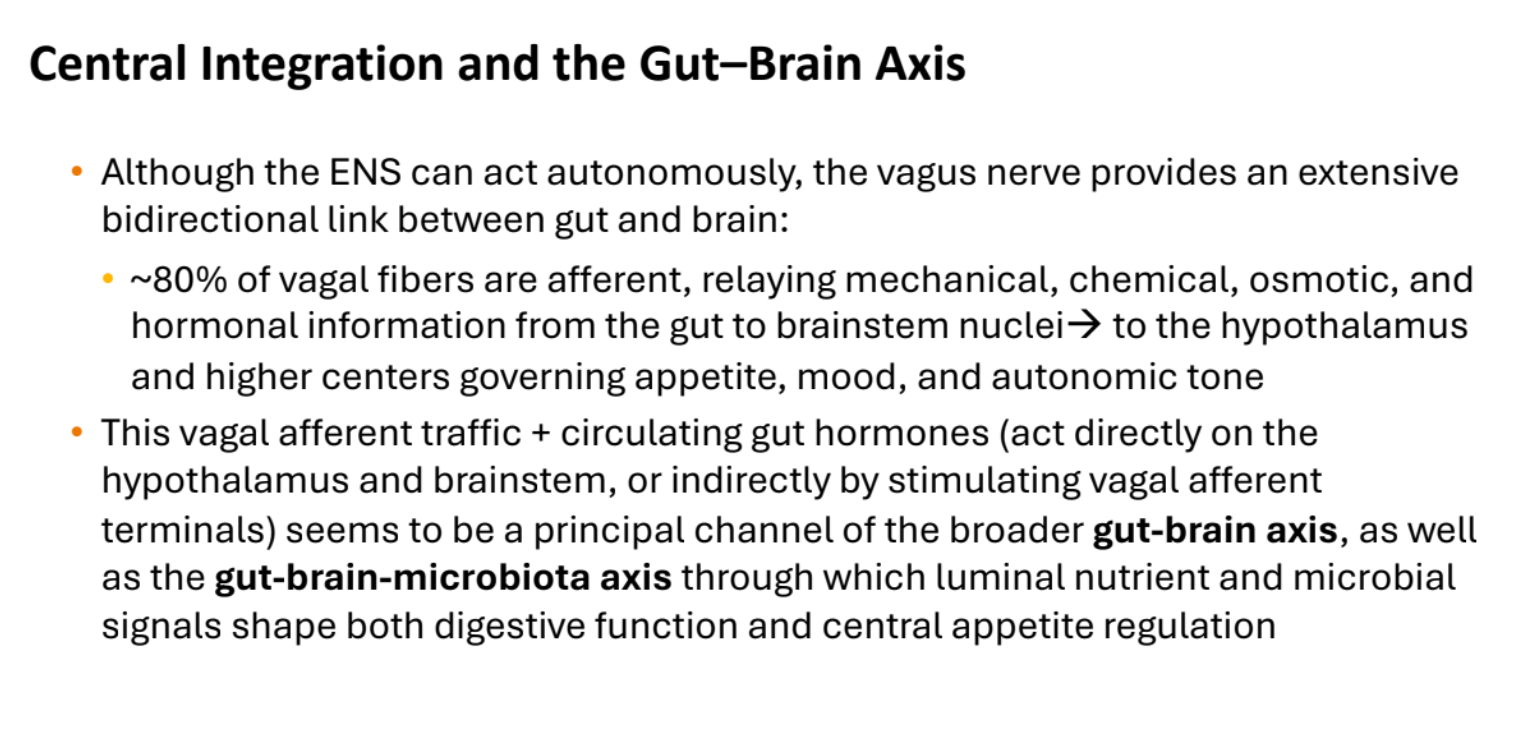
Central Integration and the Gut–Brain Axis: Although the ENS can act autonomously, the ____ provides an extensive
bidirectional link between?
vagus nerve; gut and brain:
~80% of vagal fibers are afferent, (GI to brain) relaying what type of information from the gut to brainstem nuclei
mechanical, chemical, osmotic, and hormonal
This information that’s in the brainstem nuclei then goes to the ____ and higher centers governing what 3 things?
hypothalamus
appetite, mood, and autonomic tone
What seems to be a principal channel of the broader gut-brain axis, as well as the gut-brain-microbiota axis?
Vagal afferent traffic + circulating gut hormones
(act directly on the hypothalamus and brainstem, or indirectly by stimulating vagal afferent terminals)
This vagal afferent traffic + circulating gut hormones (act directly on the hypothalamus and brainstem, or indirectly by stimulating vagal afferent terminals) seems to be a principal channel of the broader gut-brain axis, as well as the gut-brain-microbiota axis through which luminal nutrient and microbial signals shape both _____ function and _____ regulatuion
digestive; central appetite
Entero-Enteric Reflexes: Intestinofugal neurons have cell bodies in the digestive tract and project to what three areas?
sympathetic ganglia
other organs
CNS
The ones projecting to sympathetic ganglia are part of the sensory limb of entero-enteric reflexes that pass from ___ to ___ regions
distal; proximal

Entero-Enteric Reflexes: The reflex pathways bypass the?
Distension in the distal intestine triggers a reflex through sympathetic ganglia that slows ____ in more proximal intestinal regions without involving the _____ .
CNS
motility; CNS
Entero-Enteric Reflexes example: In the case of the stomach, acid or hypertonic solution in the lumen of the upper small intestine leads to an inhibition of? into the?
gastric motility and emptying
duodenum
The entero-enteric reflex that is initiated by fat in the distal intestine and slows transit in the proximal small intestine is referred to as the?
Ileal brake
Entero-Enteric Reflexes arise in ___ regions and regulate more _____ regions, so that luminal contents that arrive at more distal regions are?
distal; proximal; adequately processed proximally

Enteroendocrine Cells: Origin, Classification, and Signaling Modes: Gastrointestinal hormones are synthesized by what cells? where they arise from?
enteroendocrine cells
from pluripotent stem cells at the base of the intestinal crypts
Gastrointestinal hormones are are dispersed throughout an enormous absorptive ___ from the stomach to the colon in relatively ___ numbers
surface area; small
As stem cells migrate up the ___ axis they differentiate into specific ___ subtypes G, I, S, K, Mo, L, and D cells
crypt-villus; hormone-secreting
Enteroendocrine cell types — the G, I, S, K, Mo, L, and D cells, stores their hormones in basolateral secretory granules near the capillary bed and release their contents by ___ in response to?:
exocytosis; luminal stimuli
examples of luminal stimuli → small peptides, amino acids, fatty acids, glucose, luminal distension, changes in osmolarity, and vagal stimulation

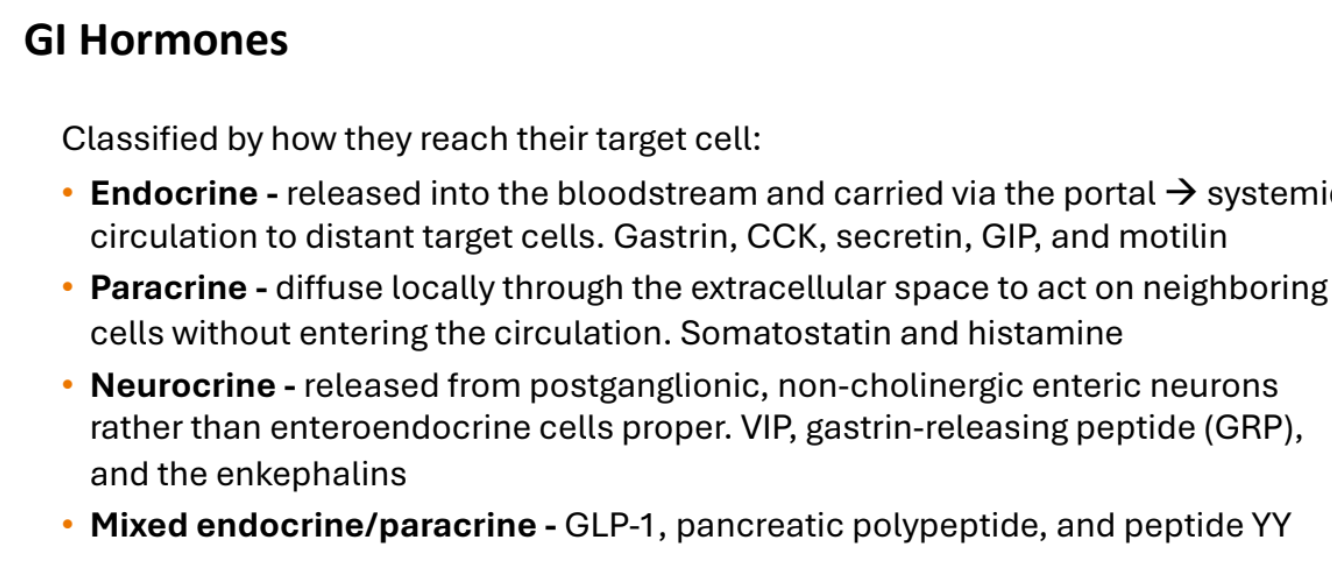
What are 4 types of GI Hormones ( which are classified by how they reach their target cell)
Endocrine
Paracrine
Neurocrine
Mixed endo/paracrine
Endocrine hormones are released into the bloodstream and carried via? they use ____ to distant target cells; what are 5 examples of endocrine cells?
Portal
Systemic circulation
Gastrin
GIP
Secretin
CCK
Motilin
GGSCM
Paracrine - diffuse locally through the ____ space to act on neighboring cells without entering? What are 2 examples?
extracellular; circulation
Somatostatin
Histamine
Neurocrine hormones are released from postganglionic ________ neurons rather than enteroendocrine cells proper. What are 3 examples?
non-cholinergic enteric
VIP
Gastrin releasing peptide (GRP)
Enkephalins
GRPEV
Mixed endocrine/paracrine what are 3 examples?
GLP-1
Pancreatic polypeptide
Peptide YY