T/F for Lin ALG
 Call Kai
 Learn
Learn Practice Test
 Spaced Repetition
 Match
Match Flashcards
 Knowt Play
1/79

There's no tags or description
Looks like no tags are added yet.
Name | Mastery | Learn | Test | Matching | Spaced | Call with Kai | Chat |
|---|
No analytics yet
Send a link to your students to track their progress
80 Terms
False
A vector space consists for four entities: A set of vectors, a set of scalars and two operations.
True
Every vector space V contains at least one subspace.
True
True
False
False
Let A, B be m x n matrices.
If A is row-equivalent to B, then the row space of A is equal to the row space of B.
True
True

True

True
Every vector space V contains at least one subspace.
True
1
False

True
Determine if it is possible to write v as a linear combination of u1, u2, u3.
v = (-1, 7, 2)
u1 = (1, 3, 5)
u2 = (2, -1, 3)
u3 = (-3, 2, -4)
False
The set of all fifth degree polynomials is a vector space.
False
If W and U are subspaces of a vector space V, then the union of W and U is a subspace of V.
False
False
False
Two vectors in a vector space are linearly dependent if and only if one is a scalar multiple of the other.
True
Row operations on a matrix A may change the dependency relationships among the columns of A.
True
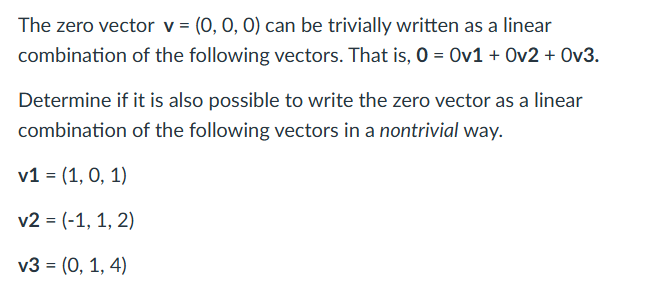
The zero vector v = (0, 0, 0) can be trivially written as a linear combination of the following vectors. That is, 0 = 0v1 + 0v2 + 0v3.
Determine if it is also possible to write the zero vector as a linear combination of the following vectors in a nontrivial way.
v1 = (1, 3, 2)
v2 = (1, 1, 3)
v3 = (2, 4, 5)
True

False
Every vector space contains exactly two subspaces.
False
False

True

False

True

True
If an m x n matrix B can be obtained from elementary row operations on an m x n matrix A, then the column space of B is equal to the column space of A.
False
The set of all real valued ordered pairs of the form (0, y) with standard operations form a vector space.
True

True
True
False

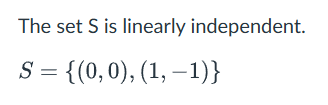
S spans a line

False
If an m x n matrix B can be obtained from elementary row operations on an m x n matrix A, then the column space of B is equal to the column space of A.
False
The matrix B is row-equivalent to the matrix A if there exists a finite
number of elementary matrices E1, E2, . . . , Ek, so that
B = EkEk-1 . . . . E1A.
True → B is row-equivalent to A if and only if B can be obtained from A by a finite sequence of elementary row operations. And each of these elementary row operations can be achieved by multiplying by an appropriate elementary matrix.
Every matrix has a multiplicative inverse.
False → any n x n matrix A with a row of 0's will fail to have a multiplicative inverse.
If A is an n x n matrix and c is a nonzero scalar, then the determinant of the matrix cA is given by
det(cA) = c det(A).
False → The correct formula would be: det(cA) = cndet(A)
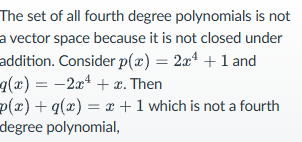
The set of all fourth-degree polynomials with the standard operations is a vector space.
False →

False
True
Let A and B be n x n matrices. If A is similar to B, then A2 is similar to B2.
True → Assume that A is similar to B. So there is an invertible P such that
A = P-1BP
Square both sides to get A2 = (P-1BP)(P-1BP)
= P-1B(PP-1)BP
= P-1BBP
= P-1B2P
Thus, A2 is similar to B2.

True
The dimension of a linear transformation T from a vector space V to a vector space W is called the rank of T.
False
If |A| = |B|, then B is similar to A.
False
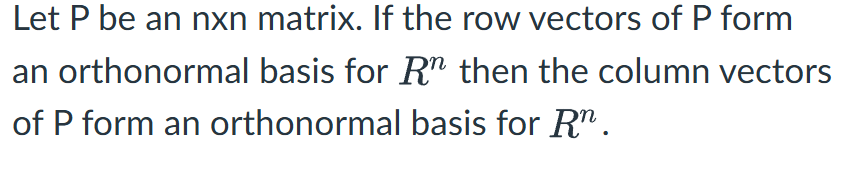
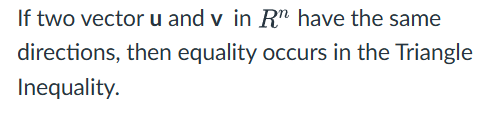
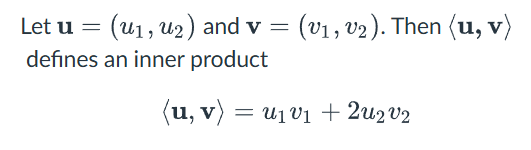
A set S of vectors in an inner product space is orthonormal if every vector is a unit vector and each pair of distinct vectors in S is orthogonal.
True
True
True

True
To apply the Gram-Schmidt process to a set of vectors, the vectors must be unit vectors.
False
An orthonormal basis created by the Gram Schmidt process does not depend on the order of the vectors in the basis.
False

False

False
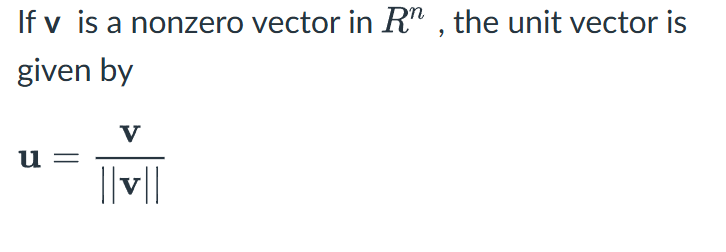
True
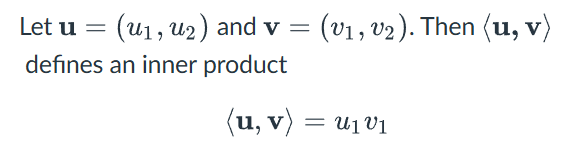
False

True
The range of a linear transformation T: V → W is a subspace of W.
True
Orthogonal
All pairs dot products are 0
orthonormal
dot product is zero and a magnitude of 1 (||u||=1)
Linear transformations
scalar multiplication, summations of all.
Things that DONT apply (sin(t), rank(t), det(t))

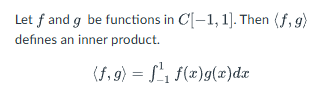
True
Invertible
non-singular
square matris
det does not = 0
Ax = b has a unique solution
Non-Invertible
singular
det = 0
row or column of zeros
rank(T)
number of non zero rows in a matrix
Is t one to one?
if nullity or kern = 0
Is T onto?
only if its columns space the entire codomain eg. if tranformation dim(W) = 4 = rank(T) = 4
Vector Spaces won’t create when
there is an inequality or set limitis
Linear Indenpendence
det does not = 0
pivots
trivial solution Ax = b
Linear Dependence
det = 0
no pivots
row of zeros
non-trivial solution
If A is a nonsingular square matrix, then the system of linear equations
Ax = b has a unique solution.
True
Multiplying a single row of a square matrix A by a nonzero constant results in the
determinant of A being multiplied by the same nonzero constant.
True

False
isomorphic things
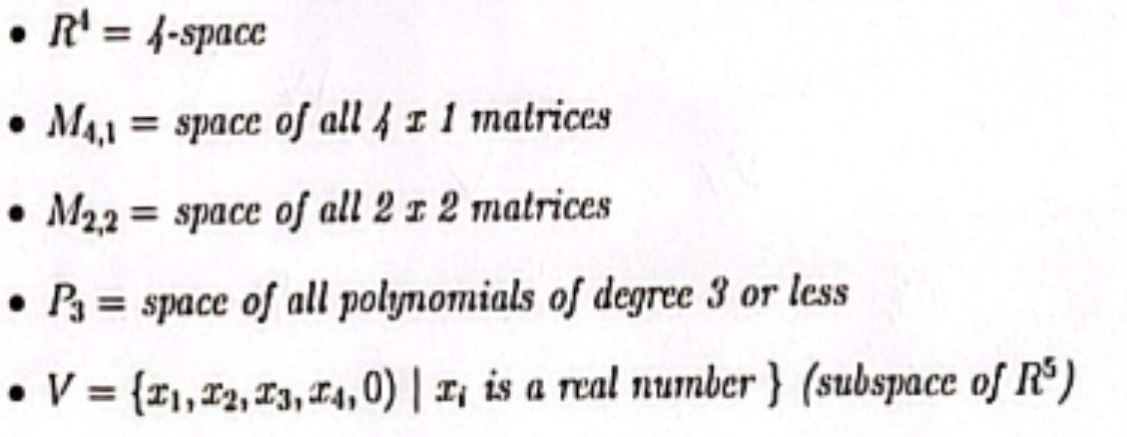
If A and B are nonsingular matrices, then A + B is also nonsingular.
False-
As a counterexample, take any n x n matrix A, and let B = −A.
Then A + B = Onn, which is not invertible.
The transpose of the inverse of a nonsingular matrix is equal to the inverse of the transpose.
TRUE By Theorem 2.8 in the text, we have the formula:
(AT)−1 = (A−1)T
If A is row-equivalent to B, then the column space of A is equal to the column space of B.
False
Of all the possible scalar multiples of a vector v, the orthogonal projection of u onto v is the vector closest to u.
True
Suppose that T1 and T2 are linear transformations from an n-dimensional vector space V into an m-dimensional vector space W, and that A1 and A2 are their respective standard matrices.
Then the standard matrix for the composition T = T2 ° T1 is A2A1.
True