BASIS OF INTEREST CALCULATIONS
 Call Kai
 Learn
Learn Practice Test
 Spaced Repetition
 Match
Match Flashcards
 Knowt Play
1/14

There's no tags or description
Looks like no tags are added yet.
Name | Mastery | Learn | Test | Matching | Spaced | Call with Kai | Chat |
|---|
No analytics yet
Send a link to your students to track their progress
15 Terms
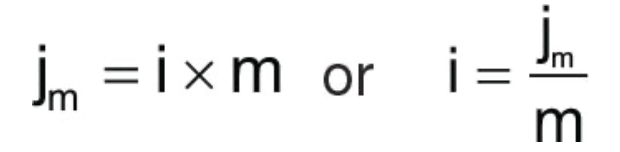
Nominal interest rate per annum
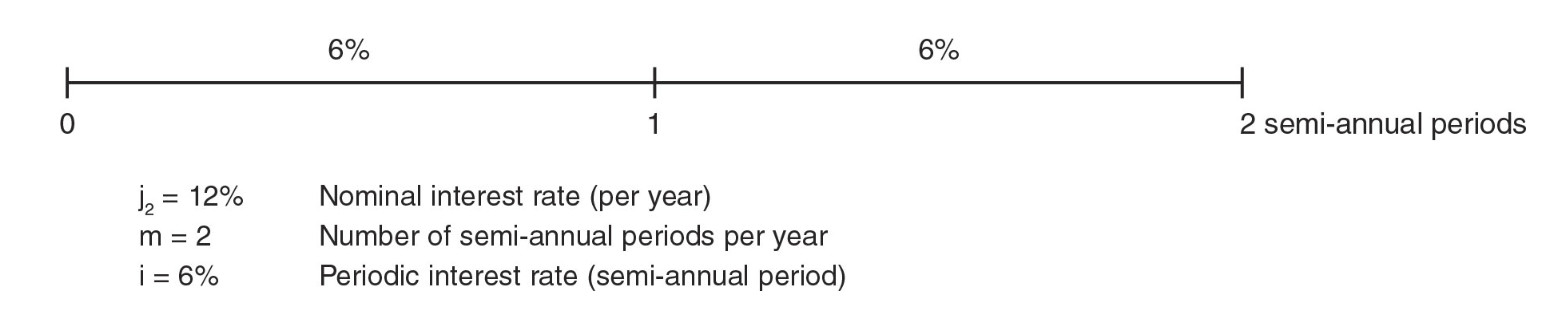
the annual interest rate generally quoted for compound interest
-Consider the nominal rate of 12% per annum, compounded semi-annually, not in advance → interest rate per compounding period = 12%/2=6%
Frequency of compounding for periodic rates
• id represents an interest rate per daily compounding period
• iw represents an interest rate per weekly compounding period
• imo represents an interest rate per monthly compounding period
• iq represents an interest rate per quarterly compounding period
• isa “represents an interest rate per semi-annual compounding period
• ia represents an interest rate per annual compounding period
id = j365 ÷ 365
iw = j52 ÷ 52
imo = j12 ÷ 12
iq = j4 ÷ 4
isa = j2 ÷ 2
ia = j1 ÷ 1
The interest rate j1, which is the nominal rate per annum, compounded annually, is also known as the effective annual interest rate. It will be used in later chapters to find equivalent interest rates.
Compound Interest Calculations
Interest owing = Principal borrowed × interest rate per interest calculation period (in this example, interest is calculated per annual compounding period)
I = PV × i
Present Value (PV)
the amount of principal owing at the beginning of an interest calculation period
PV = FV × (1 + i)-n
PV = FV × (1 + jm/m)-n
Future value (FV)
the amount of money owing in the future
FV = PV + I
FV = PV × (1 + i)n
FV = PV × (1 + jm/m)n

Interest rate per compounding period (i)
the fraction (or percentage) used to calculate the dollar amount of interest owing
Interest owing (I)
in dollars, at the end of an interest calculation (compounding) period
N
Number of compounding periods contracted for
FUTURE VALUE AND PRESENT VALUE OF LUMP SUMS
If the values of any four of the five variables (FV, PV, jm, m, and n) are known, one may directly calculate the value of the fifth variable. However, you need the following conditions for the above relationship (or the financial calculator) to be used:
1. The present value must occur at the beginning of the first compounding period.
2. The future value must occur at the end of the last (or nth) compounding period.
3. Interest rates must be expressed as a rate of interest per compounding period when solving using the exponent key yx, or as a nominal rate per year when using the calculator’s pre-programmed functions.
4. There can be no payments (made or received) during the term other than the present value and future value, i.e., PMT = 0.


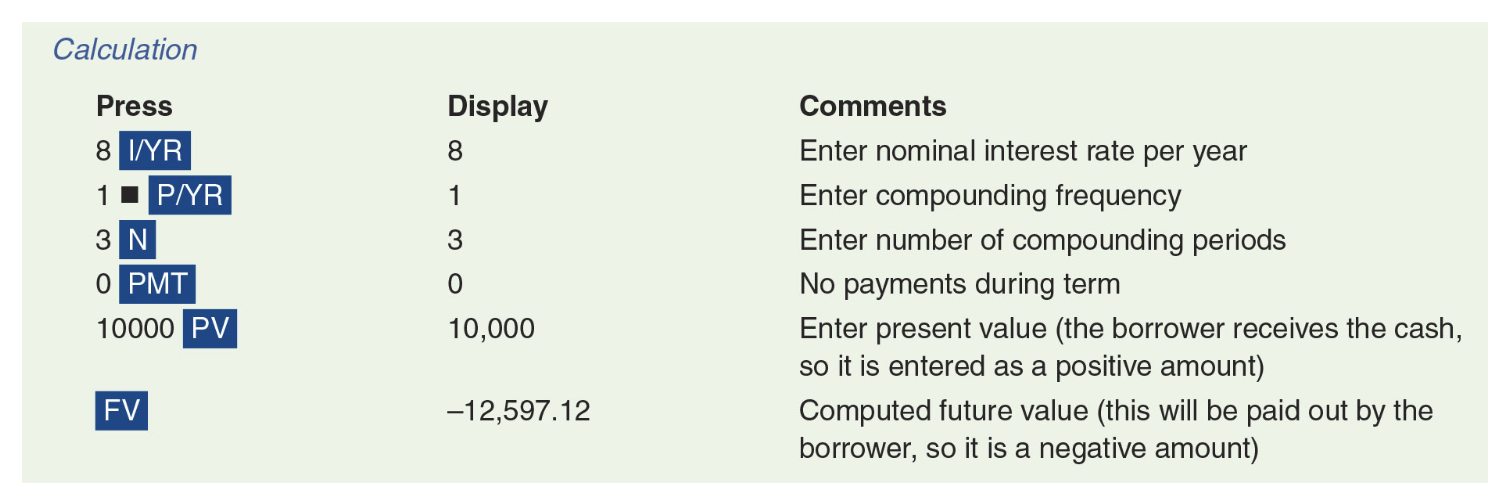
Calculation of Future Value
-Notice that the present value is shown as a negative in this example. This represents the funds needed to purchase the land, which is an outflow of cash for the developer.
-The future value that will be calculated represents the money received by the developer for selling the land in three years, which is a cash inflow and a positive amount.
Rounding Rules Alert!
When rounding monetary values (e.g., PV, FV, or PMT), normal rounding rules are applied. This is the common mathematical rule that states:
• If the third decimal is 5 or greater, the number is rounded up: e.g. 8,955.436 would be rounded UP to $8,955.44 (because the third decimal is a 6).
• If the third decimal is less than 5, the number is rounded down: e.g. 8,955.433 would be rounded DOWN to $8,955.43 (because the third decimal is a 3).
-Assume all monetary values are rounded to the nearest cent, unless instructed otherwise.
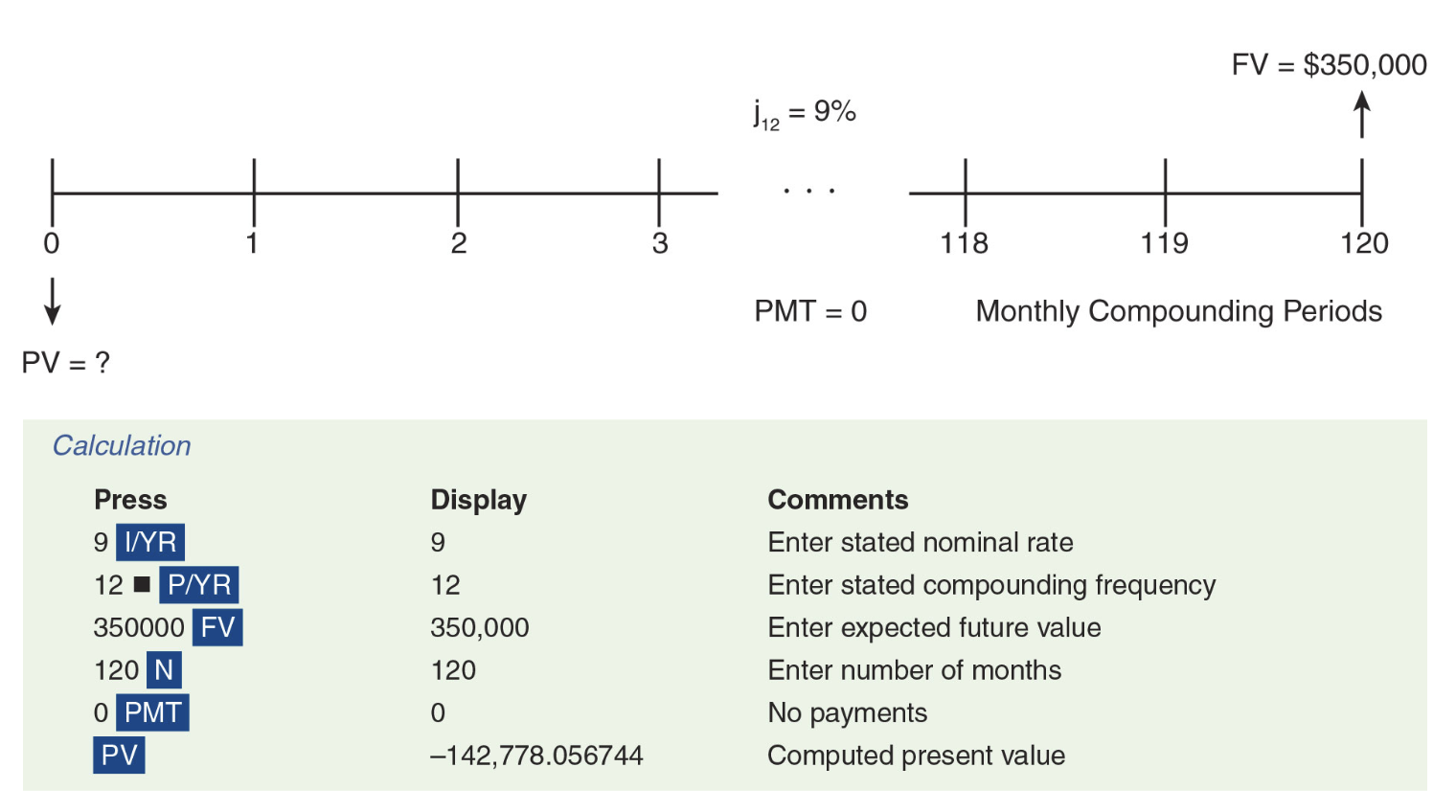
Calculation of Present Value
-the time value of money says that money received in the future is worth less than money received today

ANNUITIES: PAYMENTS
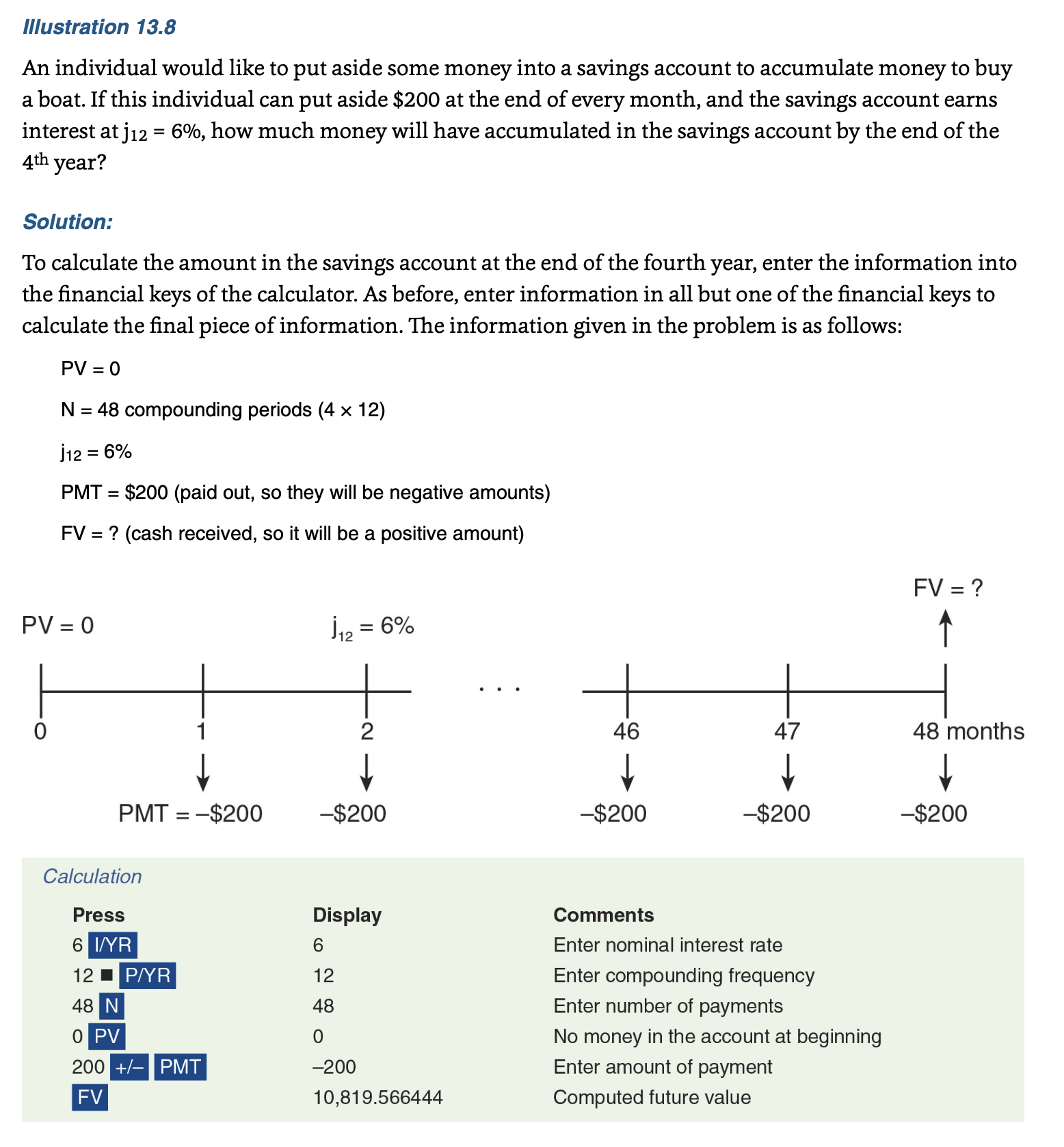
-annuity: a stream of equal payments that are spread evenly over time.
-sinking funds: a stream of cash flows where regular payments are set aside to accumulate funds for a specific purpose in the future
Frequency Alert!
-it is vital that the I/YR, N, and PMT keys all use the same frequency
1. If there is a PMT frequency (e.g. monthly mortgage payment) stated in the financial problem, then this drives the frequency in the question.
2. If there is no PMT frequency stated in the financial problem (e.g., interest accruing loan, which has no constant payments), then the compounding frequency of the interest rate given in the problem drives the question

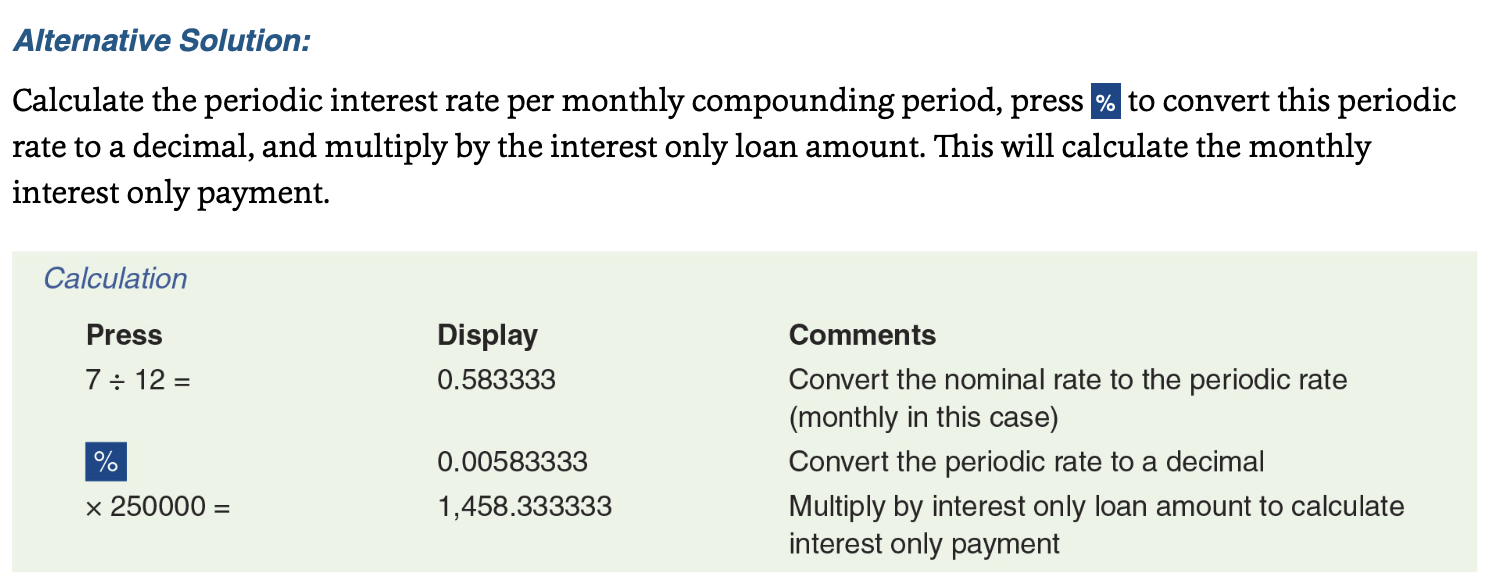
CALCULATING INTEREST ONLY PAYMENTS
-Since you never pay down the principal balance on an interest only loan, the present value and the future value will be the same.
-In an interest only loan, you can set N to equal any number because there is no principal portion of the payments paying down the loan, and each payment will be the interest portion of the loan.