Lecture 7: Earthquakes
 Studied by 0 people
 Call Kai
 Learn
Learn Practice Test
 Spaced Repetition
 Match
Match Flashcards
 Knowt Play
1/83

There's no tags or description
Looks like no tags are added yet.
Name | Mastery | Learn | Test | Matching | Spaced | Call with Kai |
|---|
No study sessions yet.
84 Terms
What creates an earthquake?
A rupture of rocks along a fault
Energy from an earthquake is released in what form?
Seismic waves
Earthquakes are mapped according to the ____
Epicentre
Where is the focus located
Directly below the epicentre
They are measured by ____ and compared by _____
seismographs
magnitude
What did the Richter Scale measure?
the strength of a wave 100 km from the epicentre
What scale do we use to measure earthquakes today?
The Moment Magnitude Scale
The Moment Magnitude Scale is determined by: (3 things)
The area of rock ruptured along a fault
The distance of movement along the fault
The eslasticity of the rock at the focus
Like the Richter Scale, it is a ______ scale
Logarithmic
An M7 earthquake represents ___x the strength of an M6 earthquake
10x
What is the strongest earthquake ever recorded o the Moment Magnitiude Scale?
M9.5 in Chile in 1960
What scale do we use to measure intensity?
The Modified Mercalli Intensity Scale
What is the The Modified Mercalli Intensity Scale?
This is a qualitative scale based on damage to property and the effect of an earthquake on people.
Where are earthquakes most common? Why?
At or near plate boundaries
Friction along plate boundaries exerts a force (stress) on the rocks, exerting strain or deformation
When the stress exceeds the strength of the rocks, there is a sudden movement along a fault
The earthquake process:
Friction along plate boundaries exerts a force (stress) on the rocks, exerting strain or deformation
When the stress exceeds the strength of the rocks, there is a sudden movement along a fault
The rupture starts at the focus and propagates in all directions in the form of seismic waves
What is a fault located below earth’s surface called?
Blind faults
What are the 2 basic type of geologic faults distinguished by?
the direction of the displacement of rock
Two types of faults and direction of displacement:
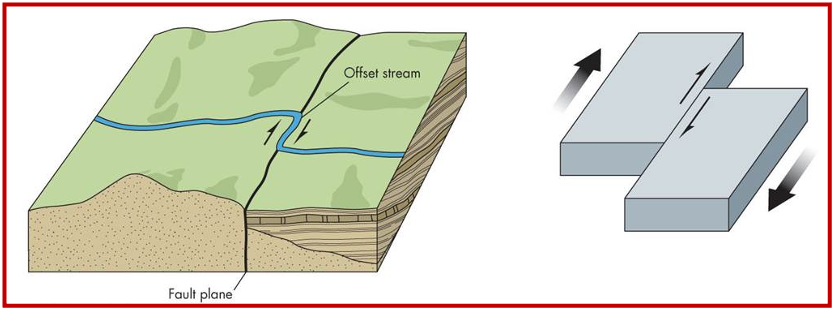
Strike-slip faults: displacements are horizontal
transform
Dip-slip faults: displacements are vertical
normal, thrust, reverse
Example of a strike-slip fault
San Andreas
What are the 3 categories of Dip-Slip faults?
Reverse faults
Thrust faults
Normal faults
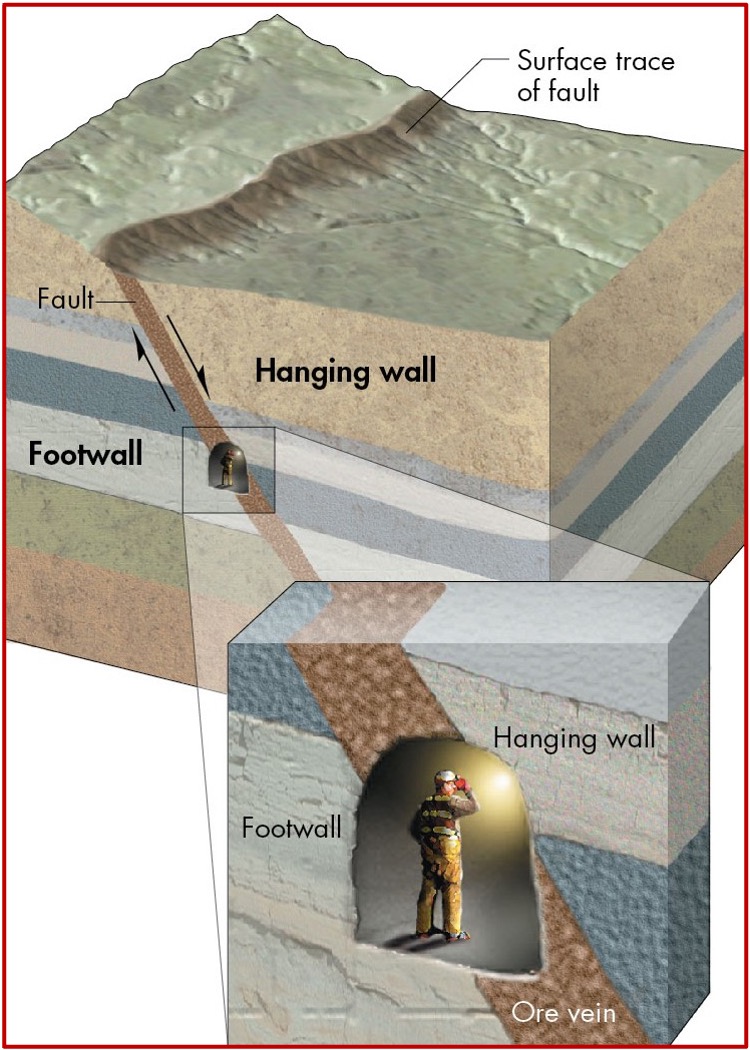
What are the two walls in dip-slip faults?
Footwall —> where miners placed their feet
Hanging-wall —> where miners placed their lanterns
Reverse fault:
The hanging-wall has moved up relative to the footwall and is inclined at an angle above 45 degrees
Thrust Fault:
These are like reverse faults except the angle us 45 degrees or less
Normal Fault:
The hanging-wall has moved down relative to the footwall
What are the 3 categories of fault activity?
Active
Potentially active
Inactive
Active faults:
movement during the past 11,600 years
Potentially active faults
movement during the past 2.6 million years
Inactive faults:
no movement during the past 2.6 million years
What is tectonic creep? (or fault creep)
The extremely slow movement of rock along a fracture caused by stress
What is bad about tectonic creep?
can damage roads and building foundations
can also produce earthquakes if sudden displacement across these faults occurs
What are body waves?
seismic waves generated by fault rupture that travel within the body of the earth
2 types of body waves?
P waves
S waves
p-waves:
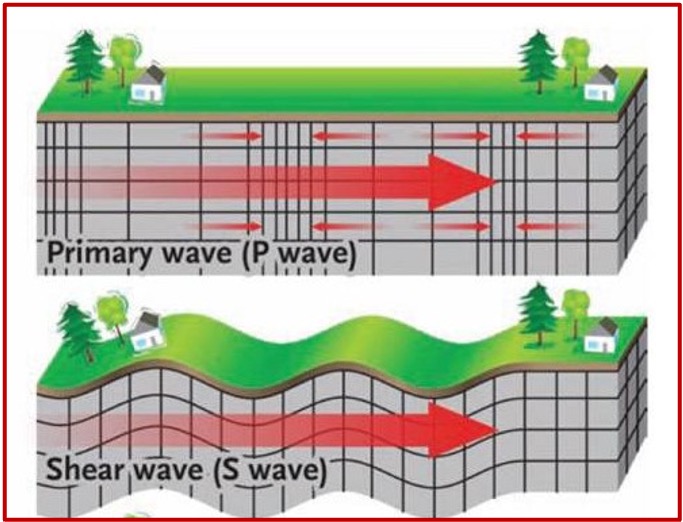
also called primary or compressional waves
move relatively fast with a push-pull motion
can travel through solids or liquids
fast
push-pull (back and forth)
solids AND liquids
s-waves:
also called secondary or shear waves
they move relatively slow in an up-and-down motion
can only travel through solids
slow
updown
ONLY solids
What are surface waves?
Seismic waves that form when P waves and S waves reach Earth’s surface and then move along it
move more slowly than body waves
surface waves are responsible for damage near the epicentre
slower
6 factors that determine earthquake shaking:
magnitude
distance to epicentre
focus depth
direction of rupture
local soil and rock type
local engineering and construction practices
What waves appear first on a seismogram?
P waves
because they travel faster
How do we determine the distance to the epicentre?
Measuring the difference between the arrival times of the P waves and S waves at different locations
gets calculated at 3 different seismic stations
a circle with a radius equal to that distance is drawn around the station
How do we locate an earthquake (epicentre)?
Triangulation —> where the 3 circles intersect
What is focus depth?
Seismic waves become less intense as they spread outward toward the surface
What is the relationship between focus depth and shaking?
Inverse
the greater the focus depth, the less intense the shaking at the surface
greater focus depth = less shaking
What is directivity?
Earthquake energy is more focused along the geographic direction of rupture
contributes to increased shaking
waves are stronger along the direction of the fault
What kind of crust transmits energy quickly vs slowly?
Dense, homogenous crust —> transmits seismic energy quickly
Heterogeneous, folded, faulted crust —> slows down seismic energy
Why do we feel more shaking in eastern North America than western North America?
The underlying bedrock in eastern North America is more homogeneous
What is amplification?
An increase in ground motion during an earthquake
P waves and S waves slow down as they travel through _____ sand, gravel, clay, soil, etc
Alluvial
What does alluvial mean?
any material deposited by water
What is the definition of The earthquake Cycle?
A hypothesis that explains successive earthquakes on a fault overtime
based on the idea that strain drops abruptly after an earthquake and then slowly accumulates until the next earthquake
As stress continues to increase, the deformed rocks with eventually rupture
The Earthquake Cycle (diagram)
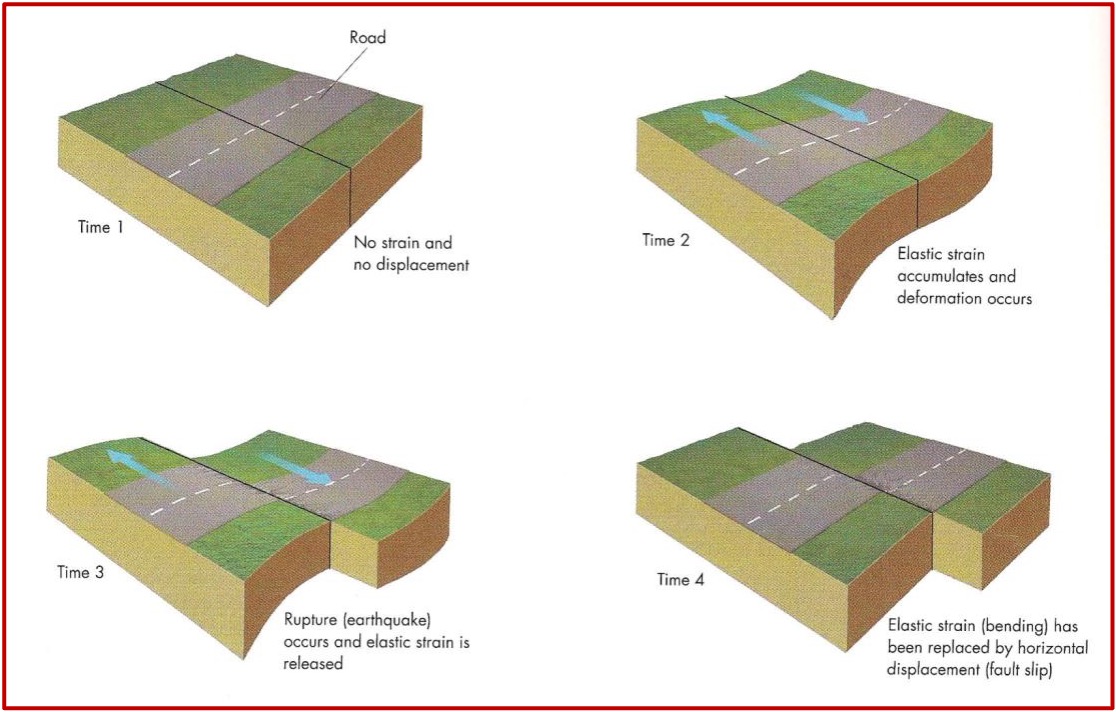
The Earthquake Cycle stages:
Inactive period
Period of strain
Period of foreshocks prior to major stress release (doesn’t always happen)
Period where the mainshock occurs, allowing the fault to release the stress
Period of aftershocks
* time between each stage varies
What is a foreshock?
a small to moderate earthquake that occurs shortly before and in the same general area as the mainshock
What is a mainshock?
the largest earthquake in a series of associated earthquakes
What is an aftershock?
a small to moderate earthquake that occurs shortly after and in the same general area as the mainshock
How can we forecast the number of aftershocks that occur on a given day after a mainshock?
Aftershocks on given day
= aftershocks on 1st day after / given day
Example: If 200 aftershocks occurred on the first day after the mainshock, how many aftershocks are likely to occur on the 7th day after the mainshock?
200 / 7 = 29
Are earthquakes randomly distrubuted?
No
Where do most earthquakes occur?
Along plate boundaries
Ex. Pacific Ring of Fire, Himalaya Mountains, Middle East
Some occur intraplate
What North American cities are at high risk of earthquakes:
Anchorage
Vancouver
Victoria
Seattle
Portland
San Francisco
LA
Mexico City
What areas are at high risk of intraplate earthquakes?
Memphis & St. Louis
What are plate boundary earthquakes?
Earthquakes that occur on faults which specifically separate plates
What are 3 types of plate boundary earthquakes?
Strike-slip
Thrust
Normal
Strike-Slip Eathquakes
occur along transform faults where plates slide horizontally past one another
Example: San Andreas fault
Thrust Earthquakes
occur on faults that separate converging plates
also called subduction earthquakes
Common off the coast of B.C., Washington, and Oregon
These earthquakes are the strongest on Earth and can produce tsunamis
Convergent plate boundary / subduction zones
Normal Fault Earthquakes
occur on faults associated with divergent plate boundaries
common along the Mid-Atlantic Ridge
Most are located under oceans and are generally smaller than M6
Convergent plate boundaries / mid-ocean ridges
Intraplate Earthquakes
An earthquake on a fault in the interior of a continent, far from a plate boundary
typically not as strong as plate boundary earthquakes.
damage could be considerable due to lack of preparedness
Why are intraplate earthquakes felt over large areas?
Because of dense continental bedrock
Where are the 2 active intraplate zones in North America?
Central Mississippi River Valley
St. Lawrence River Valley
What is recurrence interval?
the time between successive events
example: the recurrence interval in areas on active intraplate zones is likely several hundred years
Earthquake hazard map
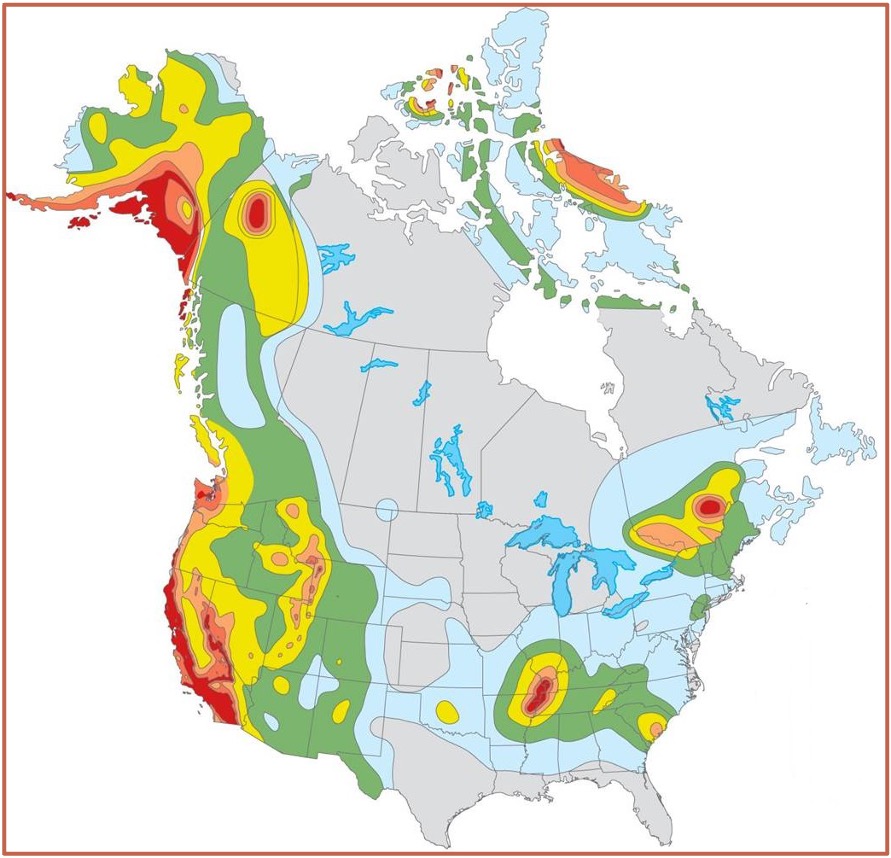
Primary effects of earthquakes
Ground shaking
surface rupture
Secondary effects of earthquakes
Liquefaction
land-level change
landslides
fire
tsunamis
What is a fault scarp?
a linear escarpment at Earth’s surface formed by movement along a fault during an earthquake
What is surface rupture and what is its effects?
Displacement along faults causes cracks in the surface.
Surface rupture can uproot trees, collapse buildings, and destroy bridges, tunnels, and pipelines
What is liquefaction?
The transformation of water-saturated sediment from solid to liquid during an earthquake
It occurs when water pressure becomes high enough to suspend particles of sediment within the soil.
Once the pressure decreases, the sediment compacts and regains its strength
How do earthquakes cause landslides?
Ground shaking produced by an earthquake can cause rock and sediment to move downslope
How do earthquakes cause fires?
Ground shaking and rupture can start fires by severing power and gas lines.
Appliances may topple over causing gas leaks that may ignite
~ 80% of the damage during the 1906 San Francisco earthquake was caused by fire
What are the natural service functions of earthquakes?
Faults provide pathways for the downward flow of water
They can channel groundwater to surface discharge points (springs)
New mineral resources can be exposed —> Some minerals are preferentially deposited in faults
Scenic landscapes (hills, valleys) develop in fault zones over millions of years.
How can earthquakes be caused by human activity?
Fracking (breaking of rock to get oil)
The weight from water reservoirs produced by dams can create new faults
Injecting liquid waste deep in the Earth can increase pressure and cause slippage along fractures
Testing nuclear weapons leads to explosions that may increase strain in an area
Earthquake Hazard Reduction Programs (5 goals)
Improve national seismograph networks
Develop awareness of earthquake sources
Determine earthquake potential
Predict effects of earthquakes on buildings
Communicate research to educate the public
What is a great example of the value of planning for earthquakes?
The Denali earthquake in Alaska in 20
Where the Trans-Alaska oil pipeline crossed the Denali fault, its construction was altered to withstand a large earthquake
How do we identify areas of seismic risk?
Hazard maps
They include areas prone to liquefaction, zones of potential ground rupture, and historic epicentre
What are the 4 precursors to earthquakes to help with forecasting?
The pattern and frequency of smaller ruptures
Based on foreshocks and microearthquakes
Land-level change
Uplift or subsidence may precede earthquakes
GPS can recognize small changes in elevation
Seismic gaps along faults
Areas along a fault that have not seen recent earthquakes may be more likely to experience one
Physical and chemical changes
Changes in groundwater level and chemistry may occur if rocks expand prior to an earthquake
Current warning systems provide how much of a warning?
15-30 seconds
only warn of a major earthquake that has already occurred
How can we minimize seismic risk?
critical facilites should be located as safely as possible
Buildings must be designed to withstand vibrations (retrofitting may be required)
Diagonal beams prevent building from collapsing
education is a component of preparedness (workshops, training sessions, earthquake drills)
-Earthquake insurance should be made available in high-risk areas
What causes most casualties from earthquakes?
building collapse and falling objects