Lect 3: Skeletal and Articular System
 Call Kai
 Learn
Learn Practice Test
 Spaced Repetition
 Match
Match Flashcards
 Knowt Play
1/77

There's no tags or description
Looks like no tags are added yet.
Name | Mastery | Learn | Test | Matching | Spaced | Call with Kai | Chat |
|---|
No analytics yet
Send a link to your students to track their progress
78 Terms
What are 3 distinct physical attributes of long bones?
greater length than width
mostly dense, compact bone
curved to absorb stress
What are distinct physical attributes of short bones?
cube shaped
spongy bone surrounded by compact bone
What is the role of flat bones in the body?
protect + muscle attachments
What is the function of sesamoid bones?
protect tendons
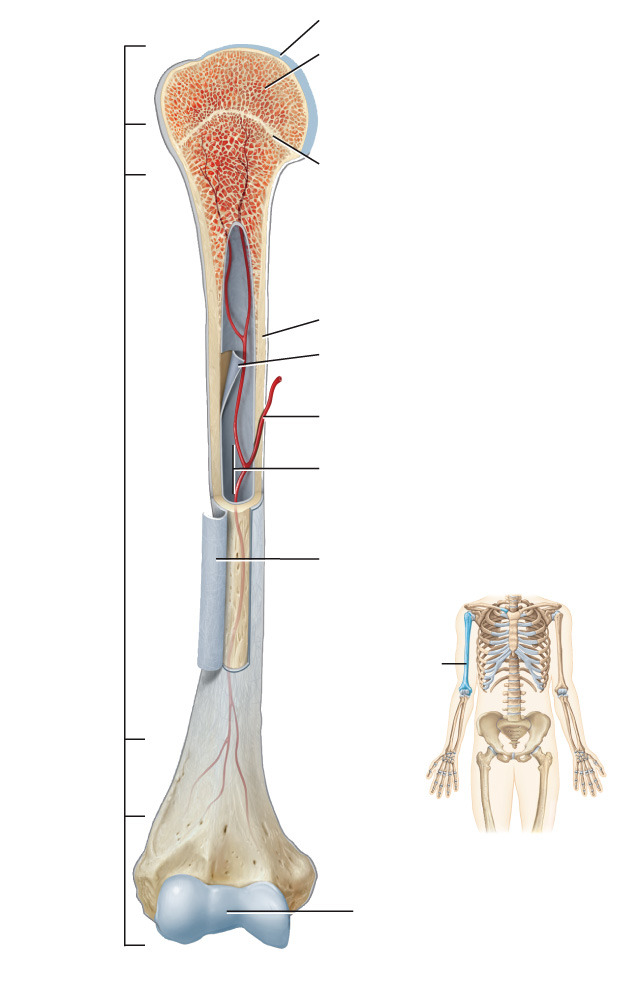
Label
periosteum- outer layer of bone
endosteum- inner lining of bone

What 3 “ingredients” compose bone?
collagen
protein
minerals
When does ossification begin? When does it end?
6th-7th week (embryonic)
continues through adulthood
What is the process by which bone is formed called?
ossification
What is heterotropic ossification?
abnormal bone growth in soft tissue that negatively impacts mobility/function
Where does bone remodeling occur?
along lines of mechanical stress
Bone replacement (remodeling) is a balance between what two things?
Osteoclast (cat break down)
Osteoblast (build- ‘boom ur bone‘)
What law can also be described as remodeling?
Wolff’s law
An imbalance in bone remodeling in which deposits are greater can result in what?
spurs / bumps
that interfere with joint movements
Imbalanced bone remodeling with greater resorption can lead to what?
weak / brittle bones (osteoporosis)
What are the components of bones vascular supply?
periosteal arteries
nutrient arteries
veins (accompany arteries through nutrient foramina)
What types of nerves go to bone?
periosteal nerves (sensory > periosteum)
vasomotor nerves (reg blood flow thru bone marrow)
Periosteal nerves
innervate the pereosteum of bones
Vasomotor nerves in bone
regulate BF through bone marrow
What are the steps in bone repair after a fracture?
1) hematoma: 6-8hr post injury
2) fibrous/cartilaginous callus formation: several weeks
3) bony callus formation: lasts 3-4 months
can takeup to a year
What terms are used to describe the 6 “sides” of bones?
anterior / posterior
medial / lateral
superior / inferior
Name the elevation:
small, raised, rounded
tubercle
Name the elevation:
swelling, knob, rounded
protuberance
Name the elevation:
large, blunt, rounded
trochanter
Name the elevation:
large, rounded
Tuberosity
Name the elevation:
rounded, articular
condyle
Name the elevation:
superior to condyle
epicondyle
Name the elevation:
slender, tooth-like
process
Name the elevation:
hammerhead-like
malleolus
Name the elevation:
large, linear ridge
crest
Name the elevation:
sharp, slender
spine
Name the depression:
pit like
sinus
Name the depression:
circumscribed, lare or small
fossa
Name the depression:
trough-like
sulcus
Name the opening:
hole in bone
foramen
Name the opening:
long narrow opening
canal / groove
Name the opening:
indentation at bone’s edge
notch

Name the opening:
enters but does not pass through structure
meatus

What is the name for bone to bone smooth areas of contact?
articular facets
What do you call a flat articular surface of bone?
Plateau
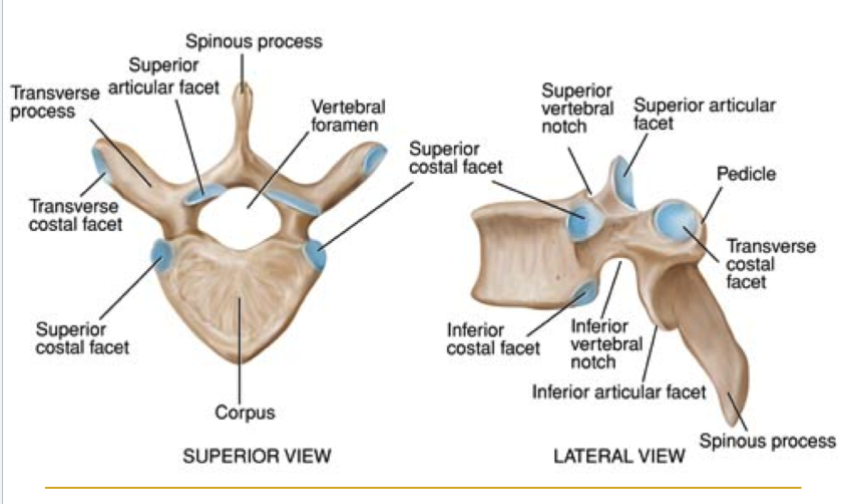
Cartilage
dense network of collagen and elastic fibers embedded in chondroitin sulfate (ground substance)
Cartilage gets its strength from ___ and resiliency from ____
collagen
ground substance (chondroitin sulfate)
What are the 3 types of cartilage?
fibrocartilage
hyaline
elastic
What is the strongest vs weakest cartilage?
strongest- fibrocartilage
weakest- hyaline
Fibrocartilage
strongest
support + fusion
ex: pubic symphysis, menisci, intervertebral discs
Pubic symphysis, menisci, intervertebral discs
are all made of what?
Fibrocartilage
Hyaline cartilage
weakest cartilage
no intrinsic blood/nerve supply
smooth surfaces for joints
What type of cartilage provides smooth surfaces for joints?
hyaline
Elastic cartilage
suppport + shape
ex: epiglottis, ear, nares
What type of cartilage makes up the epiglottis, ear, and nares?
elastic
Joints are points of contact between what?
bones
cartilage + joints
teeth + bones
What do we classify joints base on?
structure and function
What are the 3 functional classifications of joints?
synarthrosis (immoveable)
amphiarthosis (slightly moveable)
diarthrosis (freely moveable)
What are the 3 structural classification of joints?
fibrous: nocavity/space between bones -skull
cartilaginous: tightly join but allow slight movement - vertebrae
synovial: space between bones allows for movement - knee
What are the components of a synovial joint?
Articular Capsule
fibrous capsule: outer layer, dense/irregular connective tissue, prevent dyslocation but allow movement
Synovial membrain: inner layer, synovial fluid nourish/lubrical joint
Articular cartilage: hyaline (no BF/N) lines articulating surfaces of bones
reinforced by accessory ligaments
What are the 4 classifications of synovial joints?
1) Uniaxle: hinge, pivot/trochiod
2) biaxial: conyloid, saddle
3) triaxial: ball and socket
4) nonacial: plane/gluiding
Hinge joint
uniaxial synovial
convex into concave
only move in one plane
Pivot joint is also called what?
trochoid
Condyloid (joint)
oval shape body fits in elliptical cavity
biaxial
Saddle joint
modified condyloid
provide more movement
biaxial
How many degrees of freedom do ball and socket joints have?
3
and permits circumduction
Glenohumeral vs Acetabulofemoral joint
shoulder: ↑mobility but ↓ stability
hip: ↑stability but ↓ mobility
Do plane/gluiding joints themselves permit rotation?
no
Intrinsic / intracapsular ligaments
in joint capsule
anterior/posterior cruciate ligaments (ACL/PCL)
Extrinsic (Extracapsular) ligaments
outside joint capsule
medial/lateral collateral ligaments (MCL/LCL)
Study of movement in the body
Kinematics
bones, liggaments, and muscles form ____ rotating around a joint to do what?
levers
generate force to propel body through space
Majority of the levers in the body are what class?
3rd class
3rd class lever
force (muscle) is between the axis and the resistance
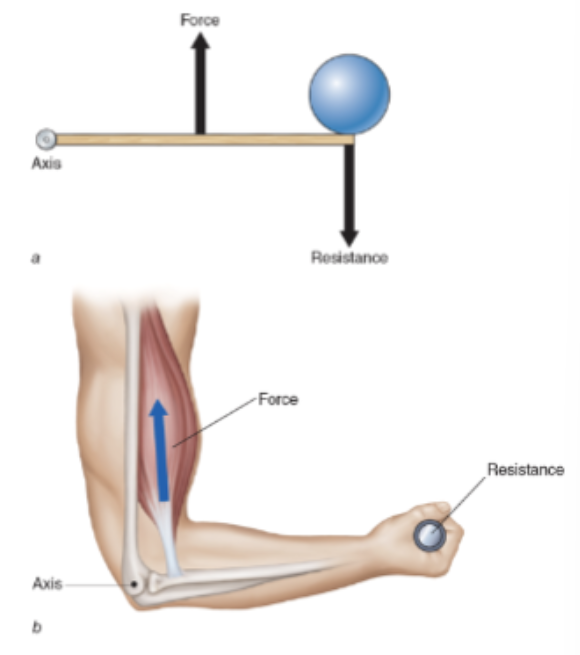
Torque
the ability of force to create rotation abt an axis
determines how successful a muscle can create movement

1st class lever
ex: head

(Lever) Equilibrium =
effort x force arm = resistance x resistance
Mechanical advantage (lever)
force arm > resistance arm
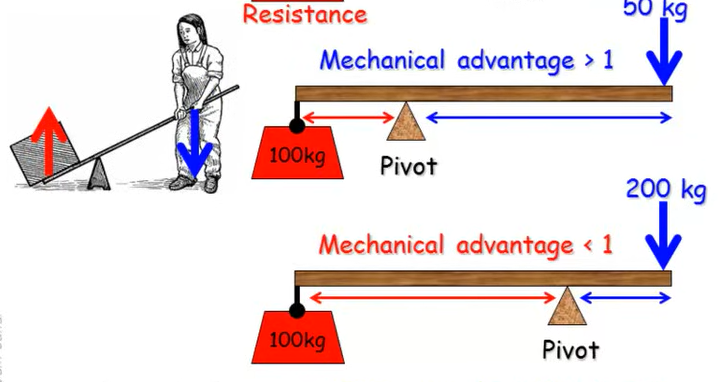
2nd class lever
resistance is in the middle
ROM sacrificed to gain force
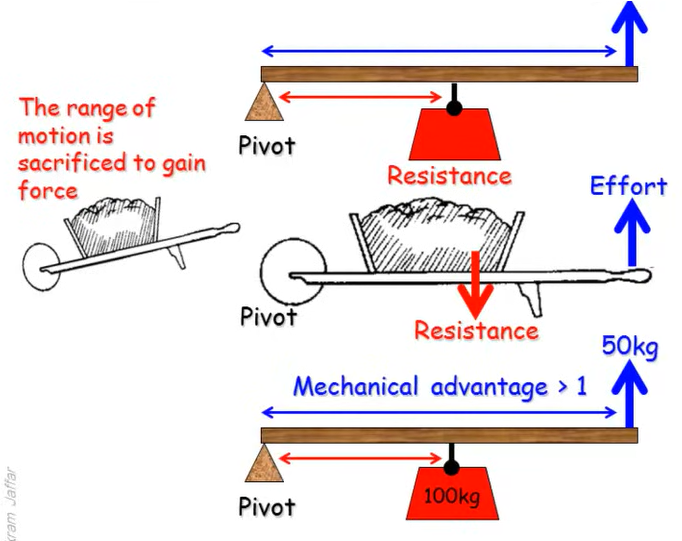

2nd class lever
3rd class lever
effort is closer to pivot than resistance (effort in middle)
*majority of muscle
*sacrifice force for inc ROM with minimal muscle shortening
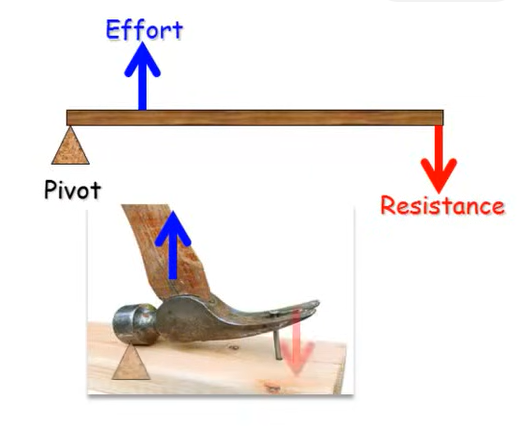
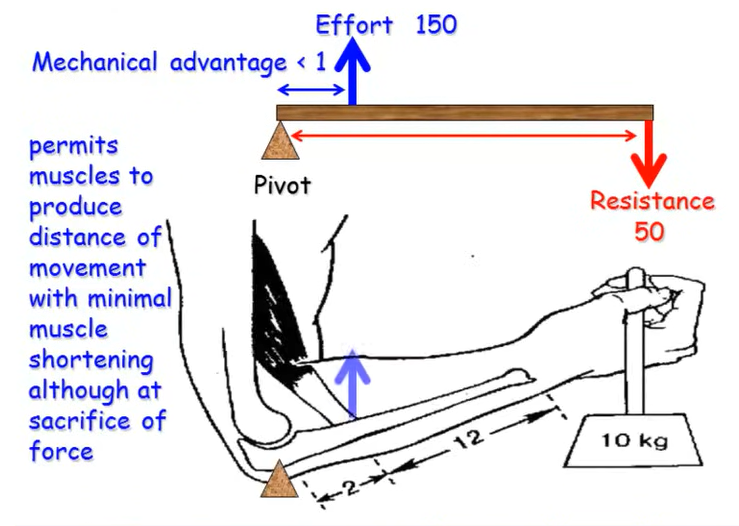
3rd class level
2nd class levers in the body are rare. One example is:
plantarflexing the foot