Psychophysics
 Call Kai
 Learn
Learn Practice Test
 Spaced Repetition
 Match
Match Flashcards
 Knowt Play
1/32

There's no tags or description
Looks like no tags are added yet.
Name | Mastery | Learn | Test | Matching | Spaced | Call with Kai | Chat |
|---|
No analytics yet
Send a link to your students to track their progress
33 Terms
Psychophysics is the study of WHAT
How physical stimuli are related or translated into psychological experience
Can the relationship be modelled by a math equation
The relationship is described by the Weber’s law and Fechner’s law
What are the two basic concepts of psychophysics
WHAT
WHAT
What are the two basic concepts of psychophysics
Absolute threshold
Just Noticeable Difference (JND)
Absolute threshold is WHAT
Absolute threshold is the minimum amount if stimulation that an organism can detect
Gustav Fechner was one of the early researchers who were interested in finding out the WHAT
Researchers found out that there is no WHAT at which the subject jumps from no detection to completely accurate detection (unlike the case of neurons)
Gustav Fechner was one of the early researchers who were interested in finding out the ABSOLUTE THRESHOLD.
Researchers found out that there is no SINGLE STIMULUS INTENSITY at which the subject jumps from no detection to completely accurate detection (unlike the case of neurons)
The chance of detecting a stimulus increases gradually with WHAT
The chance of detecting a stimulus increases gradually with STIMULUS INTENSITY
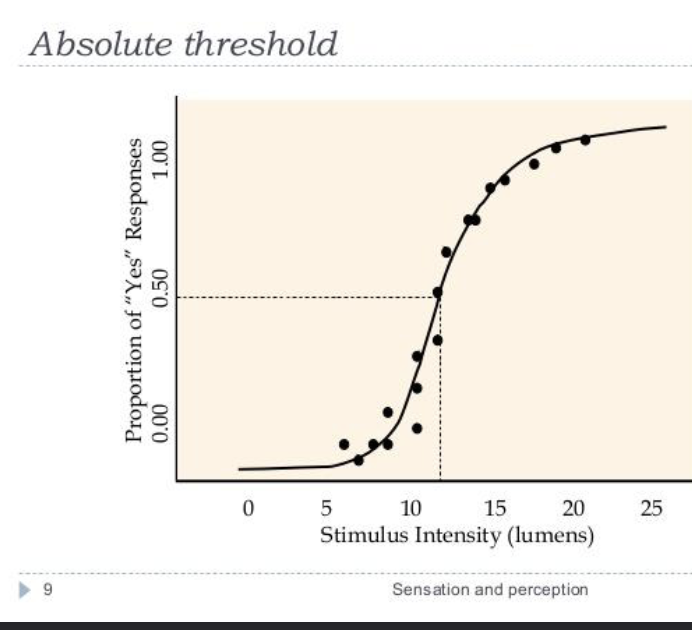
Absolute threshold is defined as the WHAT
Absolute threshold is defined as the INTENSITY LEVEL at which the probability of detection is 50%
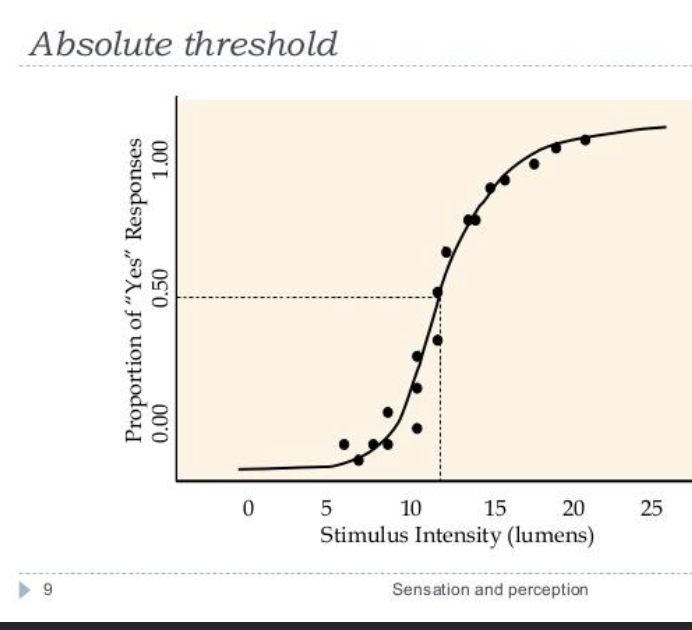
Signal detection theory: the detection of a stimulus depends on
WHAT
WHAT
Signal detection theory: the detection of a stimulus depends on
Intensity of the stimulus
Psychological state of the individual or context of the situation
Intensity of the stimulus
If the intensity of a stimulus is low/ambiguous (a vague stimulus embedded in many background noises), decision outcome is affected by WHAT
Intensity of the stimulus
If the intensity of a stimulus is low/ambiguous (a vague stimulus embedded in many background noises), decision outcome is affected by OTHER FACTORS
Psychological state of the individual or context of the situation
Two processes are involved
WHAT
WHAT
Psychological state of the individual or context of the situation
Two processes are involved
Sensory process
Decision-making process
Percievers response: Yes
Stimulus: Present
decision outcome = WHAT
Percievers response: Yes
Stimulus: Present
decision outcome = HIT
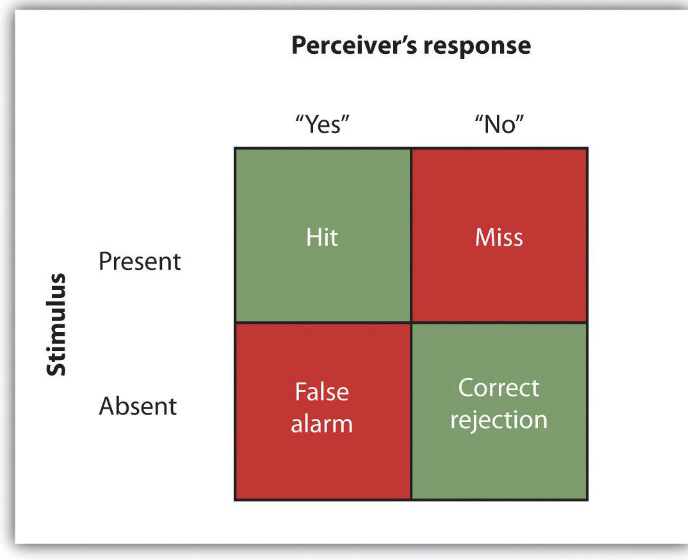
Percievers response: Yes
Stimulus: Absent
decision outcome = WHAT
Percievers response: Yes
Stimulus: Absent
decision outcome = FALSE ALARM
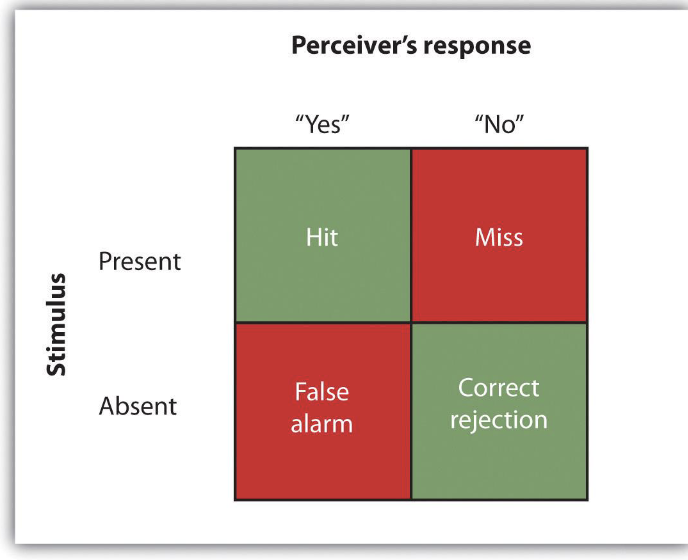
Percievers response: No
Stimulus: Absent
decision outcome = WHAT
Percievers response: No
Stimulus: Absent
decision outcome = CORRECT REJECTION -
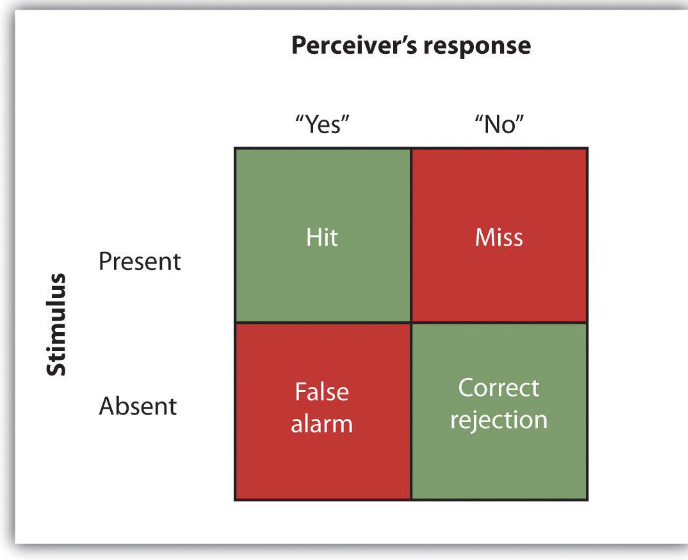
Percievers response: No
Stimulus: Present
decision outcome = WHAT
Percievers response: No
Stimulus: Present
decision outcome = MISS -
Unbiased responses
Hit rate = WHAT
Miss rate = WHAT
False alarm = WHAT
Correct rejection = WHAT
Unbiased responses
Hit rate = 95%
Miss rate = 5%
False alarm = 5%
Correct rejection = 95%
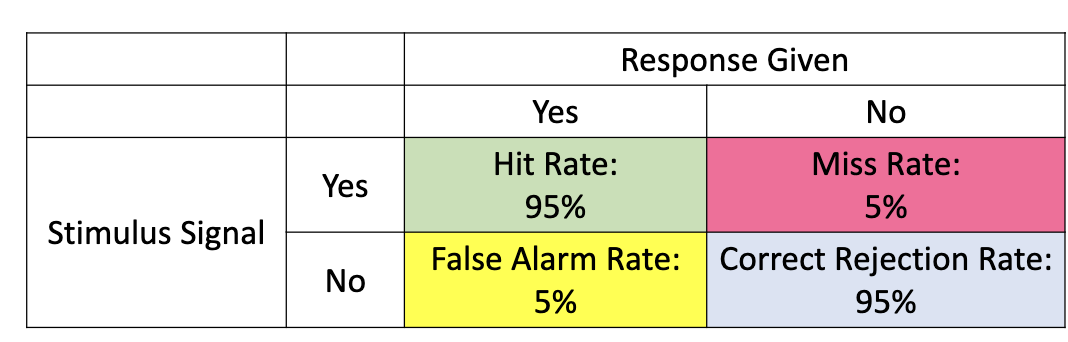
Unbiased responses
WHAT rate = WHAT rate
WHAT rate = WHAT rate
Unbiased responses
HIT rate = CORRECT REJECTION rate
MISS rate = FALSE ALARM rate
Unbiased responses
Decision is based on WHAT information only. The result is not
affected by WHAT/WHAT factors
Unbiased responses
Decision is based on SENSORY information only. The result is not
affected by PSYCHOSOCIAL/INDIVIDUAL factors
biased responses YEA-sayer
Hit rate = WHAT
Miss rate = WHAT
False alarm = WHAT
Correct rejection = WHAT
Biased responses - YEA-sayer
Hit rate = 95%
Miss rate = 5%
False alarm = 65%
Correct rejection = 35%
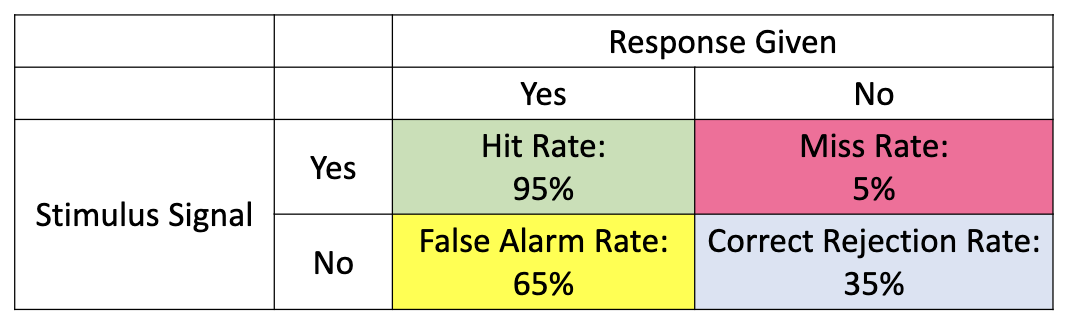
Biased responses - YEA-sayer
High WHAT rate and high WHAT rate
Biased responses - YEA-sayer
High HIT rate and high FALSE ALARM rate
biased responses NAY-sayer
Hit rate = WHAT
Miss rate = WHAT
False alarm = WHAT
Correct rejection = WHAT
biased responses NAY-sayer
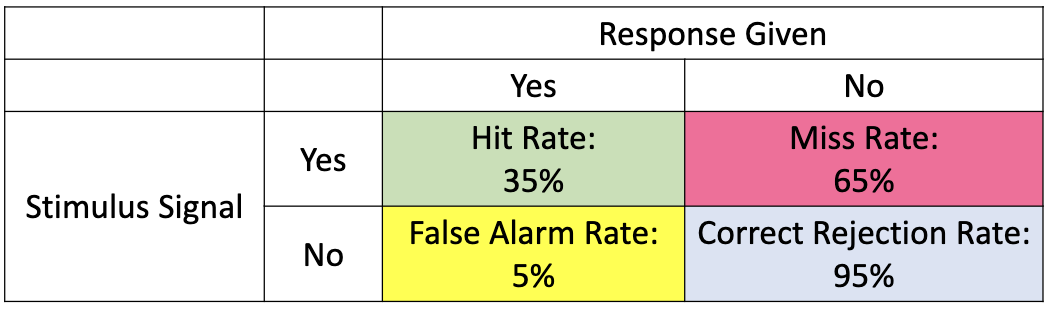
Hit rate = 35%
Miss rate = 65%
False alarm = 5%
Correct rejection = 95%
biased responses NAY-sayer
High WHAT rate and high WHAT rate
biased responses NAY-sayer
High CORRECT REJECTION rate and high MISS rate
A just noticeable difference (JND) is the WHAT
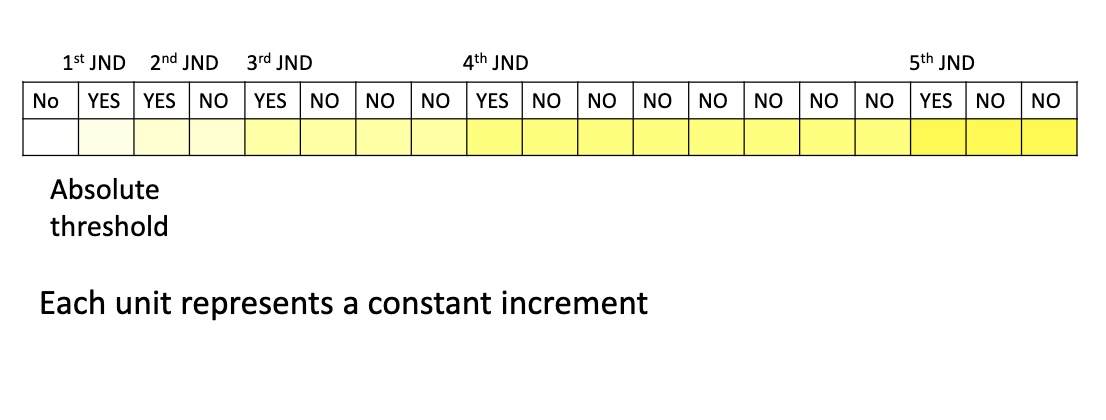
A just noticeable difference (JND) is the smallest DIFFERENCE in the amount of STIMULATION that a specific sense can detect.
Webers law
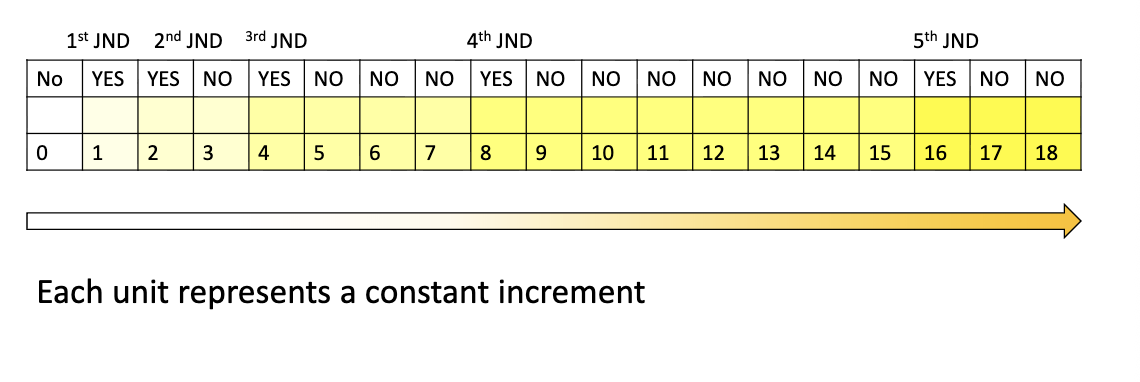
The size of a Just Noticeable Difference (JND) is a WHAT of the size of the WHAT
Weber;s law
The size of a Just Noticeable Difference (JND) is a CONSTANT PROPORTION of the size of the INITIAL STIMULUS
What is Webers fraction equation
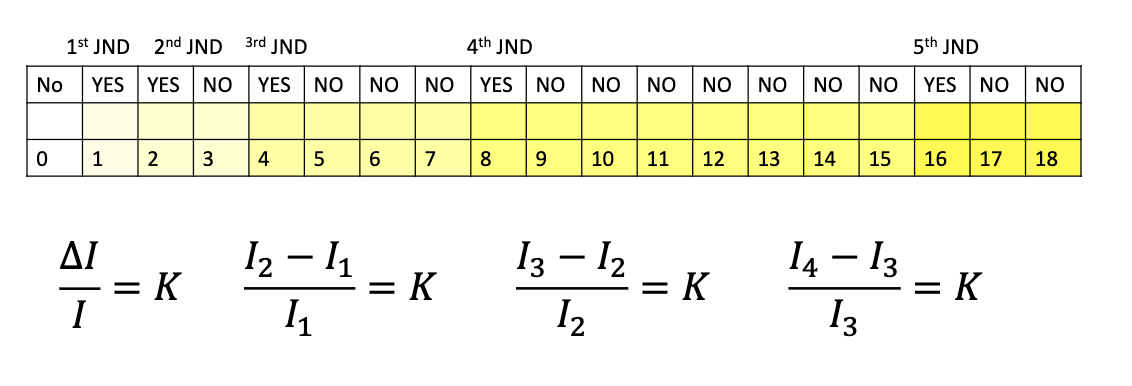
ΔI/I = K
where
I = the smaller JND - look at image
Webers law
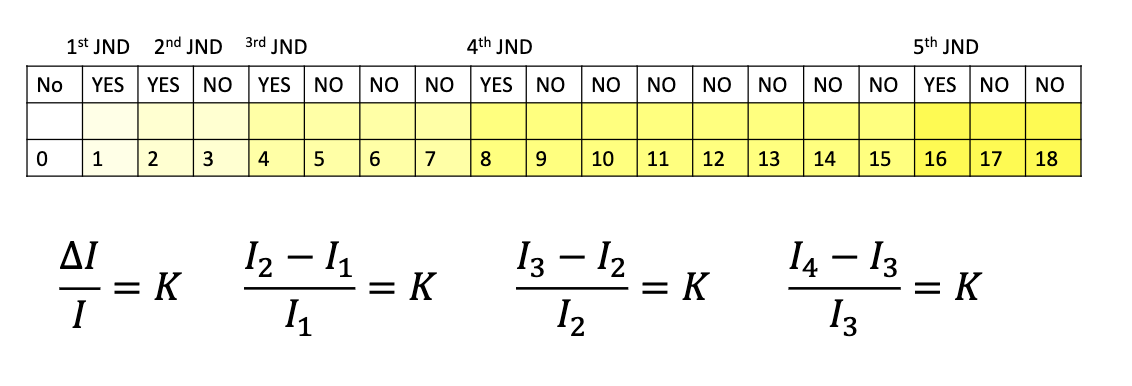
Constant increments in stimulus intensity produce smaller and smaller increases in the perceived WHAT
Webers law
Constant increments in stimulus intensity produce smaller and smaller increases in the perceived MAGNITUDE OF SENSATION
Fechner’s law
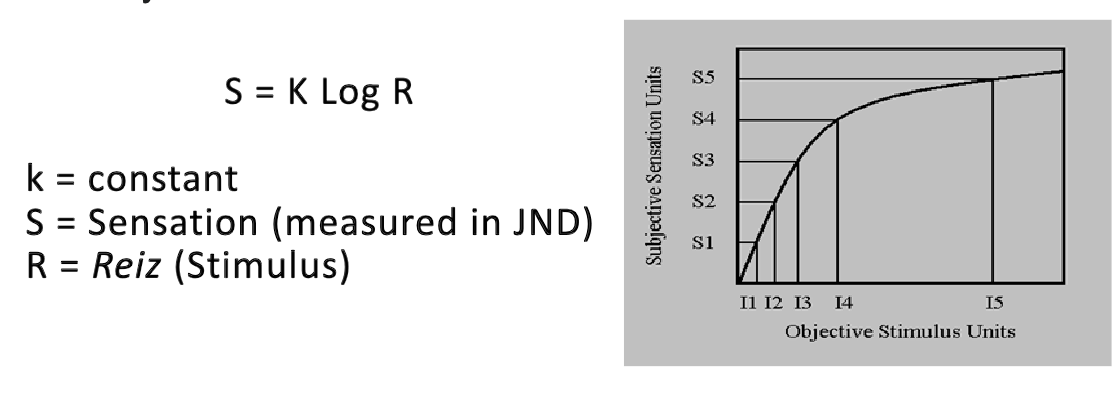
Subjective sensation is proportional to the WHAT of the WHAT of the stimulus
Fechner’s law
Subjective sensation is proportional to the LOGARITHM of the INTENSITY of the stimulus
Fechner’s law equation
S = K log R
K = constant
S = sensation (measured in JND
R = Reiz (stimulus)
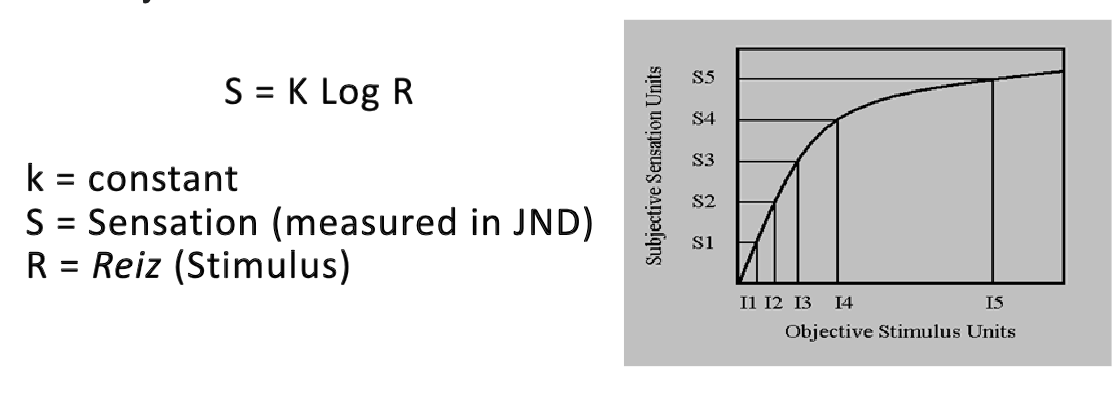
Hypothetical example of just noticeable difference (JND)
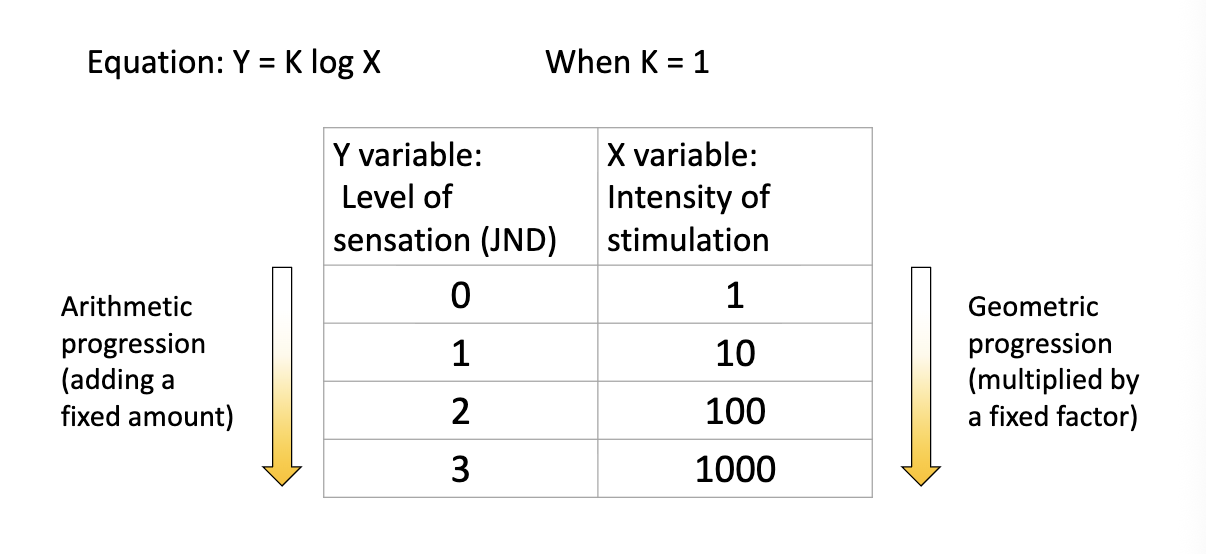
Arithmetic progression
ADDING a fixed amount
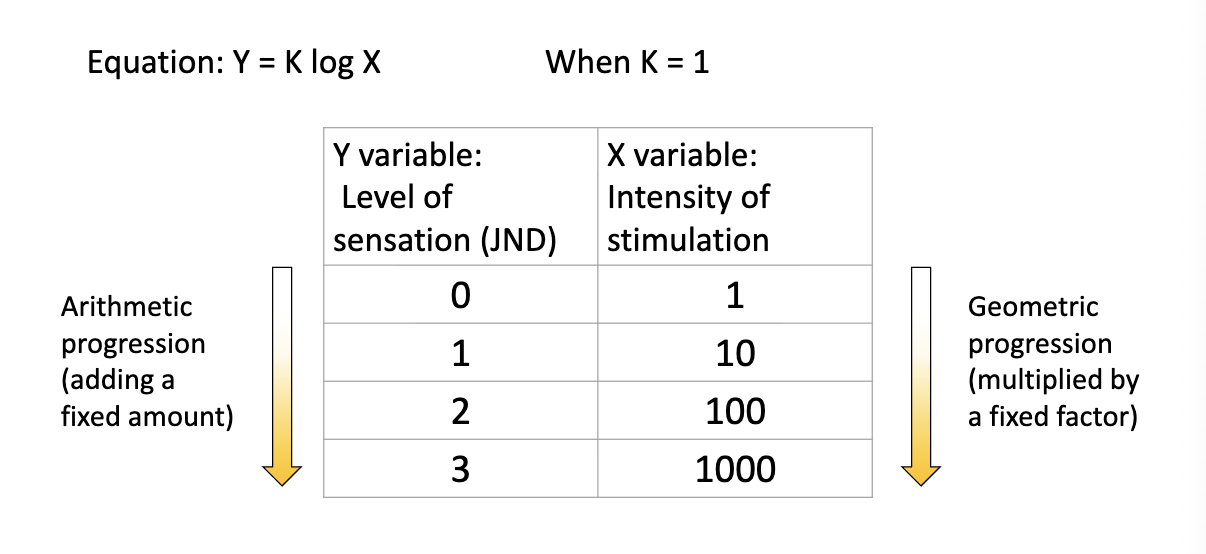
Geometric progression
MULTIPLYING by a fixed amount
Implication of Fechner’s Law
Psycho = WHAT
Psychological reality correlates with a WHAT - WHAT
Implication of Fechner’s Law
Psycho = PHYSICAL
Psychological reality correlates with a PHYSICAL REALITY - PSYCHOPHYSICAL PARALLELISM
Implication of Fechner’s Law
Experimenter WHAT one variable and WHAT another
Implication of Fechner’s Law
Experimenter CONTROLS one variable and MEASURES another
Implication of Fechner’s Law
The birth of WHAT
Implication of Fechner’s Law
The birth of EXPERIMENTAL PSYCHOLOGY