PROCEEDS OF CRIME (MONEY LAUNDERING) AND TERRORIST FINANCING OBLIGATIONS2
 Call Kai
 Learn
Learn Practice Test
 Spaced Repetition
 Match
Match Flashcards
 Knowt Play
1/21

There's no tags or description
Looks like no tags are added yet.
Name | Mastery | Learn | Test | Matching | Spaced | Call with Kai | Chat |
|---|
No analytics yet
Send a link to your students to track their progress
22 Terms
Real estate is attractive for money launderers for a variety of reasons
1. High Value: Real estate is a big-ticket, high value asset, meaning that large amounts can be laundered in a single transaction.
2. Security: Real estate is a fairly secure and stable asset that cannot be stolen and is less susceptible to dramatic decreases in value in the long term.
3. Simplicity: There is a large market for real estate and entry into the market does not require a high degree of sophistication (when compared to investing in stocks or other financial instruments, for example).
4. Potential for Profit: Real estate typically increases in value in the long term, and renovations and physical improvements can add to the profit potential of a property.
5. Various Methods to Launder Money: Money can be laundered through real estate in multiple ways, including the use of separate legal entities in real estate purchases/sales, and unregulated lenders in financing real estate.
6. Subjective Value: Since no two properties are exactly alike, prices can be manipulated to control the amount of money laundered in a transaction.
7. Oversight: Some participants in the real estate industry are unregulated, or under-regulated, meaning that there are “weak spots” in the industry that criminals can exploit.
8. Anonymity: The identity of beneficial ownership of real estate can be hidden through the use of corporations, trusts, and nominees.
9. Speculative Component: Because short-term ownership of real estate is not unusual, criminals can flip properties as part of their money laundering activities without necessarily raising suspicion.
Beneficial owners (generally)
individuals who enjoy the benefits of ownership of property even though the property is registered in the name of another person or entity
nominee
an individual or entity that is legally registered as the owner of property, with true control and ownership belonging to one or more other, unregistered persons or entities (also known as a “bare trust” arrangement)
3 stages in the money laundering process
Placement: the process of placing the proceeds of crime into the financial system
Layering: the process of converting the criminal funds into another form in order to conceal the criminal origins of the proceeds
Integration: reintroducing and reintegrating the laundered funds into the legitimate economy to create the perception of legitimacy and having the funds appear to have been legally earned.
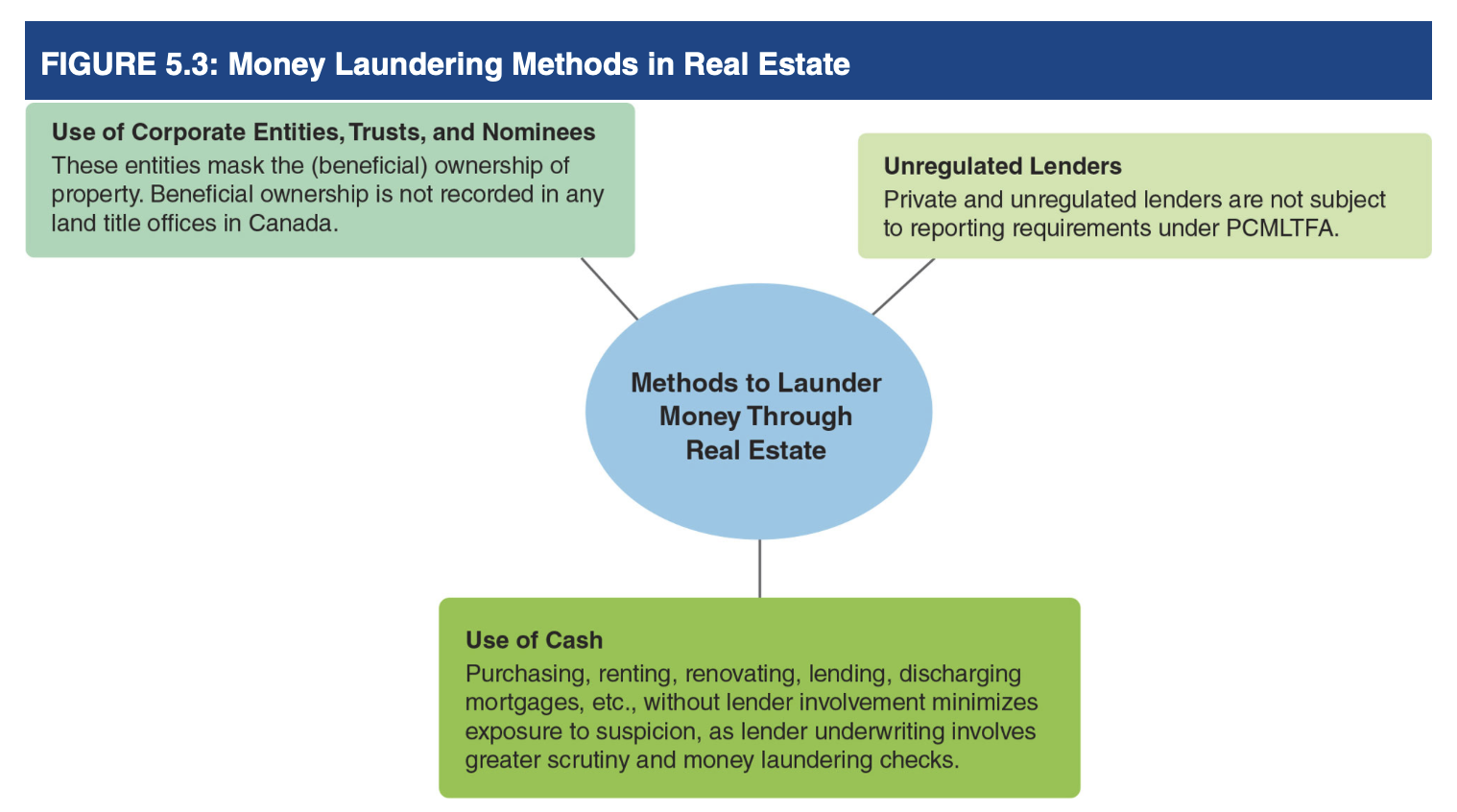
Methods Used to Launder Money Through Real Estate Transactions
use of corporate entities, trusts and nominees
unregulated lenders
use of cash
Financial Action Task Force (FATF)
The FATF’s standards were implemented in Canada in 2000 through the enactment of the Proceeds of Crime (Money Laundering) and Terrorist Financing Act (“PCMLTFA”)
4 objectives of PCMLTFA
1. To implement specific measures to detect and deter money laundering and the financing of terrorist activities, and to facilitate the investigation and prosecution of money laundering and terrorist activity financing offences
2. To respond to the threat posed by organized crime by providing law enforcement officials with the information they need to deprive criminals of the proceeds of their criminal activities while protecting individual privacy
3. To assist in fulfilling Canada’s international commitments to participate in efforts to combat transnational crime
4. To enhance Canada’s capacity to take targeted measures to protect its financial systems and mitigate the risk of it being used for money laundering
-Those who have such obligations are known as “reporting entities”, including real estate brokers and sales representatives (collectively known as licensees in British Columbia), when acting as agents for the purchase and sale of real estate
Financial Transactions and Reports Analysis Centre of Canada (“FINTRAC”)
independent government agency which operates at arm’s length from law enforcement
-collects, analyzes, and discloses information to law enforcement and national security agencies to combat money laundering and terrorist financing
KEY COMPLIANCE OBLIGATIONS UNDER THE PCMLTFA
The PCMLTFA applies to real estate brokers, sales representatives, and real estate developers. Licensees fall with the definition of a real estate broker or sales representative when they act as an agent for the purchase and sale of any type of real estate
4 key obligations under the PCMLTFA for Licensees (1. Compliance Program)
-Managing brokers must establish a compliance program for their brokerage
-5 elements:
Compliance Officer: must be appointed, who is responsible for the implementation and oversight of the brokerage’s compliance program
Policies and Procedures: written policies and procedures that are applied to all the activities of and persons within the brokerage.
Risk Assessment: an analysis of the potential risks that could expose a business to money laundering; must be documented and include mitigation measures and strategies
Training Program: Brokerages must develop, implement, and maintain a written training program
Review of Compliance Program: must be reviewed every two years to ensure that, despite any changes in the operating environment and conditions, the program continues to be effective.
4 key obligations under the PCMLTFA for Licensees (2. Know Your Client “KYC”)
-If the client is an entity (e.g., corporation, trust, partnership, fund, unincorporated association/organization), this means that the licensee must confirm the entity’s existence
-can also extend to non-clients, if they are not represented by another licensee in a particular real estate transaction
-A record of the identification (i.e., an information record) must also be kept:
• For Individuals: Name, address, date of birth, and nature of their principal business or occupation.
• For Non-Corporate Entities: Name, address, and nature of principal business for both the entity and the individual conducting the transaction on behalf of the entity.
• For Corporate Entities: A copy of the provisions in the official corporate records relating to the power to bind the corporation with respect to the transaction (e.g., certificate of incumbency, articles of incorporation, bylaws that set out the officers who are authorized to sign on the corporation’s behalf).
-licensees are not required to re-identify an individual or entity if they have already done so during a past transaction in accordance with their PCMLTFA obligations, have kept the required records, and have no doubts about the information used for that purpose.
4 main triggers for the KYC obligation to identify a party in a real estate transaction
Receipt of Funds: Licensees who receive funds from a person in any form (e.g., cash, bank draft, cheque) must identify the individual or entity except a financial entity or a public body; each licensee identifies their own client only
Purchase or Sale Transaction: Licensees must identify their own clients and any unrepresented parties; if their client or unrepresented party is acting on behalf of a third party, that third party must also be identified.
Large Cash Transaction: a transaction in which a licensee receives $10,000 or more in cash in a single transaction, or multiple payments of cash that add up to $10,000 or more in a 24-hour period (if the transactions were conducted by or on behalf of the same individual or entity, or if the amounts were for the same beneficiary).
Suspicious Transactions: when the licensee has reasonable grounds to suspect that the financial transaction is related to the commission or attempted commission of a money laundering or terrorist financing offence.
3 main methods to Identify an Individual
Government-Issued Photo Identification Method: through video conferencing and reviewing photocopied identification is not permitted.
Credit File Method: credit file must be located in Canada and have been in existence for at least three years. The name, address, and date of birth on the credit file must match
Dual Process Method: Licensees must do two of the following:
a. Refer to information from a reliable source (e.g., banks, government agencies, utility companies) that includes the individual’s name and address
b. Refer to information from a reliable source that includes the individual’s name and date of birth
c. Refer to information that includes the individual’s name and confirm that they hold a deposit account, a prepaid payment product account, or a credit card or loan account with a financial entity
How to Confirm the Existence of a Corporate Entity
a paper record, or an electronic record that was obtained from a source that is accessible to the public, such as its certificate of incorporation; a certificate of active corporate status; a record that has to be filed annually under provincial securities legislation; or any other record that confirms the corporation’s existence, such as the corporation’s published annual report signed by an audit firm, or a letter or notice of assessment for the corporation from a municipal, provincial, territorial, or federal government.
-verify the corporation’s name, address, and the names of its directors.reliance method: allows different reporting entities to share information with one another and may allow one reporting entity to rely upon another reporting entity’s identification measures, rather than independently verifying the same individual or entity twice.
Third Party Determination
-a licensee must also take reasonable measures to determine if a client is acting on behalf of someone else (i.e., a third party).
-A third party is defined by FINTRAC to be a person or entity who instructs another person or entity to conduct an activity or financial transaction on their behalf.
-Reasonable measures could involve asking the person if they are acting on someone else’s behalf, or reviewing the information that the licensee may have already collected
Beneficial Ownership Requirements
-beneficial owner is any individual who directly or indirectly owns or controls 25% or more of a corporation or other entity.
-licensees must take steps to fully trace the ownership of any entity involved in a real estate transaction through to the individuals that ultimately own the entity.
-Licensees have two obligations:
To obtain beneficial ownership information: depends upon the type of entity. For corporations, licensees must obtain the names of all directors of the corporation and the names and addresses of all persons who directly or indirectly own or control 25% or more of the shares of the corporation.
To take reasonable measures to confirm that the beneficial ownership information they have obtained is accurate: ask the authorized representative to sign a document confirming the accuracy of the information or searching the Land Owner Transparency Registry (discussed later) or the BC Company Registry, or reviewing the official documents of the entity
-There may be circumstances in which a licensee is unable to obtain beneficial ownership information from an entity, or is unable to confirm its accuracy. In such cases, the licensee is expected to take reasonable measures to verify the identity of the entity’s chief executive officer, or the person who performs a similar function
-the licensee must keep a record of the measures they took and the information they obtained in order to reach that conclusion, which must be retained for five years after the last business transaction is conducted.
-In some circumstances, such as where clients have complex ownership structures involving several different individuals, corporations, or trusts, brokerages may choose to obtain the assistance of specialized third parties to obtain
Land Owner Transparency Act (“LOTA”)
-it requires that a transparency declaration be filed when applying to register certain interests in land at the land title office
-The transparency declaration states whether or not the person receiving the interest is a “reporting body”, which includes “relevant corporations”, “trustees of relevant trusts”, and “partners of relevant partnerships”,
-“relevant corporations” include all corporations except for certain corporations that are expressly excluded such as publicly traded corporations, strata corporations, and savings institutions.
-nominee owners would be considered “trustees of relevant trusts”, and therefore, reporting bodies under LOTA.
-Under LOTA, the legal definition of “interest holder” includes individuals who may not have direct ownership of land but are considered to have an indirect interest in it.
Politically Exposed Persons and Heads of International Organizations
-licensees must take reasonable measures to determine whether the person with whom they are in a business relationship is a politically exposed persons (PEP), a head of an international organization (HIO), or a family member or close associate of a PEP or HIO, at the outset of a business relationship and at certain other points during the business relationship.
-they must do the same if licensees receive an amount of cash (or virtual currency) equal to $100,000 or more from a person
Business Relationships and Ongoing Monitoring
-A licensee is considered to be in a business relationship with an individual or entity the first time that they are required to verify their identity.
-2 key requirements placed upon licensees when they are in a business relationship with a person:
1. Keep a record of the intended nature of the business relationship.
2. Perform ongoing monitoring based on risk assessments: to detect any suspicious transactions; to keep client information up-to-date; to reassess the client’s risk profile; and to determine whether transactions are consistent with what is known about the client; to reassess the client’s risk profile, which may change if the type of transactions the client engages in changes, or the licensee learns new information about prior transactions.
-A business relationship will end five years after the last transaction that required the licensee to verify the identity of the client
4 key obligations under the PCMLTFA for Licensees (3. Reporting)
-Licensees are required to provide certain reports to FINTRAC
-3 key reporting requirements upon licensees:
Terrorist Property: A Terrorist Property Report must be filed without delay; A report must also be sent to the RCMP and the Canadian Security Intelligence Service (CSIS).
Large Cash Transactions: In addition to the KYC obligations, licensees must file a Large Cash Transaction Report within 15 days of the transaction.
Suspicious Transactions: Suspicious Transaction Reports (“STRs”) are the most valuable types of reports to identify money laundering; no monetary threshold for reporting on a suspicious transaction.
-Reasonable Grounds to Suspect: occurs when there is a possibility of a ML/TF offence• a step above simple suspicion (i.e., a “hunch” without much more); and
• a step below reasonable grounds to believe (i.e., probability supported by verified facts).
-
4 key obligations under the PCMLTFA for Licensees (4. Record Keeping)
Records must be kept in a manner such that they can be provided to FINTRAC within 30 days of a request.
6 record keeping obligations
Suspicious Transaction and other FINTRAC Reports
Large Cash Transaction Records
Client Information Records (to fulfil KYC Obligations)
Receipt of Funds Record
Unrepresented Party Record
Reasonable Measures Record
Compliance with the PCMLTFA
-FINTRAC provides published guidance and policy interpretations, as well as training and information during the assessment and examination processes
-non-compliance can result in administrative monetary penalties (“AMPs”), and/or criminal proceedings.