Blood Bank Lecture 1 Fundamental Concepts
 Call Kai
 Learn
Learn Practice Test
 Spaced Repetition
 Match
Match Flashcards
 Knowt Play
1/35

There's no tags or description
Looks like no tags are added yet.
Name | Mastery | Learn | Test | Matching | Spaced | Call with Kai | Chat |
|---|
No analytics yet
Send a link to your students to track their progress
36 Terms
Blood bank primary role
Provide the safest possible blood components to patients
Blood bank tests detect
Red blood cell antigens
Antibodies produced in response to these red cell antigens
Blood bankers job
Ensure compatible blood components are always provided
Introduction to genetics
Genetics is used to understand blood group inheritance and testing for diseases, both of which are important in transfusion medicine
Information on blood group genetics and the inherited differences among individuals forms the foundation of safe blood transfusion
Accurate and sensitive methods of pathogen testing are also important to maintain the safety of the blood supply
Historically blood bankers have been concerned with population genetics and blood group inheritance
Most blood groups follow a straightforward autosomal codominant inheritance pattern
With the increased availability of modern genetic techniques, now we can more readily use genetic test to determine antigen profiles of both donors and recipients
Most blood groups follow what inheritance pattern
Autosomal Codominant
Three different levels of genetics are
Population genetics
Cellular genetics
Molecular genetics
The antigens expressed on blood cells are called
Phenotypes
Phenotypes are controlled by
Genotypes
Population genetics as used in blood banking focuses on
Mendel’s Laws of Inheritance
Hardy-Weinberg EquationTW
The two laws of inheritance are
The Law of Independent Segregation
The Law of Independent Assortment
What is it called when the same allele is on both parental gametes
Homozygous
What is it called when different alleles are on each parental gamete
Heterozygous
Allele pairs separate during the formation of gametes
They do not have a permanent effect on each other
One allele is passed from each parent to each offspring of its own
Law of Independent Segregation
One gene is not dominant over its allele
Both alleles are expressed as their gene products are both seen at the phenotypic level
Different traits are inherited separately from each other
Law of Independent assortment
If two traits are physically near each other on the chromosome, they are considered _____ and may be inherited together as _________
linked; haplotype
Example of Haplotype
M and N alleles and the S and s alleles are physically close on the same chromosome and are inherited as a haplotype
Results in a different prevalence than if inheritance followed random assortment
Linkage disequilibrium
Hardy-Weinberg Principle
p + q = 1
p = frequency of the dominant allele
q = frequency of the recessive allele
Expanded Hardy-Weinberg to address heterozygous populations
p² + 2pq + q² = 1
The population studied must be large
Mating among all individuals must be random
Mutations must not occur in parents or offspring
There must be no migration, differential fertility, or mortality of genotypes studied
In any normal population it is almost impossible to meet all of these criteria. However, the equation is still one of the best tools for studying gene frequencies in human populations
Criteria for use of the Hardy-Weinberg Principle
The frequency of a particular phenotype can be useful in another calculation specific to blood banking.
This formula is used when looking for donor units of red blood cells that are negative for one or more specific antigens, which are most often required for patients with antibodies
This calculation provides an estimates of the number of donor red blood cell units that will need to be tested in order to find the requested number of units with the desired phenotype characteristics
number of units to test = number of units desired/ antigen negative frequency
Phenotype calculations
If more than one antigen needs to be negative, then multiply the antigen negative frequencies of each antigen in the denominator
number of units to test = number of units desired / (antigen negative frequency 1)(antigen negative frequency 2)… and so on
Molecular testing results provide an individuals
Genotype
Molecular Genetics
Biotechnology
Molecular Diagnositcs
Transfusion Medicine and Molecular Biology
The genetic basis for blood group antigens (Single nucleotide polymorphism, SNP)
Gives rise to multiple alleles for a given gene
Polymorphism
Polymorphism refers to what part of transfusion medicine and molecular biology
Molecular genetics
Recombinant proteins
Coagulation factor concentrates vs donor plasma
Biotechnology
Enhanced safety of blood products by narrowing the preseroconversion window
Nucleic Acid Testing
Nucleic Acid Testing
RBC Genotyping
Molecular diagnositcs
Being used more frequently in blood banking
Has not replaced serologic testing but complements it. This is because it is often used to make decisions for obtaining compatible blood by confirming serologic testing or used in cases where serology is not possible or not sensitive enough or where discrepancies occur
RBC genotyping
Fetal DNA typing
Extensive blood group typing of donors
Screening of blood donors for rare phenotypes
Blood group typing for patients with autoimmune hemolytic anemia and other diseases
Resolving blood type discrepancies
Determining blood type of massively transfused patients
Important applications for red blood cell genotyping
Another use for molecular genetics
Often used in cases of disputed paternity
Classical genetic systems used in the past included RBC antigens, but there has been an almost complete switch to DNA polymorphism testing using short tandem repeats (STRs)
Classically, if maternity is assumed, paternity can be excluded by either indirect or direct exclusion
DNA methods usually require 3 mismatches (of alleles between child and alleged father) before concluding an exclusion
Relationship testing
What type of exclusion is it when the child has inherited a genetic marker that is NOT found in the mother or alleged father?
Direct Exclusion
What type of exclusion is it when the child LACKS a genetic marker the alleged father SHOULD have transmitted.
Keep in mind that some alleles have silent genes, genes that do not produce a product
If this method is used, it should not be the only marker used to exclude paternity
Indirect exclusion
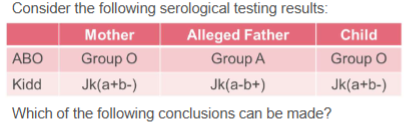
Paternity may be excluded based on Kidd typing