Molecular cell biology test 1
 Call Kai
 Learn
Learn Practice Test
 Spaced Repetition
 Match
Match Flashcards
 Knowt Play
1/83

There's no tags or description
Looks like no tags are added yet.
Name | Mastery | Learn | Test | Matching | Spaced | Call with Kai | Chat |
|---|
No analytics yet
Send a link to your students to track their progress
84 Terms
Cells ___ but have similar ____
vary, basic chemistry
All cells have
-DNA
-Plasma Membrane
-RNA
-Ribosomes
True or False? Living cells are self-replicating collections of catalysts
True
All cells share a ______
Common ancestral cell
Problem with the modern system
DNA stores information, but proteins perform most catalysis
Evolutionary Chick-and-egg problem
RNA world hypothesis
-Solution to the problem w modern system
-RNA is able to do both:
store info
catalyze chemical reactions (through ribozyme)
Ribozyme
Type of RNA molecule that has enzymatic activity (Splicing, ligation, polymerization)
-Known for helping catalyze peptide bond formation btwn amino acids in the ribosomes. This action is known as peptidyl transferase activity
Eukaryotes vs Prokaryotes
Why would DNA eventually replace RNA for information storage
DNA is more chemically more stable than RNA
Three Domains of Life
Eukarya, Archaea, Bacteria
~ Eukaryotes
~ Prokaryotes
Prokaryotes
-Cell wall
-No nucleus
-No membrane-bound organelles
-SIngle chromosome +plasmids
-Capsule
Bacteria
-Most diverse group
-There bacteria known as photosynthetic bacteria that can perform photosynthesis and get energy from sun
Archaea
-Live in extreme environments
-More linke eukaryotes than bacteria
-Mysterious
-Have unique cell wall chemistry and membrane lipids
Nucleus
Distinguishing feature of eukaryotes.
-Contain most of the DNA in the cell, rest is spread btwn the mitochondria and the chloroplast
Mitochondria
Organelles found in eukaryotic cells.
-Generate most of cell’s supply of usable energy
-DNA containing
-Encolsed by a double membrane
Chloraplasts
-Organells found in plants and algae
-Harvest energy from sunlight by photosynthesis
-DNA containing
-Have a thylakoid membrane system that has chlorophyll
Where did chloroplasts and mitochondria said to have evolved from?
An ancestral host cell (eukaryote) engulfed a bacterium which lead to mitochondria.
…..then they engulfed a photsynthetic cyanobacterium which lead to chlorplast
Evidence for endosymbiosis
-Resemble prokaryote in size
-Have their own DNA
-DNA resembles prokaryote
-Can divide independently
-Are surrounded by double membranes
Endocytosis
Import meidated by the formation of endocytic vesicles
Exocytosis
Export secretary vesicles
What determines how atoms interact?
Outermost electrons
Covalent bond
Sharing of electron
Nonpolar covalent bond
Electron are shared equally
Polar Covalent
Electrons are shared unequally
Ionic bond
Gain or Loss of electrons
Four types of weak molecule interactions
Van der Waals attraction
Electrostatic attractions
Hydrogen bonds
Hydrophobic interaction
Organic Molecules
Molecules w C-H bonds
Sugars, Fatty acid chains , Nucleotides, Amino acids
Chain of order for each organic compound
Sugars ———> Polysaccharides ———> Carbohydrates
Fatty acids——> Lipids and fats ——→ Cell membrane
Amino Acid ——> Protein
Nucleic Acid —→ Nucletoide ——> DNA and RNA
Monosaacharide
simple sugar and subinit to build carbohydrates
Ex: Glucose, fructose.
Binded by glycosidic bonds to create polysaccharides
Two monosaccharides
Disaccharide
Condensation/Dehydration
-Forms polymers
-Water is released
-Energetically unfavorable
Hydrolysis
-Breaks down polymers.
-Water is used
-Energetically faovrable
Fatty acid
-composed of a carboxyl group and a hydrocarbon tail (length of tail and saturation can very)
-Stored as energy reserves
Hydrocarbon tail is _____
Hydrophobic
Carboxyl group is _____
Hydrophillic
Hydrophilic vs Hydrophobic
Hydrophilic: Polar, forms hydrogen bonds
Hydrophobic: Nonpolar, cannot form hydrogen bonds
Phospholipids
-Made of Hydrophillic head and Hydrophobic tails
-Naturally form a lipid bilayer
Degree of saturation determines?
The physical properties of the fat molecules
-Saturated are solids produced by animals
-Undersaturated are liquid produced by plants
Saturated
No double bonds.
-Straight glycerol
-Make membrane less fluid bc they can tightly pack together
Unsaturated
Has double bond
-Kink causes a bend in the glycerol
-Makes membrane less rigid/ more fluidity bc they can’t pack as tightly
Triacylglycerols
Fats and oils:
3 fatty acids + 1 Gylycerol connected through ester linkages
-Hydrophobic
Steriods is a type of ____
lipid
Amphipatchic
Molecule containing both a hydrphilc and hydrophobic region.
Amino acids
-Building block of proteins
Made up of four things, amino group, Carboxyl grouo, Hydrogen, and a R group
-Different R group gives different amino acid which ultimately gives us dif protein functions
What bond connects amino acids toghether?
Peptide bonds
Polypeptide chain
Amino acid linked together by petide bonds
Amino terminus and Carboxyl termins
Amino end= N terminus
Carboxyl end= C-terminus

Different R group effect
Different R group will determine the aminocide sequence which effects the way protein fold. The way protein fold gives them their shape which directly affects their function
Nucleotides
-Subunits of DNA and RNA
-# of phosphates varies from 1-3
-Linear arrangments of nucleotides store genetic info
Besides being building blocks of DNA and RNA, what other functions do nucleotides have?
Carry energy (ATP), act in intracellular signaling (Cyclic AMP [cAMP], and are component of coenzymes
1-3 phosphate
1-AMP
2-ADP
3-ATP
Nucleiotides are linkef through what covalents bonds?
Phosphodiester bonds
How are phosphodiester bonds linked
Linking the 5’ P of incoming nucleotide with 3’OH of the previous nucleotide
The incoming nucleotide is usualy in the ________ during polymerization
Triphosphate form
What type of bond connect the phopshate groups of atp
phosphoanhydride bonds
ATP——> ADP
Hydrolysis reaction that release energy.
-Water used to break ATP down
Macromolecule
-Is very large complex molecule
-Has a particular primary structure due to the sequence of monomers used to produce the polymer
-Various combination of monomers produces various 3-D shapes in molecules
How do macromolecules interact with on another
Through multiple noncovalent interactions btwn surfaces
Aldoses
Ex:Glcuose
Ketoses
Ex: Fructose
Functions of proteins
-transport
-Singal
-Receptors
-Structural
-Motor
-Storage
-Enzymes
-Transcription
The shape of a protein is specified by its
amino acid sequence.
-This is bc the sequence determines which R groups occurs and where thyey occur on the polypetide
-Interactions btwn R groups is what cause the polypetide to fold.
Folding in proteins
Due to non-covalent, weak interactions (Ex: Hydrophobic force) within the polypeptide chain
-Fold into comformation of lowest energy
-Assisted by chaperone proteins
-Some proteins can spontaneously refold into their proper shape
Chaperone proteins
What assist proteins to fold properly
Primary Structure of protein
-Amino acid sequence
-Connected by peptide bonds
Ex: Gly—Ala—Ser—Val—Leu
Secondary structure of protein
-Local folding of the polypetide backbone
-Stabilize by hygrogen bonds
-α helices and β sheets.
Tertiary Structure of protein
Forms when R groups btwn secondary structures interact
-Overall 3D folding of one polypeptide
Quaterny protein structure
Large protein molecule that contains more than one polypeptide chains.
-Each polypeptide in the large protein molcule is called a subunit
-Subunits can be the same or different
What is a protein domain?
Regions of a polypetide that has a particular structure and function is performs.
-Different domains can be across multiple proteins
-Most proteins ocntain multiple domains.
Families
Protein are organized into families based on homologous domains
Ex:THe serine protease in the pic carry the same job but on dif subtrates
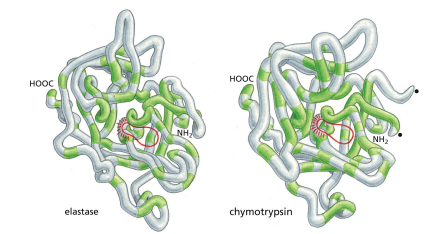
How are collagen polypetides organized?
-Organized as triple coiled coil
Collagen’s triple structure resists pulling forces
Elastin
-Composed of multiple polypeptide cross-linked to each other
-Polypetides cross linked via di-sulfide bonds that form btwn cystine residues
Permits stretching
α helices
-Are often found as transmembrane region of proteins
-α helical regions are used to interact w other polypeptides
Transmembrane region
Hydrophobic region of protein that is exposed
β sheets
-Can form rigid structures at the core of many proteins
-Structures can be parallel or anti-parallel
-Structures can form large pores called β barrels
β sheets can stack to form damaging _______
Amyloid structures
Prions
Cause normal proteins to misfold and produce amyloid structures