Parks and protected areas
 Studied by 0 people
 Call Kai
 Learn
Learn Practice Test
 Spaced Repetition
 Match
Match Flashcards
 Knowt Play
1/25

There's no tags or description
Looks like no tags are added yet.
Name | Mastery | Learn | Test | Matching | Spaced |
|---|
No study sessions yet.
26 Terms
What is the purpose of parks and protected areas?
means of protecting natural habitats and scenic areas
What levels of law impact parks/protected areas?
International law (UN conventions)
Federal Law (Canada National Parks Act)
Provincial law (eg. Ontario Provincial Parks and Conservation Reserves Act)
How much of Canada is protected?
At the end of 2023, 12.8% (1.276 million square km) of Canada’s terrestrial area (land and freshwater) and 0.9% (91 thousand) of its marine territory were recognized as protected
It is important to note that at the present time the majority of Canada’s marine protected areas are in fact the marine portions of terrestrial protected areas
This amount has been increasing over the years
Different legislations?
National Parks Act 1988
Oceans Act
Canada Wildlife Act
Migratory Birds Convention Act
SARA
Four broad types of governance
governance by government
shared governance
private governance
governance by indigenous peoples and local communities
Governance by government
95% of Canada’s protected areas of governed by federal, provincial, or territorial governments
Federal: Parks Canada, Environment and Climate Change Canada, and Fisheries and Oceans Canada
Shared governance
Collaberations between different levels of government or between at least one government organization
Two new protected areas covering a total of 695 km on the east side of lake winnipeg established in 2012 under shared governance agreements between Manitoba and Little Grand Rapids First Nation, and between Manitoba and Pauingassi First Nation as Traditional Use planning areas.???
Private Governance
private conservation areas make an important contribution to Canada’s system of protected areas; often protecting sensitive and significant natural habitat in otherwise developed or converted privatly owned landscapes
3 provinces currently report a total of approx 140 km squared protected areas under private governance (Manitoba, New Brunswick, PEI)
Governance by Indigenous Peoples and Local communities
This designation is used for protected areas where the management authority and responsibility are held by indigenous peoples and/or local communities
Indigenous Peoples of Canada have contributed to the establishment of tens of thousands of square km of protected areas through modern land-claim agreements and treaty negotiation
IUCN Management Categories
Canada uses the International Union of Conservation of Nature’s classification of management categories for protected areas
These categories help to describe the type of protected area according to stated management intent
Different IUCN Management categories
Ia - Strict Nature Reserve
Ib - Wilderness Area
II - National Park
III - Natural Monument or Feature
IV - Habitat/Species Management Area
V - Protected Landscape/Seascape
VI - Protected Area with Sustainable Use of Natural Resources
The species at Risk Act (SARA)
Key tool for the conservation and protection of Canada’s biological diversity, fulfills an important commitment under the UNCBD
Key Steps and Processes of SARA
Identification of Speceies at risk and assessment
listing
recovery strategies and action plan - critical habitat designation
Who is the key player in the identification of species at risk
The Committee on the Status of Endangered Wildlife in Canada (COSEWIC)
Independent group of experts that assess the status of wildlife species and recommends a classification for their legal protection. Not part of the federal govt, but offers the govt independent advice based on the best available knowledge
COSEWIC assessment criteria
COSEWIC’s assessment process is based on a rigorous scientific critera
Indicators of endangerd status?
A. Decline in total no. of mature inds
B. Small distribution range and decline or fluctuation
C. Small and Declining number of mature individuals
D. very small or restricted total canadian population
E. quantitative analysis
Listing process
After the govt recieves reccomendations from COSEWIC, the govt consults with concerned ministers, relevant wildlife management boards, and the public to consider many factors, including possible social and economic implications of listing the species
The govt then decides whether to add the species to the List of Wildlife Species at Risk (schedule 1 in the Act)
Once a species is listed, the provisions under SARA apply to protect and recover the species
The list will continually evolve as species are added or removed or their status changes
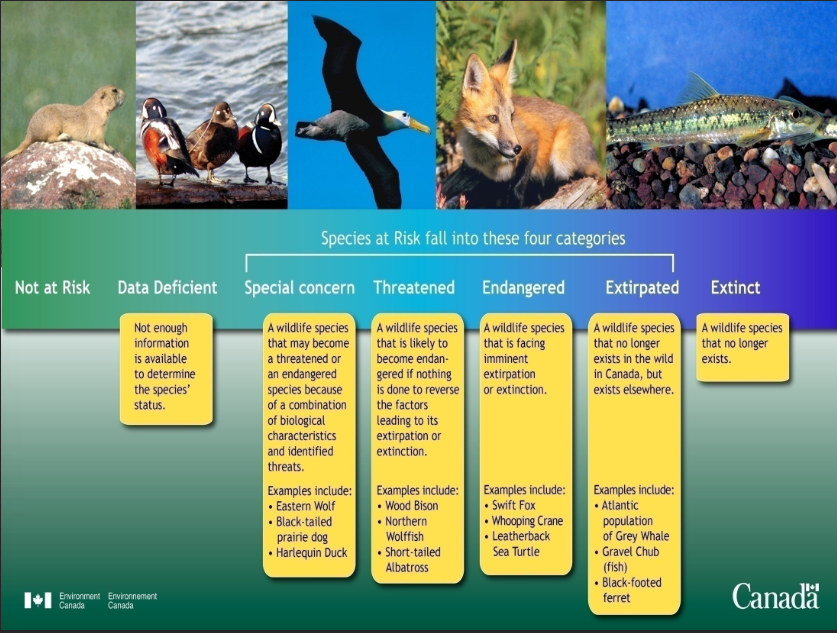
What happens as soon as a wildlife species is listed as endangered or threatened?
individuals of that species and their dwellings are automatically protected on federal land?
SARA typically applies only to federally managed lands, waters, and species
What does SARA prohibit for endangered, threatened, or extirpated species
You cannot kill, harm, or trade in the species
You cannot damage or destroy its “residence”
So what happeneds to wildlife species on lands managed by provinces and territoreis?
The responsibility for protecting these species usually falls to the province or the territory
All Canadian provinces and territories signed the Accord for the Protection of Species at Risk (1996) in Canada
With its accompanying framework for the Conservation of Species at Risk, the Accord established a mechanism for cooperation among federal, provincial, and terrirotial governments to ensure that species at risk are protected throughout Canada
Who is responsible for the administration of the Endangered Species and Ecosystems Act in Manitoba?
The Wildlife and Fisheries Branch
What process does the listing of a species initiate?
Initates a two-step recovery planning process
First step: development of a recovery strategy
identifies the needs of and threats to the wildlife species, as well as objectives for population and distribution recovery
Second step is the development of a recovery action plan
Both of these must identify critical habitat - the habitat necessary for a listed species’ survival or recovery - to the extent possible
Recovery strategy must address what?
Threat to the survival of the species
A description of the species and its needs
An identification of the threats to the survial of the species and threats to its habitat
an identification of the species critical habitat
A statement of the population and distribution objectives
a statement of when one or more action plans will be completed
What are the multi-species and Ecosystem approach to recovery
SARA makes specific provision for a multi-species or ecosystem based approach to recovery, if the competent minister determines that this approach is appropriate
How soon must recovery strategies be completed?
Within one year of listing for an endangered species and two years of listing for a threatened and extirpated species
What are action plans?
Put the strategy into action by specificying concrete recovery measures and evaluating potential socioeconomic impacts of these actions
How does SARA protect critical habitat?
The prohibition against destruction of critical habitat
the promotion of stewardship and conservation initiatives through conservation agreements
Applies to listed endangered and threatened species, extirpated species are only covered if a recovery strategy has recommended the reintroduction of the species into the wild in Canada, species of special concern are not covered