suture and biomaterials
 Call Kai
 Learn
Learn Practice Test
 Spaced Repetition
 Match
Match Flashcards
 Knowt Play
1/96

There's no tags or description
Looks like no tags are added yet.
Name | Mastery | Learn | Test | Matching | Spaced | Call with Kai | Chat |
|---|
No analytics yet
Send a link to your students to track their progress
97 Terms
what are ideal suture properties?
•Easy to handle
•Minimal reactivity with tissue
•Inhibits bacterial growth
•Holds securely when knotted
•Resists shrinking in tissue
•Is absorbed with minimal reaction once the tissue is healed
•Non-capillary
•Non-allergenic
•Non-carcinogenic
•Non-ferromagnetic
Inexpensive
suture characteristics to consider
•Suture size
•Flexibility and Memory
•Surface characteristics and coating
capillarity
knot tensile strength
relative knot security
patient factors to consider
•Type of tissue sutured
•Expected healing time of tissue
•Presence or absence of infection
•Presence or absence of neoplasia
•Presence or absence of medications prescribed
•Presence or absence of endocrine disorders
•Patient nutritional status
suture sizes
12 - 0 (smallest) to 7 (largest)
thickness of human hair
0.017-0.18 mm
flexibility often refers to
memory
inherent capability of suture to return to, or maintain, its original gross shape
memory
____ ____ & ____ also play a part in flexibility of the material
torsional stiffness and diameter
least flexible
steel
most flexible
silk
important to ____ tissue drag
decreaase
•– the amount of friction created as suture is pulled through the tissue
drag
greater the drag the more
micro trauma to the tissue
___ suture drags more than ____
braided, monofilament
braided suture often coated to reduce _____ but it also promotes a smoother surface
capillarity
•The degree to which absorbed fluid is transferred along a suture.
capillarity
•It is the process by which fluid (and potentially bacteria) are carried into the interstices of multifilament fibers
capillarity
monofilament sutures are considered
noncapillary
What effect does coating have on the capillarity of sutures?
Coating reduces capillarity.
What types of coatings may be used on sutures?
Coatings may be water soluble or insoluble.
What antibacterial coating is used on Vicryl Plus and PDS Plus sutures?
Triclosan.
What is created around the suture when using Triclosan?
A zone of inhibition.
- a measurement of the ability of a material (or tissue) to resist deformation and breakage
tensile strength
tensile strength diminishes over time as suture is ____, ____, and has constant ____ applied to it
absorbed, stretches, load
as tissue heals ___ ___ returns and the load is transferred from the suture to the tissue
tensile strength
holding capacity of the suture
relative knot security
What is relative knot security?
The strength required to break or untie a tied knot.
What is the tensile strength of suture material?
The strength required to break an untied knot.
Which type of material generally has better knot security?
Braided material.
What effect do instruments have on suture tensile strength?
Suture tensile strength is micro-damaged by instruments, causing the suture to weaken.
What should you NEVER do with suture?
Grasp suture with an instrument.
•the degree to which suture will deform under stress or load and return to its original form when the load is removed
elasticity
•the degree to which suture will deform without breaking and will maintain its shape after removal of the deforming force
plasticity
•– the ease of handling and the ability of the suture to change shape
pliability
- tendency of a suture to slowly and permanently deform under constant stress
creep
types of suture needles
•Cutting
•Taper
•Reverse cutting
•Trocar
•Blunt point
•Straight
•Micropoint
•Spatula
What are the different properties of degradation by absorbable suture material?
Different properties of degradation by material
What type of reaction does absorbable suture promote in tissue?
Promotes an inflammatory reaction in tissue
What happens to the tensile strength of absorbable suture as it stretches and degrades?
Loses tensile strength as suture stretches and degrades
What types of fibers can absorbable sutures be made from?
Natural and composite fibers
What is a characteristic of non-absorbable sutures regarding degradation?
Non-absorbable sutures do not degrade and become walled-off by the body.
What type of reaction do non-absorbable sutures promote in tissue?
Non-absorbable sutures promote an inflammatory reaction in tissue.
What happens to the tensile strength of non-absorbable sutures as they stretch?
Non-absorbable sutures lose tensile strength as they stretch.
What types of materials can be used to make non-absorbable sutures?
Non-absorbable sutures can be made from natural and composite fibers.
Absorbable suture defined as -
a suture that loses most of its tensile strength within 60-90 days in living mammalian tissue
2 types of natural fiber suture
silk and catgut
non-absorbable but does degrade after 2 years
silk
- manufactured from the small intestine submucosa of sheep
catgut
•delays absorption, decreases inflammation
•Chromium trioxide salts
chromic catgut
absorbable synthetic suture examples
•Polyglycolic acid (Dexon)
•Polyglactin 910 (Vicryl)
•Poliglecaprone 25 (Monocryl)
•Polydiaxanone (PDS)
•Polyglyconate (Maxon)
non absorbable synthetic suture examples
•Polyester (Nylon)
•Polypropylene (Prolene)
•Stainless steel
most sutures degrade by
hydrolysis
Cleavage of chemical bonds by the addition of wat
hydrolysis
Catgut degrades by
proteolysis
Breakdown of proteins into peptides and amino acid
proteolysis
suture degradation
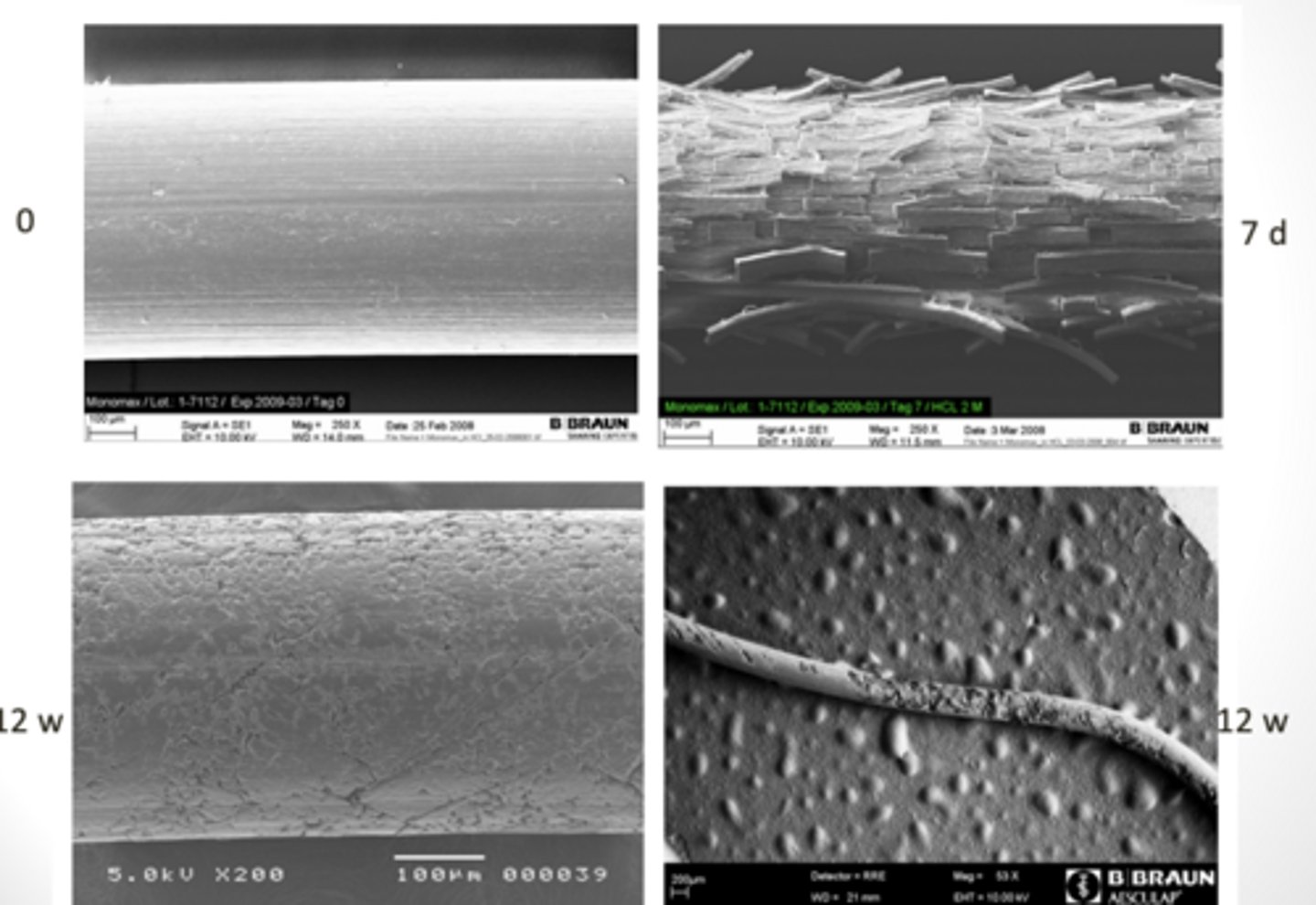
so which suture do i use?
Absorbable for buried sutures
Suture not needed after the tissue is healed
Non-absorbable for skin
Suture promotes an inflammatory reaction
Less suture material is better as long as it does the job
Use smallest suture necessary to do the job
so which suture do i use?
Smaller knots leave less for inflammatory reaction
But not at the expense of suture failure
Suture failure is usually due to knot failure
As strong as the tissue that it is holding to heal
Tensile strength reduction corresponds to gain in tissue strength
Strength comes from the tissue holding the suture, not the suture holding the tissue
examples of biomaterials
•Plates/screws
•Other metallic implants
•Allograft material
•Absorbable mesh
•Xenograft material
•Non-absorbable mesh
•Adhesives
•Cyanoacrylate
•Polymers
•Composites
•Ceramics
•Metals (staples)
What is the purpose of surgical mesh?
Used to augment surgical repair of slow healing tissue
What materials can surgical mesh be made from?
Synthetic polymers or biologically derived materials
What is one common synthetic material used in surgical mesh?
Polypropylene
What does SIS stand for in the context of surgical mesh?
Porcine small intestine submucosa (xenograft)
How is surgical mesh typically constructed for strength?
Woven or knitted
What characteristic of surgical mesh affects its mechanical properties?
Different mechanical properties
What is the effect of small pore size in surgical mesh?
Inhibits ingrowth of capillaries and fibroblasts
What type of glue is used as a tissue adhesive?
Cyanoacrylate glue
In what form is tissue adhesive typically found?
Liquid monomer form
What triggers the polymerization of tissue adhesive?
It polymerizes when it encounters anions in the moisture around a wound edge
How does tissue adhesive bond to the skin?
It bonds to skin cells and is sloughed when those cells die
What is the correct application method for tissue adhesive?
Pinch skin edges together and apply to surface on top of skin
What should you NOT do when applying tissue adhesive?
DO NOT place drop into incision and then pinch skin
What reaction can occur due to improper application of tissue adhesive?
Creates a foreign body reaction and inflammation results secondary to elution of toxic byproducts
skin staples
stainless steel
circular staples
EEA
linear staples
TA
GIA
LDS
name basic suture patterns
•Simple Interrupted pattern
•Simple Continuous pattern
•Cruciate pattern
•Horizontal Mattress pattern
•Buried Interrupted and Continuous patterns
simple interrupted pattern
•Easiest pattern to learn
•Appositional
•Provides secure closure
•Avoid excessive tension on tissue
simple interrupted
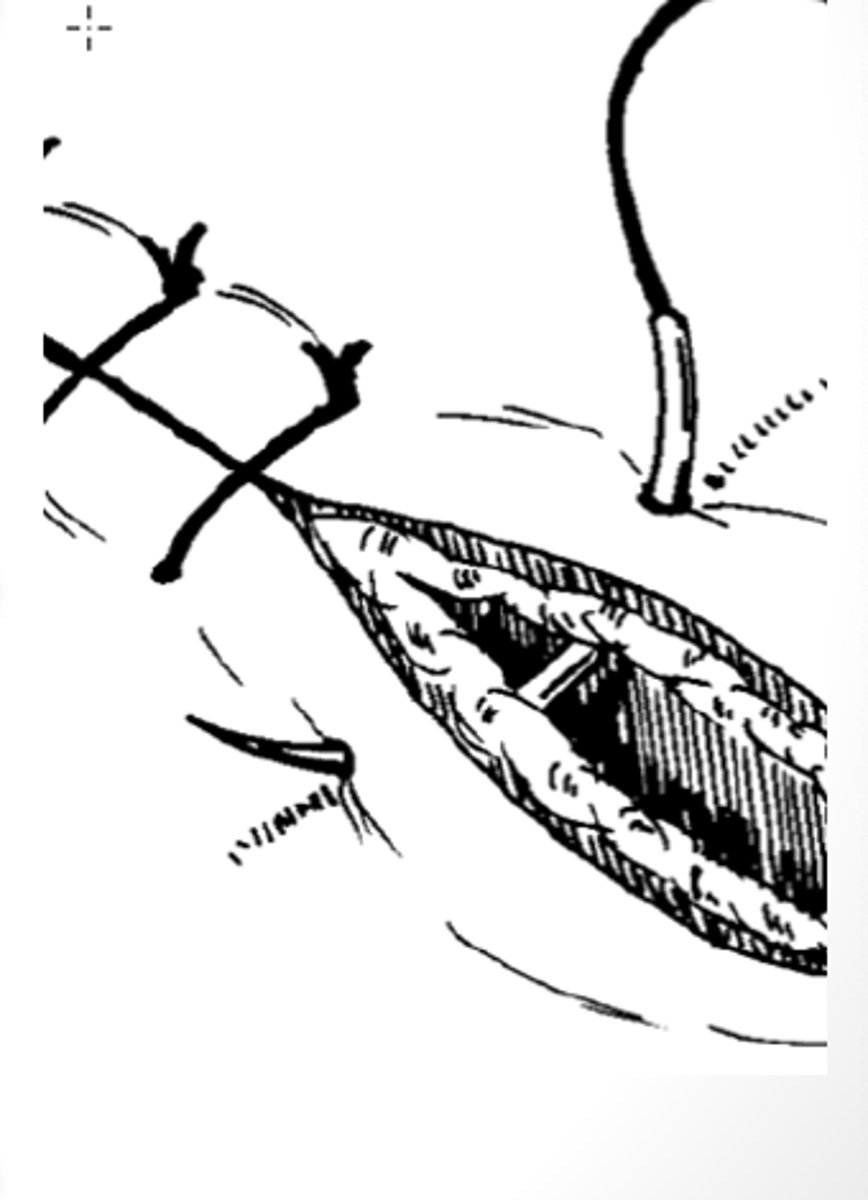
simple continuous pattern
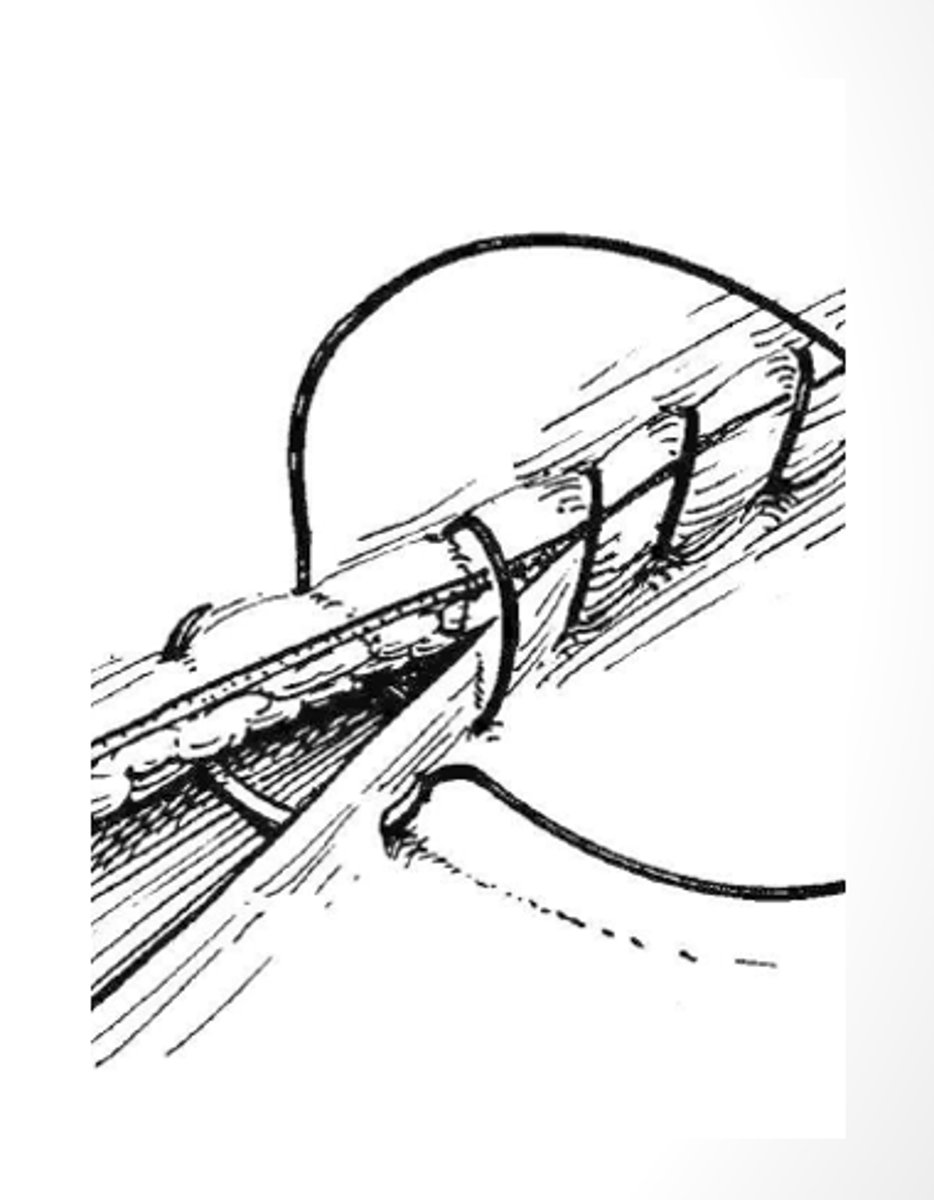
simple continuous pattern
•Appositional
•Tied off only at ends
•Saves time and suture material
•Not generally used for skin
•Avoid over-tightening
•Provides secure closure
cruciate pattern
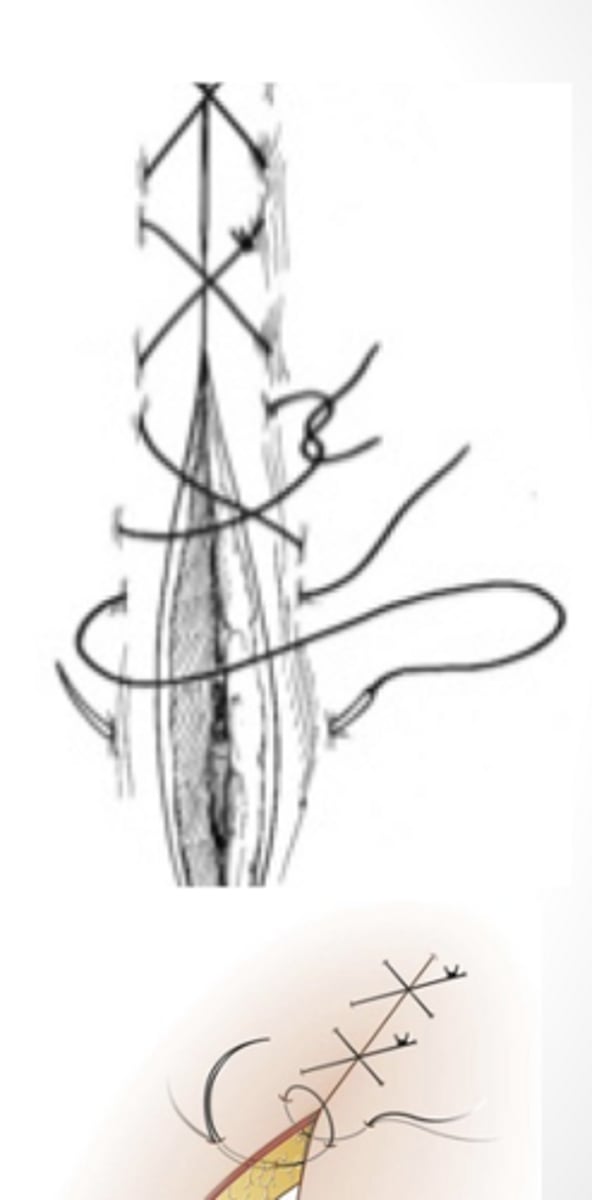
cruciate pattern
•Appositional
•Too much tension will cause tissue to invert
•Faster than simple interrupted
•Gives a strong closure
Horizontal mattress pattern
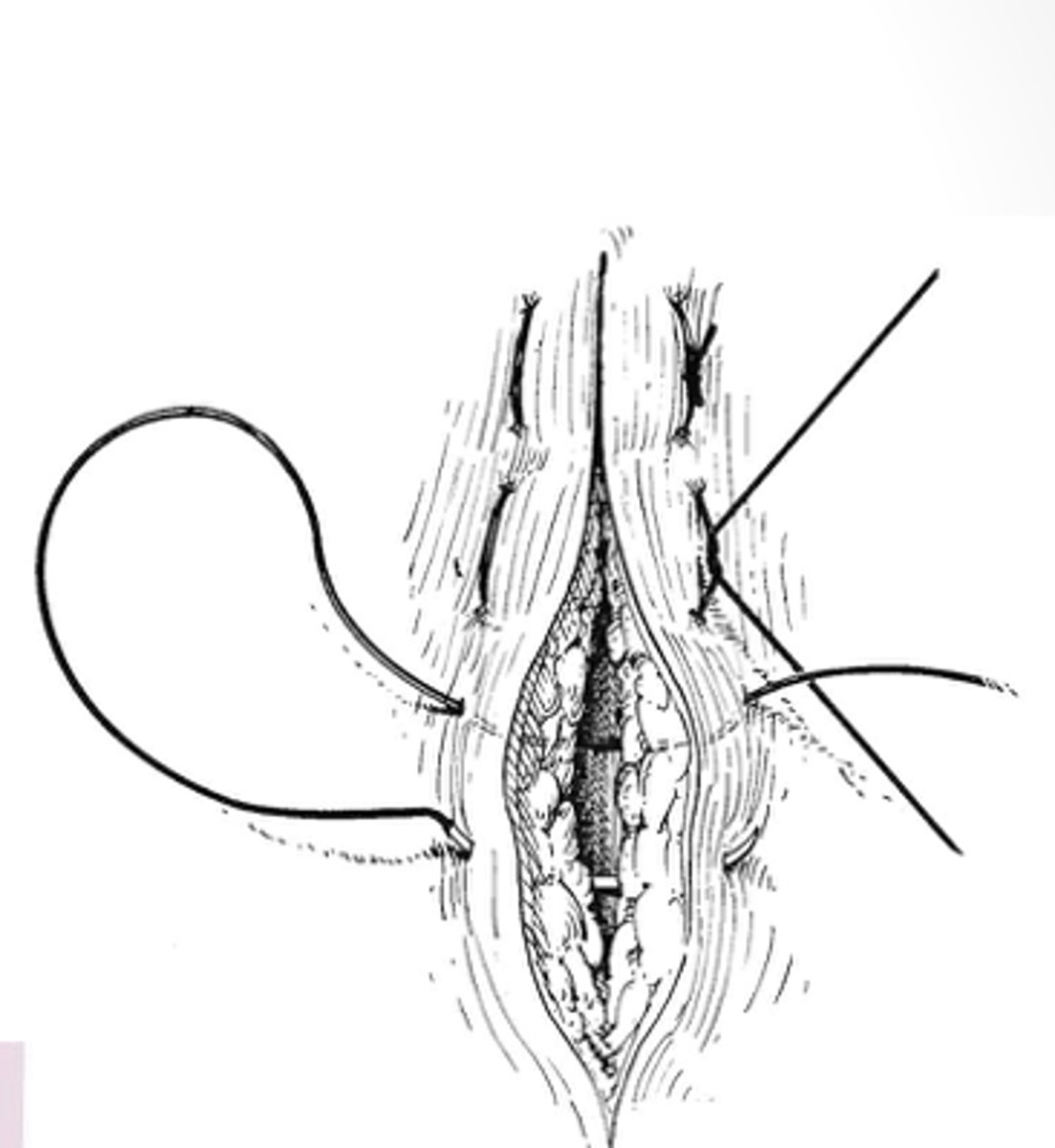
horizontal mattress pattern
•Tension relieving pattern
•Distributes forces away from the incision
•Too much tension will cause tissue to evert and damage blood supply to incision
buried patterns
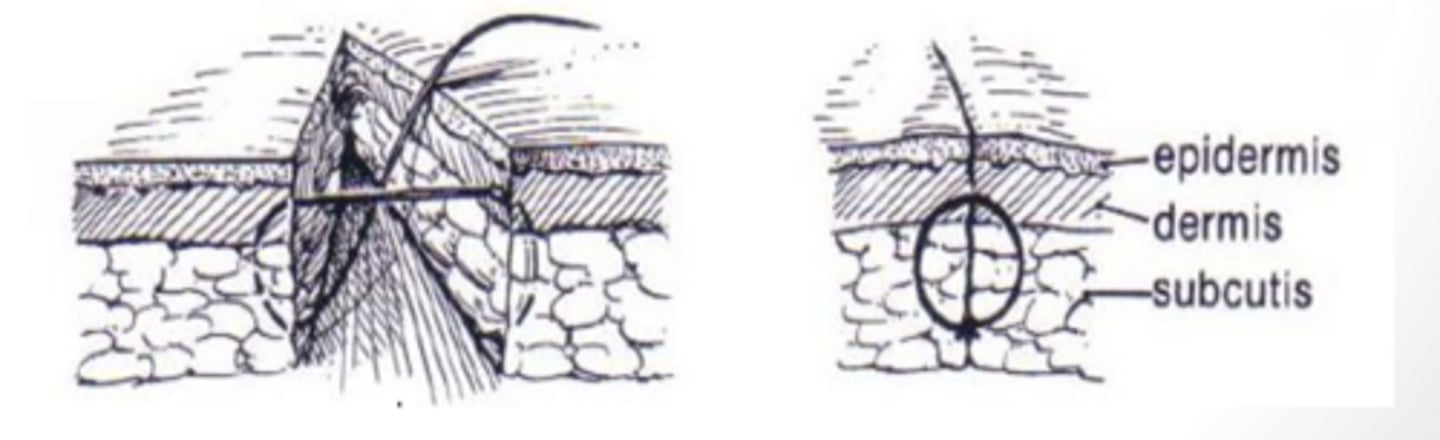
buried patterns
•Absorbable suture material
•Appositional
•Closes dead space
•Skin sutures support this layer of closure
Knot is always at deepest layer
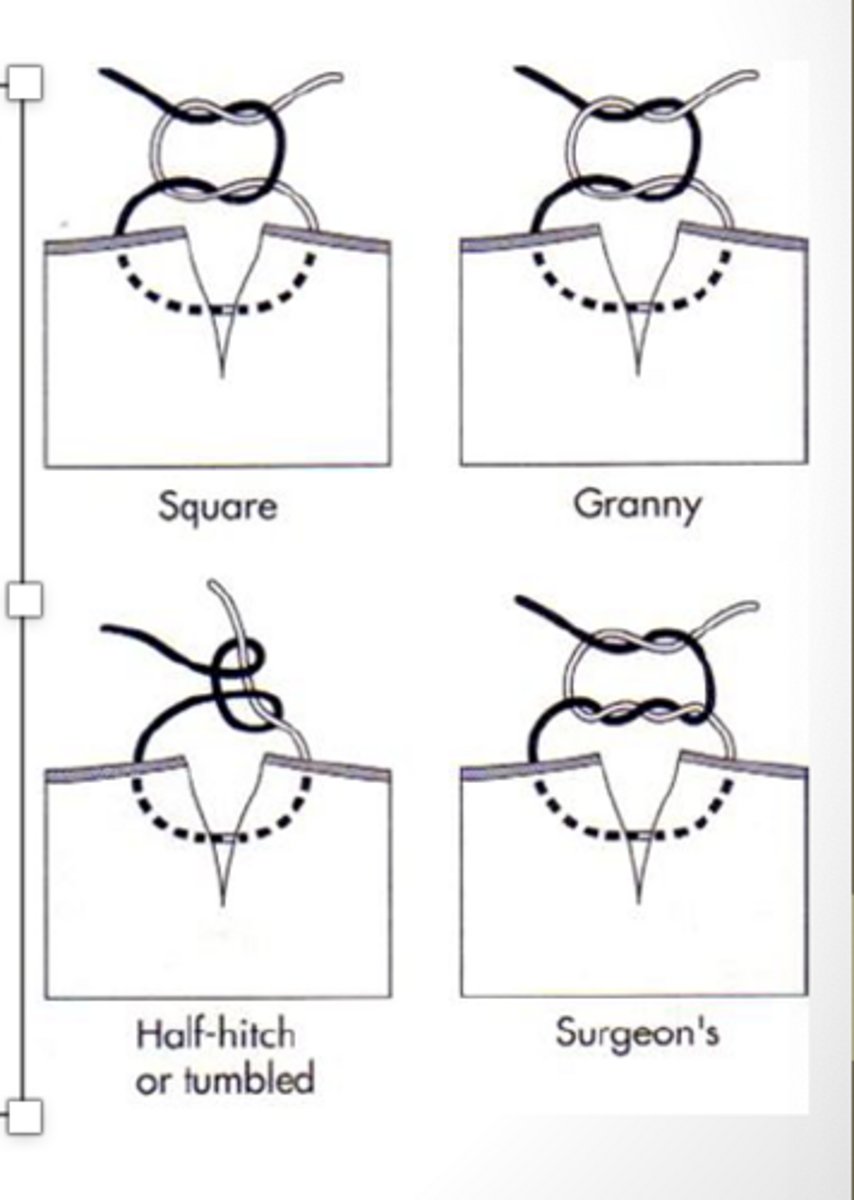
___ knot has better knot security
surgeons knot
___ ___ knot for tighter closures
half hitch
types of knots
How tight should you tighten a suture when tying a knot?
Just enough to appose tissue
What should you avoid when tying a knot to prevent tissue damage?
Crushing the tissue and damaging the blood supply
What is the minimum number of throws required when tying a suture knot?
4 throws
What may be needed when using large suture?
More than 4 throws
How long should the suture ends be cut after tying a knot?
Leaving ~3-5mm tags
What should you avoid when handling the suture?
Handling the suture with instruments
What type of knots should be ensured when tying sutures?
Square knots, not slip knots