enterobacteriaceae lactose-fermenters
 Call Kai
 Learn
Learn Practice Test
 Spaced Repetition
 Match
Match Flashcards
 Knowt Play
1/53

There's no tags or description
Looks like no tags are added yet.
Name | Mastery | Learn | Test | Matching | Spaced | Call with Kai | Chat |
|---|
No analytics yet
Send a link to your students to track their progress
54 Terms
Klebsiella
gram-negative rod
Facultative anaerobes
Non-hemolytic
Mucoid colonies
Usually non-motile (except K. aerogenes)
Lactose fermenters
Opportunistic pathogens
klebsiella pneumoniae
K. oxytoca
Klebsiealla most common pathogens in vet. med.
klebsiella pneumoniae
K. oxytoca
Klebsiealla most common pathogens in vet. med.
Coliform mastitis
Klebsiella pneumoniae
_______ - cattle
Cervicitis and metritis
Klebsiella pneumoniae
_________ - mares
Dogs
Klebsiella pneumoniae
UTI -
Pneumonia and suppurative conditiojs
Klebsiella pneumoniae
foals -
37˚C
Klebsiella
Easily identified through routine diagnostic laboratory culture at _____
non hemolytic
Large
Very mucoid
Whitish gray
Klebsiella colonoies on blood agar are
Pink to red without red haze
Klebsiella colonoies on MacConkey agar are
Negative
Oxidase-
Indole-
capsular (K) antigens
Klebsiella species are serotyped by
77
____ capsular K antigens
k1
K2
K5
_______ are venereally transmitted
Predominant types in isolates from metritis in mares
Salmonella
The nomenclature of _____ is complicated and confusing
1980s
The taxonomical designation of species has undergone numerous changes since the late
serovars/serotypes
In addition to species and subspecies, Salmonella are grouped into ______ – currently over 2,600
Serovars
defined by the presence of surface antigens
O-antigens
based on the oligosaccharides associated with LPS
H-antigens
Based on flagellar proteins
Mono- or di- phasic
H- antigens
strains may be
Two phases
H antigens
can have
Intestinal tract
Salmonella natural habitat
_________ of warm- and cold- blooded animals
Many are subclinical excretors
moist soils,
water,
fecal particles and
animal feeds (bone, meat and fish meals
Salmonella can survive for 9 months or more in the
state of colonization resistance of host
infectious dose
species or serotypes of Salmonella
Salmonella Transmission
fecal- oral route
Ingestion of contaminated food and water
Outcome of interaction of host and Salmonella depends on:
disease may or may not occur after ingestion
Enteric Form
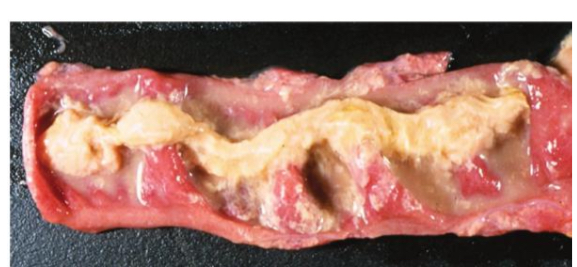
Lesions in intestinal tract consist of fibrinosuppurative, necrotizing, and hemorrhagic inflammation of the distal small intestine and large bowel
Necrosis of intestine is at first erosive → ulcerative → formation of diphtheritic membrane
Common in cattle and swine
Liver
_____ is affected with random, multifocal necrotizing inflammation that reflects bacterial spread and phagocytosis without effective bacterial killing
Septicemic Form
Fibrinoid change in blood vessels in many different organs
Vasculitis, thromboembolism, hemorrhages and infarcts
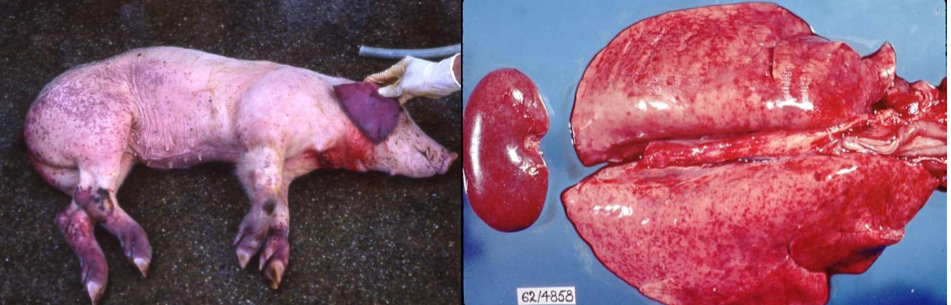
Swine with septicemic S. Choleraesuis infection
Spleen is enlarged due to hyperemia
Ears of white-skinned pigs may be dark blue from thrombosis and venous congestion
S. tymphimurium
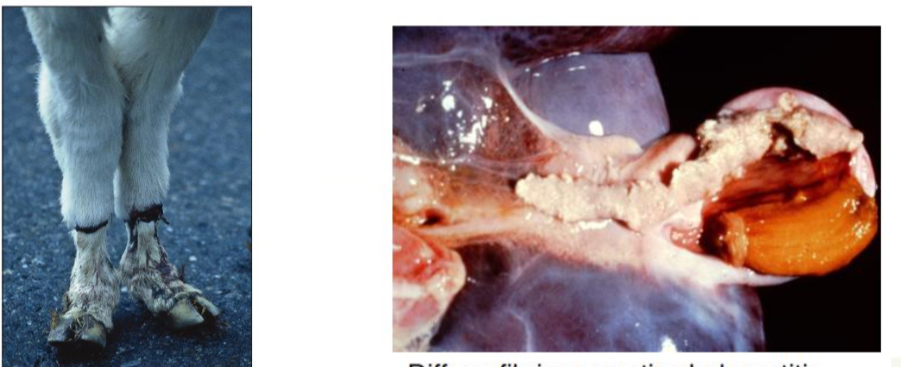
Salmonella Dublin
Host adapted to cattle
Cause of severe disease in endemic herds
Septicemia in calves <1 week old
Acute enteritis in older calves and adults
Abortion in pregnant cows
Chronic enteritis in older cows (inappetence, ↓weight gain)
Terminal dry gangrene
Salmonella Dublin
necrosis of feet
cleaning calving areas, rodent control
Vaccination possible
Salmonella dublin management
Salmonella dublina
Salmonella cholerasuis
Host adapted to pigs, maintained by carriers
Cause of:
Sepsis is most common manifestation
Enterocolitis
Secondary infections following bacteremia (pneumonia, hepatitis)
During acute disease large numbers shed in feces
Reducing stress (housing density, nutrition, concurrent infectious diseases) can reduce shedding by carriers
Autogenous bacterins may be helpful
Salmonella cholerasuis management
Salmonella cholerasuis
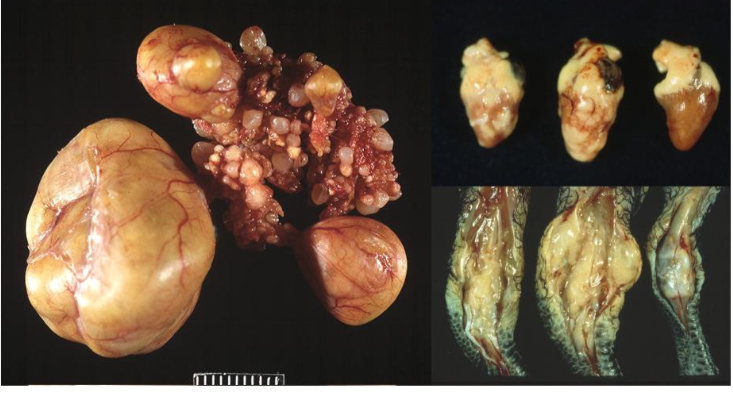
Salmonella pullorum
Host adapted to birds
Infects the ova and chicks are infected prior to hatching
After hatching, environment is contaminated facilitating transmission
Primarily affects young chicks and poults
Inappetence, depression, diarrhea, death
Inappetence,
arthritis,
decreased production,
diarrhea,
pyrexia,
increased mortality
Salmonella pullorum
in older birds
Reservoir of flock
Birds which survive infection becomes
Salmonella pullorum
Salmonella Typhi
Host adapted to humans
Spread by contaminated food and water
High fever, weakness, stomach pains, death
Primarily travel associated
Acquired by ingesting contaminated water or food
Vaccination is possible and important
Slide Agglutination Test
The Salmonella is first tested against antisera to the O (somatic) antigens and then the H (flagellar) antigens.
phase 1 (specific) flagellar antigens; or
phase 2 (non-specific) flagellar antigens
Salmonella that are motile and diphasic will contain cells that
have either:
One phase
Majority have flagella in _______ but there will be a very few cells with the alternative flagellar antigen.
Craigie Tube Method and Ditch-Plate Method
These methods are used to select cells that have the alternative flagellar antigen
Nursing care
Enteric Form Treatment
principal treatment
Controversial
Use of antibiotics is _______
Studies show that antibiotics do not alter the course of the disease.
Salmonella Systemic Form treatment
Nursing care and antimicrobial therapy
Ampicillin,
enrofloxacin,
trimethoprim-sulfonamides,
chloramphenicol/florfenicol
Since salmonellae survive in phagocytic cell, antimicrobial should be able to penetrate the cell.
4 or more drugs
Multiple resistance _____ is common
Salmonella typhimurium
Reported to have resistance to
ampicillin,
streptomycin,
sulphonamides,
tetracyclines and
furazolidone
Salmonella genomic islands, integrons and plasmids.
Antimicrobial resistance is encoded by genes found as part of
Inter
transferable between Salmonella serotypes and can be responsible for combinations of multidrug resistance