Fate bioavailability
 Call Kai
 Learn
Learn Practice Test
 Spaced Repetition
 Match
Match Flashcards
 Knowt Play
1/55

There's no tags or description
Looks like no tags are added yet.
Name | Mastery | Learn | Test | Matching | Spaced | Call with Kai | Chat |
|---|
No analytics yet
Send a link to your students to track their progress
56 Terms
Fate of organic contaminants in the environment and in biota depends on
• Chemical properties → persistence, solubility, vapor pressure...
• Transport/transformation: local – global
• Biotic uptake
Two PBTs
PCB polychlorinated biphenyl, PBDE tetrabrominated diphenylether
What structural properties signify PBTs
Aromatic hydrocarbons + Halogens: Cl, F, Br, I
Stabilise the molecule, increase hydrophobicity and persistence
Partitioning thresholds
log kow >3 = bioaccumulationg compounds
log kow >5 = very hydrophobic
log kow >7 super hydrophobic
List from lowest to highest log kow:
Polychlorinated biphenyls (PCB)
Polycyclic aromatic hydrocarbons (PAH)
Organic pesticides
Halogenated aliphatic hydrocarbons
Methyl mercury
PCB 4-10
PAH 3-7
Organic pesticides 0-7
Halogenated aliphatic hydrocarbons 1-3
Methyl mercury 0.3
What does increasing log kow mean
Decreasing solubility on water, increasing solubility in non-polar substances
Kow
octanol/water
Koc
organic matter/water
Koa
octanol/air
Kaw
air/water
Kow range for persistent polutants
10^4-10^7
Koa range for persistent polutants
10^6-10^12
Kaw range for persistent polutants
10^-1-10^-3
Abiotic chemical transformation
Potolysis - light (UV)
Hydrolosis - water, OH
Dissociation - pH
Oxidation/reduction
Biotic chemical transformation
Microbial
Macrobial
Microbial chemical transformation ex
Aerobic ring clevage
Anareobic dehalogenation
Macrobial chemical transformation ex
p450 monooxygenase system phase I and phase II enzymes
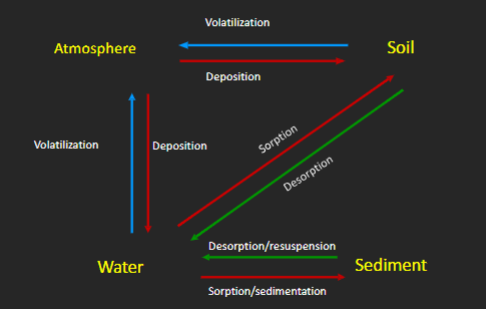
Transport - across phases
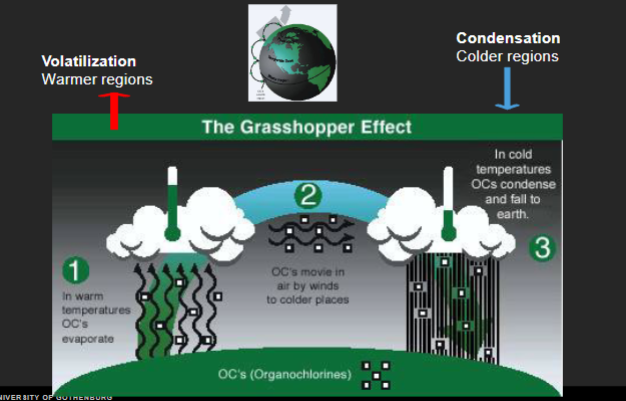
The grasshopper effect
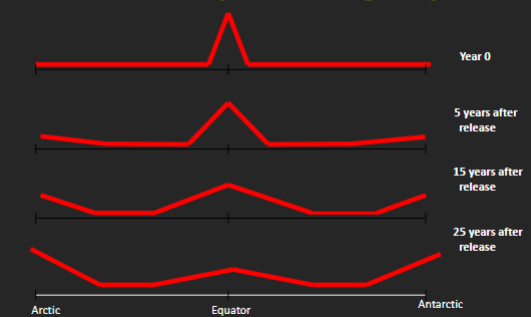
Global distrubution of persistent organic pollutants
Sorption def
associations between contaminants and particles
sorption depends on
Chemical properties of the contaminant
Quality/chemical properties of organic matter
Quantity of organic matter
DOM def
Disolved organic matter
POM def
Particulate organic matter
Sorption Relative contaminant concentration: perticle size ration
decreses with particle size. Because surfece:volume ratio is high for small particles. And small particles have high organic content
Effects of bioturbation processes
Particle mixing, Irrigation, Redox conditions
Particle mixing effects (bioturbation)
Affects distrubution of sediment associated contaminants
• Organisms affect contaminant fate, thereby affecting their own exposure
• Contaminant fate and effects are intimately connected
Irrigation effects (biotubation)
Affects distrobution of disolved contaminants (flushing the sediment)
Redox condition effects (bioturbation)
Stimulates aerobic microbial degredation of sediment associated contaminants
PCB concentration in biota – decreased over time Marenzelleria spp
Arrived in southern Baltic Sea in mid 80s rapidly spreading invading species
Lives in organically enriched oreutrophicated sediments
Tolerates low oxygen and high sulphideconditions
Burrow depth 35 cm
Average bioturbation depth by indigenous fauna is 5 cm
Reach densities of 40 000 ind. m -2
Bioturbation increases the release of PCBs from sediment to water
Bioconcentation def
Accumulation from water exposure (Cbiota>Cwater)
Bioaccumulation def
Accumulation from differet exposure routes (Cbiota>Cwater/particles)
Biomagnification def
Accumulation through trophic levels (Cbiota3>Cbiota2>Cbiota3)
BCF def
Bioconcentration factor. Net accumulation of a contaminant in an organisim from water at steady state
Bioconcentration of organic contaminant - ex lipid content
Very fat fish concentrate more lipids (water+prey)
Fat fish concentrate more lipids (water)
Lean fish concentratte less lipids (water)
BAF def
BioAccumulation factor. Net accumulation of contaminant in an organisim from all sources, includiing water, food, and sediment at steady state
Good to know about bioaccumulation
Grat variation in bioaccumulation among species exposed to the same sediment.
Routes of uptake (bioaccumulation)
Respiration (water or air)
Diffusion over skin
Food
Routes of depuration (bioaccumulation)
Respiration (water or air)
Feaces
Diffusion over skin
Metaolic conversion
Reproduction
Growth
Life strategy
exposure differs depending on life strategy and feeding
Top predators (biomagnification)
Air-breathers, cannot eliminate contaminants efficently
ower trophic levels (biomagnification)
Extremley efficient at extraction food from sediments. POPs associated with food particles
Marine sediments (biomagnification)
Main source/sink for POPs
How to measure bioavailability
bioconcentration, bioaccumulation, biotransformatio
Factros that affect those
Mimic uptake by use of special samplers
Bioavailability and organic matter
More POC and DOC = less truly dissolved contaminant
→ Bioavailability decreases with increasing POC, DOC
→ Bioacumulatoin depends on particle characteristics
Metal def
Basic substance with a shiny surface that can transfer heat and electricity, often with good tensile strength
Metal uptake in organisms occurs through
Water, food, air (hg), Me absorbed on fine particles
Free etal ions through ion- channels, pumps, carriers
HG, organometals, natural complexes straight over the cell membrane
Assimilation efficency of metals from feed
Co 46%, Zn 41%, cd 17%, ag 7%
Abiotic factors influence metal bioavialability and toxicity
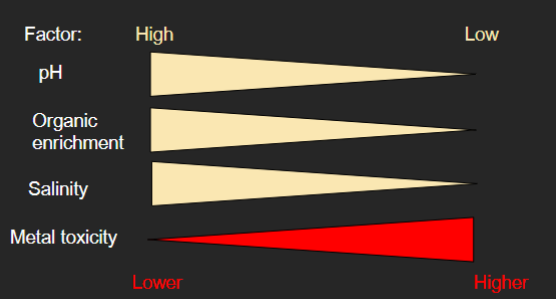
Ph and metals
affects speciation of metals. some are more toxic
DOC and metals
DOC binds free metal ions. UV radiation decreases this capacity by breakdown of DOC
Carbon qualit and metals
Allochontous carbon more effective att lowering toxicity than autochtonous carbon
Humic/fluvic acids and metal
Have phenol and carboxylic groups that can bind metals
Considerations for sampling to assess environmental status
Taking a representative sample:
sample matrices
time of sampling
sampling sites
Getting a correct measurment:
analytical method
QA/QC
Accuracy - precicion
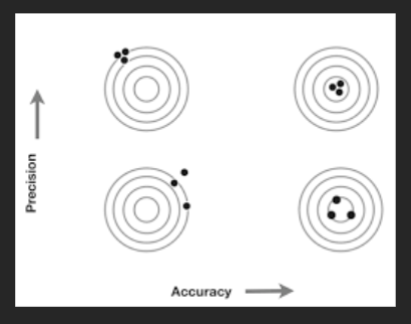
Factors that influence analytical quality
Accuracy
Repetability
Reproducability
Limit of detection