4.2.2 classification and evolution
 Call Kai
 Learn
Learn Practice Test
 Spaced Repetition
 Match
Match Flashcards
 Knowt Play
1/38

There's no tags or description
Looks like no tags are added yet.
Name | Mastery | Learn | Test | Matching | Spaced | Call with Kai | Chat |
|---|
No analytics yet
Send a link to your students to track their progress
39 Terms
Consider the statement: ‘Genetically modified plants and animals should be classed as new species’. Outline one experiment or investigation that would provide evidence to support or contradict the statement. (3 marks)
breed GM stock with non-modified stock
see if offspring fertile
if so they should be classed as the same species

Describe two differences between the two images that could have been used to classify humans and chimpanzees in separate families. (2 marks)
chimpanzees have relatively…
smaller/ shorter/ thinner thumb
longer/ narrower palm
thicker fingers
wider wrists
→ no scale was given so references to size are ignored
The Scottish wildcat and European wildcat are both classified in the same species, Felis silvestris.
Researchers have suggested that both wildcats originated from the same population.
Name the genus of the Scottish wildcat (1 mark)
Felis
The Scottish wildcat and European wildcat are both classified in the same species, Felis silvestris.
Researchers have suggested that both wildcats originated from the same population.
What is the term used to describe the differences between the two populations of wildcat? (1 mark)
intraspecific ✓
variation ✓
The Scottish wildcat and European wildcat are both classified in the same species, Felis silvestris.
Researchers have suggested that both wildcats originated from the same population.
After the Ice Age, sea levels rose and the British Isles became isolated from the rest of Europe.
The isolated population of wildcats in the British Isles developed slightly different characteristics from the mainland population in Europe.
Suggest why the Scottish wildcat and the European wildcat cannot yet be classified as different species (2 marks)
can produce fertile offspring
similar in appearance/ not enough phenotypic differences
have only been isolated for a short time
genetically similar
The creation of an organism with an artificial genome is known as ........................... biology. The bacterium created has been classified in the genus ........................... However, the classification of this organism is problematic because the basis of classification is ........................... . (3 marks)
synthetic
Escherichia
phylogeny/ phylogenetics
The Titicaca water frog, Telmatobius culeus, is an aquatic amphibian found in Lake Titicaca in sub-tropical South America. Name the genus of the Titicaca water frog (1 mark)
Telmatobius

The Sumatran rhinoceros, Dicerorhinus sumatrensis, is a rare member of the family Rhinocerotidae.
Complete the table below, showing the classification of the Sumatran rhinoceros (2 marks)
column 1
class
order
genus
column 2
animalia
sumatrensis
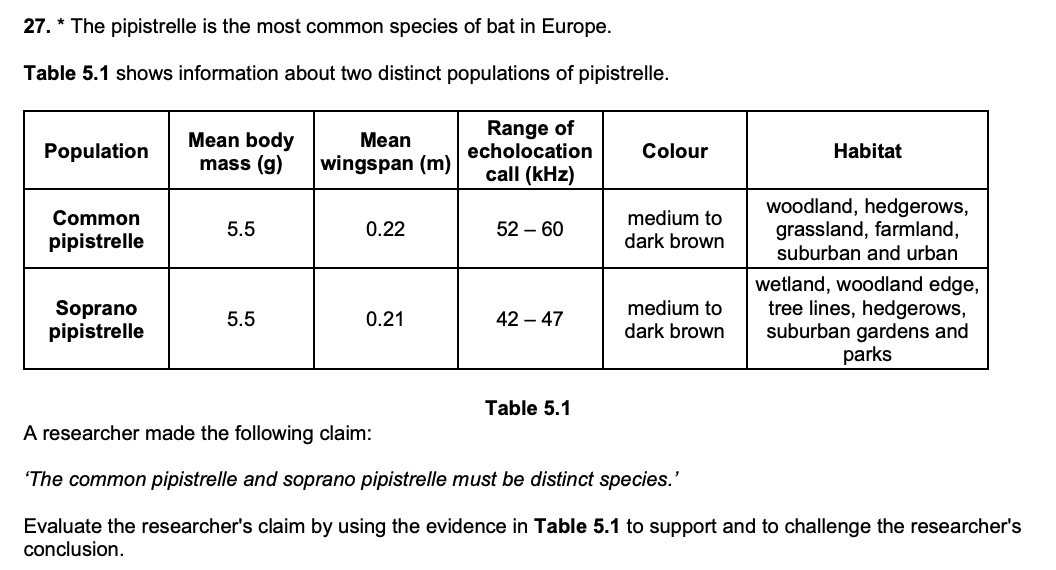
(6 marks)

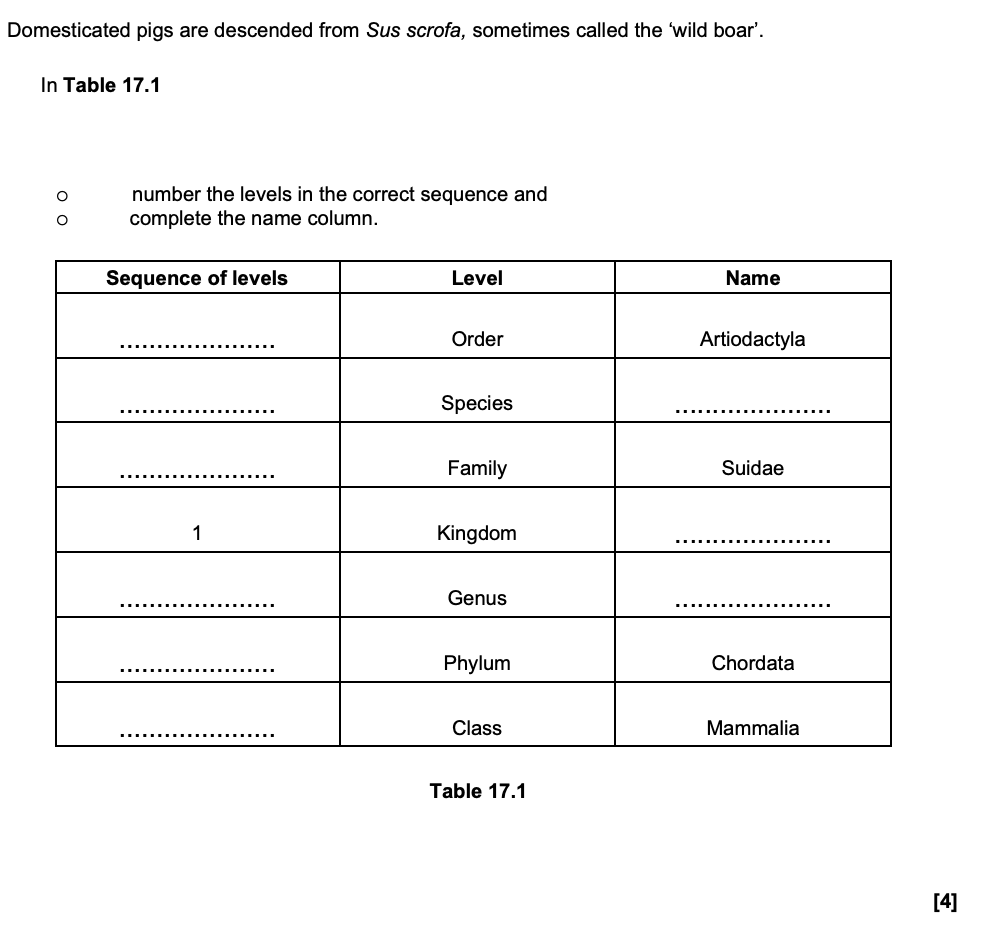
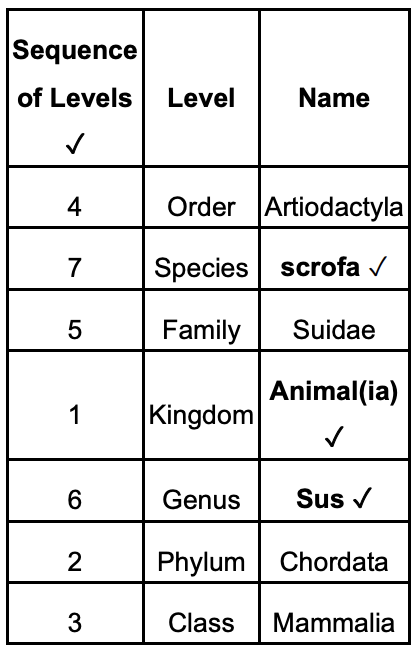
The name Dicerorhinus sumatrensis is part of the binomial naming system for classifying species.
State an advantage of using this system rather than using the common nameof the species, Sumatran rhinoceros. (1 mark)
universal/ recognised worldwide
knows which genus/ species it belongs to
idea of different common name for the same organism
State two features of organisms that belong to the Kingdom Protoctista. (2 marks)
eukayotic cells
detail of eukaryotic feature (e.g. membrane bounded organelles, 80S ribosomes, linear DNA, DNA with histones)
aquatic
most are unicellular/ few multicellular
autotrophic or heterotrophic
describe how genetic material is arranged in prokayota organisms (1 mark)
ref to nucleoid OR loop/ circular OR free in the cytoplasm
not associated with histones/ proteins
only one chromosome

At various times, algae have been classified in different kingdoms. Using the information given above, draw a conclusion about which kingdom is the most appropriate in which to classify algae. In your answer explain why other kingdoms are not appropriate choices. (4 marks)
protoctista
nucleus/ (named) membrane-bound organelles, so eukaryotic/ not prokaryotic
unicellular so not plant(ae)
cell wall/ chloroplast/ starch grains, so not animal(ia)
cellulose cell wall/ chloroplast, so not fungi
Name the cell component that appears in organisms of all three domains that Woese suggested (1 mark)
ribosomes
One of the domains Carl Woese suggested is called Eukarya. Name the other two domains (2 marks)
bacteria
archaea
State two defining features of all members of the domain Eukarya (2 marks)
nucleus
DNA with histones/ associated proteins
linear DNA
(named) membrane bound organelles
80S ribosomes
Woese carried out a detailed study of RNA molecules in order to draw his conclusions.
Suggest two ways in which the scientific community are likely to have validated Woese’s research. (2 marks)
scientific conferences/ meetings
peer review
replication of work by others to see if the same results are obtained
looking for more evidence (e.g. from other people’s work)

Explain how scientists are able to estimate the age of extinct organisms, such as species A and species B. (2 marks)
fossils
idea that fossils deeper in the ground are older than those near the surface
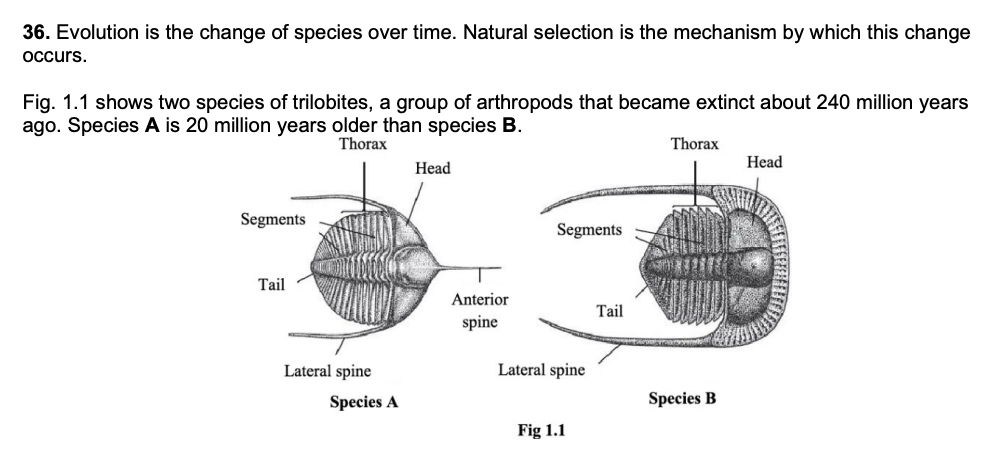
One such observation was “species B had longer lateral spines than species A”.
Explain why this is not a valid observation to make on the basis of Fig. 1.1. (2 marks)
no scale given on figure
idea that comparison in absolute length cannot be made
maturity/ age of specimen unknown
idea that only one individual of each species observed
Explain how a specific molecule is used to show that two different species have evolved from a recent common ancestor. (2 marks)
sequence of amino acids/ DNA bases
the smaller the differences, the more closely related they are
reference to named protein (e.g. cytochrome c)
How might scientists a century ago have known that termites evolved in the Jurassic geological period? (1 mark)
fossils
What new source of evidence might help today's scientists to find out how closely related termites are to cockroaches? (1 mark)
DNA/ cytochrome c
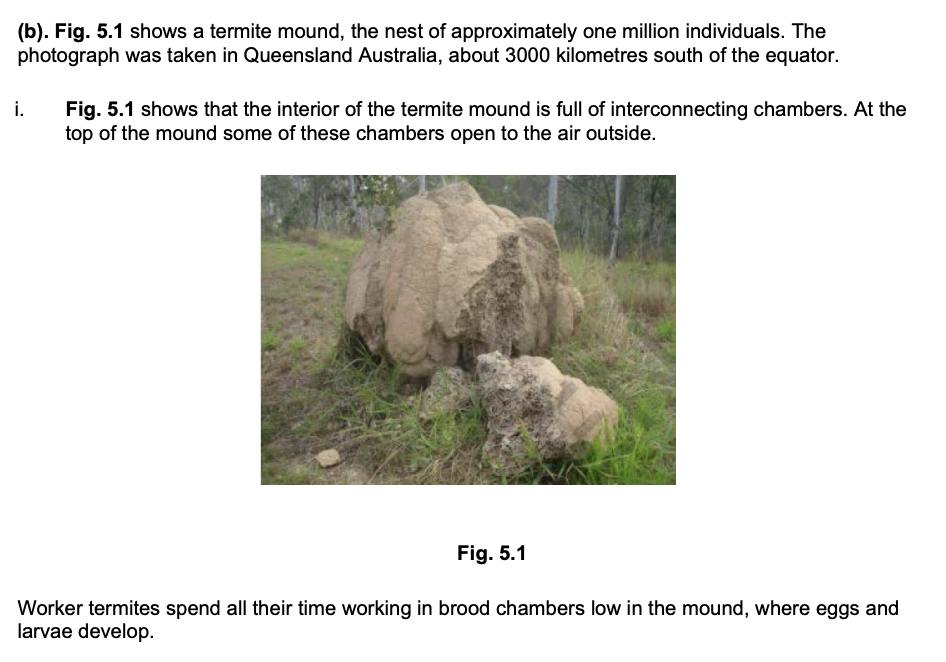
Explain how carbon dioxide produced in the respiring body cells of worker termites is removed to the air outside the termite mound. (4 marks)
carbon dioxide diffuses down concentration gradient out of the respiring cell
carried through body from cell (to tracheoles) by blood passing out via tracheoles/ trachea/ spiracles
hot gases expand and are less dense so rise up by convention through the mounds to vents at mound-top
State one way in which genetic diversity can be measured (1 mark)
genetic polymorphism/ proportion of heterozygotes/ proportion of gene variants
The cheetah, Acinonyx jubatus, is a member of the cat family, Felidae. Cheetahs display less intraspecific variation than other members of the family Felidae. The population of cheetahs has been declining for the past 100 years and is estimated to be between 6000 and 7000. Within the remaining cheetah population, intraspecific genetic diversity is very low. One isolated population of cheetahs in Iran has fewer than 100 individuals.
It is thought that the modern cheetah population has low genetic diversity because the population,relatively recently, experienced a genetic bottleneck.
Explain why a genetic bottleneck can lead to low genetic diversity (2 marks)
many alleles lost when population dropped
modern population descended from few survivors
The cheetah, Acinonyx jubatus, is a member of the cat family, Felidae. Cheetahs display less intraspecific variation than other members of the family Felidae. The population of cheetahs has been declining for the past 100 years and is estimated to be between 6000 and 7000. Within the remaining cheetah population, intraspecific genetic diversity is very low. One isolated population of cheetahs in Iran has fewer than 100 individuals.
Scientists are concerned about genetic drift in the remaining cheetah populations.
Explain why genetic drift is likely to be of particular concern in the population of 100 cheetahs in Iran. (2 marks)
idea that one individual or allele has proportionally higher effect on small population
more likely that alleles will be lost from population
population more vulnerable/ likely to become extinct due to environmental change
Name the type of speciation that occurs when two populations live in the same location. (1 mark)
sympatric
In disruptive selection, extreme phenotypes are selected for and average phenotypes selected against. The G. fortis all live in the same location. If disruptive selection is occurring in the G. fortis population, it is possible that speciation might occur.
Suggest how G. fortis with large beaks could become reproductively isolated from G. fortis with small beaks despite living in the same location. (1 mark)
idea that individuals choose to mate only with other individuals with similar sized beaks
Describe how DNA can be used to provide evidence to support the theory of evolution by natural selection (2 marks).
(DNA) found in all organisms ✓
some / AW , sequences highly conserved ✓
comparison (of DNA between species) ✓
similar (base) sequence indicates recent common ancestor ✓ ora
Alfred Russel Wallace is another important figure in the understanding of evolution.
Outline the way in which Wallace contributed to the acceptance of Darwin’s theory of natural selection by the wider scientific community. (2 marks)
similar ideas to Darwin ✓
arrived at independently ✓
presented / published (paper) , together ✓
idea of increased weight of evidence ✓
Explain how biological molecules can provide evidence that species have evolved.
You should refer to different types of molecule in your answer. (2 marks)
biological molecule
nucleic acid / (nuclear) DNA / mtDNA / RNA (1)
idea that in samples from two species sequence similarity in any of the above can imply an evolutionary relationship, difference / divergence in sequence implies evolutionary distance (1)
biological molecule
proteins / polypeptides / cytochrome C / haemoglobin (1)
idea that in the same protein from two species, amino acid / primary sequence similarity implies evolutionary relationship, difference / divergence in sequence implies evolutionary distance (1)
The students concluded that there is a positive correlation between distance of the tree from the river and mean leaf hair density.
Suggest reasons for this positive correlation (2 marks)
further away from the river less water (available) / ORA ✓
transpiration causes water loss ✓
hairs, trap water vapour / reduce transpiration / reduce loss of water (vapour)✓
reduced water (vapour) potential gradient from inside to outside leaf ✓
Another group of students repeated this investigation and calculated rs = 0.589. The critical value of rs at the 5% level for 9 degrees of freedom is 0.600.
They concluded that their results showed a weak positive correlation between leaf hair density and distance of the tree from the river.
Evaluate the conclusion of this group of students. (1 mark)
their conclusion is incorrect ✓
reject (the student’s), hypothesis / H1 ✓
there is no, relationship / correlation, (between leaf hair density and distance from river) / the pattern seen is due to chance ✓
state the two patterns of variation (1 marks)
continuous and discontinuous

using fig. 20.1 and that female cheetahs are 4.7% shorter than male cheetahs at ages 2.5 and 4 years old, what can be concluded about the significance of the difference between the length of male and female cheetahs aged between 2.5 and 4 years? Explain your answer (2 marks)
little / nothing (can be concluded) ✓
because no (named) statistical test done ✓

A student looked at Fig. 20.1 and wrote:
“The longest male cheetah that was measured was 1.52 m long”.
Explain whether the information in Fig. 20.1 supports the student’s answer. (1 mark)
No, because… idea that standard deviation is not the same as range ✓

State the likely causes of variation in body length in cheetahs (2 marks)
environment ✓
genes / genetic / alleles , and environment ✓
many genes / polygenic ✓
age ✓

state 2 factors that should be controlled as part of this investigation (2 marks)
number of seeds per pot ✓
size of pot ✓
type of soil / compost used ✓
mass of soil / compost used ✓
temperature ✓
light intensity ✓
oxygen / carbon dioxide concentration ✓
AVP ✓