Chapter 6/7: Metabolism + Cellular respiration
 Call Kai
 Learn
Learn Practice Test
 Spaced Repetition
 Match
Match Flashcards
 Knowt Play
1/142

There's no tags or description
Looks like no tags are added yet.
Name | Mastery | Learn | Test | Matching | Spaced | Call with Kai |
|---|
No analytics yet
Send a link to your students to track their progress
143 Terms
Metabolism
the totality of an organism's chemical reactions
2 types of metabolic pathways
chains and cycles
example of chain pathway
glycolysis
example of cycle pathway
krebs cycle and calvin cycle
How are metabolic pathways catalyzed?
enzymes
activation energy
the minimum amount of energy required to start a chemical reaction
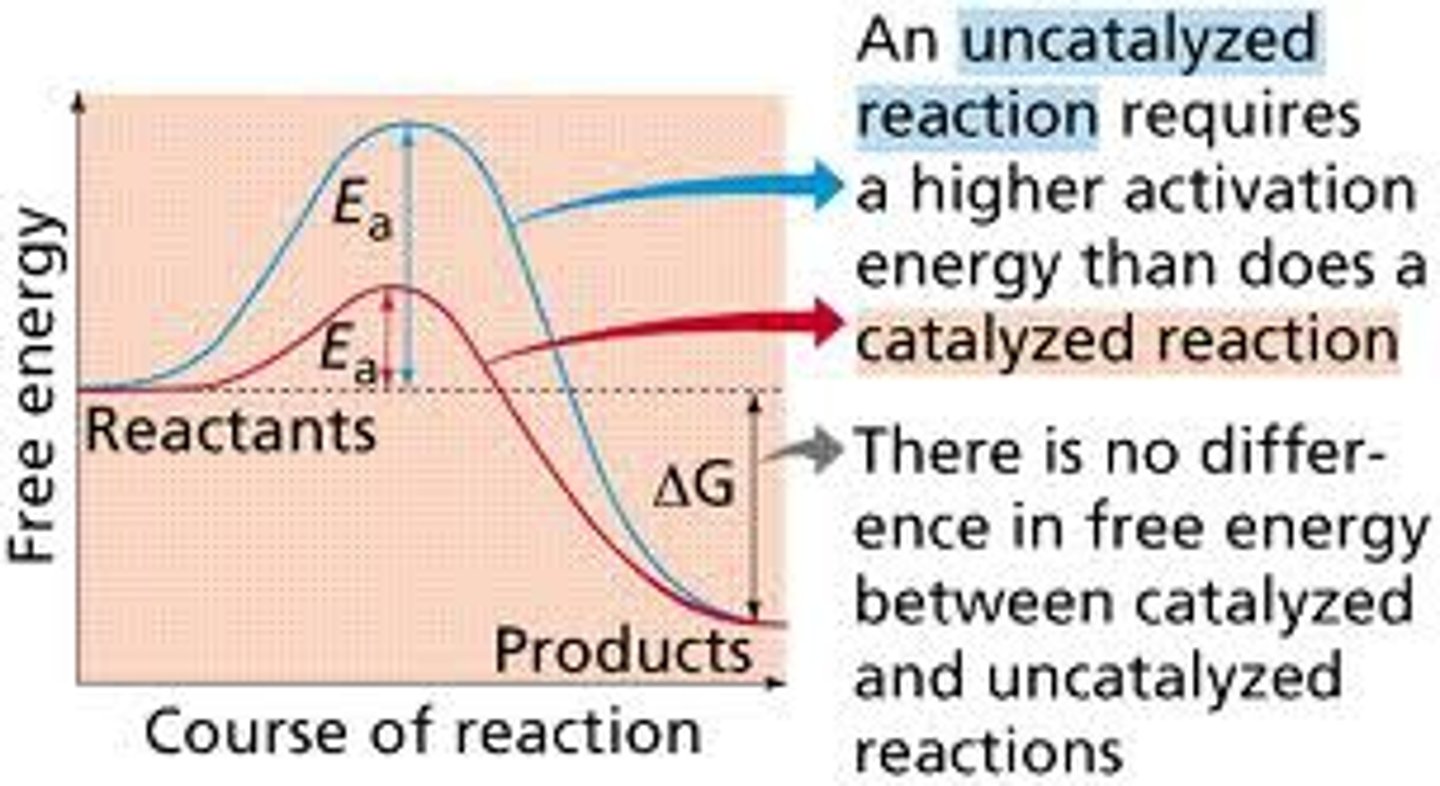
Enzymes lower...
the activation energy of a reaction
an enzyme catalyzed reaction means...
it reduces the effort/energy needed for a reaction to occur meaning the reaction occurs at a faster rate than a normal reaction
Reactant
a substance that takes part in and undergoes change during a reaction.
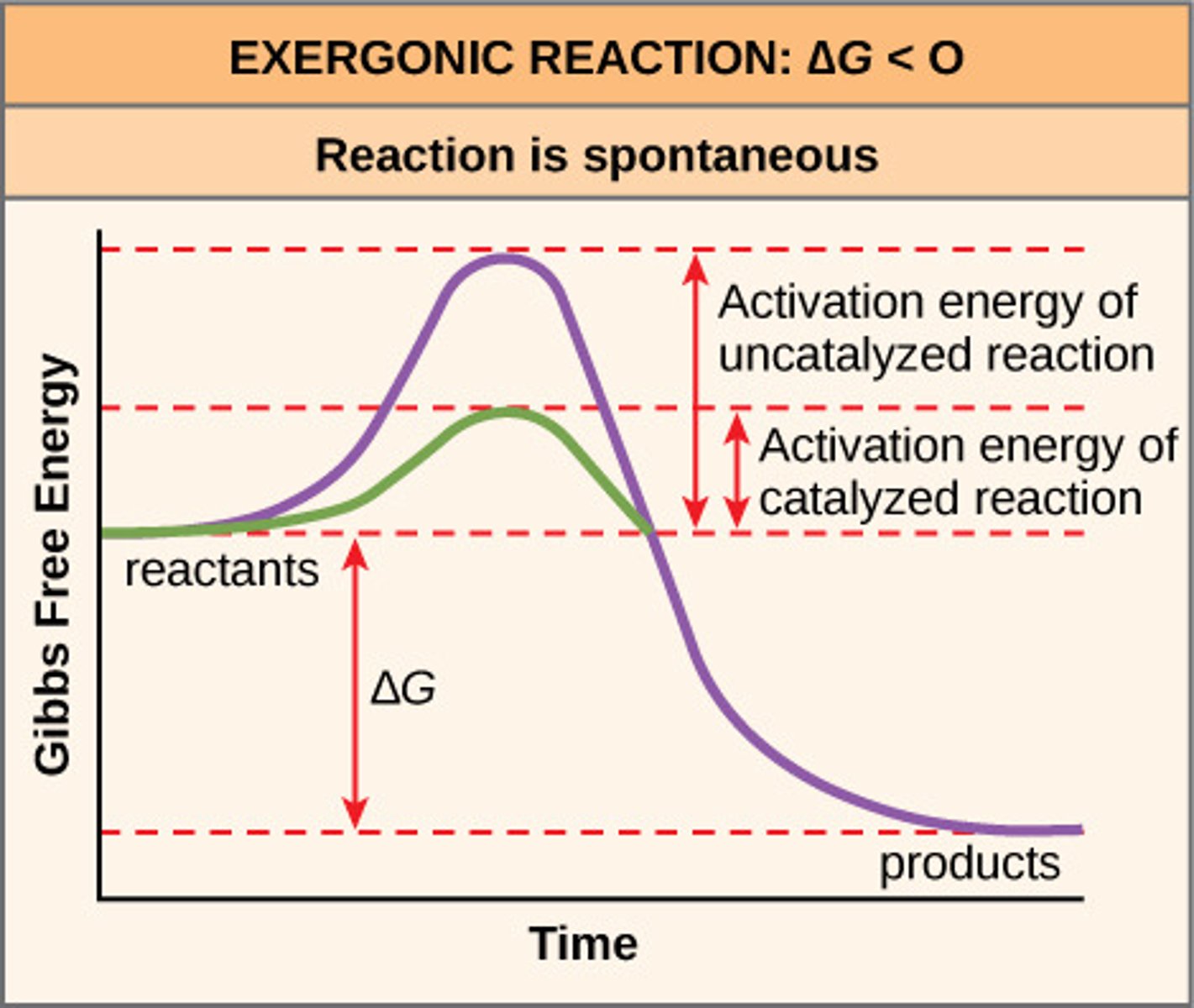
exergonic reaction
If the reactants contain more energy than the products, the free energy is released into the system
These reactions are usually catabolic (breaking down), as energy is released from broken bonds within a molecule
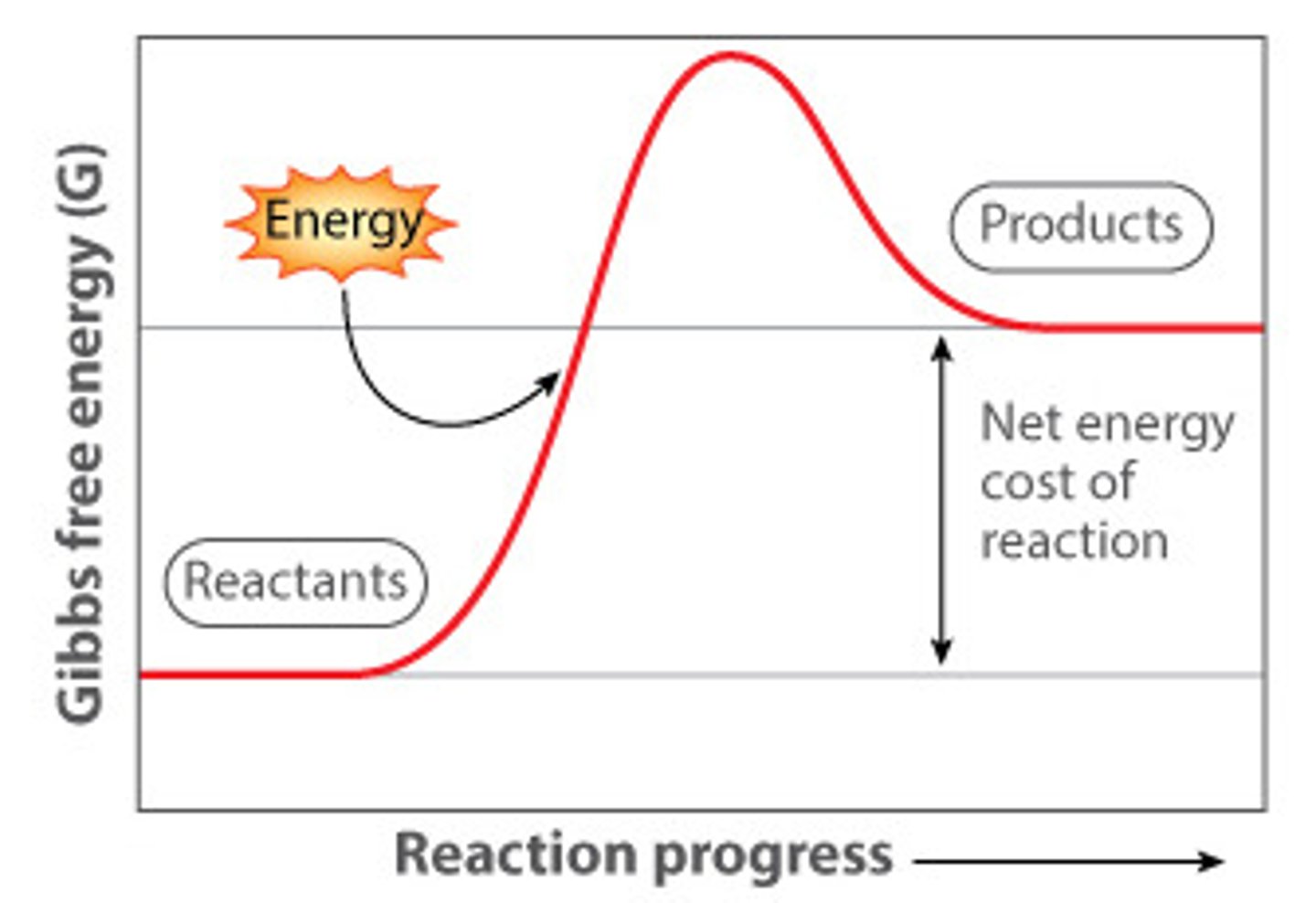
endergonic reaction
If the reactants contain less energy than the products, free energy is lost to the system
These reactions are usually anabolic (building up), as energy is required to synthesise bonds between molecules
Ea
activation energy
catabolic reactions
break down large chemicals and release energy
anabolic reactions
build up large chemicals and require energy
enzyme inhibitors
a molecule that disrupts the normal reaction pathway between an enzyme and a substrate
Enzyme inhibitors can be either
competitive or non-competitive depending on their mechanism of action
Normal Enzyme Reaction
In a normal reaction, a substrate binds to an enzyme (via the active site) to form an enzyme-substrate complex
The shape and properties of the substrate and active site are complementary, resulting in enzyme-substrate specificity
As a consequence of enzyme interaction, the substrate is converted into product at an accelerated rate
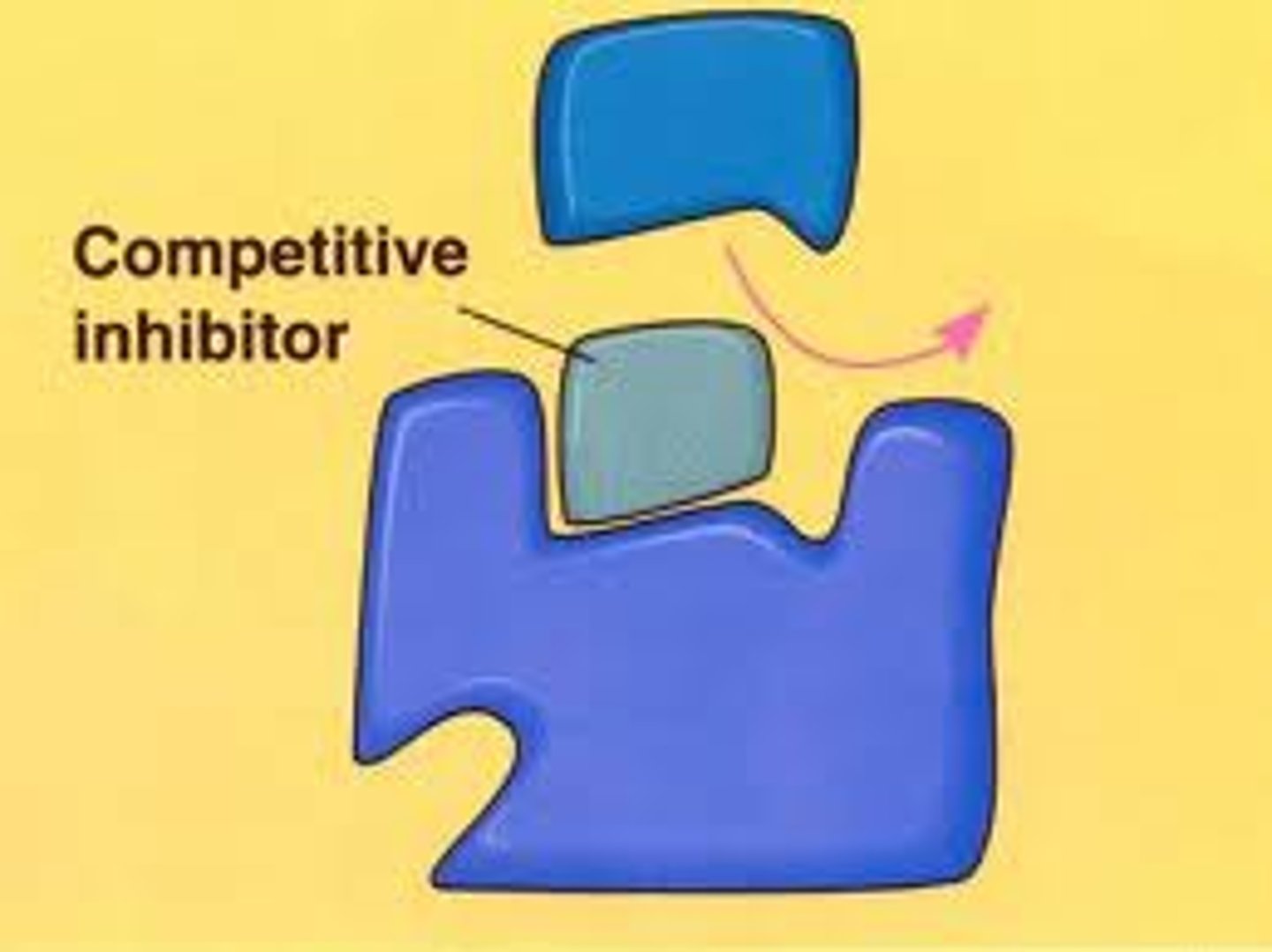
competitive inhibition
structurally similar to the substrate
directly blocks the active site
increasing the substrate concentration will reduce the effect of competitive inhibition
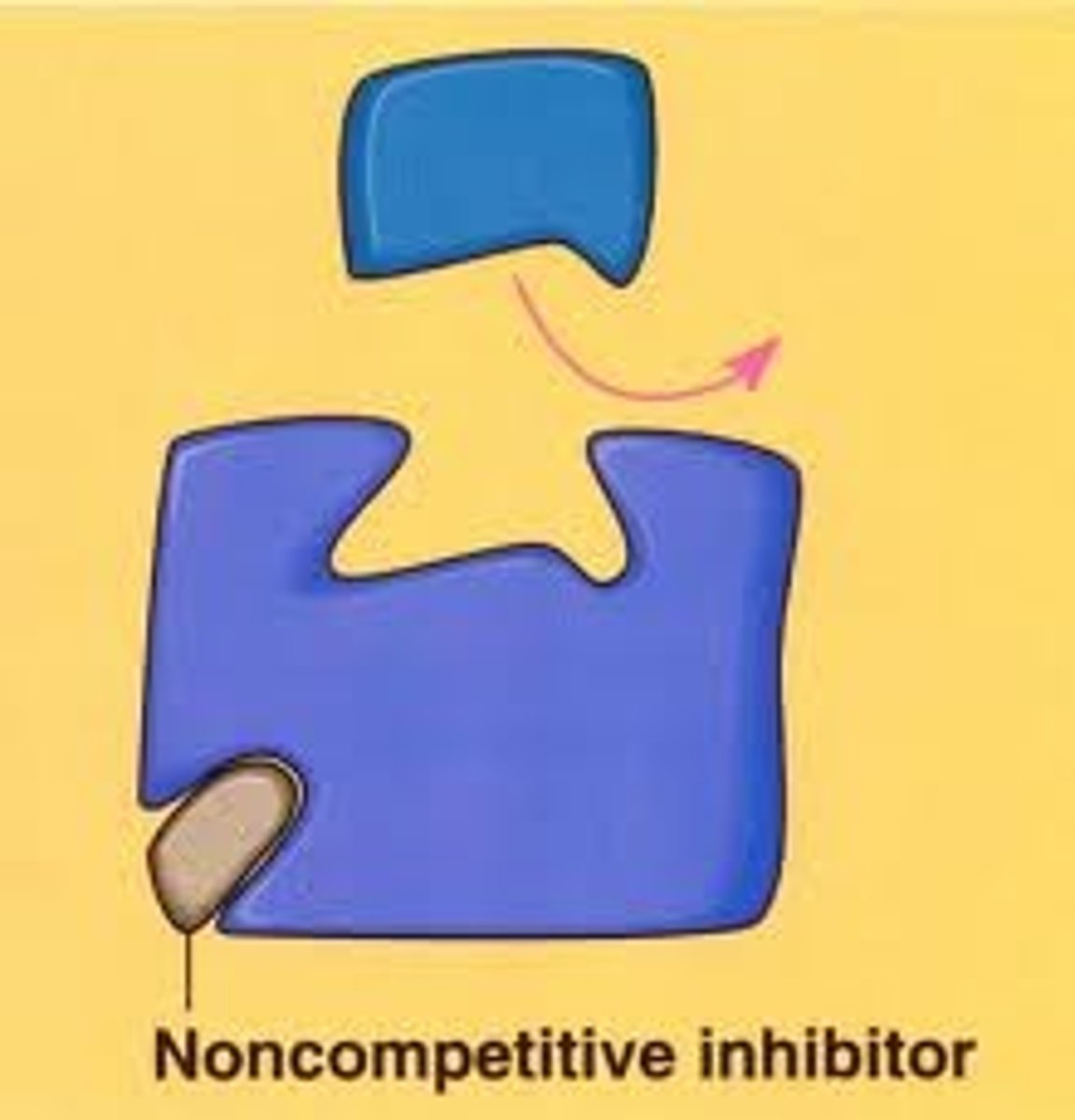
non-competitive inhibitor
it is not structurally similar to the substrate
binds to the allosteric site
causes a conformational change in the active site, so that the substrate cannot bind
increasing substrate concentration has no effect on the level of inhibition
feedback inhibition
a form of negative feedback / end-product inhibition by which metabolic pathways can be controlled
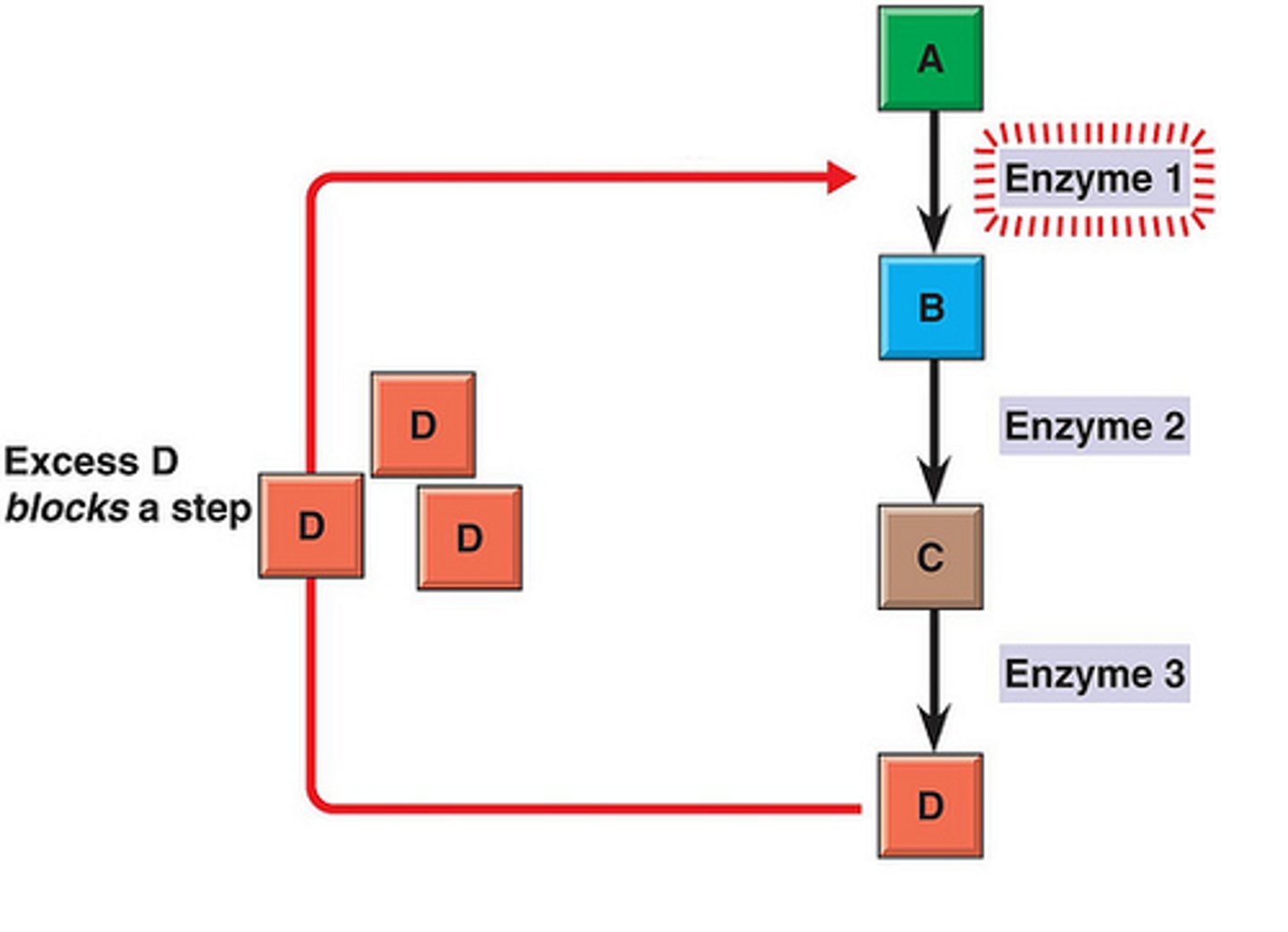
what happens with end product inhibition?
the product of a reaction acts as the inhibitor (via non competitive inhibition)
the product therefore regulates the rate of it's own production
End-product inhibition functions to ensure levels of an essential product are always tightly regulated: If product levels build up...
the product inhibits the reaction pathway and hence decreases the rate of further product formation
End-product inhibition functions to ensure levels of an essential product are always tightly regulated: If product levels drop...
the reaction pathway will proceed unhindered and the rate of product formation will increase
example of competitive inhibition
relenza - blocks enzymes active site and prevents viral release
Example of non-competitive inhibition
cyanide - protein carriers are used in the electron transport chain, cyanide breaks bonds with protwin carrier (changes conformation), preventing protein shuttling and and ATP production
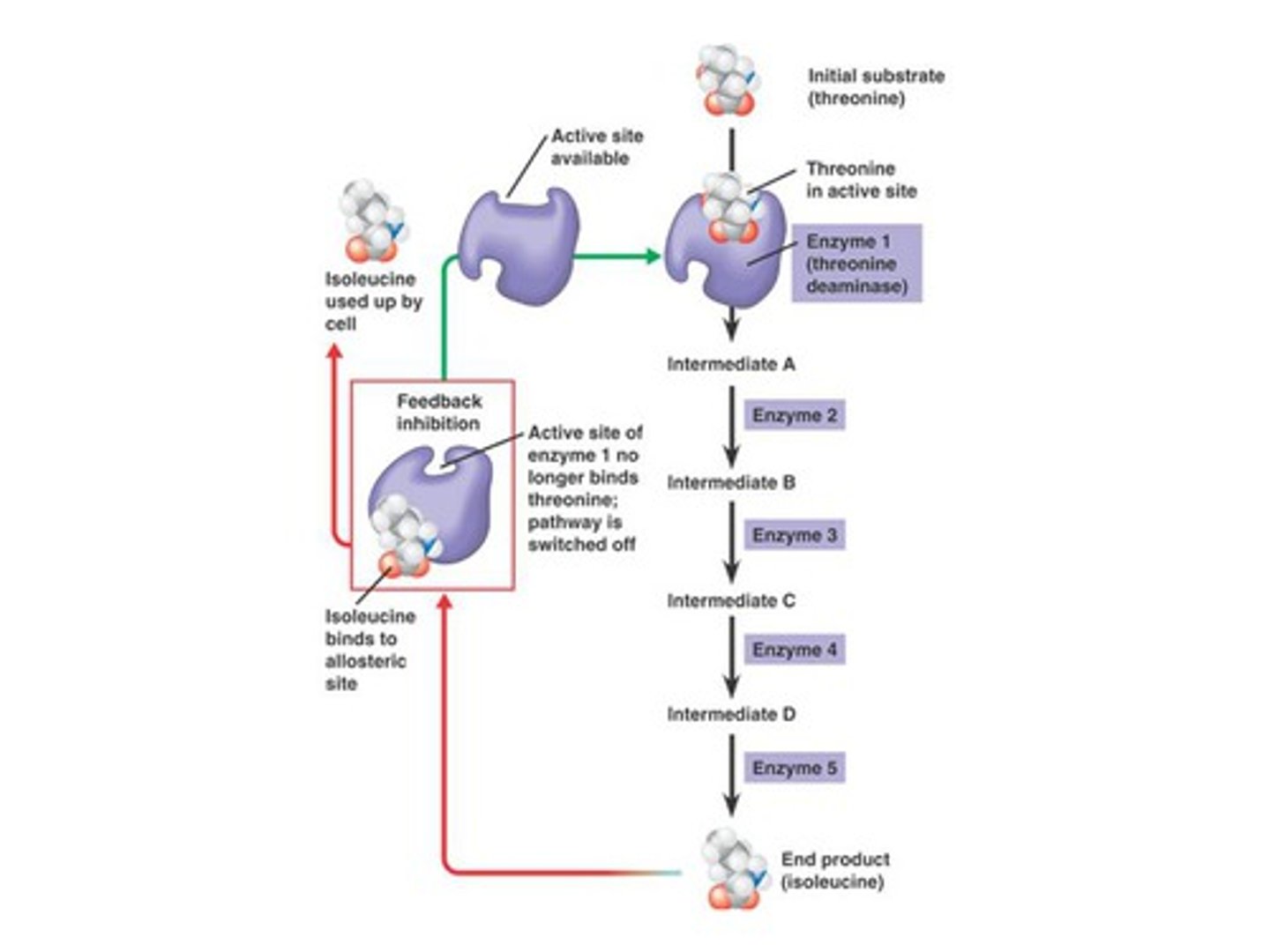
example of feedback inhibition
isoleucine - threonine is converted into isoleucine (end product) by an enzyme, isoleucine then binds to the allosteric site and blocks activity, isoleucine synthesis inhibits further production of isoleucine
Isoleucine
essential amino acid
The rate of an enzyme-catalysed reaction can be calculated and plotted according...
to the time taken for the reaction to proceed
Rate of reaction formula
1 / time taken (s)
enzyme kenetics
In enzyme kinetics, the reaction rate is measured and the effects of varying the conditions of the reaction are investigated.
Both competitive and non competitive inhibitors
effect the kinetics of an enzyme-catalysed reaction,
by reducing the rate of reaction by limiting the amount of uninhibited enzyme available for reaction but in different ways
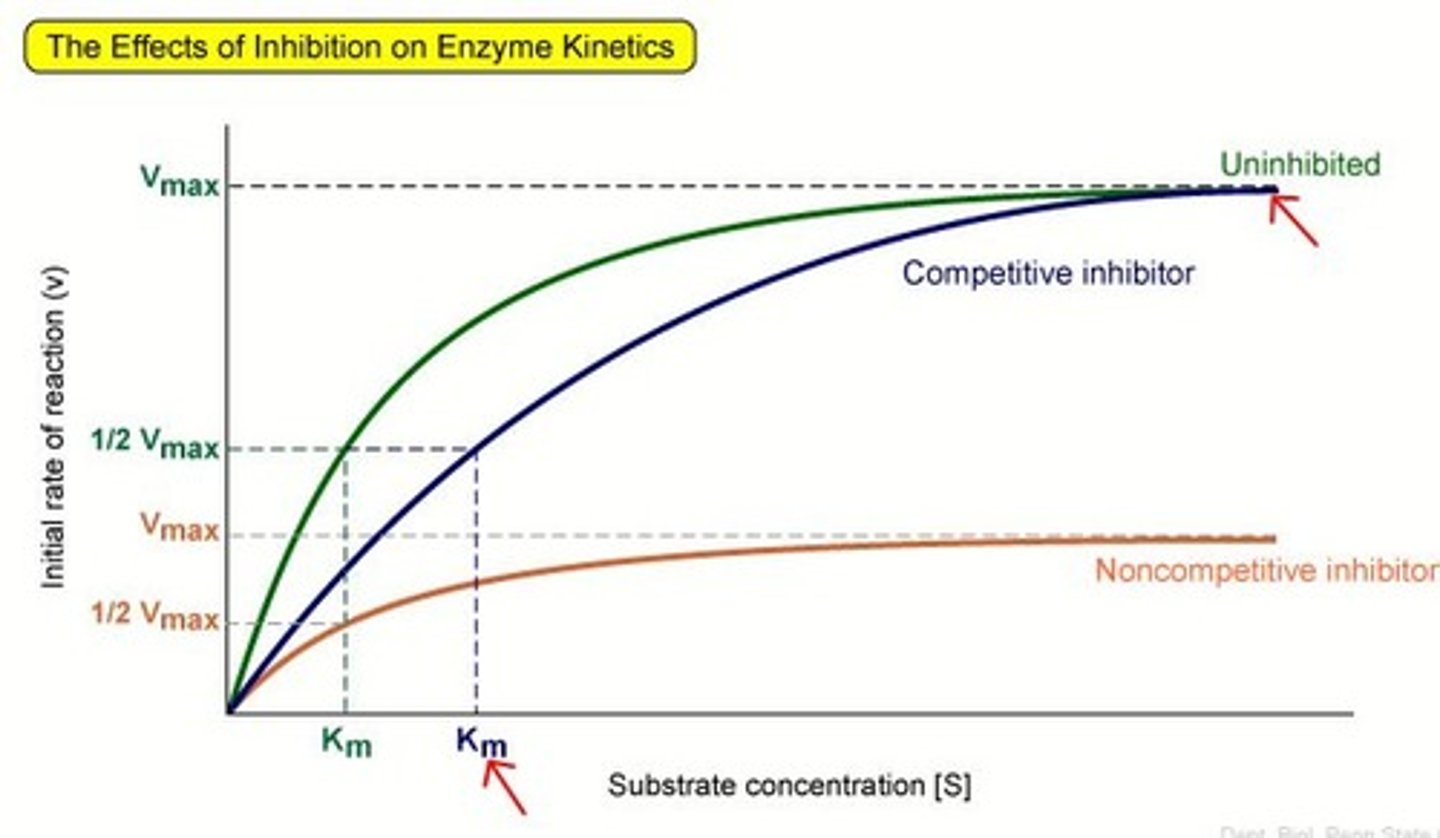
Competitive inhibitors impacting enzyme kenetics/rate of reaction
Bind directly to the active site and hence exist in direct competition with the substrate
Increasing substrate levels will increase the likelihood of the enzyme colliding with the substrate instead of the inhibitor
The maximum rate of enzyme activity (Vmax) can still be achieved, although it requires a higher substrate concentration
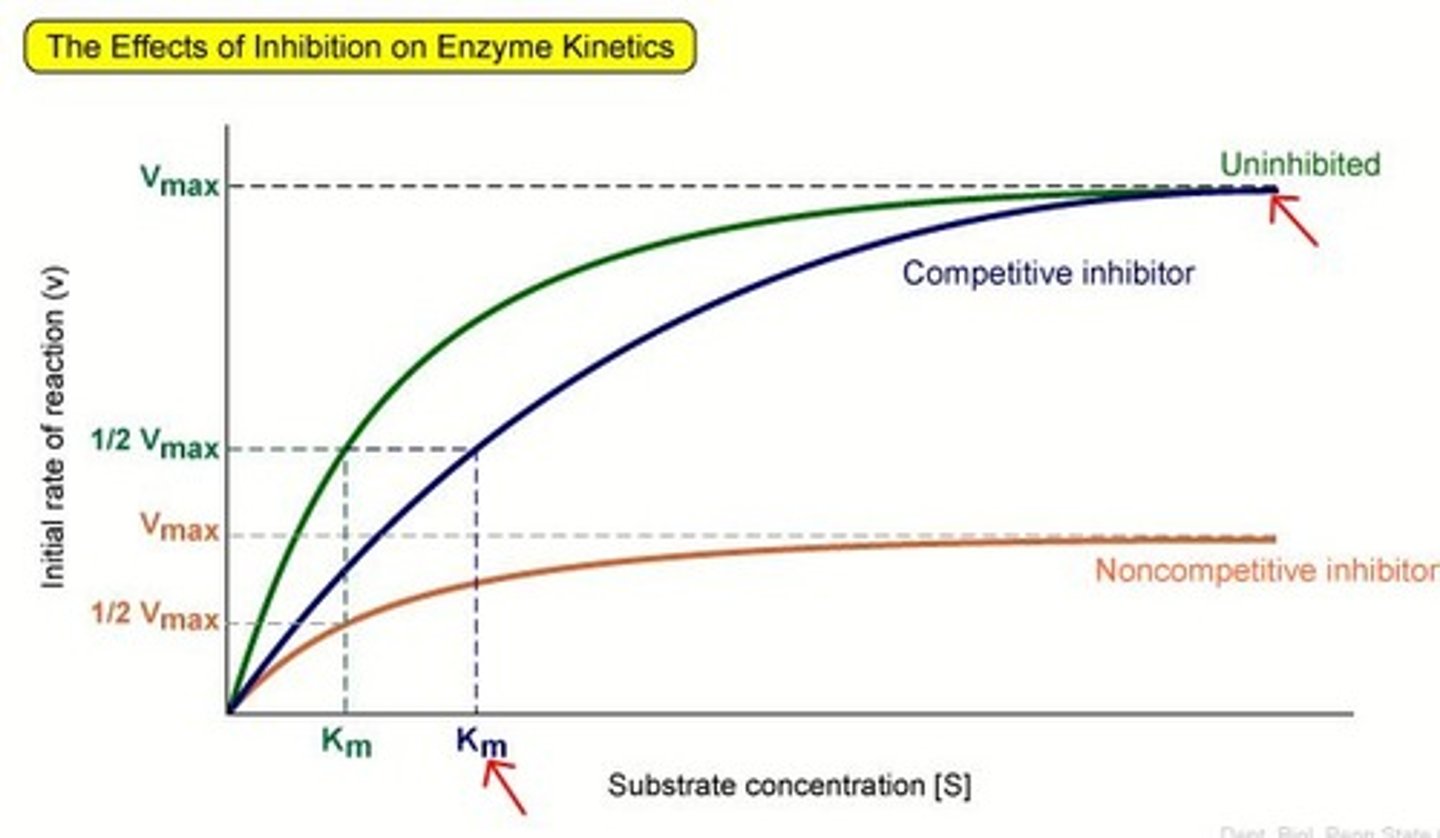
Non-competitive inhibitor impacting enzyme kenetics/rate of reaction
Bind to an allosteric site and hence do not exist in direct competition with the substrate
Increasing substrate concentrations will not effect the level of inhibition caused by the non-competitive inhibitor
The maximum rate of enzyme activity (Vmax) is therefore reduced
how can inhibitors be used to treat pathogenic diseases?
by targeting the enzymes involved
how to find inhibitors for disease causing enzymes?
pathogenic enzymes may be screened against a bioinformatic database to idenitfy inhibitors, new inhibitor compounds can also be made through combinatorial chemistry and computer modelling
Drug treatment of malaria
indentify's inhibitors specific to enzymes involved in the malarial parasite life cycle through both database mining and computer modeling and combinatorial chemistry to find a competetive inhibitor for the enzymes active site
cell respiration
the process by which organisms transform the energy contained in macromolecules into ATP
Phosphorylation of molecules...
makes them less stable
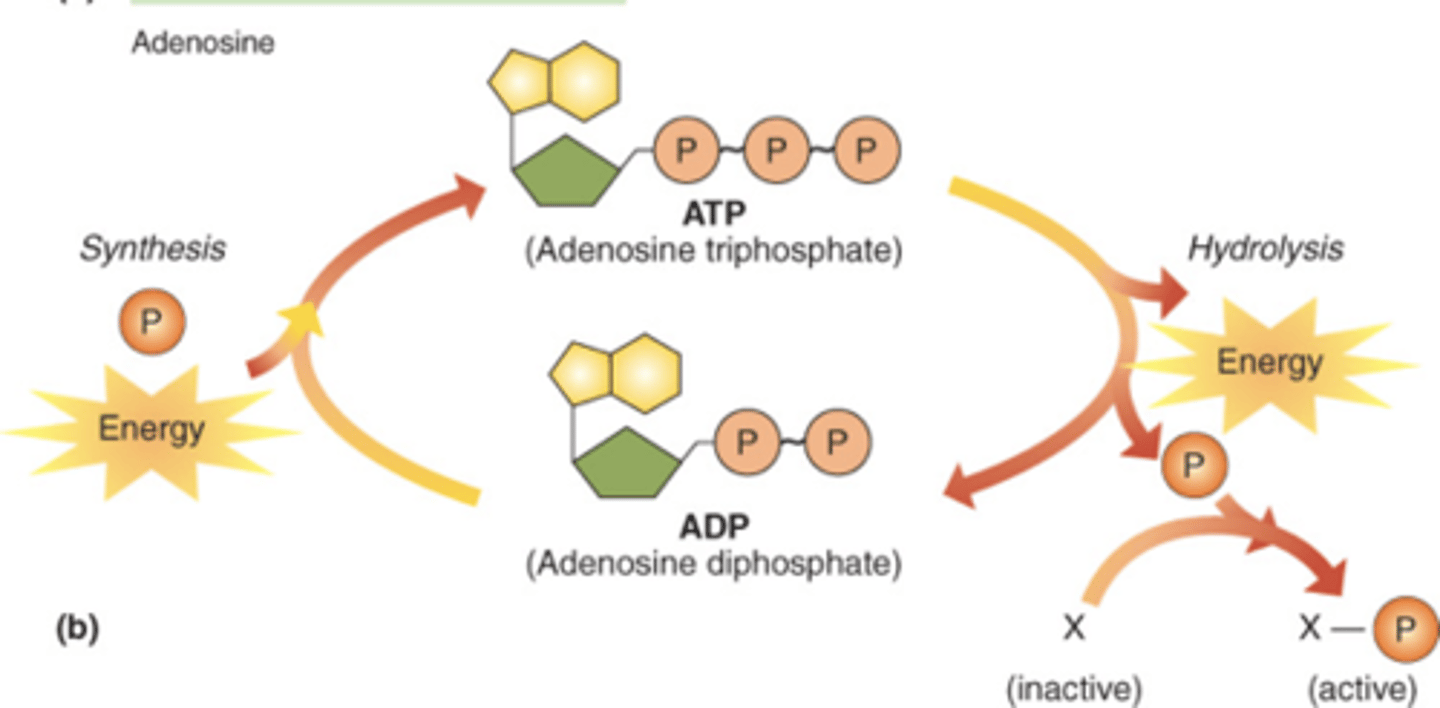
ATP
a high energy molecule that functions as an immediate power source for cells
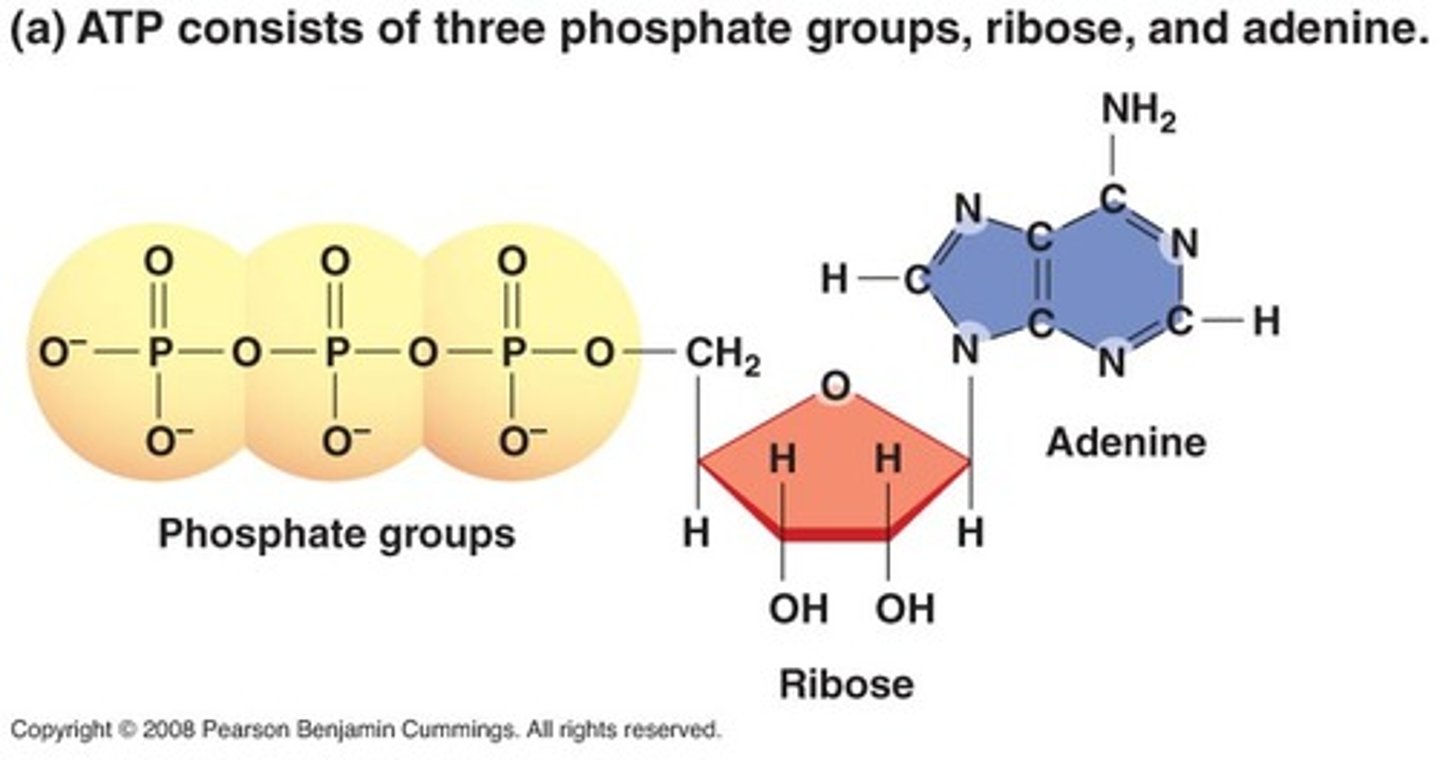
hydrolysis reaction
A chemical reaction that breaks apart a larger molecule by adding a molecule of water
ATP is hydrolysed into
ADP
ADP
a lower-energy molecule that can be converted into ATP by the addition of a phosphate group
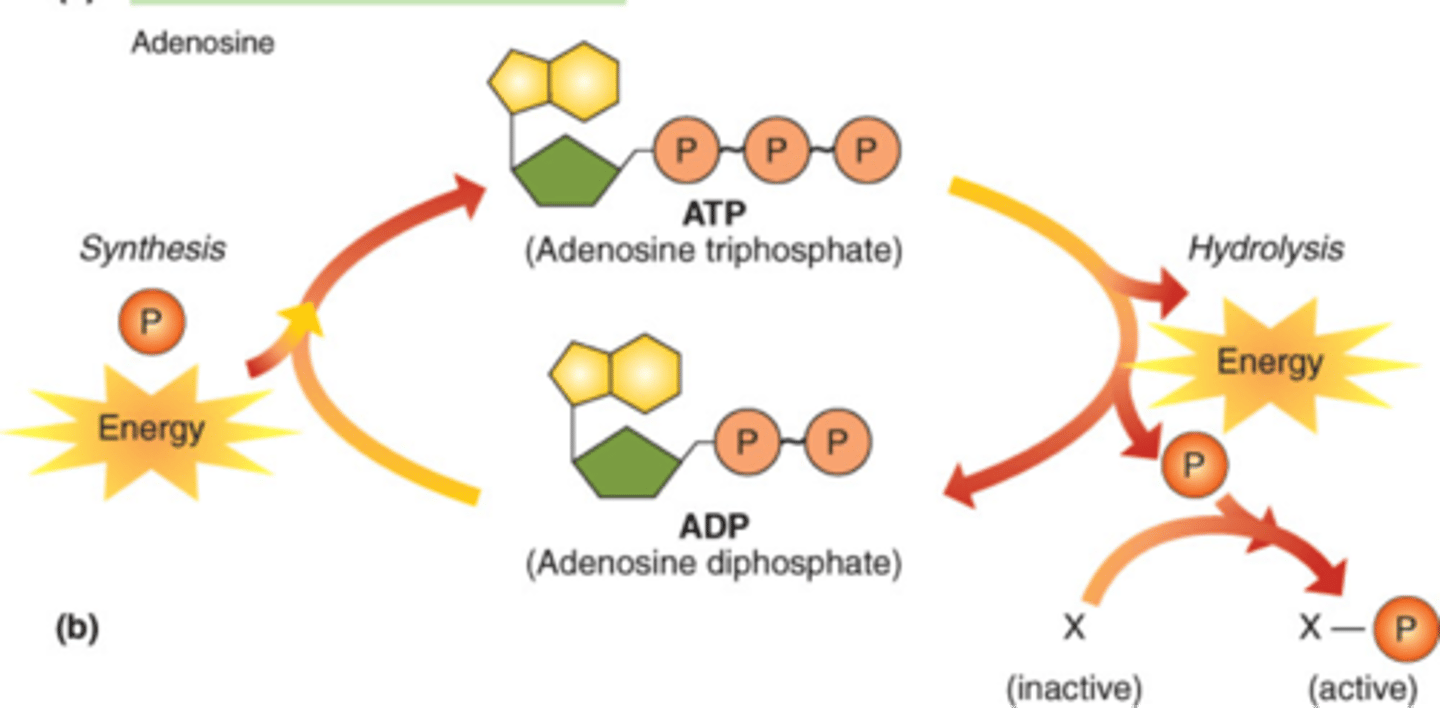
when ATP is hydrolyzed into ADP...
a phosphate group is released and with it energy
anaerobic respiration involves
the incomplete breakdown of organic molecules for a small yield of ATP (no oxygen required)
Aerobic respiration involves
the complete breakdown of organic molecules for a larger yield of ATP (oxygen is required)
The breakdown of organic molecules occurs via
a number of linked processes that involve a number of discrete steps
redox reactions involve
the reduction of one chemical species and the oxidation of another (redox = reduction / oxidation)
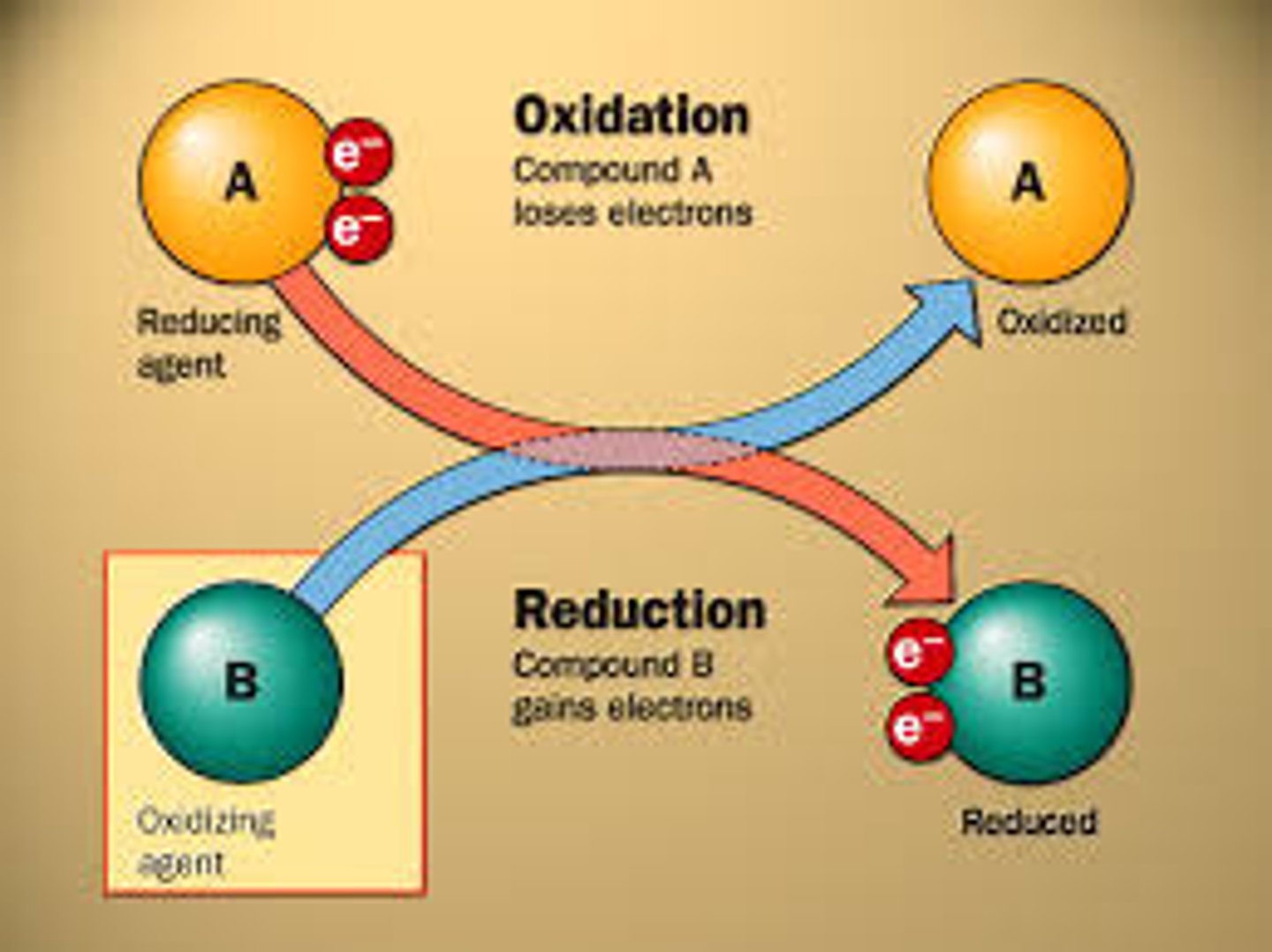
Most redox reactions typically involve the transfer of
electrons, hydrogen or oxygen
Reduction is gain of
electrons / hydrogen or the loss of oxygen
Oxidation is the loss of
electrons / hydrogen or the gain of oxygen
OIL RIG
Oxidation is loss of electrons
Reduction is gain of electrons
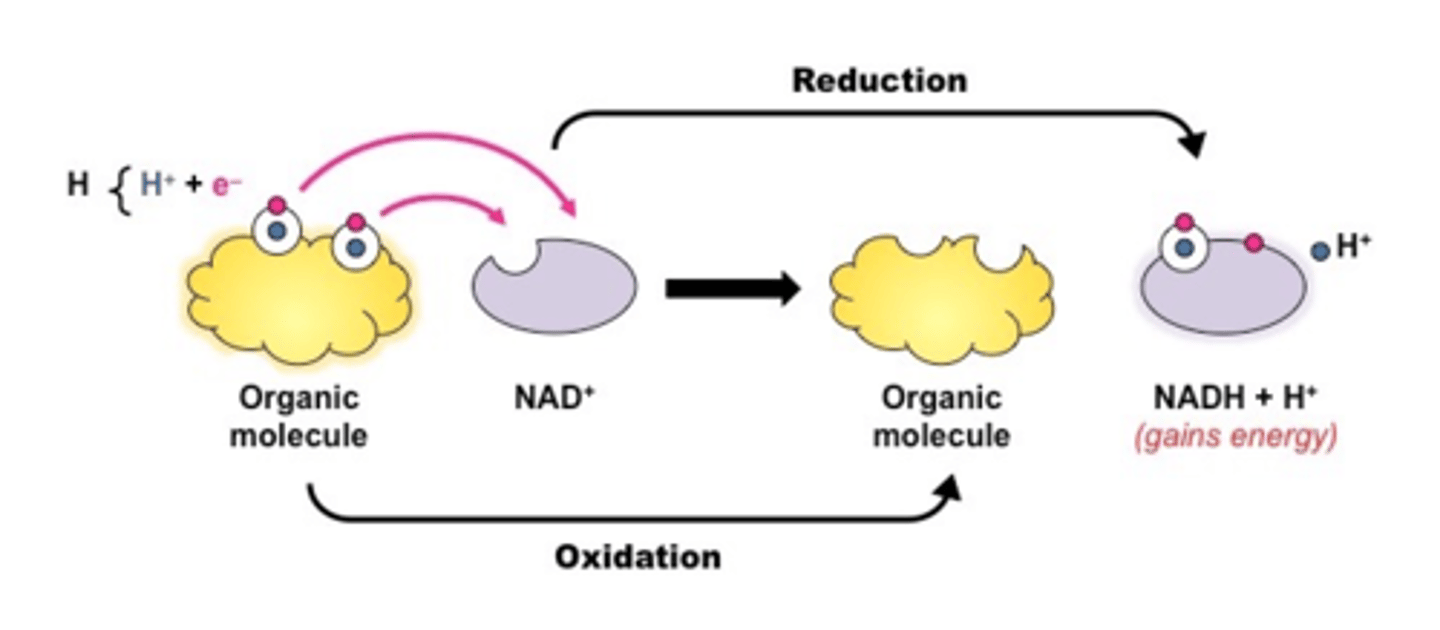
Energy released by oxidation reactions is carried to the
cristae of the mitochondria
Energy released by oxidation reactions is carried to the cristae of the mitochondria by...
reduced NAD and FAD (which is) NADH and FADH2, as they have gained electrons and protons
Cell respiration breaks down organic molecules and transfers hydrogen atoms and electrons to carrier molecules, what short of reaction is this?
As the organic molecule is losing hydrogen atoms and electrons, this is an oxidation reaction
hydrogen carriers
reduced NAD and FAD
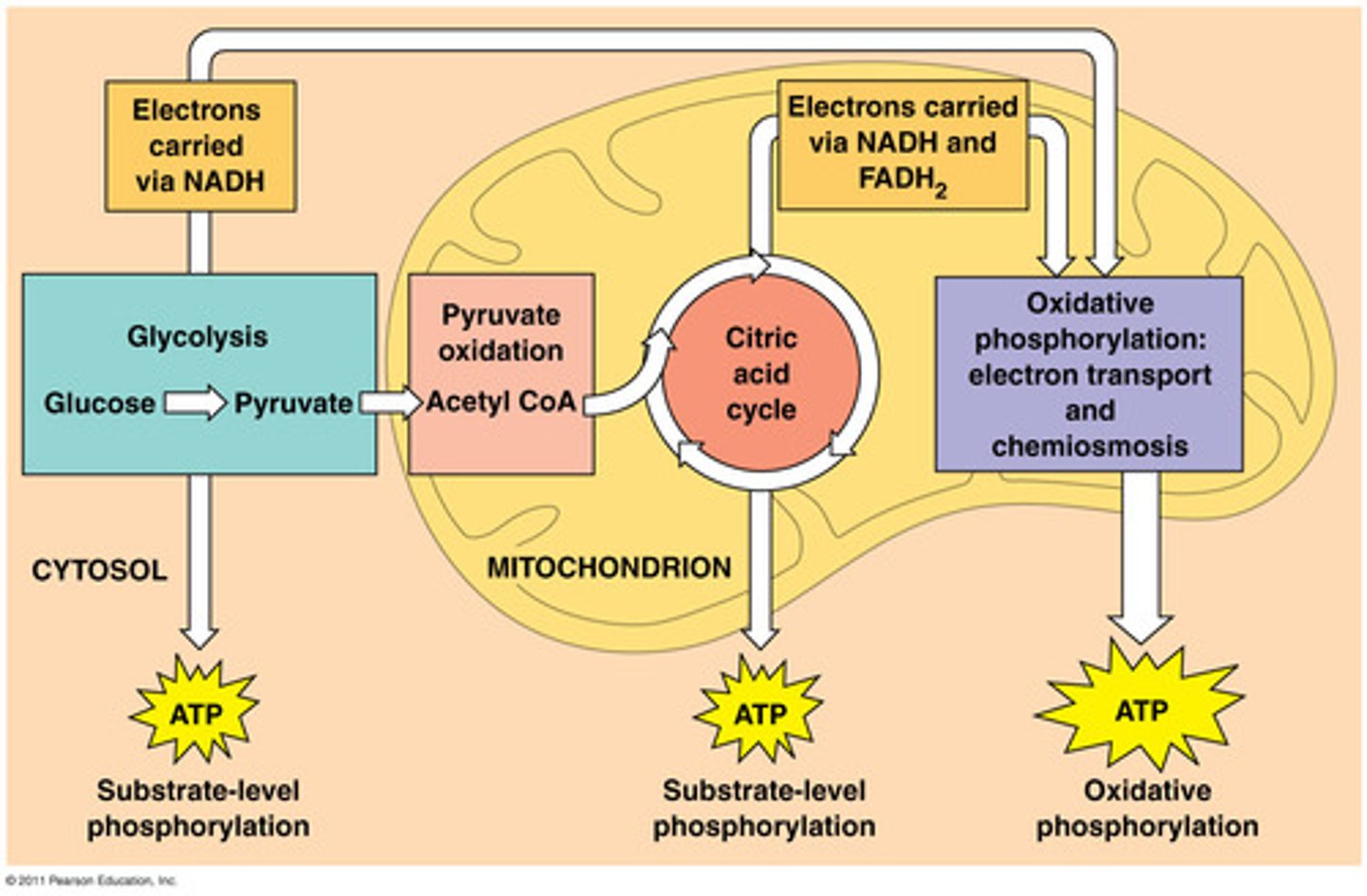
aerobic respiration (and steps)
yields much higher levels of ATP then anaerobic and is the link reaction, krebs cycle, and the electron transport chain
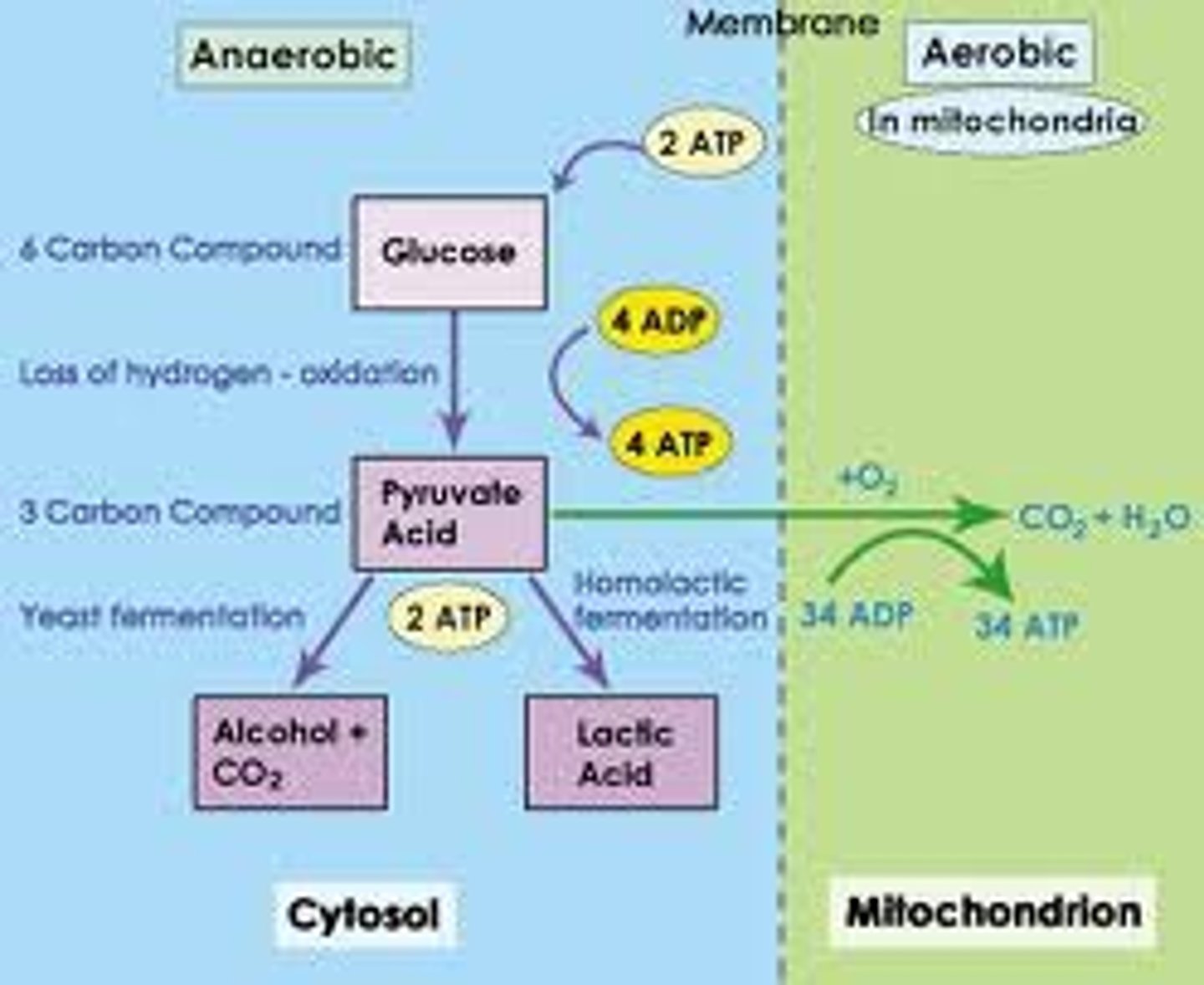
anaerobic respiration
Respiration that does not require oxygen, just glycolysis (but if no oxygen then fermentation too)
Where does glycolysis occur?
cytosol
Where does the link reaction occur?
cytosol -> mitochondiral matrix
Where does the Krebs cycle occur?
mitochondrial matrix
Where does the electron transport chain take place?
mitochondiral cristae
how much atp does aerobic respiration generate?
36 ATP
How much ATP does anaerobic respiration (glycolysis) produce?
2 ATP
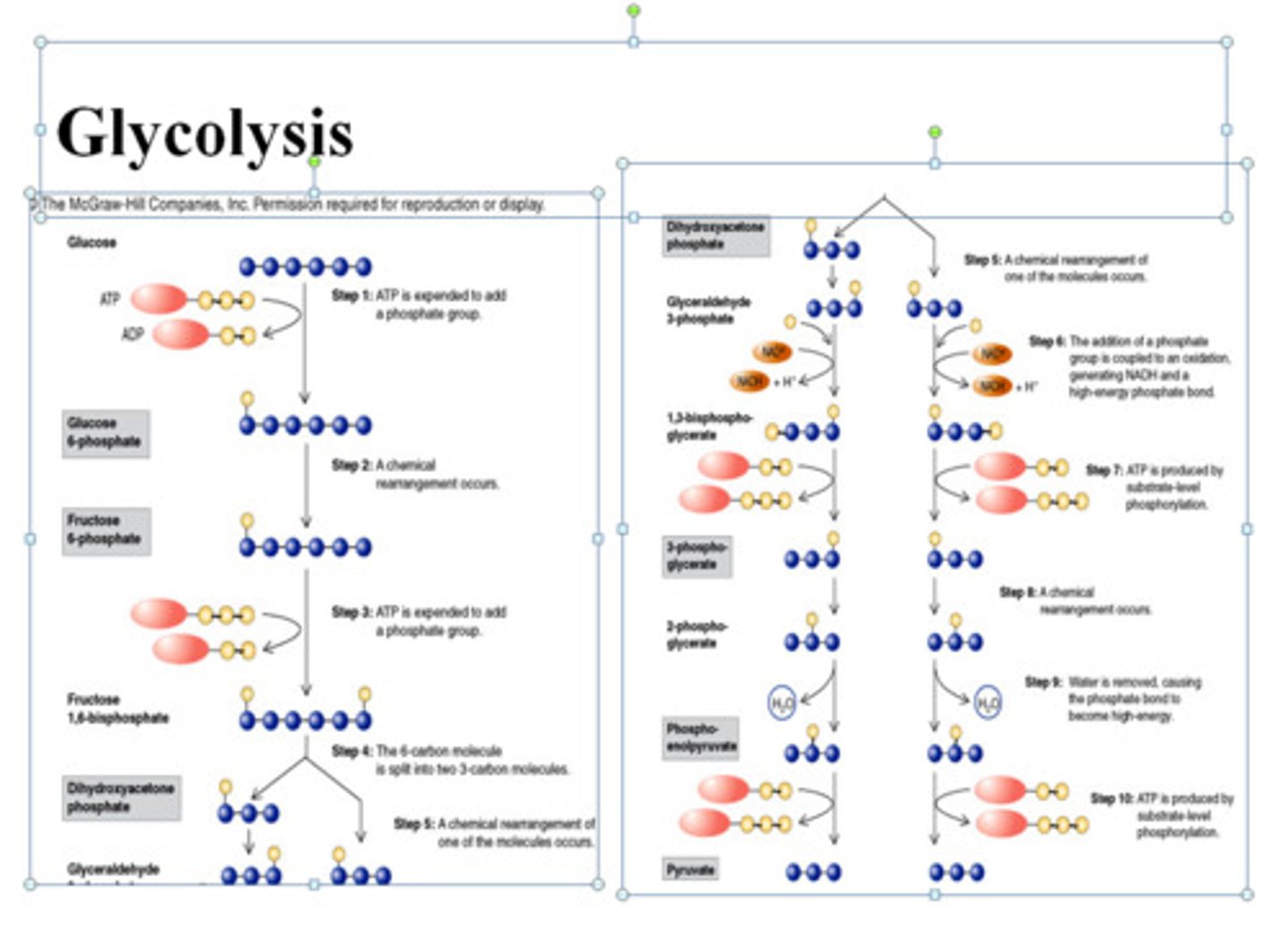
Steps of Glycolysis
phosphorylation, lysis, oxidation, ATP formation
What is glycolysis?
the breakdown of glucose (anaerobically into two pyruvate)
Phosphorylation in glycolysis
- Glucose is phosphorylated by two molecules of ATP to become hexose biphosphate (6 carbon sugar)
- Phosphorylation of molecules makes them less stable and thus more reactive
Lysis in glycolysis
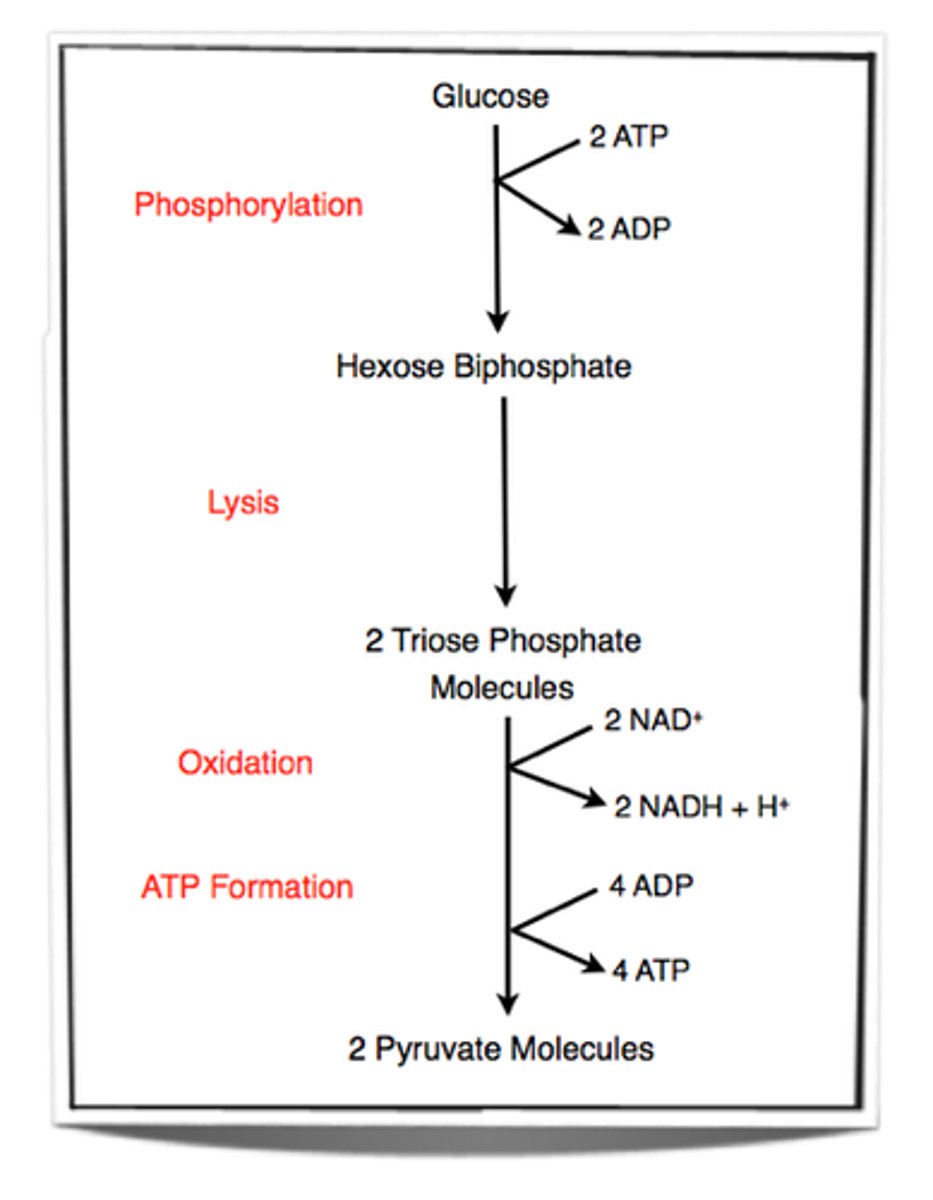
- the hexose biphosphate (6 carbon sugar) splits into two triose phosphates (2 x 3 carbon sugars)
Oxidation in glycolysis
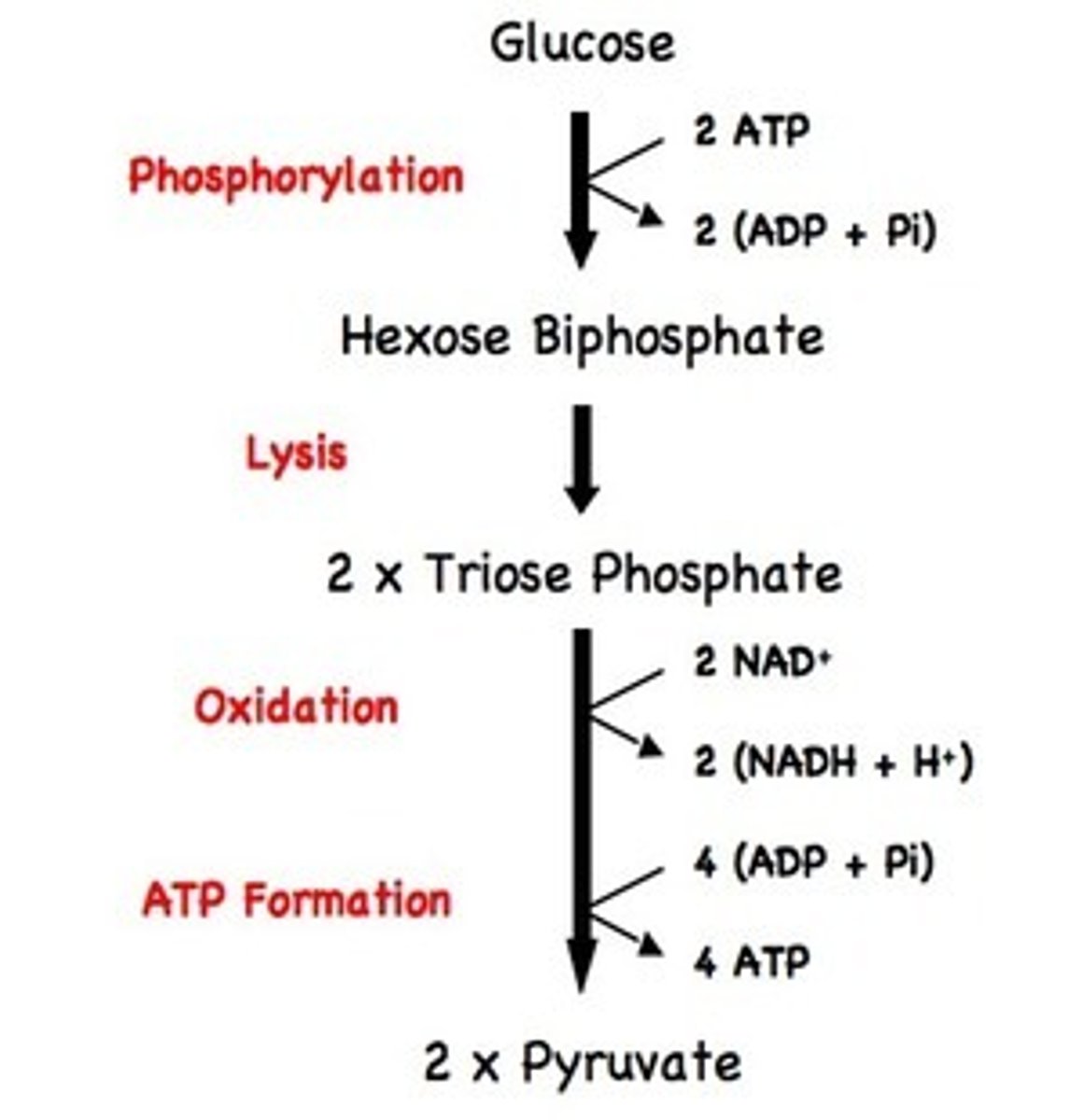
- Hydrogen removed from the triose phosphate via oxidation (NAD+ is reduced to NADH and H+)
- Two NADH are produced (one per 3C sugar)
ATP formation in glycolysis
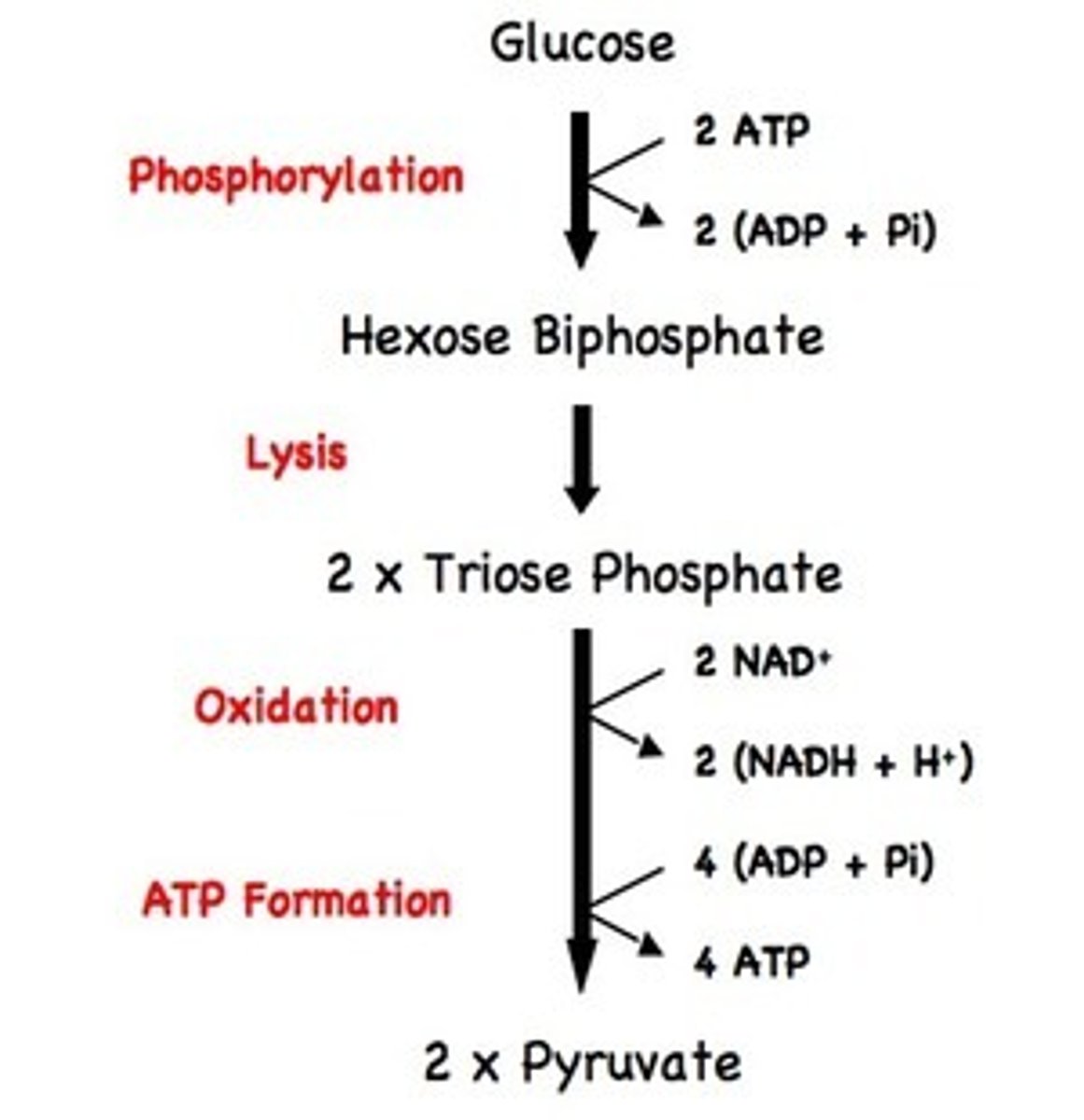
- Some of the energy released from the sugar intermediates is used to directly synthesise ATP
- Four ATP molecules are released as the triose phosphates are converted into pyruvate
(but 2 ATP get used so net is 4)
Overall products of glycolysis
2 pyruvate, 2 NADH, 2ATP
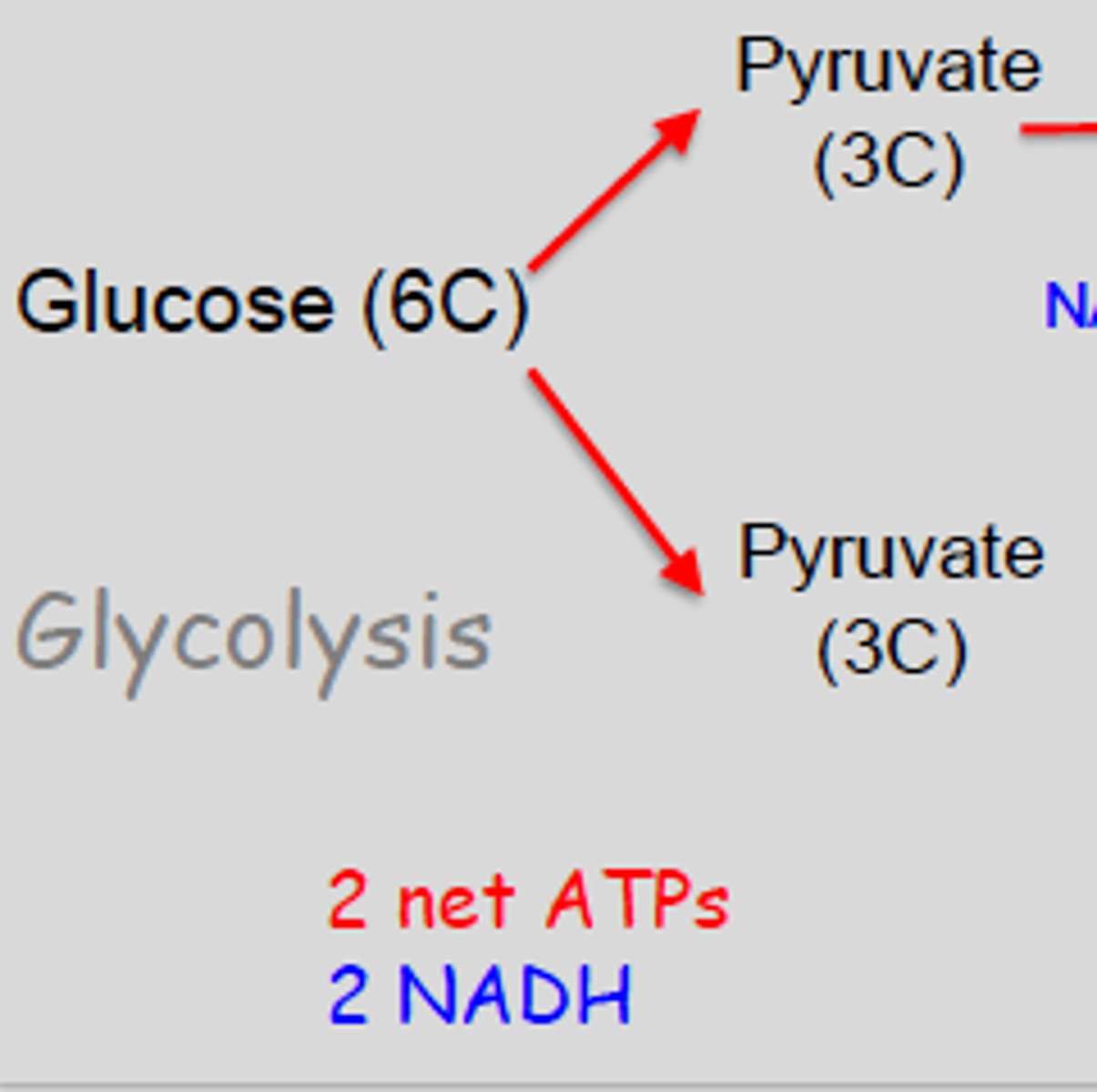
Glycolysis gives a small net gain of ATP without the use of
oxygen
Where can pyruvate go after glycosis?
Depending on the availability of oxygen, the pyruvate may be subjected to one of two alternative processes:
Aerobic respiration occurs in the presence of oxygen and results in the further production of ATP (~ 34 molecules)
Anaerobic respiration (fermentation) occurs in the absence of oxygen and no further ATP is produced
Fermentation
Process by which cells release energy in the absence of oxygen
Steps of Fermentation
- The pyruvate remains in the cytosol and is converted into lactic acid (animals) or ethanol and CO2 (plants and yeast)
- In the absence of oxygen, glycolysis will quickly deplete available stocks of NAD+, preventing further glycolysis
- Fermentation of pyruvate involves a reduction reaction that oxidises NADH (made from glycolysis) into NAD+ which in turn produces ATP and resorts NAD+ stocks so glycolysis alone can keep making 2 ATPS
- Hence, anaerobic respiration allows small amounts of ATP to be produced (via glycolysis) in the absence of oxygen
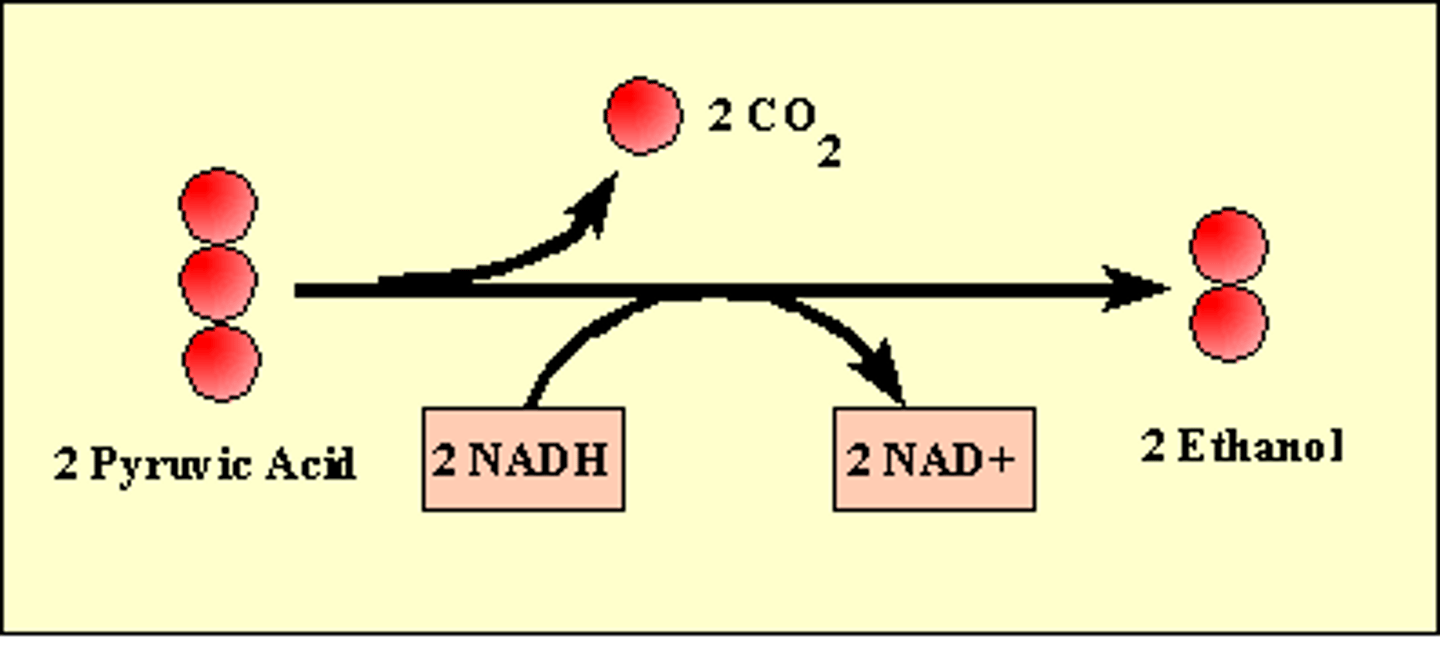
what is made via fermentation in plants
ethanol and CO2
what is made via fermentation in animals
lactic acid
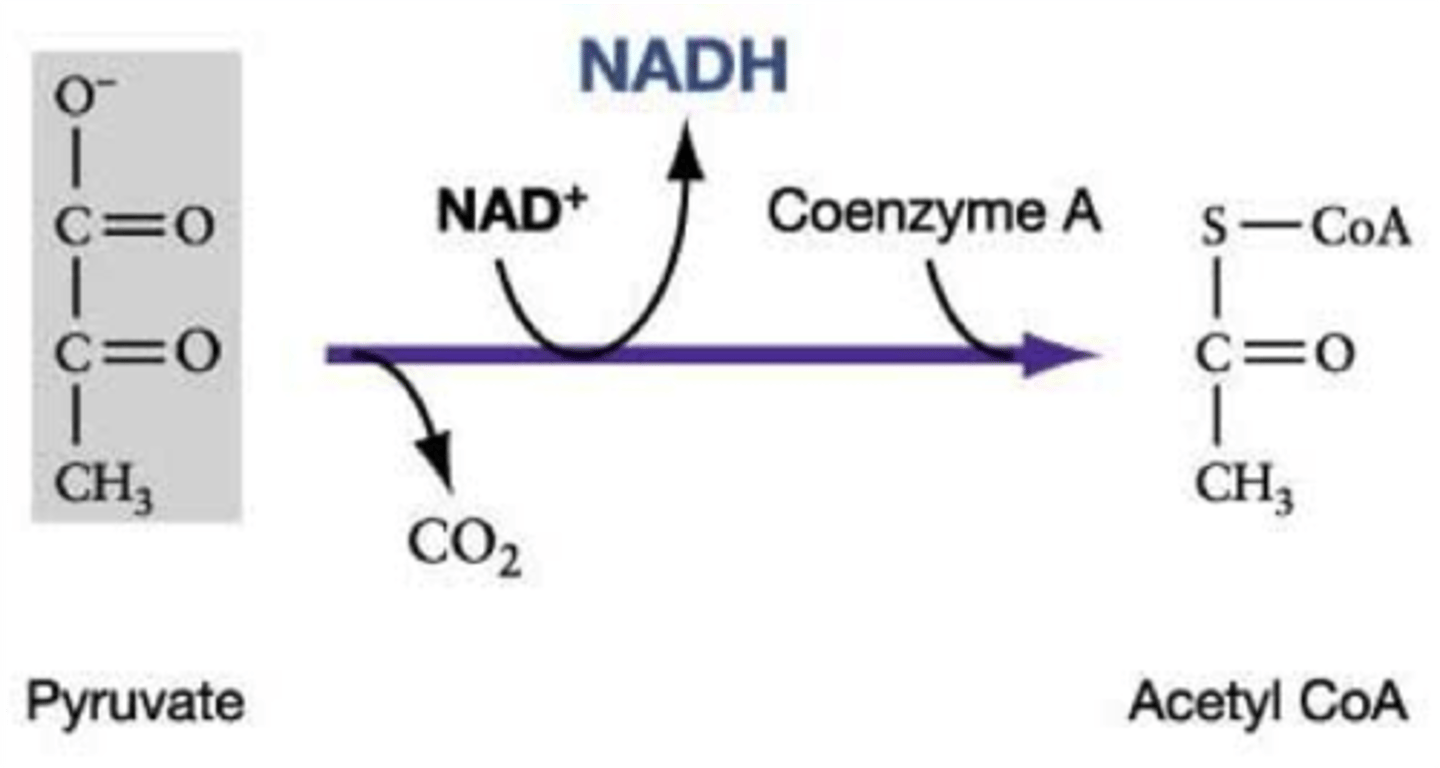
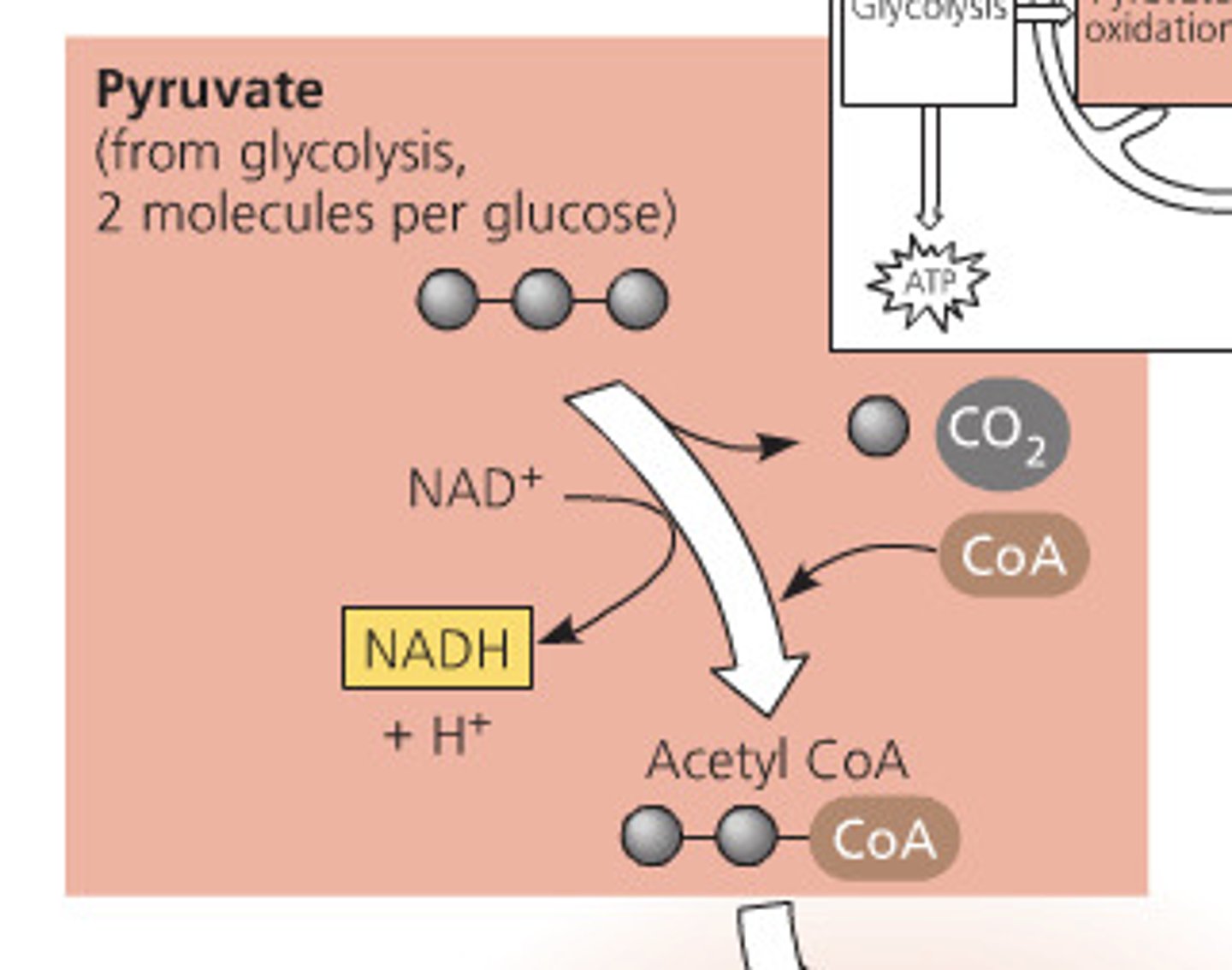
Link Reaction
functions to connect the anaerobic process of glycolysis to the aerobic activities of the mitochondria - hence linking
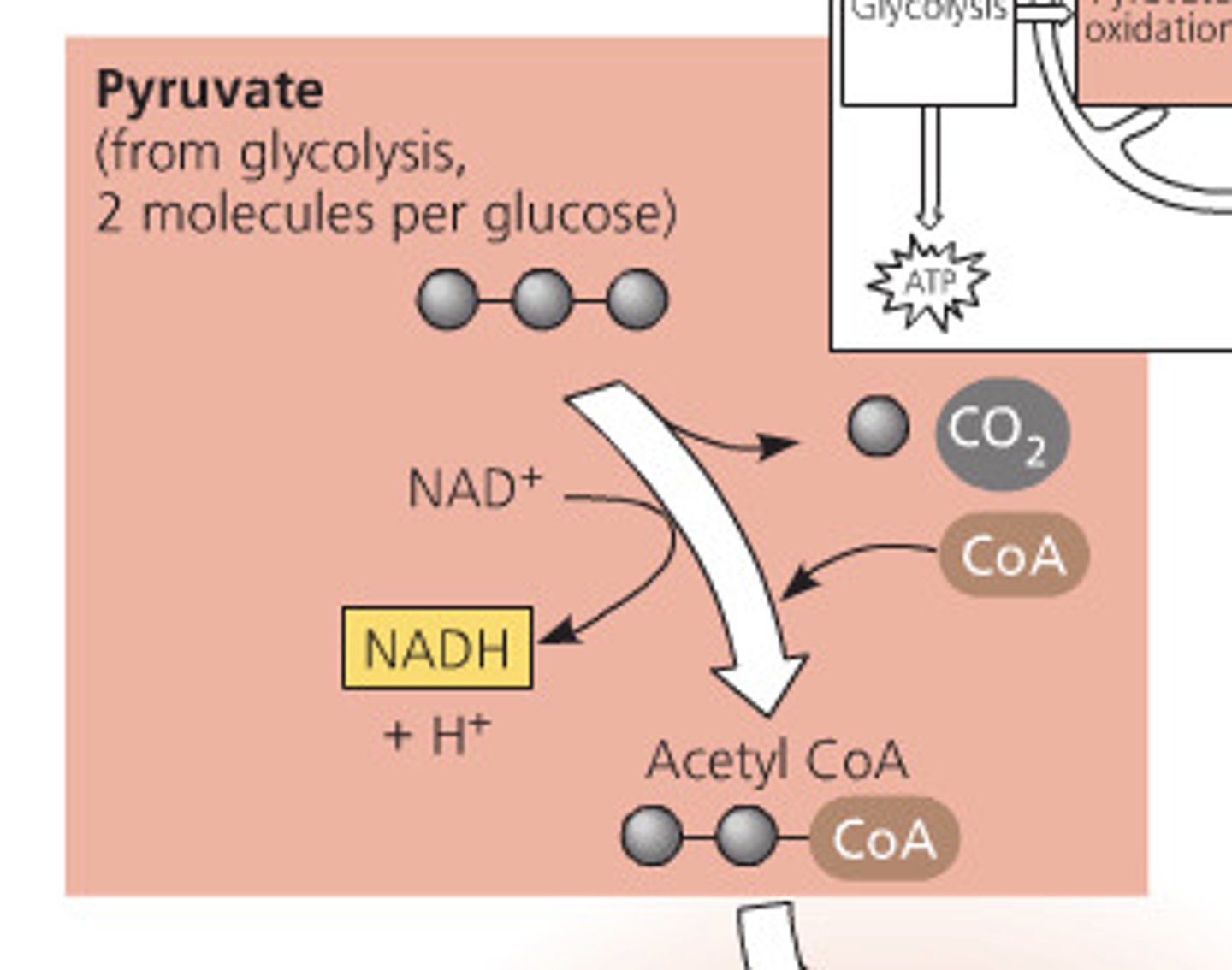
Link Reaction steps
- Pyruvate from glycolysis is transported from cytosol to mitochondrial matrix
- Pyruvate is decarboxylated (CO2 is produced) to form an acetyl compound that is then attached to coenzyme A / makes acetyl CoA
- Pyruvate is also oxidized to produce one reduced hydrogen carrier (NADH) -happens to both pyruvates as 2 separate processes
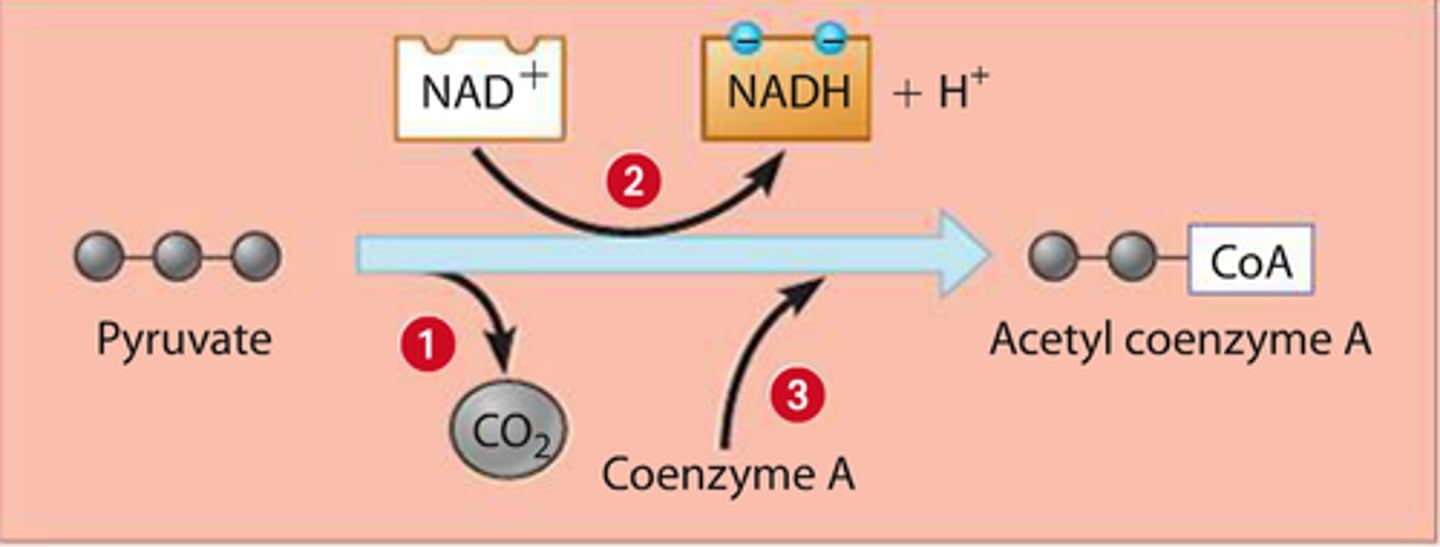
Products of Link Reaction
2x Acetyl coenzyme A
2x CO2
2x NADH
- 1 for each pyruvate
The Krebs Cycle
a series of oxidation reactions that occur within the mitochondrial matrix
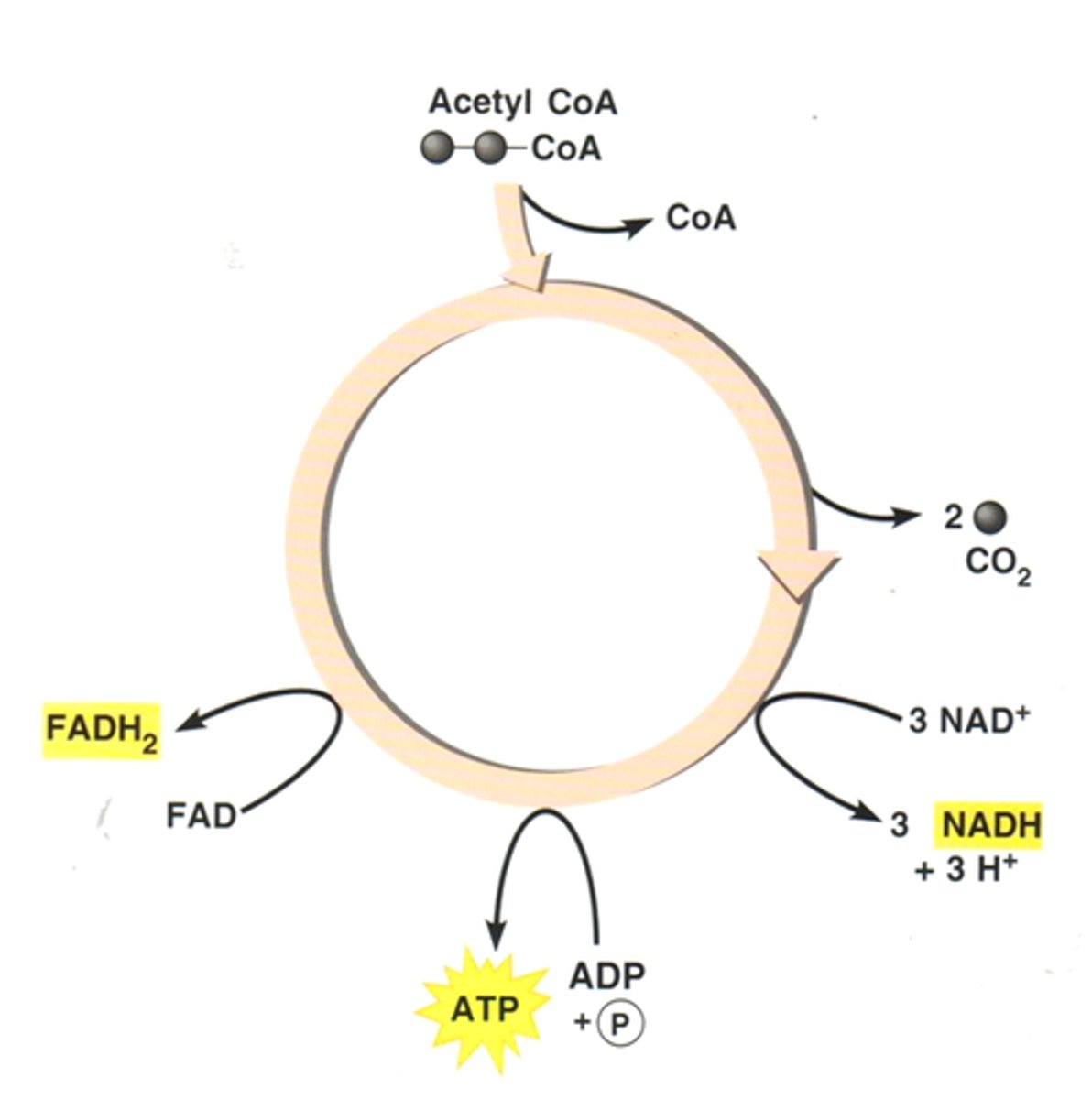
Krebs Cycle steps
- Acetyl CoA combines with a 4C compound to form a 6C compound
- Via oxidation / decarboxylation reactions, the original 4C compound is reformed (meaning NADH and FADH2 are formed)
- These reactions result in the formation of carbon dioxide and multiple hydrogen carriers
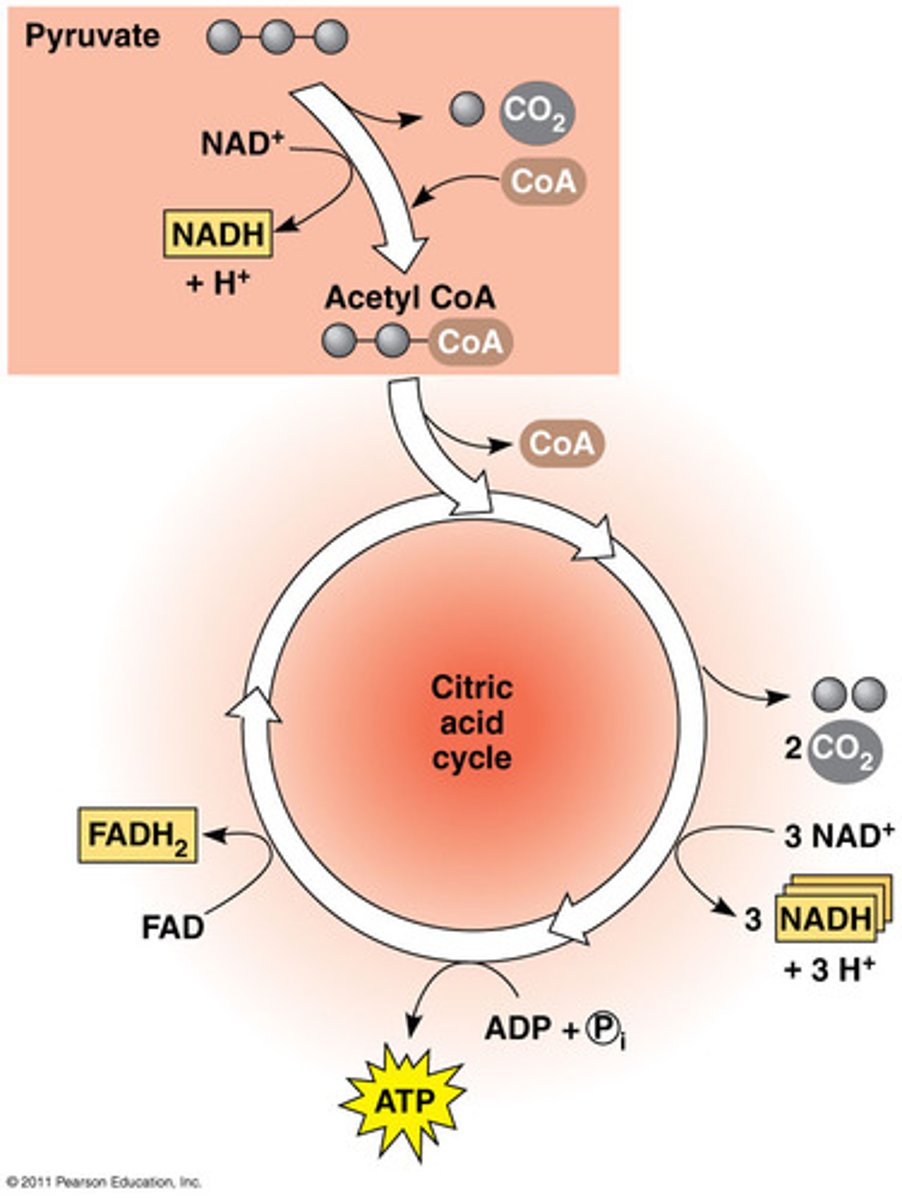
Products of Krebs Cycle (in a single cycle)
2 x CO2
ATP
3x NADH
FADH2
but the krebs cycle generally cycles through twice
how does it go from 6C to 4C in the krebs cycle
carbon dioxide is lost in through the decarboxylation of the 1st two NAD+s
electron transport chain
utilizes chemiosmosis to synthesize ATP via oxidative phosphorylation
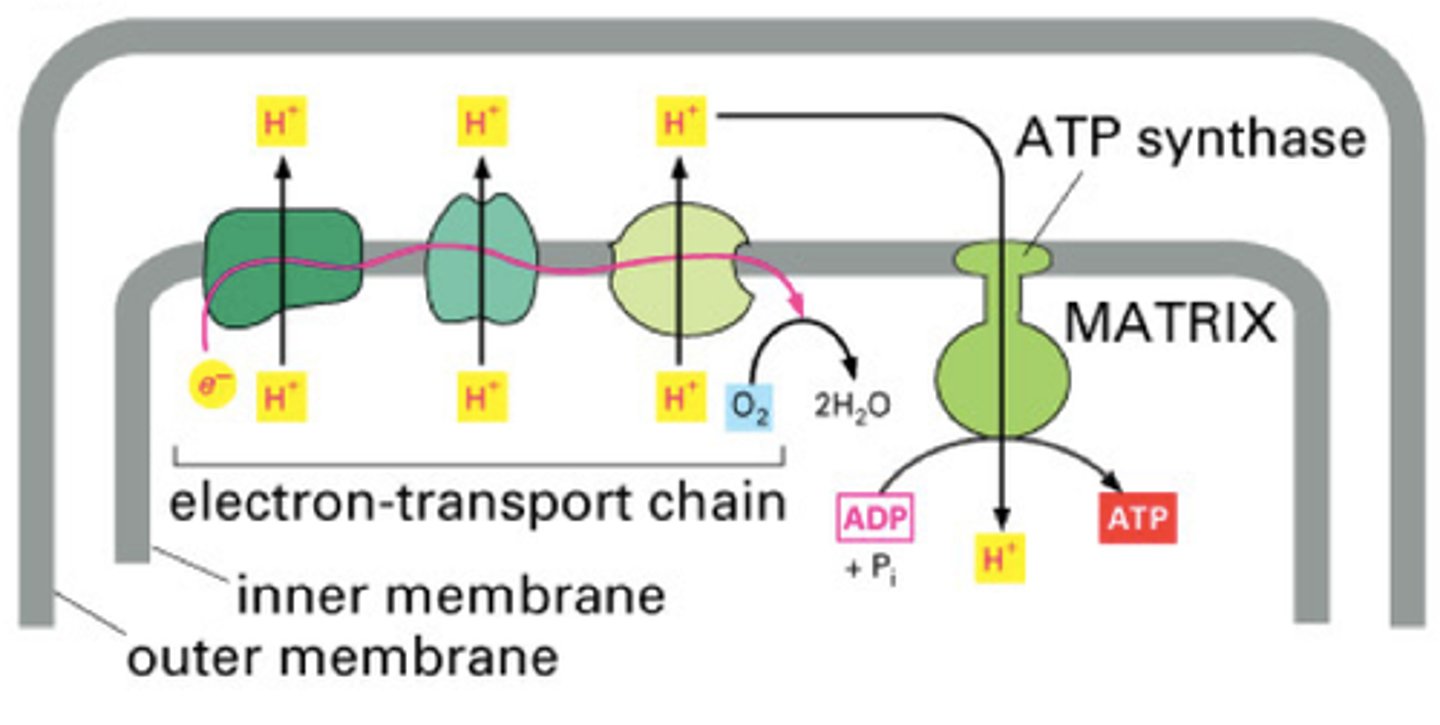
4 steps of the electron transport chain
proton motive force
ATP synthesis via chemiosmosis
reduction of oxygen
oxidative phosphorylation
Steps in the electron chain process
- reduced carriers (NADH and FADH2) are continuously oxidized, this energy is used to make ATP (via oxidative phosphorylation)
- 32 ATP molecules are made from the reduced carriers
Chemiosmosis
A process for synthesizing ATP using the energy of an electrochemical gradient and the ATP synthase enzyme
oxidative phosphorylation
The production of ATP using energy derived from the redox reactions of an electron transport chain
- Proton pumps create an electrochemical gradient (proton motive force)
- ATP synthase uses the subsequent diffusion of protons (chemiosmosis) to synthesise ATP
- Oxygen accepts electrons and protons to form water
The basics of the electron transport chain
A sequence of electron carrier molecules (membrane proteins) that shuttle electrons during the redox reactions that release energy used to make ATP.
how many CO2 produced overall from cell respiration
6CO2
aerobic respiration overview
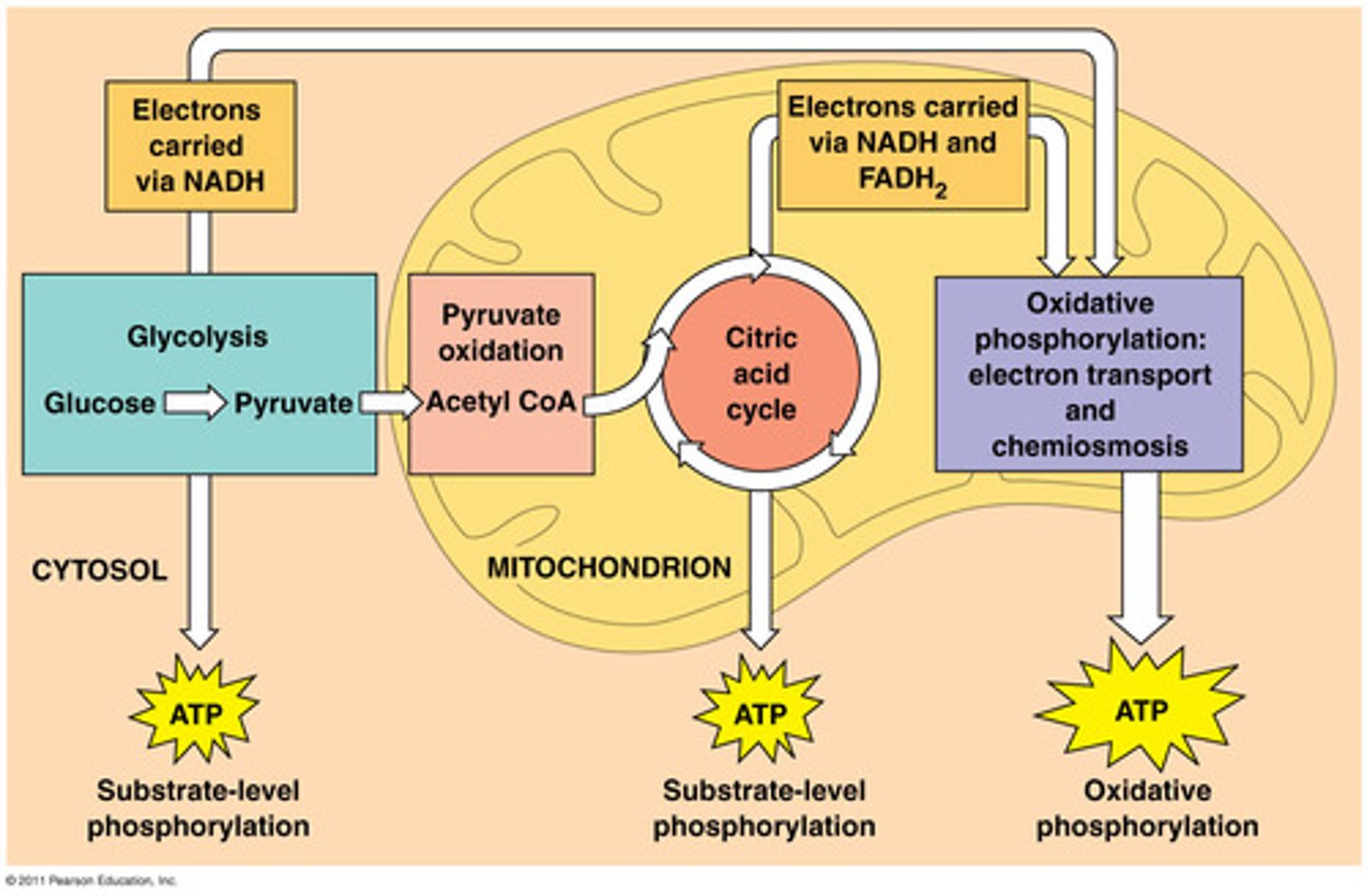
how many NADH are produced through aerobic respiration before ETC
10
how many FADH2 are produced through aerobic respiration before ETC
2 (from krebs cycle)
Where do all of the NADH and FADH2 shuttle busses take their high energy hydrogens?
Electron Transport Chain
Inputs of ETC
10 NADH, 2 FADH2, 6 O2
products of ETC
32 ATP and 6 H20
proton pumping
produces an electrochemical proton gradient across the inner mitochondrial membrane
Decarboxylation creates what
carbon dioxide
oxidation creates what
NADH and FADH2 - hydrogen carriers
phosphorylation creates what
ATP