Exam 1 Combined
 Call Kai
 Learn
Learn Practice Test
 Spaced Repetition
 Match
Match Flashcards
 Knowt Play
1/974

There's no tags or description
Looks like no tags are added yet.
Name | Mastery | Learn | Test | Matching | Spaced | Call with Kai | Chat |
|---|
No analytics yet
Send a link to your students to track their progress
975 Terms
Current fructose consumption estimate
About 35–73 g/day, found in sucrose, high fructose corn syrup, fruits, and honey.
Fructose and protein glycation
Fructose is 8-10 times more reactive than glucose at glycating proteins.
Location of fructose metabolism
The liver is where fructose is mostly metabolized.
Fructokinase reaction
Fructose+ATP→Fructose-1-phosphate+ADP
Aldolase B
Splits fructose-1-phosphate into dihydroxyacetone phosphate (DHAP) and glyceraldehyde; also cleaves fructose-1,6-bisphosphate in glycolysis.
Glyceraldehyde kinase
Uses ATP to convert glyceraldehyde → glyceraldehyde-3-phosphate, feeding it into glycolysis.
Fructose entry point in glycolysis
Enters after the PFK-1 step, bypassing that regulatory checkpoint.
Tarui disease (Muscle PFK-1 deficiency)
Presents with easy fatigue, muscle weakness/stiffness with exercise, no rise in blood lactate during exercise, and symptoms improve after eating fructose.
Fructose benefit in PFK-1 deficiency
Fructose bypasses the defective PFK-1 step and can still enter glycolysis further downstream, giving muscle an alternate energy source.
Essential fructosuria
Benign condition from fructokinase deficiency; fructose is simply excreted since it's never phosphorylated.
Hereditary fructose intolerance (HFI)
Serious condition from aldolase B deficiency; fructose-1-phosphate accumulates and becomes toxic.
Consequences of fructose-1-phosphate buildup in HFI
Sequesters inorganic phosphate (Pi), blocking glycogen breakdown, gluconeogenesis, and oxidative phosphorylation.
Fructose/sorbitol IV infusion clinical lesson
A patient with unrecognized HFI given IV fructose/sorbitol developed severe hypoglycemia, liver failure, and died -- fructose infusions are dangerous in undiagnosed HFI.
Estimated daily galactose consumption
About 1–3 g/day, found primarily in dairy products.
Galactitol
A sugar alcohol converted from galactose via aldose reductase (using NADPH).
Galactokinase
Phosphorylates galactose to galactose-1-phosphate using ATP.
Gal-1-P uridylyl transferase (GALT)
Converts galactose-1-phosphate + UDP-glucose into UDP-galactose + glucose-1-phosphate.
Epimerase (galactose metabolism)
Interconverts UDP-galactose and UDP-glucose.
Phosphoglucomutase (galactose pathway)
Converts glucose-1-phosphate to glucose-6-phosphate, feeding into glycolysis.
Galactose activation requirement
Further processing requires activated glucose in the form of a sugar-nucleotide (UDP-glucose).
UDP-galactose biosynthetic uses
Combines with glucose to form lactose, and is used to build glycoproteins and glycolipids.
Galactokinase deficiency
Causes minor problems, mainly cataracts, from galactitol accumulation.
GALT deficiency
Causes classic galactosemia -- a serious disease.
Epimerase deficiency (galactose pathway)
A rare cause of galactosemia.
Newborn screening for galactosemia
Legally mandated in every U.S. state.
Dietary galactose requirement
Some galactose intake is still needed to glycosylate proteins and lipids, even though UDP-galactose can come from UDP-glucose via epimerase.
Annual U.S. deaths from alcohol (CDC)
More than 140,000 deaths per year, including about 2,200 from acute alcohol poisoning.
Economic cost of alcohol in the U.S. (2010 estimate)
About $249 billion, or roughly $800 per person / $2.05 per drink.
Effects at BAC ~50 mg/dL
Warmth, flushing, loss of emotional restraint at 50 mg/dL BAC.
Effects at BAC ~100 mg/dL
Loss of fine motor skills, emotional instability at 100 mg/dL BAC.
Effects at BAC ~300 mg/dL
Stuporous but arousable; death possible at 300 mg/dL BAC.
Effects at BAC ~400-500 mg/dL
Comatose; death likely at 400–500 mg/dL BAC.
Alcohol absorption mechanism
Directly, with no receptors or transporters -- about 80% in the intestine, 20% in the stomach.
Food effect on alcohol absorption
Eating, especially fatty foods, slows gastric emptying and thus slows alcohol absorption.
Neurotransmitter effects of alcohol
Increases dopamine and serotonin release; enhances GABA (sedative) activity while glutamate (excitatory) stays elevated.
Step 1 of alcohol metabolism
Alcohol dehydrogenase (ADH) oxidizes ethanol to acetaldehyde, reducing NAD+ to NADH.
Step 2 of alcohol metabolism
Aldehyde dehydrogenase 2 (ALDH2) oxidizes acetaldehyde to acetate, generating more NADH.
Step 3 of alcohol metabolism
Acetyl-CoA synthetase converts acetate + ATP + CoA into acetyl-CoA, AMP, and pyrophosphate.
Disulfiram (Antabuse) mechanism
Inhibits ALDH2, letting acetaldehyde accumulate and cause unpleasant symptoms after drinking.
ADH1B*2 variant
An altered ADH allele common in Asian populations that metabolizes ethanol to acetaldehyde much faster than normal.
ALDH2*2 variant
A common variant (mostly in people of Asian descent, ~560 million people) with reduced activity, causing acetaldehyde buildup, facial flushing, and increased heart rate after drinking.
MEOS (microsomal ethanol oxidizing system)
A CYP2E1-based system in the smooth ER that oxidizes ethanol using NADPH and O2; induced by chronic alcohol use, can account for up to 63% of ethanol oxidation, and generates reactive oxygen species.
Chronic alcohol use and drug metabolism
Induced CYP2E1/MEOS alters metabolism of other drugs, e.g. converting acetaminophen into the toxic metabolite NAPQI.
Acetaldehyde DNA damage mechanism
Forms interstrand (and intrastrand) DNA crosslinks, contributing to its carcinogenic potential.
High NADH/NAD+ ratio effect on gluconeogenesis
Inhibits gluconeogenesis (blocks lactate→pyruvate and malate→oxaloacetate), which can cause lactic acidosis and hypoglycemia.
High NADH/NAD+ ratio effect on fat metabolism
Stimulates triglyceride formation and drives fatty liver disease; over 90% of AUD patients develop fatty liver.
Calories per gram of ethanol
7 calories/gram
Wernicke's encephalopathy mnemonic
CAT: Confusion, ataxia, ophthalmoplegia (treat with thiamine).
Korsakoff's psychosis mnemonic
RACK: Retrograde amnesia, anterograde amnesia, confabulation, Korsakoff's psychosis.
Cause of thiamine deficiency in alcoholics
Poor diet plus impaired thiamine absorption/utilization.
Sudden alcohol withdrawal
GABA activity falls while glutamate stays high, causing anxiety, nausea, autonomic dysfunction, and insomnia; 5-10% progress to delirium tremens, fatal in 15-20% if untreated (about 1% with benzodiazepine treatment).
Methanol metabolism danger
Metabolized by the same ADH/ALDH enzymes as ethanol, producing toxic formaldehyde/formic acid that causes eye/tissue damage and severe acidosis.
Ethylene glycol (antifreeze) metabolism
Metabolized by ADH/ALDH2 into glycoaldehyde and glycolic acid, causing severe acidosis and kidney failure.
Treatment for methanol or ethylene glycol poisoning
Saturate ADH with ethanol (the 'good' substrate) to outcompete the toxic alcohol, or give fomepizole (an ADH inhibitor).
What is the major dietary carbohydrate?
Glucose
What percent of daily glucose intake is used by the brain?
75%
How is glucose metabolized?
Glycolysis
Is glycolysis universal?
Yes
How are other carbohydrates (fructose, galactose, mannose) metabolized?
Conversion to glycolytic intermediates
Glycolysis is the conversion of glucose to what in aerobic conditions?
Pyruvate
Glycolysis is the conversion of glucose to what in anaerobic conditions?
Lactate
If glucose enters cells by facilitated diffusion, it will leave the same way, so how do you keep it there?
Phosphorylation
What enzyme catalyzes:
Glucose + ATP → Glucose-6-Phosphate + ADP
Hexokinase/glucokinase
What enzymes phosphorylate glucose?
hHexokinase and glucokinase
What term describes the set of enzymes that have different amino acid sequences but catalyze the same reaction?
Isoenzymes (Isozymes)
What is the difference between what hexokinase and glucokinase can phosphorylate?
Hexokinase: can phosphorylate other hexoses
Glucokinase: specific for glucose
Where does hexokinase vs. glucokinase work?
Hexokinase: ubiquitous
Glucokinase: restricted to liver and pancreatic β cells
Is hexokinase or glucokinase inhibited by G6P?
Hexokinases
Hexokinase is always active unless...
Unless G6P has accumulated
What helps clear glucose from the blood?
Liver glucokinase
What inhibits hexokinase?
G6P
What does glucokinase do to blood glucose in the liver?
Decreases
What does the graph of glucose concentration vs. enzyme activity look like?

Some people become diabetic even though they have pancreatic β cells that make insulin:
Type II diabetes
One class of type II occurs in people younger than usual (
Mature onset diabetes in the young (MODY)
MODY is based on a ______ mutation in one of several genes, but commonly a mutation in ___________.
Single mutation to glucokinase
How does glucokinase deficiency cause MODY?
Glucokinase activity regulates the rate of glycolysis that in turn regulates insulin secretion
Glucokinase and hexokinase are isozymes that catalyze the same reaction. Which of the following does NOT describe relevant facts about the two?
Glucokinase is found in brain and pancreatic β cells, while hexokinase is found everywhere
Red cells lack mitochondria, so they rely on __________ for ATP production.
Glycolysis
Glycolysis provides muscle the energy for ________.
Exercise

Aerobically or anaerobically, glycolysis produces energy in the form of ___.
ATP
What is the first phase of glycolysis?
Energy investment phase
The first phase of glycolysis uses _ ATP to generate what?
2 ATP → 2 phosphorylated 3-carbon intermediates (G3P)
What happens to GAP (Glyceraldehyde-3-Phosphate)?
Oxidized and phosphorylated by the enzyme glyceraldehyde-3-phosphate dehydrogenase (GAPDH) to form 1,3-bisphosphoglycerate
Glyceraldehyde 3P dehydrogenase shows ________ cooperativity.
Negative cooperativity

What is NAD+?
Nicotinamide adenine dinucleotide - a coenzyme from Vitamin B3 that functions as an electron carrier
NAD+ reversibly accepts _e- and _H+ from substrate
2e- and 1H+
What is niacin?
Vitamin B3
What happens when you have a niacin deficiency?
Diarrhea, dermatitis, dementia
What happens when you run out of NAD+ (i.e. under anaerobic conditions)?
Lactate dehydrogenase (LDH) regenerates oxidized NAD+

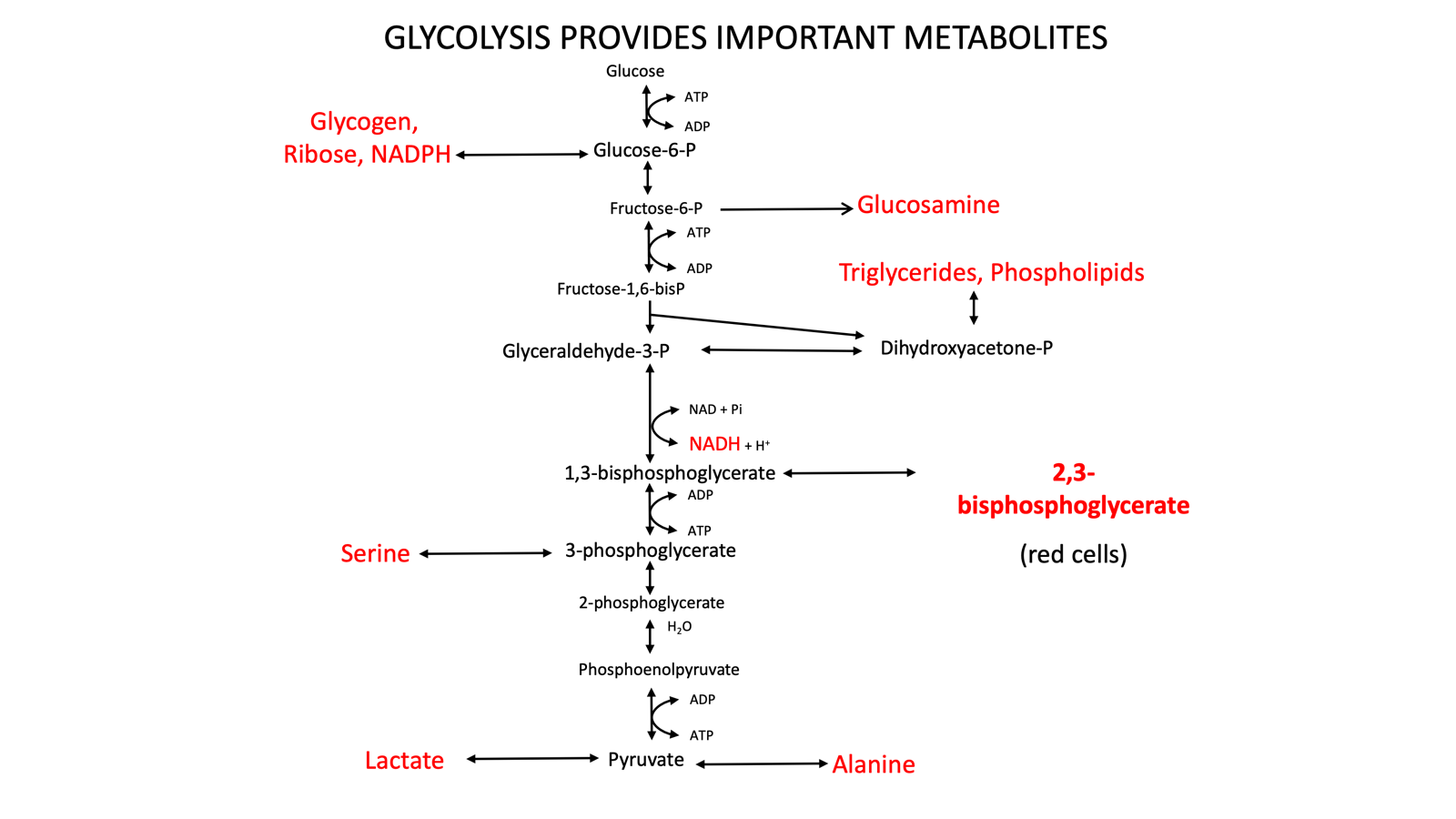
Important glycolysis metabolites
Glycogen, ribose, NADPH
Glucosamine
Triglycerides, phospholipids
NADH
2,3-bisphosphoglycerate (RBCS)
Serine
Alanine, lactate
T/F: The regulation of glycolysis occurs at steps that are close to equilibrium.
False; far from equilibrium
What does a defect in glucokinase cause?
MODY
What does a defect in pyruvate kinase cause?
Warburg Effect
What regulates hexokinase?
Inhibited by glucose-6-phosphate
What regulates phosphofructokinase I?
Inhibited by ATP
Promoted by AMP
What regulates pyruvate kinase?
Promoted by fructose,1,6,BP
What does PFK-1 do?
Converts fructose-6-P to F1,6P2
What is the key regulated step in glycolysis?
PFK-1
What is a strong inhibitor of PFK-1?
Intracellular ATP