Ch 3: Buying Behavior and the Buying Process
 Call Kai
 Learn
Learn Practice Test
 Spaced Repetition
 Match
Match Flashcards
 Knowt Play
1/27

There's no tags or description
Looks like no tags are added yet.
Name | Mastery | Learn | Test | Matching | Spaced | Call with Kai | Chat |
|---|
No analytics yet
Send a link to your students to track their progress
28 Terms
Original Equipment Manufacturer (OEM)
A business that purchases goods to use in making its products.
End Users
Manufacturers who buy goods and services to support their own production and operations.
Derived Demand
Demand for a product that depends ultimately on demand for the customer's final products.
Creeping Commitment
A customer's step-by-step commitment to a course of action as options narrow during buying.
Early Supplier Involvement
Participation of potential suppliers during the initial design process of a customer's new product.
New Task Buying Situation
An organizational buying situation where a customer purchases a product or service for the first time.
Straight Rebuy
A buying situation where a customer purchases the same product from the same source repeatedly.
Modified Rebuy
A purchase decision where a customer has prior experience but seeks new information or alternatives.
Buying Center (DMU)
An informal, cross-departmental group of people involved in an organizational purchase decision.
Initiator (Buying Center)
The individual who starts the organizational buying process.
Gatekeeper (Buying Center)
An individual who controls the flow of information and limits alternatives considered in purchases.
Economic Influencer
A buying center member specifically concerned with the financial aspects of a decision.
Life-Cycle Costing
A method determining the total cost of equipment or supplies over their entire useful lives.
Service Level Agreement (SLA)
A contract specifying minimum standards for measurable service delivery by a vendor.
Behavioral Loyalty
Routine purchase repetition from a vendor due to convenience and low decision costs.
Attitudinal Loyalty
An emotional attachment to a vendor based on shared values or brand alignment.
Just-In-Time (JIT) Inventory
An inventory system using frequent deliveries right before assembly to minimize holding costs.
Annual Spend
The total amount spent by an organization with a specific vendor in one year.
Multiattribute Model
An evaluation tool quantifying product choice by multiplying attribute performance ratings by importance weights.
What is the step in the buying process after recognizing a need?
Definition of the product type needed
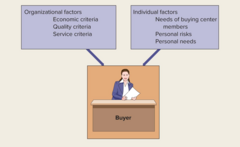
The evaluation and selection of products and suppliers are affected by the needs of both the organization and the individuals making the decision. These needs are categorized as
emotional and rational.
The need for risk reduction is one of the factors affecting an individual making an organizational buying decision. To help reduce the risk, a salesperson can
provide the buyer with product information from independent sources not connected with the company for which the salesperson works.
Using the life-cycle costing approach, salespeople can demonstrate that
a product with a higher initial cost will have lower overall costs.
Vincent is trying to analyze how important his suppliers are to his business. He wants to know which supplier is best for a long-term relationship. If he has to apply the supplier relationship management (SRM) strategy, Vincent should most likely begin the analysis by first
calculating the amount that is spent with each vendor and for what products.
__________ is a strategy by which organizational buyers evaluate the relative importance of suppliers and use that information to determine with whom they want to develop partnerships.
Supplier relationship management
Efficient consumer response systems
use automatic replenishment technology through electronic data interchange
Why do people in a customer's firm involve in a buying center?
Because they are significant sources of information