Genetics Summer with Huq
 Call Kai
 Learn
Learn Practice Test
 Spaced Repetition
 Match
Match Flashcards
 Knowt Play
1/116

There's no tags or description
Looks like no tags are added yet.
Name | Mastery | Learn | Test | Matching | Spaced | Call with Kai | Chat |
|---|
No analytics yet
Send a link to your students to track their progress
117 Terms
Gene
a specific segment of DNA in a discrete region of a chromosome that serves as a unit of function encoding particular RNA or protein
Heredity
the way genes transmit physiological, physical, and behavioral traits from parents to offspring
Discrete Traits
an inherited trait that exhibits an either/or status (that is, purple versus white flowers). Synonymous with discontinuous trait.
Continuous traits
Inherited trait that is controlled by many different genes, and sometimes also environmental factors. The characteristics associated with quantitative traits, such as human height, can be measured and assignment.
Antagonistic Pair
distinct, mutually exclusive versions of heritable characteristics. for example: yellow or green seed color
Reciprocal Crosses
crosses performed in two directions, with the characters of traits in the males and females reversed relative to the other, thereby controlling whether a particular character is transmitted by the male or female gamete.
Parental (P) Generation
individuals whose progeny in subsequent generations will be studied for specific traits
Monohybrid Crosses
crosses between parents that different in only one trait
monohybrid
Individuals having two different alleles for a single trait.
Gametes
specialized cells (egg and sperm) that carry genes between generations
zygote
the cell formed by the fertilization of the egg by the sperm during sexual reproduction; in humans, eggs and sperm are haploid, and zygotes are diploid.
law of segregation
Mendel’s first law
two alleles for each trait separate (segregate) during gamete formation and then unite at random, one from each parent, at fertilization.
segregation
separation of alleles during gamete formation, in which one allele of each gene goes to each gamete.
Mendel’s Contributions
quantitative approach
concept of units of heredity
concept of dominant and recessive traits
note: mendel had no idea the mechanism of transmission of traits
Karyotype
individual’s complete set of chromosomes
Are genes turned on all the time?
no
Does gene expression change in cells?
yes
Most (but not all) mutations arise from ______________ part of the gene
protein-coding
Exome
protein-coding regions within a genome
Dihybrid Cross
between parents with variant characters for two traits
Phenotypic Ratio in a Dihybrid Cross
9:3:3:1
Law of Segregation
allelic pairs will separate during (Anaphase 1) gamete formation
Law of Independent Assortment
the alleles of two different genes will be distributed randomly into gametes
Mulithybrid Cross
matings between the F1 progreny of pure-breeding parents that differ in three or more traits
How do dominant and recessive alleles’ generated proteins differ?
Most often, the dominant allele of a gene specifics a function protein, while the recessive allele determines either a nonfunctional version of the protein, or no protein at all.
The inheritance of common human traits such as hair and eye color follows Mendelian inheritance. (T/F)
False, although many human traits clearly run in families, most do not show a simple Mendelian pattern of inheritance.
consanguineous mating
mating between genetic relatives sharing a recent common ancestor
An allele that specifies a normally functioning gene in a human is typically written as the name of the gene followed by?
a superscript +
C-Value Paradox
size of DNA content (C-Value) is not correlated with development complexity; can be explained by “ploidy” and “repetitive sequences”
G-Value Paradox
Number of genes is not correlated with developmental complexity; can be explained by “non-protein-coding”
Four key aspects of pedigrees with recessive traits
affected individuals can be the children of two unaffected carriers, particularly as a result of consanguineous mating.
all the children of two affected parents should be affected
Rare recessive traits show a horizontal pattern of inheritance
recessive traits may show a vertical pattern of inheritance if the trait is extremely common in the population
Complex Traits
traits controlled by multiple genes and often also by environmental factors. Can be discrete or continuous.
dominance series
the dominance relations of all possible pairs of alleles arranged in a linear order
Monomorphic
a gene with only one wild-type allele
Polymorphic
describes a locus with two or more distinct alleles in a population
pleiotropy
phenomenon in which a single gene determines a number of distinct and seemingly unrelated characteristics
Genotypic Classes
a grouping defined by a set of related genotypes that will produce a particular phenotype. For example, in a cross between Aa Bb individuals, the genotypic classes are A- B-, A- bb, aa B-, and aa bb
Epistasis
a gene interaction in which the effects of alleles at one gene hide the effects of alleles at another gene.
Recessive Epistasis
a gene interaction in which the effects of recessive alleles at one gene hide the effects of alleles at another gene.
usually indicates that the dominant alleles of the two genes function in the same pathway to achieve a common outcome.
Dominant Epistasis
a phenomenon where the effects of a dominant allele at one gene hide the effects of alleles at another gene.
usually indicates that the dominant alleles of the two genes have antagonistic functions.
Redundant Gene Action
a phenomenon where dominant, functional alleles of either one or the other of two genes is required in a pathway.
Reciprocal dominant epistasis
Dominant allele of each gene masks the effects of recessive allele of the other gene.
Reciprocal recessive epistasis
When homozygous, recessive allele of each gene masks the dominant allele of the other gene.
Locus Heterogeneity
describes a trait where mutations in any one of two or more genes results in the same mutant phenotype.
Complementation Test
method of discovering whether two mutations are in the same or separate genes. Two mutant strains with the same or similar mutant phenotype are crossed. If the progeny are all wild type (complementation occurred), the strains had mutations in different genes; if the progeny are all mutant (no complementation occurred), the strains had mutations in the same gene.
complementation
the process in which heterozygosity for loss-of-function mutant recessive alleles for two different genes produces a normal phenotype.
occurs in the progeny of pure-breeding parents with the same mutant phenotype if the parents are homozygous for recessive, nonfunctional alleles of different genes.
Bombay Phenotype
In terms of their blood group, a human with genotype I^A I^B hh will appear to be ?
Type O since the H gene is not present, substance H is not produced, A and B antigens have no way to attach to the surface of red blood cells. (Bombay phenotype)
Genetic Background
all the alleles of genes in an organism’s genome; the set of unknown modifier genes that influence the action of all known genes that control specific aspects of phenotype
Sex Reversal
the phenomenon whereby males are XX or females are XY
Phenocopy
a change in phenotype arising from environmental agents that mimics the effects of a mutation in a gene. inheritable.
modifier genes
genes that produce a subtle, secondary effect on phenotype. No formal distinction exists between primary and modifier genes, rather it is a continuum of degrees of influence.
Penetrance
in a population, the fraction of individuals with a particular genotype that show the associated phenotype.
Expressivity
the degree or intensity with which a particular genotype is expressed as a phenotype
incomplete penetrance
a phenotype appears in fewer than 100% of individuals having the same genotype
Variable Expressivity
a phenotype appears at different levels among individuals with the same genotype
metacentric chromosomes
chromosomes whose centromeres is at or near their middles
recombine fairly evenly
acrocentric chromosomes
chromosomes whose centromeres are close to one end
chromosomes 13, 14, 15, 21, 22
suppressed recombination on the tiny p arm because it contains repetitive rDNA clusters (NORs; forms the nucleolus) and heterochromatin
autosomes
chromosomes not involved in sex determination.
aneuploidy
condition in which a cell or an individual has extra or missing chromosomes
Prophase
Chromosomes condense and become visible.
Centrosomes move apart toward opposite poles and generate new microtubules.
Nucleoli begin to disappear.
Prometaphase
Nuclear envelope breaks down
Microtubules from the centrosomes invade the nucleus and attach through the kinetochore.
Sister chromatids attach to microtubules from opposite centrosomes.
Metaphase
Chromosomes align on the metaphase plate with sister chromatids facing opposite poles
Anaphase
The connection between the centromeres of the sister chromatids is severed.
The now separated sister chromatids move to opposite poles.
Telophase
Nuclear membranes and nucleoli re-form.
Spindle fibers disappear.
Chromosomes uncoil and become a tangle of chromatin.
Pleiotropy Big Ideas
A single gene can have more than 1 job.
A gene might be expressed in multiple cell types.
A gene may be required at different stages of development.
How does Marfan Syndrome represent pleiotropy?
having dominant gene called FBN1 results in connective tissue disorder with effects in cardiovascular, skeletal, and optical system with very tall organs
Paralogs
genes within the same organism that have evolved as a result of a gene duplication event. the duplicated gene can acquire new functions.
Genetic Anticipation
phenomenon where a genetic disorder’s symptoms become more sever and appear at an earlier age with each successive generation.
Pseudoautosomal Regions (PARs)
homologous regions at both ends of the X and Y chromosomes; the two PARs in humans together contain about 30 genes
heterogametic sex
the sex of a species in which the two sex chromosomes are dissimilar; for example, human males are the heterogametic sex because they have an X and a Y chromosome
homogametic sex
the sex of a species in which the two sex chromosomes are identical; in humans, females are the homogametic sex because they have two X chromosomes.
Gametogenesis
the formation of gametes
germ line
all the germ cells in a sexually reproducing organism. The germ cells in the germ line divide by mitosis to produce a collection of specialized diploid cells that then divide by meiosis to produce haploid cells or gametes.
ovum
haploid female germ cell (the egg)
Haplodiploidy
a sex-determination system where males develop from unfertilized eggs and are haploid (one set of chromosomes), while females develop from fertilized eggs and are diploid (two sets of chromosomes). Ants, bees, and wasps
What causes human females to be mosaics for X‑linked gene expression?
Random X‑chromosome inactivation in early embryonic cells. Each cell independently inactivates either the maternal or paternal X, and all descendant cells maintain that choice, producing clonal patches expressing different X‑linked alleles.
Genetic Linkage
the phenomenon where particular alleles of genes tend to travel together during vertical or horizontal gene transfer
recombination
process by which offspring derive a combination of alleles different from that of either parent; the generation of new allelic combinations. In higher organisms, this can occur by independent assortment or crossing-over.
Syntenic
describes the relationship of two or more loci located on the same chromosome
Parental Type
phenotypes that reflect a previously existing parental combination of alleles that is retained during gamete formation
Recombinant Types
phenotypes reflecting a new combination of alleles that occurred during gamete formation
Recombination Frequency (RF)
the percentage of recombinant progeny; can be used as an indication of the physical distance separating any two loci on a chromosome
NCO
meiosis that occurs with no crossovers between a particular gene pair
Recombination Frequencies between two genes never exceed ___________%
50
What happens as the distance between genes increases?
As the distance between genes increases, the frequency of SCO meioses increases, and the fraction of recombinant gametes increases.
Properties of Linked Genes
Parentals > Recombinants (RF < 50%)
Linked genes must be sufficiently close together on the same chromosome so that their alleles do not assort independently.
Properties of Unlinked Genes
Parentals = Recombinants (RF = 50%)
Occurs either when two genes are on different chromosomes or when they are sufficiently far apart on the same chromosome that at least one crossover occurs.
How many genes does a typical human chromosome contain
Many hundreds or a few thousand
When following the inheritance of two genes, a testcross is a cross between
a double heterozygote and a double recessive homozygote
Z DNA
Forms left-handed helix and has an irregular backbone
B DNA
forms right-handed helix and has a smooth backbone
Three Differences Between RNA and DNA
Sugar: RNA contains ribose sugar with a 2’ hydroxyl group, whereas DNA contains deoxyribose which lacks this oxygen atom.
Base: RNA utilizes the pyrimidine base uracil instead of the thymine found in DNA.
Structure: RNA generally exists as a single-stranded molecule, unlike the stable double-stranded helix of DNA.
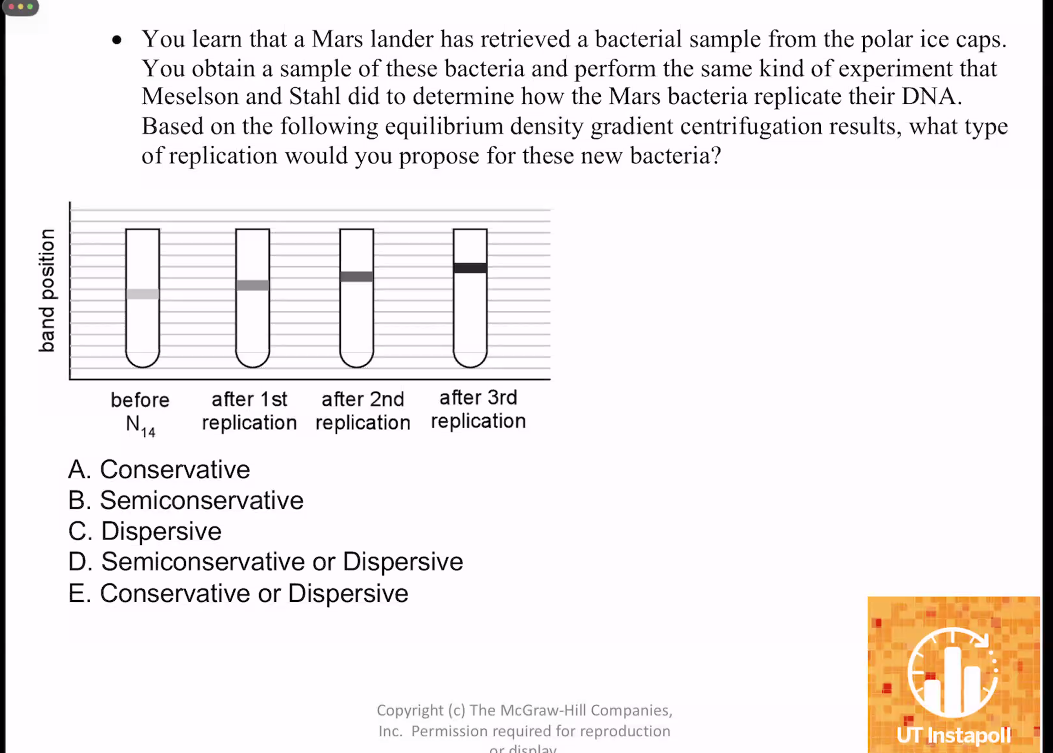
Dispersive because there is only one distinct band.
Three mechanisms for accuracy in DNA replication
hydrogen bonding between A and T and G and C is more stable than mismatched combinations.
Active site of DNA Polymerase is unlikely to form bonds if pairs mismatched.
DNA polymerase can proofread to remove mismatched pairs by backing up and digesting linkages, as well as other DNA repair enzymes.
What does the Holliday model describe and how does a Holliday junction form?
The Holliday model explains homologous recombination beginning with identical single‑strand nicks in two homologous DNA molecules. The cut strands cross over and invade the opposite duplex, creating heteroduplex DNA. The nicks are then sealed, stabilizing the crossed strands. The junction can undergo branch migration, moving along the DNA and enlarging the heteroduplex region. This four‑way DNA structure is the Holliday junction, and in bacteria its formation and processing are governed by the RecBCD pathway.
How are Holliday junctions resolved, and which resolution produces true recombinant chromosomes?
Holliday junctions can be resolved by cutting the same strands, which produces a patch product without a crossover, or by cutting opposite strands, which produces a true recombinant chromosome containing a crossover. Both outcomes involve nicking followed by sealing, but only opposite‑strand resolution results in genetic exchange between homologous chromosomes.
Codon
series of three nucleotide bases that specifies a particular amino acid
Intragenic Suppression
the restoration of function by a second mutation at a different site in the same gene
Reading Frame
The partitioning of groups of three nucleotides from a fixed starting point such that the sequential interpretation of each succeeding triplet codon generates the order of amino acids in the resulting polypeptide chain.