EAns - Essay (Chap 1-4B)
 Call Kai
 Learn
Learn Practice Test
 Spaced Repetition
 Match
Match Flashcards
 Knowt Play
1/14

There's no tags or description
Looks like no tags are added yet.
Name | Mastery | Learn | Test | Matching | Spaced | Call with Kai | Chat |
|---|
No analytics yet
Send a link to your students to track their progress
15 Terms
Explain how, according to economists, the pursuit of self-interest by consumers and producers can help to address the problem of limited resources and unlimited wants (R1)
R1: Marginalist principle
Consumers want to maximise net total private benefits -> demand curve shows highest prices consumers are W/A to pay for a good = MPB derived from good -> willing to buy an additional unit of a good when the MPB derived from consuming > MPC -> MPB = MPC at P at Qo
Firms seek to maximise total profits -> In a perfectly competitive market, MR is the price of the good -> firms are willing to produce and sell an additional unit of a good when the MR from selling it exceeds > MPC -> lowest prices that producers are willing and able to accept for an additional unit of a good must cover their MPC -> supply curve maps Qs of a good to P = MPC incurred by firms in producing the good -> produces will increase production till MPC = MPB at P

Explain how, according to economists, the pursuit of self-interest by consumers and producers can help to address the problem of limited resources and unlimited wants (R2)
R2: The 3 functions
How much to produce?
When the highest prices that consumers are willing to pay > the lowest prices that firms are willing to accept -> mutually beneficial exchange
Goods will be sold and transacted up till point E where DD = SS -> Qe units sold at price Pe
Increase DD -> (MAP)
Explain how consumers make rational decisions
Consumers weigh the MPB and MPC of consuming the good and apply the marginalist principle
MPB includes the satisfaction gained from consuming one additional unit of the good
This is subject to the law of diminishing marginal utility (LDMU) = downward sloping MPB
MPC = MC of the good = price
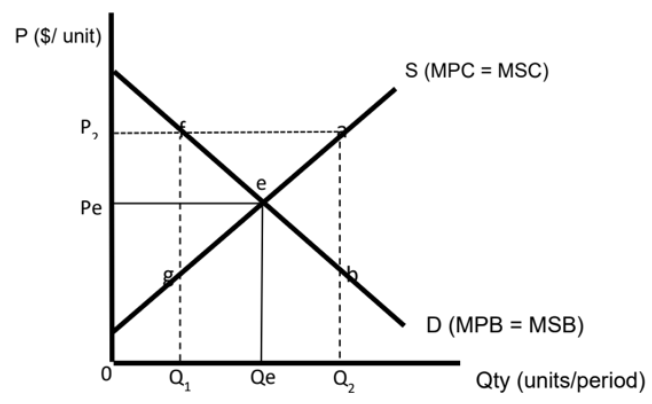
At Q1, MPB is MB1 and MPC is P -> MPB > MPC -> consuming one more unit adds more to total private benefit than total private cost -> increasing net total private benefit to the consumer -> increase consumption
At Q2, MPB is MB2 and MPC is P -> MPC > MPB -> consuming one less unit reduces total private cost more than total private benefit -> increasing net total private benefit to the consumer -> decrease consumption
Consumer will consume up till Q*, where MPB = MPC

Assess whether the price mechanism will always allocate scarce resources in the most efficient manner for all goods and services in a market economy
R1: How price mechanism can achieve AE (MSB = MSC -> assuming no externality, MPC = MSC -> at Q1 VS at Q2
Explain impact on expenditure on pork from effect of outbreak depends on PED of pork + graph
R1: Impact of outbreak on expenditure of pork
R2: Impact of PED on pork (Give BOTH PED > 1 / < 1)

Discuss whether DD or SS factors key determinant of sharp increase in prices
Relative extent of shift of DD/SS
Relative magnitude of PED/PES
Explain the economic rationale on why some countries provide subsidies while others tax the use of petroleum = CAUSES of market failure
Subsidies: to reduce inequity
Petroleum is a good with a high degree of necessity required by many consumers to fuel their cars for transportation (Eg. Large countries like Malaysia where public transportation sucks and country is big)
PED petrol inelastic -> increase price leads to less than proportionate fall in Qd -> high CE
Higher income able to afford large expenditure VS low income
Rich able to consume more essential G&S -> unfair distribution of G&S -> inequity
Taxes: to reduce -ve externalities
Discuss whether government policies used to correct market failure due to positive externalities will always create unintended consequences (Eg. Indirect subsidies)
Indirect subsidies
Method
Unintended consequence (fiscal sustainability)
When got no unintended consequence
As more educated workers enter the workforce and earn high income with their university degrees -> government collect higher income tax revenue
Future employers will enjoy higher profits as more university graduates are employed (+ve externality) -> higher corporate income tax revenue
Eg. SG GST and personal income tax revenue constitutes 14.7% and 13.7% of governments' revenue sources respectively
Discuss whether government policies used to correct market failure due to positive externalities will always create unintended consequences (EVAL)
Should the university graduates decide to migrate and work in other countries instead for better job opportunities, the government will be unable to collect the higher tax revenue due to the domestic labour outflow (Brain drain) (Eg. India) which reduces the tax base of the government
Using demand and supply analysis, discuss whether consumers buying products online are more likely to be adversely affected by the imposition of a tax on plastic packaging than firms selling products online.
Tax on plastic packaging will increase UCOP for producers, regardless of type of packaging used (Eg. Plastic (intuitive) VS Cardboard (since close substitutes, P plastic increase will increase DD cardboard -> P cardboard increase)
Draw market for online products
Use TR/TC stuff
R1: Impact on firms VS R2: Impact on consumers
Discuss whether government intervention will lead to more efficient outcome (R1)
Yes:
Tax
Sometimes, 2 policies if pre-amble gives both - public education and subsidies
Evaluation (subsidy): Demand for healthcare elastic -> small subsidy effective in increasing consumption
Discuss whether government intervention will lead to more efficient outcome (R2)
Over-tax/subsidy OR Ban leading to larger welfare loss
Cost of subsidy > benefits:
Attract wrong target group (lower risk, individuals with more knowledge) -> resources may be inefficiently allocated as they are diverted away from higher risk, ignorant or older populations who are more likely to benefit from such screening
Subsidy borne by the taxpayers -> higher burden on taxpayers
Tax rates in other markets increase -> welfare loss in those markets
Higher tax rates have detrimental effects on economic growth -> potentially add to the costs of the intervention
Discuss the (R2) extent to which public education is likely to resolve the (R1) market failure caused by information failure
Since part a) is Qns 7 (NOT on market failure)
R1: Consumer ignorance cause market failure
R2: Public education
Evaluation: Give 2 examples
Eg. Healthcare: Implement both education campaigns and subsidies
Eg. Education: Implement both regulations and public education especially in short run
Discuss reasons why some governments ban e-cigarettes while others tax it to solve AE (R1 and R2)
R1: Tax over ban
Government weak budget position -> tax to generate revenue (vapes generate high tax revenue as PED < 1)
R2: Ban over tax
Population dense -> high MEC -> very large tax needed to solve AE + highly politically unpopular -> ban
Eval: Depends on nature of government: technocratic (emphasis on data collection) -> likely to estimate MEC accurately -> size of MEC more important
Discuss reasons why some governments ban e-cigarettes while others tax it to solve AE (Final eval)
Final eval: Context
Governments where MEC high and budget is healthy -> ban > tax
Government where MEC low and budget is unhealthy -> tax > ban
But between 2 factors, MEC is more important as government wants to maximise society's welfare -> population health not taken care of -> fall in productivity and economic growth