Observations, self-report & correlations
 Call Kai
 Learn
Learn Practice Test
 Spaced Repetition
 Match
Match Flashcards
 Knowt Play
1/36

There's no tags or description
Looks like no tags are added yet.
Name | Mastery | Learn | Test | Matching | Spaced | Call with Kai | Chat |
|---|
No analytics yet
Send a link to your students to track their progress
37 Terms
What is the definition of a naturalistic observation?
Watching & recording behaviour in the setting within which it would normally occur
What are the strengths & limitations of a naturalistic observation?
Strength:
high external validity → findings can be generalised to everyday life
Limitations:
lack of control over the research situation makes replication of the investigation difficult
there may be uncontrolled extraneous variables → more difficult to judge any pattern of behaviour
What is the definition of a controlled observation?
Watching & recording behaviour within a structured environment (variables are controlled)
What are the strengths & limitations of controlled observations?
Strengths:
high control over the research situation makes replication of the investigation easier
high control of extraneous variables → more easier to judge patterns of behaviour
Limitations:
low external validity → findings are less generalisable to everyday life, due to the artificial environment
What is the definition of a covert observation?
Participants’ behaviour is watched & recorded without their knowledge or consent
What are the strengths & limitations of a covert observation?
Strengths:
avoids demand characteristics & social desirability bias
increases internal validity → behaviour observed is natural
Limitations:
ethical issues → participants cannot give informed consent & may not want to have their behaviours noted down
What is the definition of an overt observation?
Participants’ behaviour is watched & recorded with their knowledge & consent
What is a strength & limitation of an overt observation?
Strength:
more ethical as participants provide their informed consent
Limitation:
possibility of demand characteristics & social desirability bias → participants know they’re being watched
What is the definition of participant observation?
The researcher becomes a member of the group whose behaviour they are watching & recording
What are the strengths & limitations of participant observation?
Strengths:
researcher can experience the situation as the participants do → increases insight into the lives of the people being studied (increases validity of findings)
researcher may be able to build a rapport with the participants → encourages them to behave more naturally
Limitation:
researcher may come to identify too strongly with the participants & lose objectivity
What is the definition of a non-participant observation?
The researcher remains outside of the group whose behaviour they are watching & recording
What is a strength & limitation of a non-participant observation?
Strength:
Allows the researcher to maintain an objective psychological distance from their participants → less chance they are going to lose objectivity
Limitation:
Researcher may lose the valuable insight to be gained in a participant observation, as they are too far removed from the people & behaviour they are studying
What is the difference between structured & unstructured observations?
Structured observations: a pre-determined list of target behaviours is used to record participants’ behaviours
Unstructured observations: the researcher writes down everything they see
What is a strength & limitation of a structured observation?
Strength:
Data produced is likely to be numerical → analysing & comparing the behaviour observed between participants is more straightforward
Limitation:
Less richness & depth of detail in the data collected
What are the strengths & limitations of an unstructured observation?
Strength:
more richness & depth of detail in the data collected
Limitations:
produces qualitative data, which is more difficult & time-consuming to record & analyse
possibility of observer bias → researcher may only record behaviour that ‘catches their eye’
What is the definition of behavioural categories?
A target behaviour is broken up into components that are observable & measurable
What is the definition of event sampling?
A target behaviour or event is first established, then the researcher records this event every time it occurs
What is a strength & limitation of event sampling?
Strength:
useful when the target behaviour or event happens quite infrequently & could be missed if time sampling was used
Limitation:
if the specified event is too complex, the observer may overlook important details
What is the definition of time sampling?
A target individual or group is first established, then the researcher records their behaviour in a fixed time frame
What is a strength & limitation of time sampling?
Strength:
effective in reducing the number of observations that have to be made
Limitation:
instances when behaviour is sampled might be unrepresentative of the observation as a whole
What is inter-observer reliability & how is it achieved?
Single observers may miss details or show researcher bias, so observations should use at least two observers:
observers familiarise themselves with behavioural categories, observe the same behaviour simultaneously, compare & discuss recordings, then calculate inter-observer reliability by correlating their observations
What is the definition of a self-report technique?
Any method in which a person is asked to state or explain their own feelings, opinions, behaviours &/or experiences related to a given topic
What is the definition of a questionnaire?
A set of written questions used to assess a person’s thoughts &/or experiences
What are the strengths & limitations of questionnaires?
Strengths:
time & cost effective → able to gather large amounts of data as they can be distributed to large numbers of people
can be completed without the researcher being present → reduces effort involved
produces data that is usually straightforward to analyse
Limitations:
responses may not always to truthful (e.g. social desirability bias)
possibility of acquiescence bias → tendency to agree with questions regardless of the content of the question
What is the difference between open & closed questions?
Open questions: phrased in a way that allows the participant to answer in any way they choose
Closed questions: phrased in a way that limits the participants’ responses to only a few fixed options
What is a strength & limitation of open questions?
Strength:
produces qualitative data → rich in detail & depth
Limitation:
more time-consuming & difficult to analyse
What is a strength & limitation of closed questions?
Strength:
produces quantitative data → easy & quick to analyse, making comparisons between answers easy
Limitation:
quantitative data lacks detail & depth
What is the definition of an interview?
A ‘live’ encounter where the interviewer asks a set of questions to assess an interviewee’s thoughts &/or experiences
What are the different types of interviews?
Structured interviews: made up of a pre-determined set of questions that are asked in a fixed order
Unstructured interviews: no set questions & interaction is free-flowing → interviewee is encouraged to expand & elaborate their answers as prompted by the interviewer
Semi-structured interviews: a pre-determined set of questions but interviewers are free to ask follow-up questions when they feel it is appropriate
What are the strengths & limitations of structured interviews?
Strengths:
straightforward to replicate due to their standardised format
standardised format reduces differences between interviewers
Limitation:
not possible for interviewers to deviate from the topic or for interviewees to elaborate their points
What is a strength & limitation of an unstructured interview?
Strength:
more flexibility → interviewer can follow up points as they arise & is much more likely to gain insight into the worldview of the interviewee
Limitation:
analysis of data is not straightforward → researcher may have to sift through much irrelevant information & drawing conclusions may be difficult
How should interviews & questionnaires be conducted & designed?
Avoid jargon & emotive language
Avoid leading questions & double-barrelled/negative questions
Pilot the questions (so if need be, they can be altered)
Include filler/neutral questions → reduces demand characteristics & makes participants feel relaxed & comfortable, establishing a rapport
Conduct interview in a quiet room, away from other people → increases likelihood interviewee will open up
Remind participants their answers will remain anonymous
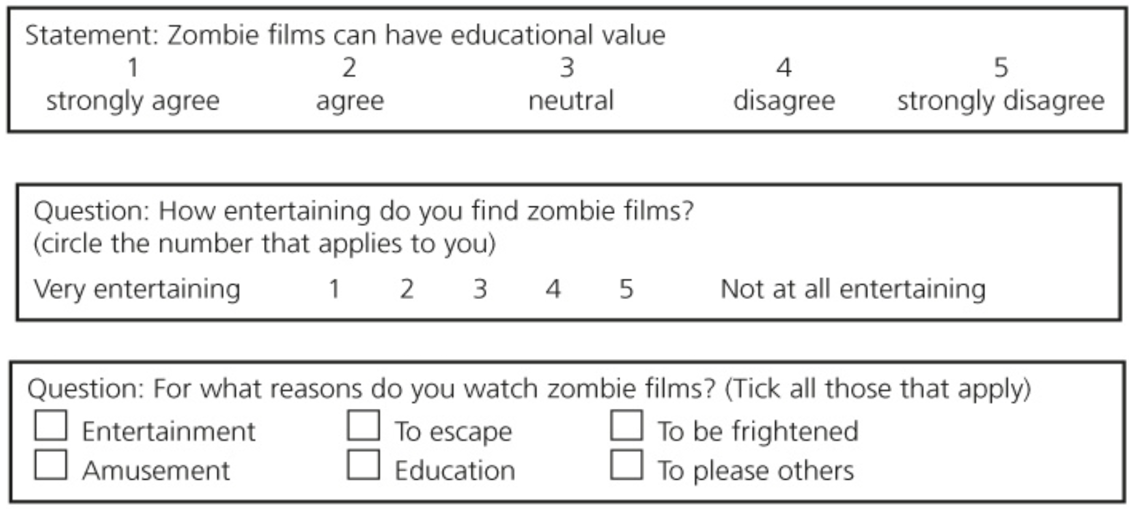
What are Likert scales, rating scales & fixed choice option items?
Likert scales: respondent indicates their agreement (or otherwise) with a statement using a scale of usually five points → the scale ranges from strongly agree to strongly disagree
Rating scales: respondents identify a value that represents their strength of feeling about a particular topic
Fixed choice option item: includes a list of possible options & respondents are required to indicate those that apply to them
What is the definition of a correlation?
A mathematical technique in which a researcher investigates an association between two co-variables (plotted on a scattergraph)
What is the definition of a positive, negative & zero correlation?
Positive correlation: as one co-variable increases, so does the other
Negative correlation: as one co-variable increases, the other decreases
Zero correlation: there is no relationship between the co-variables
What correlation coefficient do psychologists typically consider indicative of a strong relationship?
+0.8
What are the strengths & limitations of correlations?
Strengths:
provide a precise & quantifiable measure of how two variables are related → may suggest ideas for possible future research
relatively quick & economical to carry out → no need for a controlled environment or manipulation of variables
secondary data can be used, meaning correlations are less time-consuming
Limitation:
does not show cause & effect → third, intervening variable could have caused relationship observed